
TensorFlow NormLization
local_response_normalization
local_response_normalization出现在论文”ImageNet Classification with deep Convolutional Neural Networks”中,论文中说,这种normalization对于泛化是有好处的.

经过了一个conv2d或pooling后,我们获得了[batch_size, height, width, channels]这样一个tensor.现在,将channels称之为层,不考虑batch_size
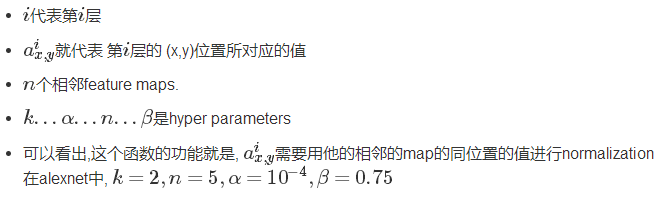
 tf.nn.local_response_normalization(input, depth_radius=None, bias=None, alpha=None, beta=None, name=None)

 '''

 Local Response Normalization.

 The 4-D input tensor is treated as a 3-D array of 1-D vectors (along the last dimension), and each vector is normalized independently. Within a given vector, each component is divided by the weighted, squared sum of inputs within depth_radius. In detail,

 '''

 """

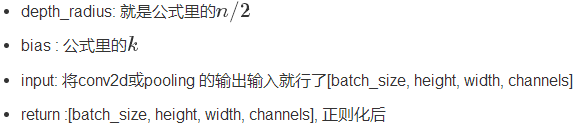
 input: A Tensor. Must be one of the following types: float32, half. 4-D.

 depth_radius: An optional int. Defaults to 5. 0-D. Half-width of the 1-D normalization window.

 bias: An optional float. Defaults to 1. An offset (usually positive to avoid dividing by 0).

 alpha: An optional float. Defaults to 1. A scale factor, usually positive.

 beta: An optional float. Defaults to 0.5. An exponent.

 name: A name for the operation (optional).

 """
举例子:
 import tensorflow as tf

 a = tf.constant([

     [[1.0, 2.0, 3.0, 4.0],

      [5.0, 6.0, 7.0, 8.0],

      [8.0, 7.0, 6.0, 5.0],

      [4.0, 3.0, 2.0, 1.0]],

     [[4.0, 3.0, 2.0, 1.0],

      [8.0, 7.0, 6.0, 5.0],

      [1.0, 2.0, 3.0, 4.0],

      [5.0, 6.0, 7.0, 8.0]]

 ])

 #reshape a,get the feature map [batch:1 height:2 width:2 channels:8]

 a = tf.reshape(a, [1, 2, 2, 8])

 normal_a=tf.nn.local_response_normalization(a,2,0,1,1)

 with tf.Session() as sess:

     print("feature map:")

     image = sess.run(a)

     print (image)

     print("normalized feature map:")

     normal = sess.run(normal_a)

     print (normal)
feature map:

[[[[ 1.  2.  3.  4.  5.  6.  7.  8.]

   [ 8.  7.  6.  5.  4.  3.  2.  1.]]

  [[ 4.  3.  2.  1.  8.  7.  6.  5.]

   [ 1.  2.  3.  4.  5.  6.  7.  8.]]]]

normalized feature map:

[[[[ 0.07142857  0.06666667  0.05454545  0.04444445  0.03703704  0.03157895

     0.04022989  0.05369128]

   [ 0.05369128  0.04022989  0.03157895  0.03703704  0.04444445  0.05454545

     0.06666667  0.07142857]]

  [[ 0.13793103  0.10000001  0.0212766   0.00787402  0.05194805  0.04

     0.03448276  0.04545454]

   [ 0.07142857  0.06666667  0.05454545  0.04444445  0.03703704  0.03157895

     0.04022989  0.05369128]]]]
这里我取了n/2=2,k=0,α=1,β=1,举个例子,比如对于一通道的第一个像素“1”来说,我们把参数代人公式就是1/(1^2+2^2+3^2)=0.07142857,对于四通道的第一个像素“4”来说,公式就是4/(2^2+3^2+4^2+5^2+6^2)=0.04444445,以此类推
注意:这里的feature_map为【1,2,2,8】,其中1代表图像的数量,2X2代表图像的长宽,8代表图像的层数(map),NRL主要是利用map去计算,然后计算的值为图像的长宽(像素),与图像的数量无关!
我们可以这么理解,feature_map分割为直观的图像,第一个通道[1,8,4,1],第二个通道[2,7,3,2],第三个通道[3,6,2,3],以此类推。。。
那么求解的过程和上面就一一对应了,其中在边角达不到n的时候,那就省略。
能感觉到这种方法不好吗?效果肯定有的,因为对像素归一化了,有利于计算。但是对于一整幅图像来说反而没有什么太大的作用,因为归一化的种类不同,造成部分特征体现不出来,有时候反而不好。
batch_normalization
为什么有batch?上面结尾已经做了初步分析,也已经大概引出来对批量的图像做归一化,对单个图像做的归一化效果不好!

可以看出,batch_normalization之后,数据的维数没有任何变化,只是数值发生了变化
OutOut作为下一层的输入
函数:
tf.nn.batch_normalization()
def batch_normalization(x,

                        mean,

                        variance,

                        offset,

                        scale,

                        variance_epsilon,

                        name=None):
Args:
- x: Input
Tensorof arbitrary dimensionality. - mean: A mean
Tensor. - variance: A variance
Tensor. - offset: An offset
Tensor, often denoted ββ in equations, or None. If present, will be added to the normalized tensor. - scale: A scale
Tensor, often denoted γγ in equations, orNone. If present, the scale is applied to the normalized tensor. - variance_epsilon: A small float number to avoid dividing by 0.
- name: A name for this operation (optional).
- Returns: the normalized, scaled, offset tensor.
对于卷积,x:[bathc,height,width,depth]
对于卷积,我们要feature map中共享 γiγi 和 βiβi ,所以 γ,βγ,β的维度是[depth]
现在,我们需要一个函数 返回mean和variance, 看下面.
tf.nn.moments()
def moments(x, axes, shift=None, name=None, keep_dims=False):

# for simple batch normalization pass `axes=[0]` (batch only):
对于卷积的batch_normalization, x 为[batch_size, height, width, depth],axes=[0,1,2],就会输出(mean,variance), mean 与 variance 均为标量。
参考:
https://blog.csdn.net/mao_xiao_feng/article/details/53488271
https://www.jianshu.com/p/c06aea337d5d
https://blog.csdn.net/u012436149/article/details/52985303
TensorFlow NormLization的更多相关文章
- Tensorflow&CNN:验证集预测与模型评价
版权声明:本文为博主原创文章,转载 请注明出处:https://blog.csdn.net/sc2079/article/details/90480140 - 写在前面 本科毕业设计终于告一段落了.特 ...
- Tensorflow&CNN:裂纹分类
版权声明:本文为博主原创文章,转载 请注明出处:https://blog.csdn.net/sc2079/article/details/90478551 - 写在前面 本科毕业设计终于告一段落了.特 ...
- Tensorflow 官方版教程中文版
2015年11月9日,Google发布人工智能系统TensorFlow并宣布开源,同日,极客学院组织在线TensorFlow中文文档翻译.一个月后,30章文档全部翻译校对完成,上线并提供电子书下载,该 ...
- tensorflow学习笔记二:入门基础
TensorFlow用张量这种数据结构来表示所有的数据.用一阶张量来表示向量,如:v = [1.2, 2.3, 3.5] ,如二阶张量表示矩阵,如:m = [[1, 2, 3], [4, 5, 6], ...
- 用Tensorflow让神经网络自动创造音乐
#————————————————————————本文禁止转载,禁止用于各类讲座及ppt中,违者必究————————————————————————# 前几天看到一个有意思的分享,大意是讲如何用Ten ...
- tensorflow 一些好的blog链接和tensorflow gpu版本安装
pading :SAME,VALID 区别 http://blog.csdn.net/mao_xiao_feng/article/details/53444333 tensorflow实现的各种算法 ...
- tensorflow中的基本概念
本文是在阅读官方文档后的一些个人理解. 官方文档地址:https://www.tensorflow.org/versions/r0.12/get_started/basic_usage.html#ba ...
- kubernetes&tensorflow
谷歌内部--Borg Google Brain跑在数十万台机器上 谷歌电商商品分类深度学习模型跑在1000+台机器上 谷歌外部--Kubernetes(https://github.com/kuber ...
- tensorflow学习
tensorflow安装时遇到gcc: error trying to exec 'as': execvp: No such file or directory. 截止到2016年11月13号,源码编 ...
随机推荐
- 错误:com.mysql.jdbc.exceptions.jdbc4.MySQLSyntaxErrorException
Caused by: com.mysql.jdbc.exceptions.jdbc4.MySQLSyntaxErrorException: Table 'hdjyproj.t_userinfo' do ...
- GDT临时分段
GDT临时分段 GDT临时段说明 现在已经进入了保护模式, 目前的改变 可以访问1M以上的内存了 可以使用32位的指令操作 问题: 由于以前的是实式下段寄存器寻址方式无法使用了,我们必须切换到使用GD ...
- 超简单的实现wordcount
worcount1.0,源码参见GitHub:https://github.com/18382271904/spring_lee_flag.git
- 初始C#(二)
一 数组 定义:能存放任意多个同类型数据 声明与赋值:声明:数据类型[ ]变量名 赋值:变量名=new 数据类型[长度] ...
- C语言打印杨辉三角(2种方法)
杨辉三角是我们从初中就知道的,现在,让我们用C语言将它在计算机上显示出来. 在初中,我们就知道,杨辉三角的两个腰边的数都是1,其它位置的数都是上顶上两个数之和.这就是我们用C语言写杨辉三角的关键之一. ...
- OpenStack的HA方案
一.HA服务分类 HA将服务分为两类: 有状态服务:后续对服务的请求依赖之前对服务的请求,OpenStack中有状态的服务包括MySQL数据库和AMQP消息队列.对于有状态类服务的HA,如neutro ...
- 拉格朗日乘子法&KKT条件
朗日乘子法(Lagrange Multiplier)和KKT(Karush-Kuhn-Tucker)条件是求解约束优化问题的重要方法,在有等式约束时使用拉格朗日乘子法,在有不等约束时使用KKT条件.前 ...
- ela的UNASSIGNED索引修复
1.查找UNASSIGNED未分片的索引: #curl -s "http://localhost:9200/_cat/shards" -u username:passwd | gr ...
- idea护眼设置
idea护眼设置 看了很多intelliJ IDEA的配置文章,不知道大家为什么都不约而同的选择了黑色的那个主题,是很有感觉,很有程序猿的范.但是个人感觉对眼睛不太好,所以我还是用正常的框,建议大家把 ...
- 剑指Offer 51. 构建乘积数组 (数组)
题目描述 给定一个数组A[0,1,...,n-1],请构建一个数组B[0,1,...,n-1],其中B中的元素B[i]=A[0]*A[1]*...*A[i-1]*A[i+1]*...*A[n-1].不 ...