
2019-ICLR-DARTS: Differentiable Architecture Search-论文阅读
DARTS
2019-ICLR-DARTS Differentiable Architecture Search
- Hanxiao Liu、Karen Simonyan、Yiming Yang
- GitHub:2.8k stars
- Citation:557
Motivation
Current NAS method:
- Computationally expensive: 2000/3000 GPU days
- Discrete search space, leads to a large number of architecture evaluations required.
Contribution
- Differentiable NAS method based on gradient decent.
- Both CNN(CV) and RNN(NLP).
- SOTA results on CIFAR-10 and PTB.
- Efficiency: (2000 GPU days VS 4 GPU days)
- Transferable: cifar10 to ImageNet, (PTB to WikiText-2).
Method
Search Space
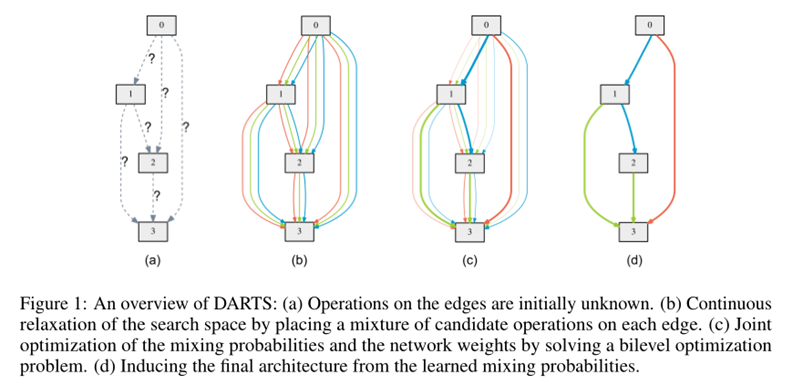
Search for a cell as the building block of the final architecture.
The learned cell could either be stacked to form a CNN or recursively connected to form a RNN.
A cell is a DAG consisting of an ordered sequence of N nodes.
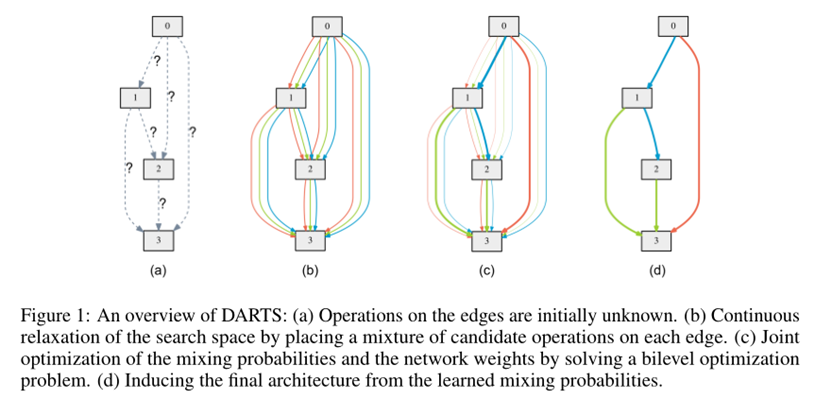
\(\bar{o}^{(i, j)}(x)=\sum_{o \in \mathcal{O}} \frac{\exp \left(\alpha_{o}^{(i, j)}\right)}{\sum_{o^{\prime} \in \mathcal{O}} \exp \left(\alpha_{o^{\prime}}^{(i, j)}\right)} o(x)\)
\(x^{(j)}=\sum_{i<j} o^{(i, j)}\left(x^{(i)}\right)\)




Optimization Target
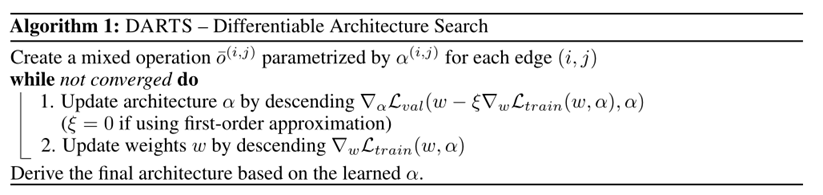
Our goal is to jointly learn the architecture α and the weights w within all the mixed operations (e.g. weights of the convolution filters).
\(\min _{\alpha} \mathcal{L}_{v a l}\left(w^{*}(\alpha), \alpha\right)\) ......(3)
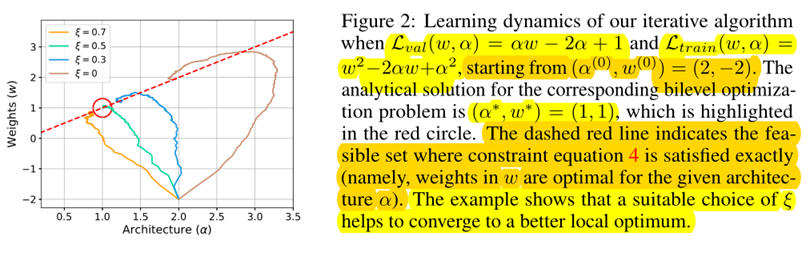
s.t. \(\quad w^{*}(\alpha)=\operatorname{argmin}_{w} \mathcal{L}_{\text {train}}(w, \alpha)\) .......(4)
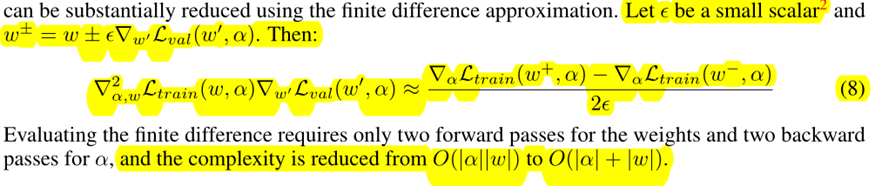
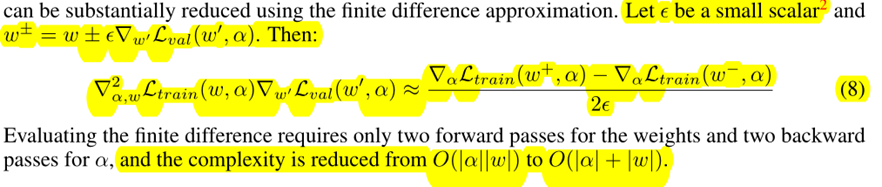
The idea is to approximate w∗(α) by adapting w using only a single training step, without solving the inner optimization (equation 4) completely by training until convergence.
\(\nabla_{\alpha} \mathcal{L}_{v a l}\left(w^{*}(\alpha), \alpha\right)\) ......(5)
\(\approx \nabla_{\alpha} \mathcal{L}_{v a l}\left(w-\xi \nabla_{w} \mathcal{L}_{t r a i n}(w, \alpha), \alpha\right)\) ......(6)
- When ξ = 0, the second-order derivative in equation 7 will disappear.
- ξ = 0 as the first-order approximation,
- ξ > 0 as the second-order approximation.




Discrete Arch
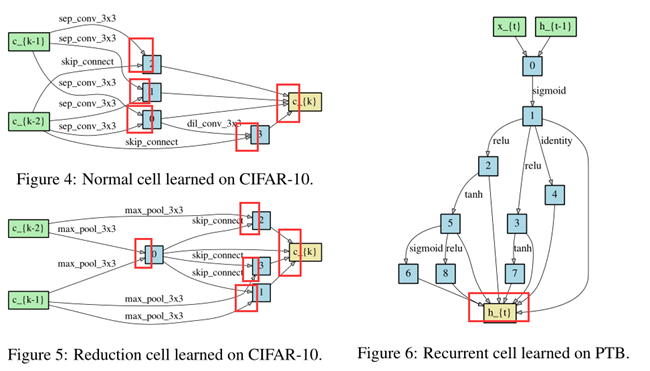
To form each node in the discrete architecture, we retain the top-k strongest operations (from distinct nodes) among all non-zero candidate operations collected from all the previous nodes.
we use k = 2 for convolutional cells and k = 1 for recurrent cellsThe strength of an operation is defined as \(\frac{\exp \left(\alpha_{o}^{(i, j)}\right)}{\sum_{o^{\prime} \in \mathcal{O}} \exp \left(\alpha_{o^{\prime}}^{(i, j)}\right)}\)
Experiments
We include the following operations in O:
- 3 × 3 and 5 × 5 separable convolutions,
- 3 × 3 and 5 × 5 dilated separable convolutions,
- 3 × 3 max pooling,
- 3 × 3 average pooling,
- identity (skip connection?)
- zero.
All operations are of
- stride one (if applicable)
- the feature maps are padded to preserve their spatial resolution.
We use the
- ReLU-Conv-BN order for convolutional operations,
- Each separable convolution is always applied twice
- Our convolutional cell consists of N = 7 nodes, the output node is defined as the depthwise concatenation of all the intermediate nodes (input nodes excluded).
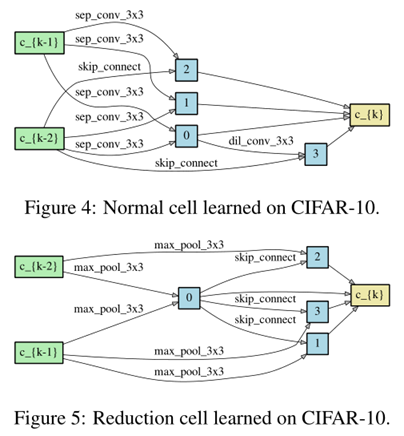
The first and second nodes of cell k are set equal to the outputs of cell k−2 and cell k−1
Cells located at the 1/3 and 2/3 of the total depth of the network are reduction cells, in which all the operations adjacent to the input nodes are of stride two.
The architecture encoding therefore is (αnormal, αreduce),
where αnormal is shared by all the normal cells
and αreduce is shared by all the reduction cells.
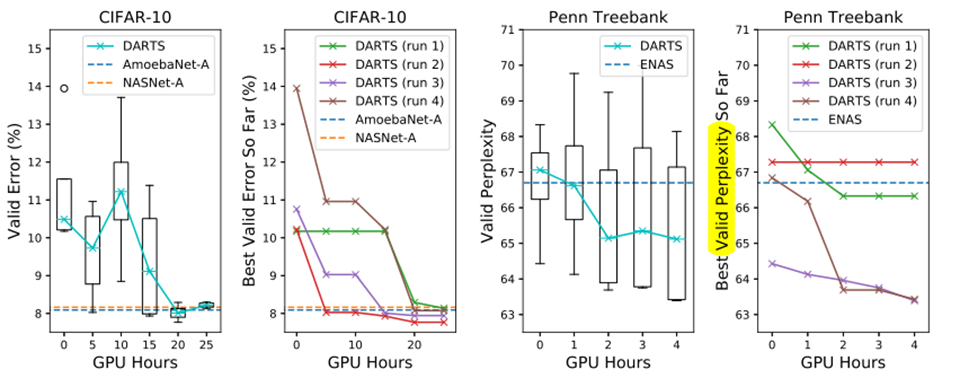
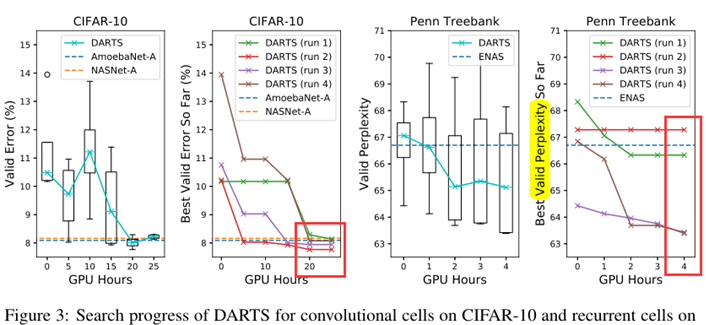
To determine the architecture for final evaluation, we run DARTS four times with different random seeds and pick the best cell based on its validation performance obtained by training from scratch for a short period (100 epochs on CIFAR-10 and 300 epochs on PTB).
This is particularly important for recurrent cells, as the optimization outcomes can be initialization-sensitive (Fig. 3)
Arch Evaluation
- To evaluate the selected architecture, we randomly initialize its weights (weights learned during the search process are discarded), train it from scratch, and report its performance on the test set.
- To evaluate the selected architecture, we randomly initialize its weights (weights learned during the search process are discarded), train it from scratch, and report its performance on the test set.
Result Analysis
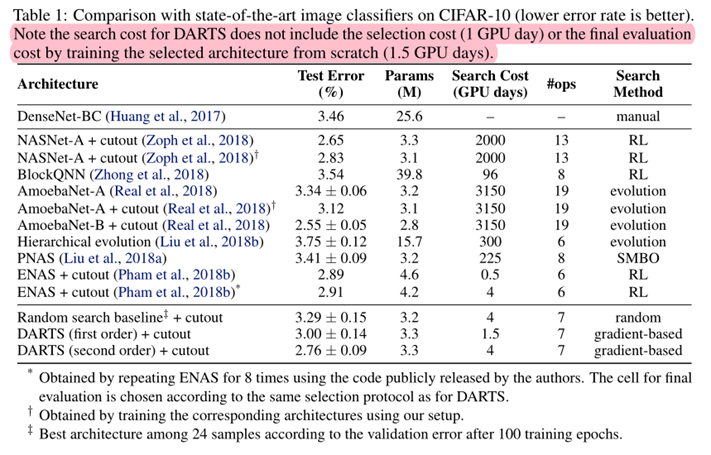
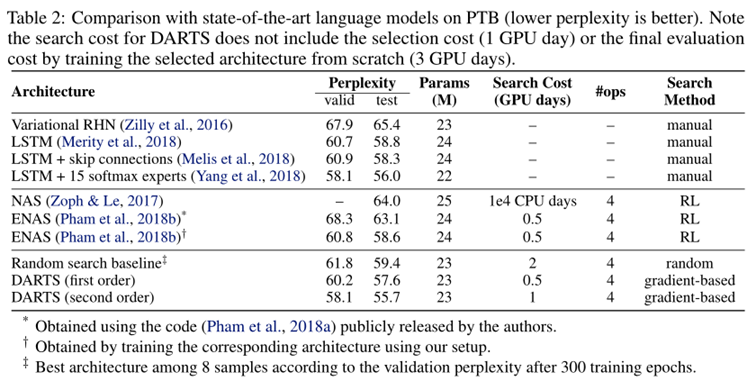
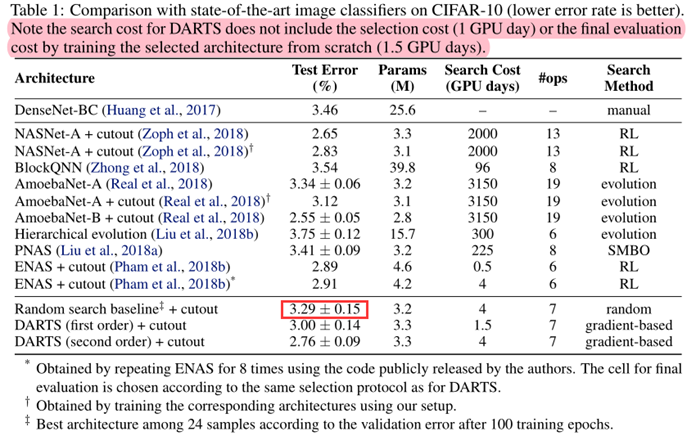
- DARTS achieved comparable results with the state of the art while using three orders of magnitude less computation resources.
- (i.e. 1.5 or 4 GPU days vs 2000 GPU days for NASNet and 3150 GPU days for AmoebaNet)
- The longer search time is due to the fact that we have repeated the search process four times for cell selection. This practice is less important for convolutional cells however, because the performance of discovered architectures does not strongly depend on initialization (Fig. 3).
- It is also interesting to note that random search is competitive for both convolutional and recurrent models, which reflects the importance of the search space design.
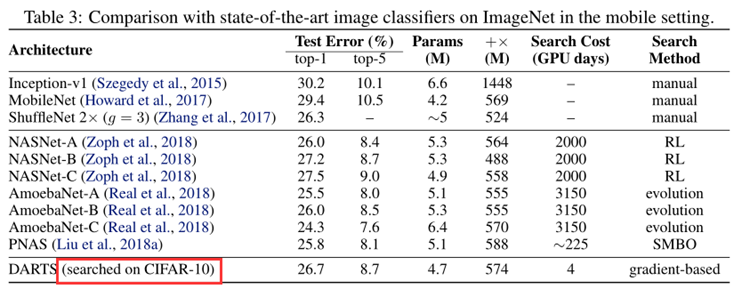
Results in Table 3 show that the cell learned on CIFAR-10 is indeed transferable to ImageNet.
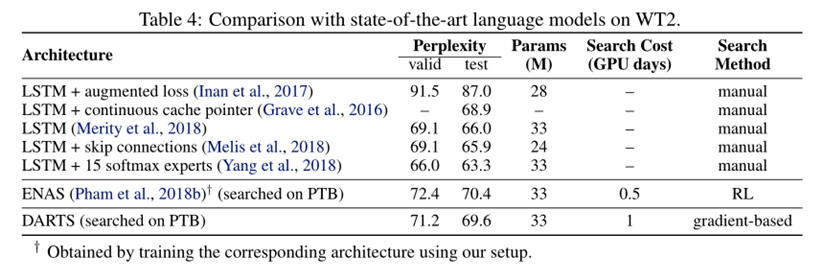
The weaker transferability between PTB and WT2 (as compared to that between CIFAR-10 and ImageNet) could be explained by the relatively small size of the source dataset (PTB) for architecture search.
The issue of transferability could potentially be circumvented by directly optimizing the architecture on the task of interest.
Conclusion
- We presented DARTS, a simple yet efficient NAS algorithm for both CNN and RNN.
- SOTA
- efficiency improvement by several orders of magnitude.
Improve
- discrepancies between the continuous architecture encoding and the derived discrete architecture. (softmax…)
- It would also be interesting to investigate performance-aware architecture derivation schemes based on the shared parameters learned during the search process.
Appendix
2019-ICLR-DARTS: Differentiable Architecture Search-论文阅读的更多相关文章
- 论文笔记:DARTS: Differentiable Architecture Search
DARTS: Differentiable Architecture Search 2019-03-19 10:04:26accepted by ICLR 2019 Paper:https://arx ...
- 论文笔记系列-DARTS: Differentiable Architecture Search
Summary 我的理解就是原本节点和节点之间操作是离散的,因为就是从若干个操作中选择某一个,而作者试图使用softmax和relaxation(松弛化)将操作连续化,所以模型结构搜索的任务就转变成了 ...
- 论文笔记:Progressive Differentiable Architecture Search:Bridging the Depth Gap between Search and Evaluation
Progressive Differentiable Architecture Search:Bridging the Depth Gap between Search and Evaluation ...
- 2019-ICCV-PDARTS-Progressive Differentiable Architecture Search Bridging the Depth Gap Between Search and Evaluation-论文阅读
P-DARTS 2019-ICCV-Progressive Differentiable Architecture Search Bridging the Depth Gap Between Sear ...
- 论文笔记系列-Auto-DeepLab:Hierarchical Neural Architecture Search for Semantic Image Segmentation
Pytorch实现代码:https://github.com/MenghaoGuo/AutoDeeplab 创新点 cell-level and network-level search 以往的NAS ...
- Research Guide for Neural Architecture Search
Research Guide for Neural Architecture Search 2019-09-19 09:29:04 This blog is from: https://heartbe ...
- 小米造最强超分辨率算法 | Fast, Accurate and Lightweight Super-Resolution with Neural Architecture Search
本篇是基于 NAS 的图像超分辨率的文章,知名学术性自媒体 Paperweekly 在该文公布后迅速跟进,发表分析称「属于目前很火的 AutoML / Neural Architecture Sear ...
- 论文笔记系列-Neural Architecture Search With Reinforcement Learning
摘要 神经网络在多个领域都取得了不错的成绩,但是神经网络的合理设计却是比较困难的.在本篇论文中,作者使用 递归网络去省城神经网络的模型描述,并且使用 增强学习训练RNN,以使得生成得到的模型在验证集上 ...
- 论文笔记:Auto-DeepLab: Hierarchical Neural Architecture Search for Semantic Image Segmentation
Auto-DeepLab: Hierarchical Neural Architecture Search for Semantic Image Segmentation2019-03-18 14:4 ...
随机推荐
- Java——异常那些事
异常的基本定义 异常情形是指阻止当前方法或者作用域继续执行的问题.在这里一定要明确一点:异常代码某种程度的错误,尽管Java有异常处理机制,但是我们不能以“正常”的眼光来看待异常,异常处理机制的原因就 ...
- 王颖奇 201771010129《面向对象程序设计(java)》第一周学习总结
<面向对象程序设计(java)>第一周学习总结 第一部分:课程准备部分 填写课程学习 平台注册账号, 平台名称 注册账号 博客园:www.cnblogs.com wangyingqi 程序 ...
- 004_Python的列表切片,增删改查,常用操作方法,元组,range,join
列表 列表是Python中的基础数据类型之一,它是以[]括起来,每个元素以逗号隔开,而且他里面可以存放各种数据类型比如: li = ['kevin',123,True,(1,2,3,'wusir'), ...
- 在windows环境里,用Docker搭建Redis开发环境(新书第一个章节)
大家都知道高并发分布式组件的重要性,而且如果要进大厂,这些技术不可或缺.但这些技术的学习难点在于,大多数项目里的分布式组件,都是搭建在Linux系统上,在自己的windows机器上很难搭建开发环境,如 ...
- 【HBase】Java实现过滤器查询
目录 概述 代码实现 rowKey过滤器RowFilter 列族过滤器FamilyFilter 列过滤器QualifierFilter 列值过滤器ValueFilter 专用过滤器 单列值过滤器 Si ...
- Linux内核驱动学习(九)GPIO外部输入的处理
文章目录 前言 设备树 两个结构体 gpio_platform_data gpio_demo_device 两种方式 轮询 外部中断 总结 附录 前言 前面是如何操作GPIO进行输出,这里我重新实现了 ...
- clang8.0及以上编译rocks问题
升级了MacOS 10.15 Beta版,结果编译 CockroachDB 遇到了问题. [ %] Building CXX object CMakeFiles/rocksdb.dir/db/buil ...
- JDBC03 Statement接口
Statement接口 用于执行静态SQL语句并返回它所生成结果的对象 三种Statem类 Statement:由createStatement创建,用于发送简单的SQL语句(不带参数的),会有SQL ...
- spring-boot+spring-cloud+maven-module 一个 maven多模块的微服务架构模版
spring-boot-cloud-module spring-boot+spring-cloud+maven-module 一个 maven多模块的微服务架构模版. 新手上路的绝佳模版,只有必要的配 ...
- 内网穿透访问Vue项目的时候出现Invalid Host header解决办法
适用场景: 在本地的Vue-cli3项目, 需要其他人浏览. 如果没有外网的服务器, 可以把自己的电脑当做服务器. 这时候需要外网的人能访问到自己的电脑. Mac内网穿透工具:natapp Inval ...