
STL—— 容器(vector)的数据写入、修改和删除
1. 通过 push_back() 尾部增加一个元素 :
vector 可以通过 “push_back ” 写入数据,通过 push_back 可以将数据直接写入至 vector 的末尾,push_back 会自动申请内存,并且多次 push_back 后会自动预先分配内存,如下代码:
 1 #include <iostream>

 2 #include <vector>

 3

 4 using namespace std;

 5

 6 int main()

 7 {

 8     //第一部分:容器 vector

 9     vector<int> num;

10

11     cout << "num 的元素个数:" << num.size() << endl;

12     cout << "num 容器的大小:" << num.capacity() << endl;

13

14     num.push_back(1);    //push_back:往 vector 最后放置1个元素 “1”

15     num.push_back(2);

16     num.push_back(3);

17     num.push_back(4);

18     num.push_back(3);

19

20     cout << "尾部插入5个元素后" << endl;

21     cout << "num 的元素个数:" << num.size() << endl;

22     cout << "num 容器的大小:" << num.capacity() << endl;

23

24     return 0;

25 }
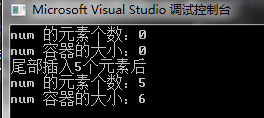
运行结果:
插入5个元素后打印内存大小,结果发现这时的 vector 占用了6个 int 元素的内存
2.通过 pop_back() 删除尾部的一个元素:
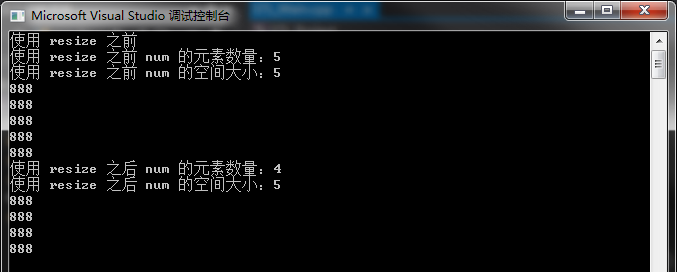
vector 可以通过 “pop_back” 删除尾部一个元素,pop_back 删除尾部的元素后,元素个数会变少,但空间并不会缩小,如下代码:
 1 #include <iostream>

 2 #include <vector>

 3

 4 using namespace std;

 5

 6 int main()

 7 {

 8     vector<int>num(5, 888);

 9

10     printf("使用 resize 之前\n");

11     cout << "使用 resize 之前 num 的元素数量:" << num.size() << endl;

12     cout << "使用 resize 之前 num 的空间大小:" << num.capacity() << endl;

13

14     for (int i = 0; i < num.size(); i++)

15     {

16         cout << num[i] << endl;

17     }

18

19     num.pop_back();

20

21     cout << "使用 resize 之后 num 的元素数量:" << num.size() << endl;

22     cout << "使用 resize 之后 num 的空间大小:" << num.capacity() << endl;

23     for (int i = 0; i < num.size(); i++)

24     {

25         cout << num[i] << endl;

26     }

27

28     return 0;

29 }
打印结果:
3. 使用下标进行数据修改:
如果使用下标进行数据写入,需要一个前提,那就是 vector 已经进行了内存分配,如果像下方代码:vector 没有进行带参构造,这时不能直接通过下标去写 vector 的数据。
1 vector<int> num;

2

3 num[0] = 1;     //不能这样通过下标去访问,因为vector是进行默认构造的,这时并没有相关内存
以下几种带参构造的 vector 是可以进行下标数据写入的:
//例1

int main()

{

    vector<int> num(10);

    num[0] = 1;

    num[1] = 2;

    return 0;

}

//例2

int main()

{

    vector<int> num(10);

    vector<int>num_1(num);

    num_1[0] = 1;

    num_1[1] = 2;

    return 0;

}

//例3

int main()

{

    int test[] = { 1,2,3,4,5 };

    vector<int> num(test, test + 2);

    num[0] = 1;

    num[1] = 2;

    return 0;

}
4. 使用 vectorName.at() 进行数据修改:
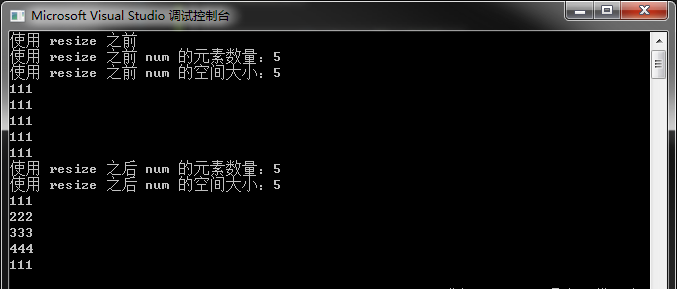
这种用法与下标修改类似,at() 这个方法返回的是一个引用,可以吧一个常量 int 赋值给它,如下代码:
 1 #include <iostream>

 2 #include <vector>

 3

 4 using namespace std;

 5

 6 int main()

 7 {

 8     vector<int>num(5, 111);

 9

10     printf("使用 resize 之前\n");

11     cout << "使用 resize 之前 num 的元素数量:" << num.size() << endl;

12     cout << "使用 resize 之前 num 的空间大小:" << num.capacity() << endl;

13

14     for (int i = 0; i < num.size(); i++)

15     {

16         cout << num[i] << endl;

17     }

18

19     num.at(1) = 222;

20     num.at(2) = 333;

21     num.at(3) = 444;

22

23     cout << "使用 resize 之后 num 的元素数量:" << num.size() << endl;

24     cout << "使用 resize 之后 num 的空间大小:" << num.capacity() << endl;

25     for (int i = 0; i < num.size(); i++)

26     {

27         cout << num[i] << endl;

28     }

29

30     return 0;

31 }
打印结果:
5. 使用 assign 进行重写操作
assign 可以改变原来的 vector 中的元素个数和值,如下代码:
 1 #include <iostream>

 2 #include <vector>

 3

 4 using namespace std;

 5

 6 int main()

 7 {

 8     vector<int>num(10, 666);

 9

10     printf("使用 assign 之前\n");

11     cout << "使用 assign 之前 num 的元素数量:" << num.size() << endl;

12     cout << "使用 assign 之前 num 的空间大小:" << num.capacity() << endl;

13

14     num[0] = 1;

15     num[1] = 2;

16

17     for (int i = 0; i < num.size(); i++)

18     {

19         cout << num[i] << endl;

20     }

21     num.assign(2,888);              //第一种 assign 的用法

22     printf("使用 assign 之后\n");

23     cout << "使用 assign 之后 num 的元素数量:" << num.size() << endl;

24     cout << "使用 assign 之后 num 的空间大小:" << num.capacity() << endl;

25     for (int i = 0; i < num.size(); i++)

26     {

27         cout << num[i] << endl;

28     }

29

30     return 0;

31 }
打印结果:
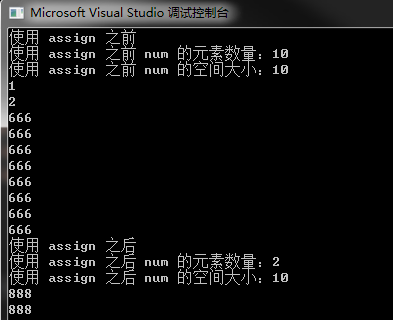
我们会发现,使用 assign 之后元素数量变为了2,但 vector 的空间大小并没有变。
assign 还可以搭配迭代器用:
 1 #include <iostream>

 2 #include <vector>

 3

 4 using namespace std;

 5

 6 int main()

 7 {

 8     vector<int>num(10, 111);

 9     vector<int>num_1(10, 888);

10

11     printf("使用 assign 之前\n");

12     cout << "使用 assign 之前 num_1 的元素数量:" << num_1.size() << endl;

13     cout << "使用 assign 之前 num_1 的空间大小:" << num_1.capacity() << endl;

14

15     num_1[0] = 1;

16     num_1[1] = 2;

17

18     for (int i = 0; i < num_1.size(); i++)

19     {

20         cout << num_1[i] << endl;

21     }

22     num_1.assign(2,888);                        //第一种 assign 的用法

23     num_1.assign(num.begin() + 3, num.end());   //第二种 配合迭代器的用法

24

25     printf("assign 的第二种用法:\n");

26     cout << "assign 的第二种用法之后 num_1 的元素数量:" << num_1.size() << endl;

27     cout << "assign 的第二种用法之后 num_1 的空间大小:" << num_1.capacity() << endl;

28     for (int i = 0; i < num_1.size(); i++)

29     {

30         cout << num_1[i] << endl;

31     }

32

33     return 0;

34 }
打印如下:
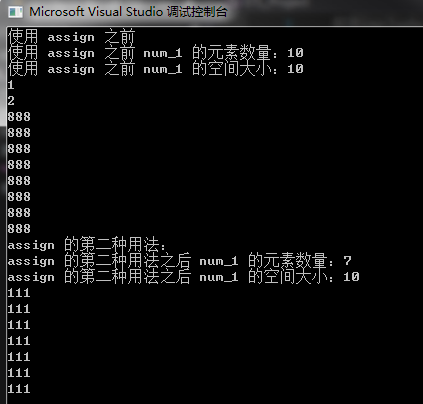
既然使用迭代器可以这样玩,那么使用数组也一样可以,如下:
 1 #include <iostream>

 2 #include <vector>

 3

 4 using namespace std;

 5

 6 int main()

 7 {

 8     int test[] = { 111,222,333,444,555,666,777,888,999 };

 9     vector<int>num(10, 888);

10

11     printf("使用 assign 之前\n");

12     cout << "使用 assign 之前 num_1 的元素数量:" << num.size() << endl;

13     cout << "使用 assign 之前 num_1 的空间大小:" << num.capacity() << endl;

14

15     num[0] = 1;

16     num[1] = 2;

17

18     for (int i = 0; i < num.size(); i++)

19     {

20         cout << num[i] << endl;

21     }

22     num.assign(2,888);                        //第一种 assign 的用法

23     num.assign(test, test + 5);          //第二种 使用迭代器一样的用法 用数组进行重新赋值

24

25     printf("assign 的第二种用法:\n");

26     cout << "assign 的第二种用法之后 num_1 的元素数量:" << num.size() << endl;

27     cout << "assign 的第二种用法之后 num_1 的空间大小:" << num.capacity() << endl;

28     for (int i = 0; i < num.size(); i++)

29     {

30         cout << num[i] << endl;

31     }

32

33     return 0;

34 }
打印如下:
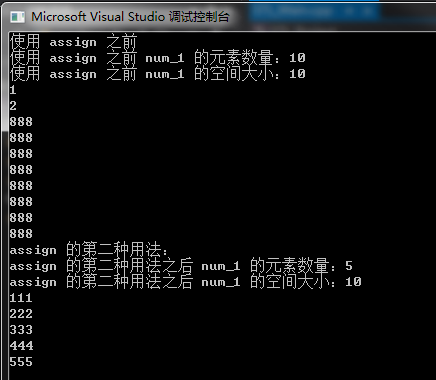
6. 获取&修改 vector 容器的第一个和最后一个元素的值:
获取:使用 vectorName.front() 与 vectorName.back() 来获取 vector 的第一个元素与最后一个元素的引用,如下代码:
 1 #include <iostream>

 2 #include <vector>

 3

 4 using namespace std;

 5

 6 int main()

 7 {

 8     int test[] = { 111,222,333,444,555,666,777,888,999 };

 9     vector<int>num(test, test + 9);

10

11     cout << "num 的第一个元素为:" << num.front() << endl;

12     cout << "num 的第一个元素为:" << num.back() << endl;

13

14     return 0;

15 }
打印结果:

赋值:因为返回的是其引用,那么我们也可以进行赋值操作,如下代码:
 1 #include <iostream>

 2 #include <vector>

 3

 4 using namespace std;

 5

 6 int main()

 7 {

 8     int test[] = { 111,222,333,444,555,666,777,888,999 };

 9     vector<int>num(test, test + 9);

10

11     cout << "num 的第一个元素为:" << num.front() << endl;

12     cout << "num 的第一个元素为:" << num.back() << endl;

13

14     cout << "=========改变首尾的值========" << endl;

15     num.front() = 1;

16     num.back() = 9;

17

18     for (int i = 0; i < num.size(); i++)

19     {

20         cout << num.at(i) << endl;

21     }

22

23     return 0;

24 }
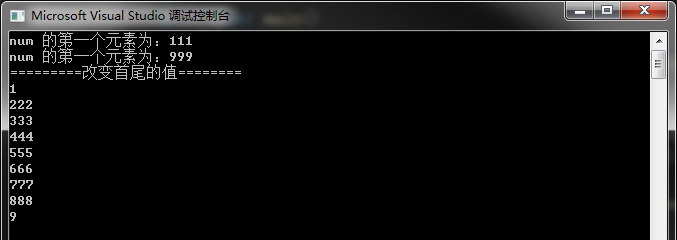
打印结果:
=======================================================================================================================
STL—— 容器(vector)的数据写入、修改和删除的更多相关文章
- 从零开始写STL—容器—vector
从0开始写STL-容器-vector vector又称为动态数组,那么动态体现在哪里?vector和一般的数组又有什么区别?vector中各个函数的实现原理是怎样的,我们怎样使用会更高效? 以上内容我 ...
- STL容器 vector,list,deque 性能比较
C++的STL模板库中提供了3种容器类:vector,list,deque对于这三种容器,在觉得好用的同时,经常会让我们困惑应该选择哪一种来实现我们的逻辑.在少量数据操作的程序中随便哪一种用起来感觉差 ...
- [C++]STL容器Vector的内存释放
直接抛出两句话,说明到底应该如何释放Vector占用的内存. “vector的clear不影响capacity,你应该swap一个空的vector.” <Effective STL>中的“ ...
- STL容器vector应用注意事项
[1]提前分配足够空间以免不必要的重新分配和复制代价 关于vector容器重新分配和复制及析构释放的代价,请参见随笔<STL容器之vector>. 应用示例对比代码如下: #include ...
- Thinkphp 数据的修改及删除操作
一.数据修改操作 save() 实现数据修改,返回受影响的记录条数 具体有两种方式实现数据修改,与添加类似(数组.AR方式) 1.数组方式: a) $goods = D(“Goods ...
- 6月17 ThinkPHP连接数据库------数据的修改及删除
1.数据修改操作 save() 实现数据修改,返回受影响的记录条数 具体有两种方式实现数据修改,与添加类似(数组.AR方式) 1.数组方式 a) $goods = D(“Goods” ...
- STL容器 -- Vector
核心:Vector 是 STL 里的一个向量容器,可以像数组那样进行随机访问,能在尾部插入元素,对于元素的删除和插入可以动态管理内存. 头文件: #include <vector> 构造函 ...
- STL - 容器 - vector简单应用
VectorTest.cpp #include <vector> #include <iostream> #include <string> #include &l ...
- STL——容器(deque) 构造 & 头尾添加删除元素
1.deque容器概念 deque是"double-ended queue"的缩写,和vector一样都是STL的容器,唯一不同的是:deque是双端数组,而vector是单端的. ...
- [Oracle]Oracle数据库数据被修改或者删除恢复数据
1.SELECT * FROM CT_FIN_RiskItem--先查询表,确定数据的确不对(cfstatus第一行缺少)2.select * from CT_FIN_RiskItem as of t ...
随机推荐
- 彻底卸载MySQL5.7(msi,exe)版
1,停止MySQL服务 2,右键找到任务管理器 3,在程序中卸载MySQL 4,删除MySQL安装目录 有的是在C:\Program Files下,我的是在(X86)下 5,删除隐藏文件中的MySQL ...
- PEP8编程规范
1.PEP8编程规范 [少加空格多写注释,严格对齐] 1.缩进 缩进table = 4个空格:设置好后使用编辑器的自然table 2.if条件书写规范 if的条件多的时候用左边括号对齐:if条件完毕后 ...
- redis部署安装【建议收藏】
一.redis安装教程 1.安装redis ~]# yum -y install gcc gcc-c++ make ~]# tar -xf redis-4.0.8.tar.gz ~]# cd redi ...
- OWASP固件安全性测试指南
OWASP固件安全性测试指南 固件安全评估,英文名称 firmware security testing methodology 简称 FSTM.该指导方法主要是为了安全研究人员.软件开发人员.顾问. ...
- OCR之前这些因素必须考虑到!
用久了ABBYY FineReader 14OCR文字识别软件,相信大家都知道图像质量对OCR质量有很大的影响,本文将给大家讲解下在识别图像之前,有哪些因素需要考虑到! 1.OCR语言 ABBYY F ...
- 利用css3实现照片列表展开小demo
效果如下: 其实实现起来很简单,就是控制 宽 高的变化,然后给他加上transition 过度而已.觉得代码没什么难的地方,就不打注释了,如果哪里有不懂的话,可以直接评论呢. 直接上源码 html代码 ...
- 根节点到叶子节点路径之和为target
//递归吧,但是在递归到底的条件上要判断好,比如说完整路径是到叶子节点,也就是说左右子节点都为空,并且这时候的root.val==target表示找到了一个list,再返回. 但是因为我并没有直接就用 ...
- Java基础知识面试题(最详细版)
刚刚经历过秋招,看了大量的面经,顺便将常见的Java常考知识点总结了一下,并根据被问到的频率大致做了一个标注.一颗星表示知识点需要了解,被问到的频率不高,面试时起码能说个差不多.两颗星表示被问到的频率 ...
- Calling unknown method: app\modules\mobile\controllers\CompanyController::redirect()
$this->redirect(['default/error']); Yii::$app->end();上边的代码出现 Calling unknown method: app\modul ...
- Java基础教程——异常处理详解
异常处理 好程序的特性 可重用性 可维护性 可扩展性 鲁棒性 |--|--Robust的音译 |--|--健壮.强壮之意 |--|--指在异常和危险情况下系统依然能运行,不崩溃 Java中,写下如下代 ...