
HDU 1507 Uncle Tom's Inherited Land*(二分图匹配)
Uncle Tom's Inherited Land*
Time Limit: 2000/1000 MS (Java/Others) Memory Limit: 65536/32768 K (Java/Others)
Total Submission(s): 3339 Accepted Submission(s): 1394
Special Judge
old uncle Tom inherited a piece of land from his great-great-uncle.
Originally, the property had been in the shape of a rectangle. A long
time ago, however, his great-great-uncle decided to divide the land into
a grid of small squares. He turned some of the squares into ponds, for
he loved to hunt ducks and wanted to attract them to his property. (You
cannot be sure, for you have not been to the place, but he may have made
so many ponds that the land may now consist of several disconnected
islands.)
Your uncle Tom wants to sell the inherited land, but
local rules now regulate property sales. Your uncle has been informed
that, at his great-great-uncle's request, a law has been passed which
establishes that property can only be sold in rectangular lots the size
of two squares of your uncle's property. Furthermore, ponds are not
salable property.
Your uncle asked your help to determine the
largest number of properties he could sell (the remaining squares will
become recreational parks). 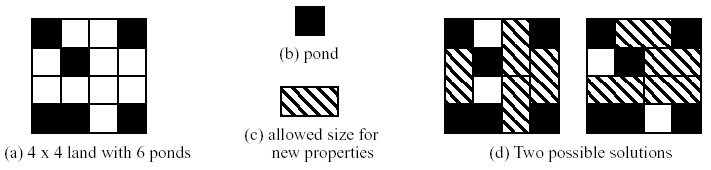
will include several test cases. The first line of a test case contains
two integers N and M, representing, respectively, the number of rows
and columns of the land (1 <= N, M <= 100). The second line will
contain an integer K indicating the number of squares that have been
turned into ponds ( (N x M) - K <= 50). Each of the next K lines
contains two integers X and Y describing the position of a square which
was turned into a pond (1 <= X <= N and 1 <= Y <= M). The
end of input is indicated by N = M = 0.
each test case in the input your program should first output one line,
containing an integer p representing the maximum number of properties
which can be sold. The next p lines specify each pair of squares which
can be sold simultaneity. If there are more than one solution, anyone is
acceptable. there is a blank line after each test case. See sample
below for clarification of the output format.
6
1 1
1 4
2 2
4 1
4 2
4 4
4 3
4
4 2
3 2
2 2
3 1
0 0
(1,2)--(1,3)
(2,1)--(3,1)
(2,3)--(3,3)
(2,4)--(3,4)
3
(1,1)--(2,1)
(1,2)--(1,3)
(2,3)--(3,3)
#include <iostream>

#include <cstring>

#include <cstdio>

#include <algorithm>

#include <cmath>

#include <string>

#include <map>

#include <queue>

#include <vector>

#define inf 0x7fffffff

#define met(a,b) memset(a,b,sizeof a)

typedef long long ll;

using namespace std;

const int N = ;

const int M = ;

int read() {int x=,f=;char c=getchar();while(c<''||c>'') {if(c=='-')f=-;c=getchar();}while(c>=''&&c<='') {x=x*+c-'';c=getchar();}return x*f;}

int n,m,cnt;

int dis[][]={{,},{,-},{,},{-,}};

int tot,head[N];

int w[][],t[N],x[N],y[N];

struct man

{

    int x,y,color,num;

};

struct EDG

{

    int to,next;

}edg[M];

struct ANS

{

    int x,y;

}answ[N];

void add(int u,int v)

{

    edg[cnt].to=v;edg[cnt].next=head[u];head[u]=cnt++;

}

void bfs(int u,int v)

{

    queue<man>q;

    man s;s.color=;s.num=++tot;s.x=u;s.y=v;q.push(s);

    w[u][v]=;answ[tot].x=u;answ[tot].y=v;

    while(!q.empty()){

        man t=q.front();q.pop();

        for(int i=;i<;i++){

            int xx=t.x+dis[i][];int yy=t.y+dis[i][];

            if(xx>=&&xx<=n&&yy>=&&yy<=m&&!w[xx][yy]){

                man k;k.color=(t.color+)%;k.num=++tot;k.x=xx;k.y=yy;

                q.push(k);w[xx][yy]=;answ[k.num].x=xx;answ[k.num].y=yy;

                if(!t.color)add(t.num,k.num);

                else add(k.num,t.num);

            }

        }

    }

}

bool dfs(int u) {

    for(int i=head[u];i!=-;i=edg[i].next) {

        int v=edg[i].to;

        if(!t[v]) {

            t[v]=;

            if(!y[v]||dfs(y[v])) {

                x[u]=v;

                y[v]=u;

                return true;

            }

        }

    }

    return false;

}

void MaxMatch() {

    int ans=;

    for(int i=; i<=tot; i++) {

        if(!x[i]) {

            met(t,);

            if(dfs(i))ans++;

        }

    }

    printf("%d\n",ans);

    for(int i=;i<=tot;i++){

        if(x[i]){

            int v=x[i];

            printf("(%d,%d)--(%d,%d)\n",answ[i].x,answ[i].y,answ[v].x,answ[v].y);

        }

    }

    printf("\n");

}

int main() {

    while (~scanf("%d%d",&n,&m)&&n&&m) {

        met(w,);met(head,-);met(x,);met(y,);met(edg,);met(answ,);cnt=;tot=;

        int k=read();

        while(k--){

            int x=read();int y=read();

            w[x][y]=;

        }

        for(int i=;i<=n;i++)for(int j=;j<=m;j++)if(!w[i][j])bfs(i,j);

        MaxMatch();

    }

    return ;

}
HDU 1507 Uncle Tom's Inherited Land*(二分图匹配)的更多相关文章
- Hdu 1507 Uncle Tom's Inherited Land* 分类: Brush Mode 2014-07-30 09:28 112人阅读 评论(0) 收藏
Uncle Tom's Inherited Land* Time Limit: 2000/1000 MS (Java/Others) Memory Limit: 65536/32768 K (J ...
- HDU 1507 Uncle Tom's Inherited Land*(二分匹配,输出任意一组解)
Uncle Tom's Inherited Land* Time Limit: 2000/1000 MS (Java/Others) Memory Limit: 65536/32768 K (J ...
- HDU1507 Uncle Tom's Inherited Land* 二分图匹配 匈牙利算法 黑白染色
原文链接http://www.cnblogs.com/zhouzhendong/p/8254062.html 题目传送门 - HDU1507 题意概括 有一个n*m的棋盘,有些点是废的. 现在让你用1 ...
- HDU 1507 Uncle Tom's Inherited Land(最大匹配+分奇偶部分)
题目链接:http://acm.hdu.edu.cn/showproblem.php?pid=1507 题目大意:给你一张n*m大小的图,可以将白色正方形凑成1*2的长方形,问你最多可以凑出几块,并输 ...
- HDU 1507 Uncle Tom's Inherited Land*
题目大意:给你一个矩形,然后输入矩形里面池塘的坐标(不能放东西的地方),问可以放的地方中,最多可以放多少块1*2的长方形方块,并输出那些方块的位置. 题解:我们将所有未被覆盖的分为两种,即分为黑白格( ...
- hdu-----(1507)Uncle Tom's Inherited Land*(二分匹配)
Uncle Tom's Inherited Land* Time Limit: 2000/1000 MS (Java/Others) Memory Limit: 65536/32768 K (J ...
- HDU——T 1507 Uncle Tom's Inherited Land*
http://acm.hdu.edu.cn/showproblem.php?pid=1507 Time Limit: 2000/1000 MS (Java/Others) Memory Limi ...
- hdu1507 Uncle Tom's Inherited Land* 二分匹配
题目链接:http://acm.hdu.edu.cn/showproblem.php?pid=1507 将i+j为奇数的构成x集合中 将i+j为偶数的构成y集合中 然后就是构建二部图 关键就是构图 然 ...
- XTU 二分图和网络流 练习题 B. Uncle Tom's Inherited Land*
B. Uncle Tom's Inherited Land* Time Limit: 1000ms Memory Limit: 32768KB 64-bit integer IO format: %I ...
随机推荐
- 大学生成绩管理系统(C语言)
功能:成绩管理系统包含了学生的全部信息,每个学生是一个记录,包括学号,姓名,性别,班级,各科成绩(语数外). 系统功能: 1.信息录入——录入学生信息: 2.信息输出——显示所有信息: 3.信息查询— ...
- 支持多人协作的在线免费作图工具:ProcessOn
之前朋友给我推荐一款作图工具ProcessOn,出于好奇我就研究了一下它,今天我就给大家简单介绍一下这款免费的在线作图工具:ProcessOn 首先使用ProcessOn我们需要有一个帐号,这样每次操 ...
- 本节向大家介绍一下UML建模误区
本节向大家介绍一下UML建模误区,这里向大家介绍九个误区,希望通过本节的学习,你对UML建模有清晰的认识,以免在以后使用过程中产生不必要的麻烦.下面让我们一起来看一下这些建模误区吧. UML建模误区 ...
- 关键字const
const关键字常和指针一起使用. 1,const给读代码的人传达非常有用的信息.比如一个函数的参数是const char *,你在调用这个函数时就可以放心地传给它char *或const char ...
- ODI中显示us7ascii字符集的测试
安装oracle DB时,选择的字符集:美国.英语.US7ASCII. 在不设置nls_lang的情况,插入中文,成功,但存进去的是乱码,select看到也是??(无论后面再怎么设置nls_lang) ...
- Actioncontext之类的map嵌套,取值
假设图中最顶端的map设为Actioncontext的map,这种情况,用<s:property value=""/>或者EL表达式取值,可以用#key1.key2.k ...
- for循环进阶
[引例] 输出一行10个“*” #include<cstdio> int main(){ printf("**********\n"); ; } 思考: (1)输出一行 ...
- Javascript 的类型转换之减号
专职写JS已经有一个月了(对,没错就是一个月),从2014年11月24实习开始到今的2月份,我做的工作一直都是切图,另外跟着老板学产品,现在我一听到切图两字,我就想吐...所以我找了一份专职写JS的工 ...
- LNA和PA
低噪声放大器(Low Noise Amplifier) -------------LNA 功率放大器(Power Amplifier)---------------------PA LNA是低噪声放大 ...
- SAP 中如何寻找增强
http://blog.csdn.net/edifierliu/article/details/5978824 查找SAP标准事务代码中使用的BADI: 在SE24中,查看类对象CL_EXITHAND ...