
1. Vectors and Linear Combinations
1.1 Vectors
We have n separate numbers \(v_1、v_2、v_3,...,v_n\),that produces a n-dimensional vector \(v\),and \(v\) is represented by an arrow.
\begin{matrix}
v_1 \\
v_2 \\
.\\
.\\
.\\
v_n
\end{matrix}
\right] = (v_1,v_2,...,v_n)
\]
Two-dimensional vector :\(v = \left[\begin{matrix} v_1 \\ v_2 \end{matrix}\right]\) and \(w = \left[\begin{matrix} w_1 \\ w_2 \end{matrix}\right]\)
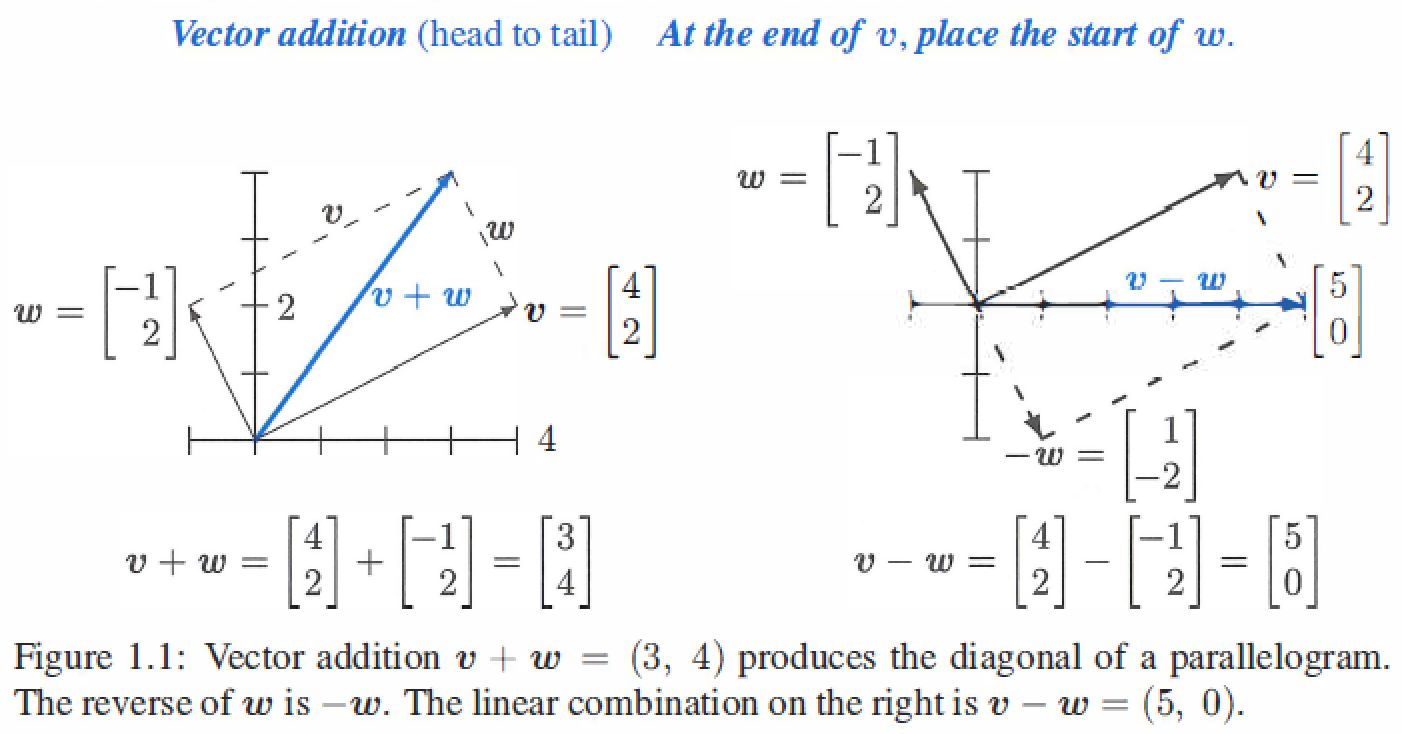
- Vector Addition : \(v + w = \left[\begin{matrix} v_1 + w_1 \\ v_2 + w_2\end{matrix}\right]\)
- Scalar Multiplication : \(cv = \left[\begin{matrix} cv_1 \\ cv_2 \end{matrix}\right]\),c is scalar.
1.2 Linear Combinations
Multiply \(v\) by \(c\) and multiply \(w\) by \(d\),the sum of \(cv\) and \(dw\) is a linear combination : \(cv + dw\).
We can visualize \(v + w\) using arrows,for example:
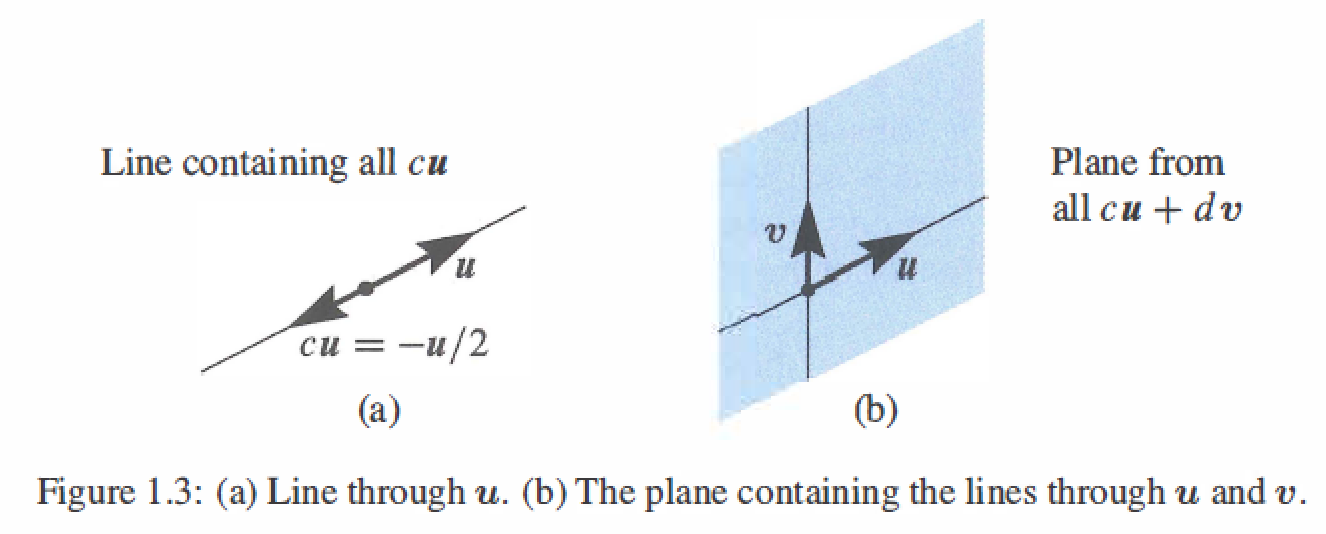
The combinations can fill Line、Plane 、or 3-dimensional space:
- The combinations \(cu\) fill a line through origin.
- The combinations \(cu + dv\) fill a plane throught origin
- The combinations \(cu + dv +ew\) fill three-dimensional space throught origin.
1.3 Lengths and Dot Products
Dot Product/ Inner Product: \(v \cdot w = v_1w_1 + v_2w_2\),where $v = (v_1, v_2) $ and \(w=(w_1, w_2)\) ,the dot product \(w \cdot v\) equals \(v \cdot w\)
Length : \(||v|| = \sqrt{v \cdot v} = (v_1^2 + v_2^2 + v_3^2 +...+ v_n^2)^{1/2}\)
Unit vector : \(u = v /||v||\) is a unit vector in the same direction as \(v\),length =1
Perpendicular vector : \(v \cdot w = 0\)
Cosine Formula : if \(v\) and \(w\) are nonzero vectors then \(\frac{v \cdot w}{||v|| \ ||w||} = cos \theta\) , \(\theta\) is the angle between \(v\) and \(w\)
Schwarz Inequality : \(|v \cdot w| \leq ||v|| \ ||w||\)
Triangel Inequality : \(||v + w|| \leq ||v|| + ||w||\)
1.4 Matrices
1、\(A = \left[ \begin{matrix} 1 & 2 \\ 3 & 4 \\ 5 & 6 \end{matrix}\right]\) is a 3 by 2 matrix : m=2 rows and n=2 columns
2、$Ax = b $ is a linear combination of the columns A
3、 Combination of the vectors : \(Ax = x_1\left[ \begin{matrix} 1 \\ -1 \\ 0 \end{matrix} \right] + x_2\left[ \begin{matrix} 0 \\ 1 \\ -1 \end{matrix} \right] + x_3\left[ \begin{matrix} 0 \\ 0 \\ 1 \end{matrix} \right] = \left[ \begin{matrix} x_1 \\ x_2-x_1 \\ x_3-x_2 \end{matrix} \right]\)
4、Matrix times Vector : $Ax = \left[ \begin{matrix} 1&0&0\ -1&1&0 \ 0&-1&1 \end{matrix} \right] \left[ \begin{matrix} x_1\ x_2 \ x_3 \end{matrix} \right]= \left[ \begin{matrix} x_1 \ x_2-x_1 \ x_3-x_2 \end{matrix} \right] $
5、Linear Equation : Ax = b --> \(\begin{matrix} x_1 = b_1 \\ -x_1 + x_2 = b_2 \\ -x_2 + x_3 = b_3 \end{matrix}\)
6、Inverse Solution : \(x = A^{-1}b\) -- > \(\begin{matrix} x_1 = b_1 \\ x_2 = b_1 + b_2 \\ x_3 =b_1 + b_2 + b_3 \end{matrix}\), when A is an invertible matrix
7、Independent columns : Ax = 0 has one solution, A is an invertible matrix, the column vectors of A are independent. (example: \(u,v,w\) are independent,No combination except \(0u + 0v + 0w = 0\) gives \(b=0\))
8、Dependent columns : Cx = 0 has many solutions, C is a singular matrix, the column vectors of C are dependent. (example: \(u,v,w^*\) are dependent,other combinations like \(au + cv + dw^*\) gives \(b=0\))
1. Vectors and Linear Combinations的更多相关文章
- 【读书笔记】:MIT线性代数(1):Linear Combinations
1. Linear Combination Two linear operations of vectors: Linear combination: 2.Geometric Explaination ...
- 【线性代数】1-1:线性组合(Linear Combinations)
title: [线性代数]1-1:线性组合(Linear Combinations) toc: true categories: Mathematic Linear Algebra date: 201 ...
- 线性代数导论 | Linear Algebra 课程
搞统计的线性代数和概率论必须精通,最好要能锻炼出直觉,再学机器学习才会事半功倍. 线性代数只推荐Prof. Gilbert Strang的MIT课程,有视频,有教材,有习题,有考试,一套学下来基本就入 ...
- [MIT 18.06 线性代数]Intordution to Vectors向量初体验
目录 1.1. Vectors and Linear Combinations向量和线性组合 REVIEW OF THE KEY IDEAS 1.2 Lengths and Dot Products向 ...
- Linear Algebra lecture1 note
Professor: Gilbert Strang Text: Introduction to Linear Algebra http://web.mit.edu/18.06 Lecture 1 ...
- PRML-Chapter3 Linear Models for Regression
Example: Polynomial Curve Fitting The goal of regression is to predict the value of one or more cont ...
- 大规模视觉识别挑战赛ILSVRC2015各团队结果和方法 Large Scale Visual Recognition Challenge 2015
Large Scale Visual Recognition Challenge 2015 (ILSVRC2015) Legend: Yellow background = winner in thi ...
- What is an eigenvector of a covariance matrix?
What is an eigenvector of a covariance matrix? One of the most intuitive explanations of eigenvector ...
- Getting started with machine learning in Python
Getting started with machine learning in Python Machine learning is a field that uses algorithms to ...
- sklearn包学习
1首先是sklearn的官网:http://scikit-learn.org/stable/ 在官网网址上可以看到很多的demo,下边这张是一张非常有用的流程图,在这个流程图中,可以根据数据集的特征, ...
随机推荐
- 【LeetCode回溯算法#02】组合总和III
组合总和III 力扣题目链接(opens new window) 找出所有相加之和为 n 的 k 个数的组合.组合中只允许含有 1 - 9 的正整数,并且每种组合中不存在重复的数字. 说明: 所有数字 ...
- git修改地址三种方法
1.修改命令 git remote set-url origin [NEW_URL] 2.先删后加 git remote rm origin git remote add origin [url]3. ...
- 【Azure Redis 缓存】Redis Geo-replication(异地复制)的问题
问题描述 在Azure官网中,已列出了一系列的常规问题:https://docs.azure.cn/zh-cn/azure-cache-for-redis/cache-how-to-geo-repli ...
- KVM整理
管理命令: virsh list --all 查看所有虚拟机状态 virsh start vm1 VM1开机 virsh shutdown vm1 VM1关机 virsh destroy vm1 强制 ...
- MAUI发布APK初体验
目的 很早就有想编写安卓程序玩玩的念头了,所以这次学习将MAUI程序生成apk包来玩. 本文apk下载地址:https://azrng.lanzouv.com/iBQRe0eeg8wf ,内容很简单, ...
- c++复习笔记——STL(vector)
c++-----STL容器系列(1) vector 1 介绍 Vector是stl容器中一种常见的容器 ,基本和数组类似,其大小(size)可变,常用于数组长度不确定时来代替数组,当数据超过vecto ...
- Codeforces Round 345 (Div. 1)A. Watchmen(容斥原理)
A. Watchmen 当欧几里得距离和曼哈顿距离相等时,\(x1==x2||y1==y2\) 这两个条件满足其一.这和容斥原理一样,至少选择一个的条件. 我们可以计算xi,以及小于i之前的这些,这样 ...
- Python面向对象之派生和组合
[一]什么是派生 派生是指,子类继承父类,派生出自己的属性与方法,并且重用父类的属性与方法 [二]派生的方法 子类可以派生出自己新的属性,在进行属性查找时,子类中的属性名会优先于父类被查找 例如每个老 ...
- Nginx-负载均衡系列
综合架构-负载均衡系列 目录 综合架构-负载均衡系列 一个新的开始 一 代理模块 proxy 2.1 概述 2.2 正向代理用户 2.3 反向代理 2.4 反向代理环境准备 2.5 反正代理指令 二 ...
- Xmind 括号图 风格不错,挺好看的
Xmind 括号图 风格不错,挺好看的 之前没注意到呢~ 又搞了个竖屏的,竖屏的关键点是 先隐藏第一层包括线,然后线就全部隐藏了,然后再选择要显示线的那部分,让线显示就ok了.