
曹工说Spring Boot源码(8)-- Spring解析xml文件,到底从中得到了什么(util命名空间)
写在前面的话
相关背景及资源:
曹工说Spring Boot源码(1)-- Bean Definition到底是什么,附spring思维导图分享
曹工说Spring Boot源码(2)-- Bean Definition到底是什么,咱们对着接口,逐个方法讲解
曹工说Spring Boot源码(3)-- 手动注册Bean Definition不比游戏好玩吗,我们来试一下
曹工说Spring Boot源码(4)-- 我是怎么自定义ApplicationContext,从json文件读取bean definition的?
曹工说Spring Boot源码(5)-- 怎么从properties文件读取bean
曹工说Spring Boot源码(6)-- Spring怎么从xml文件里解析bean的
曹工说Spring Boot源码(7)-- Spring解析xml文件,到底从中得到了什么(上)
工程结构图:

概要
先给大家看看spring支持的xml配置,我列了个表格如下:
| namespace | element |
|---|---|
| util | constant、property-path、list、set、map、properties |
| context | property-placeholder、property-override、annotation-config、component-scan、load-time-weaver、spring-configured、mbean-export、mbean-server |
| beans | import、bean、alias |
| task | annotation-driven、scheduler、scheduled-tasks、executor |
| cache | advice、annotation-driven |
| aop | config、scoped-proxy、aspectj-autoproxy |
我标题的意思是,既然spring支持这么多种xml配置,那解析这些xml的代码,是否是有共性的呢?还是说,就是很随意的,产品经理说要支持这个元素的解析,就写个分支呢?
看过我上讲的同学应该知道,不管是什么元素,不管在哪个namespace下,其对应的解析代码,都是一种类,这种类,叫做:BeanDefinitionParser,这个类的接口如下:
org.springframework.beans.factory.xml.BeanDefinitionParser

public interface BeanDefinitionParser {

	/**

	 * 解析指定额element,注册其返回的BeanDefinition到BeanDefinitionRegistry

	 * (使用参数ParserContext#getRegistry()得到BeanDefinitionRegistry)

	 */

	BeanDefinition parse(Element element, ParserContext parserContext);

}
这个接口的实现类,相当多,除了beans命名空间下的xml元素,其他namespace下的xml元素的解析代码都实现了这个接口。
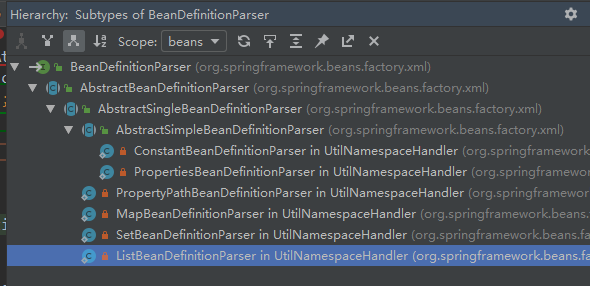
首先是util命名空间下:
其次是context命名空间:
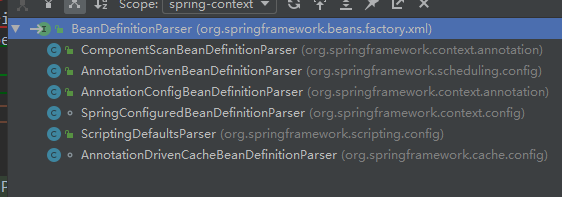
这里面有大家熟悉的。
这里就不一一列举了,所以大家知道了,每个xml元素的解析器,都是实现了BeanDefinitionParser,这个接口的方法,就是交给各个子类去实现:针对指定的xml元素,如何获取到对应的bean definition。
有的xml元素,比较简单,比如上一篇提到的util:constant,只能得到一个bean definition(factory bean);还有的xml元素,则是群攻魔法,比如<context:component-scan>这种,一把就能捞一大波bean definition上来。
本讲,我们会继续从util namespace开始,将比较常见的xml元素,一路扫过去
util:properties
用法如下:
#test.properties

name=xxx system
import lombok.Data;

@Data

public class TestPropertiesBean {

    private String appName;

}
	spring xml中如下配置:

    <util:properties id="properties"

                     location="classpath:test.properties"/>

	<bean class="org.springframework.utilnamespace.TestPropertiesBean">

        // 注意,这里的value,#{properties.name},点号前面引用了上面的properties bean的id,点号后面

        // 是properties文件里key的名称

		<property name="appName" value="#{properties.name}"></property>

	</bean>
测试类如下:
@Slf4j

public class TestProperties {

    public static void main(String[] args) {

        ClassPathXmlApplicationContext context = new ClassPathXmlApplicationContext(new String[]{"classpath:util-namespace-test-properties.xml"},false);

        context.refresh();

        List<BeanDefinition> list =

                context.getBeanFactory().getBeanDefinitionList();

        MyFastJson.printJsonStringForBeanDefinitionList(list);

        Object o = context.getBean(TestPropertiesBean.class);

        System.out.println(o);

    }

}
输出如下:
TestPropertiesBean(appName=xxx system)
原理解析
在UtilNamespaceHandler中,我们看看该元素对应的BeanDefinitionParser是啥:
public class UtilNamespaceHandler extends NamespaceHandlerSupport {

	public void init() {

		registerBeanDefinitionParser("constant", new ConstantBeanDefinitionParser());

		registerBeanDefinitionParser("property-path", new PropertyPathBeanDefinitionParser());

		registerBeanDefinitionParser("list", new ListBeanDefinitionParser());

		registerBeanDefinitionParser("set", new SetBeanDefinitionParser());

		registerBeanDefinitionParser("map", new MapBeanDefinitionParser());

		registerBeanDefinitionParser("properties", new PropertiesBeanDefinitionParser());

	}

}
ok! 是PropertiesBeanDefinitionParser。
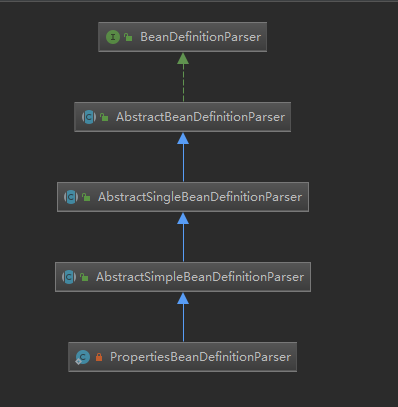
具体的解析过程,和上一讲里的util:constant相似,这里只说不同的:
private static class PropertiesBeanDefinitionParser extends AbstractSimpleBeanDefinitionParser {

         // 这里就是指定了bean definition里的bean class

		@Override

		protected Class getBeanClass(Element element) {

			return PropertiesFactoryBean.class;

		}

		// 一些定制逻辑,无需操心

		@Override

		protected void doParse(Element element, ParserContext parserContext, BeanDefinitionBuilder builder) {

			super.doParse(element, parserContext, builder);

			Properties parsedProps = parserContext.getDelegate().parsePropsElement(element);

			builder.addPropertyValue("properties", parsedProps);

			String scope = element.getAttribute(SCOPE_ATTRIBUTE);

			if (StringUtils.hasLength(scope)) {

				builder.setScope(scope);

			}

		}

	}
这里其实,主要就是指定了beanClass,其他逻辑都不甚重要。这里的beanClass就是PropertiesFactoryBean,类型是一个工厂bean。
因为我们的主题是,Spring解析xml文件,从中得到了什么,所以我们不会进一步剖析实现,从对上面这个元素的解析来说,就是得到了一个工厂bean
util:list
用法如下:
<?xml version="1.0" encoding="UTF-8"?>

<beans xmlns="http://www.springframework.org/schema/beans"

       xmlns:xsi="http://www.w3.org/2001/XMLSchema-instance"

       xmlns:util="http://www.springframework.org/schema/util"

       xsi:schemaLocation="http://www.springframework.org/schema/beans http://www.springframework.org/schema/beans/spring-beans.xsd

                http://www.springframework.org/schema/util  http://www.springframework.org/schema/util/spring-util.xsd">

    <util:list id="testList" list-class="java.util.ArrayList">

        <value>a</value>

        <value>b</value>

        <value>c</value>

    </util:list>

    <bean id="testPropertiesBeanA" class="org.springframework.utilnamespace.TestPropertiesBean">

        <property name="appName" value="xxx"/>

    </bean>

    <bean id="testPropertiesBeanB" class="org.springframework.utilnamespace.TestPropertiesBean">

        <property name="appName" value="yyy"/>

    </bean>

    <util:list id="testBeanList" list-class="java.util.ArrayList">

        <ref bean="testPropertiesBeanA"/>

        <ref bean="testPropertiesBeanB"/>

    </util:list>

</beans>
测试代码:
@Slf4j

public class TestUtilListElement {

    public static void main(String[] args) {

        ClassPathXmlApplicationContext context = new ClassPathXmlApplicationContext(

                new String[]{"classpath:util-namespace-test-list.xml"},false);

        context.refresh();

        Map<String, Object> map = context.getDefaultListableBeanFactory().getAllSingletonObjectMap();

        log.info("singletons:{}", JSONObject.toJSONString(map));

        List<BeanDefinition> list =

                context.getBeanFactory().getBeanDefinitionList();

        MyFastJson.printJsonStringForBeanDefinitionList(list);

        Object bean = context.getBean("testList");

        System.out.println("bean:" + bean);

        bean = context.getBean("testBeanList");

        System.out.println("bean:" + bean);

    }

}
输出如下:
23:32:06.396 [main] DEBUG o.s.b.f.s.DefaultListableBeanFactory - Returning cached instance of singleton bean 'testList'

bean:[a, b, c]

23:32:06.396 [main] DEBUG o.s.b.f.s.DefaultListableBeanFactory - Returning cached instance of singleton bean 'testBeanList'

bean:[TestPropertiesBean(appName=xxx), TestPropertiesBean(appName=yyy)]
我们看看这两个bean的beanDefinitionParser,
private static class ListBeanDefinitionParser extends AbstractSingleBeanDefinitionParser {

   // 这里指定本bean的class,可以看到,这也是一个工厂bean

   @Override

   protected Class getBeanClass(Element element) {

      return ListFactoryBean.class;

   }

   //解析元素里的属性等

   @Override

   protected void doParse(Element element, ParserContext parserContext, BeanDefinitionBuilder builder) {

      String listClass = element.getAttribute("list-class");

      List parsedList = parserContext.getDelegate().parseListElement(element, builder.getRawBeanDefinition());

      builder.addPropertyValue("sourceList", parsedList);

      if (StringUtils.hasText(listClass)) {

         builder.addPropertyValue("targetListClass", listClass);

      }

      String scope = element.getAttribute(SCOPE_ATTRIBUTE);

      if (StringUtils.hasLength(scope)) {

         builder.setScope(scope);

      }

   }

}
回到题目,spring 从这个util:list元素获得了什么,一个工厂bean,和前面一样。
我们可以仔细看看beandefinition,我这里的测试类是用json输出了的:
{

    "abstract": false,

    "autowireCandidate": true,

    "autowireMode": 0,

    "beanClassName": "org.springframework.beans.factory.config.ListFactoryBean",

    "constructorArgumentValues": {

      "argumentCount": 0,

      "empty": true,

      "genericArgumentValues": [],

      "indexedArgumentValues": {}

    },

    "dependencyCheck": 0,

    "enforceDestroyMethod": true,

    "enforceInitMethod": true,

    "lazyInit": false,

    "lenientConstructorResolution": true,

    "methodOverrides": {

      "empty": true,

      "overrides": []

    },

    "nonPublicAccessAllowed": true,

    "primary": false,

    "propertyValues": {

      "converted": false,

      "empty": false,

      "propertyValueList": [

        {

          "converted": false,

          "name": "sourceList",

          "optional": false,

          "value": [

            {

              "beanName": "testPropertiesBeanA",

              "toParent": false

            },

            {

              "beanName": "testPropertiesBeanB",

              "toParent": false

            }

          ]

        },

        {

          "converted": false,

          "name": "targetListClass",

          "optional": false,

          "value": "java.util.ArrayList"

        }

      ]

    },

    "prototype": false,

    "qualifiers": [],

    "resolvedAutowireMode": 0,

    "role": 0,

    "scope": "",

    "singleton": true,

    "synthetic": false

  }
从上面可以看出,beanClass是ListFactoryBean,而我们xml里配置的元素,则被解析后,存放到了propertyValues,被作为了这个bean的属性对待。
总结
util命名空间还有几个别的元素,比如map、set,都差不多,spring都把它们解析为了一个工厂bean。
工厂bean和普通bean的差别,会放到后面再说,下一讲,会继续讲解context命名空间的元素。
源码我放在:
欢迎大家和我一起学习spring/spring boot源码,有问题欢迎一起交流!
曹工说Spring Boot源码(8)-- Spring解析xml文件,到底从中得到了什么(util命名空间)的更多相关文章
- 曹工说Spring Boot源码(2)-- Bean Definition到底是什么,咱们对着接口,逐个方法讲解
写在前面的话 相关背景及资源: 曹工说Spring Boot源码系列开讲了(1)-- Bean Definition到底是什么,附spring思维导图分享 工程代码地址 思维导图地址 工程结构图: 正 ...
- Spring mybatis源码篇章-Mybatis的XML文件加载
通过阅读源码对实现机制进行了解有利于陶冶情操,承接前文Spring mybatis源码篇章-Mybatis主文件加载 前话 前文主要讲解了Mybatis的主文件加载方式,本文则分析不使用主文件加载方式 ...
- 曹工说Spring Boot源码系列开讲了(1)-- Bean Definition到底是什么,附spring思维导图分享
写在前面的话&&About me 网上写spring的文章多如牛毛,为什么还要写呢,因为,很简单,那是人家写的:网上都鼓励你不要造轮子,为什么你还要造呢,因为,那不是你造的. 我不是要 ...
- 曹工说Spring Boot源码(5)-- 怎么从properties文件读取bean
写在前面的话 相关背景及资源: 曹工说Spring Boot源码(1)-- Bean Definition到底是什么,附spring思维导图分享 曹工说Spring Boot源码(2)-- Bean ...
- 曹工说Spring Boot源码(6)-- Spring怎么从xml文件里解析bean的
写在前面的话 相关背景及资源: 曹工说Spring Boot源码(1)-- Bean Definition到底是什么,附spring思维导图分享 曹工说Spring Boot源码(2)-- Bean ...
- 曹工说Spring Boot源码(7)-- Spring解析xml文件,到底从中得到了什么(上)
写在前面的话 相关背景及资源: 曹工说Spring Boot源码(1)-- Bean Definition到底是什么,附spring思维导图分享 曹工说Spring Boot源码(2)-- Bean ...
- 曹工说Spring Boot源码(9)-- Spring解析xml文件,到底从中得到了什么(context命名空间上)
写在前面的话 相关背景及资源: 曹工说Spring Boot源码(1)-- Bean Definition到底是什么,附spring思维导图分享 曹工说Spring Boot源码(2)-- Bean ...
- # 曹工说Spring Boot源码(10)-- Spring解析xml文件,到底从中得到了什么(context:annotation-config 解析)
写在前面的话 相关背景及资源: 曹工说Spring Boot源码(1)-- Bean Definition到底是什么,附spring思维导图分享 曹工说Spring Boot源码(2)-- Bean ...
- 曹工说Spring Boot源码(11)-- context:component-scan,你真的会用吗(这次来说说它的奇技淫巧)
写在前面的话 相关背景及资源: 曹工说Spring Boot源码(1)-- Bean Definition到底是什么,附spring思维导图分享 曹工说Spring Boot源码(2)-- Bean ...
随机推荐
- H3C 命令行编辑功能
- H3C 传输层
- call,apply,bind详解
为什么要改变this指向? 我们知道bind,call,apply的作用都是用来改变this指向的,那为什么要改变this指向呢?请看下面的例子: var name="lucy"; ...
- 深入java面向对象三:抽象类和接口(转载)
文章系转载,地址: http://blog.csdn.net/xw13106209/article/details/6923556 1.概述 一个软件设计的好坏,我想很大程度上取决于它的整体架 ...
- mysql 第三课 jdbc基础操作
jdbc连接可以大致分为5步: 1.注册驱动 2.获取连接 3.编写语句 4.执行语句 5.关闭连接 其中可以设置参数等等. 1.我们先建一个项目目录: 其中com.etc.dao为数据访问对象 co ...
- Java 参数的值传递和引用传递
在Java中,方法的参数的传递分为值传递(基本数据)和引用传递(引用数据:对象.字符串),这是最容易接受的.如果你能知道有这两种情况存在,那么,在遇到调用方法时,你可以避免很多问题的产生.但是,仔细查 ...
- CSS 实现单行及多行文字省略
单行文字省略 很多时候不确定字数限制,但换行可能影响整体设计,这个时候常用就是文字省略加全文字提示了 .dom{ text-overflow: ellipsis; overflow: hidden; ...
- 【codeforces 764A】Taymyr is calling you
time limit per test1 second memory limit per test256 megabytes inputstandard input outputstandard ou ...
- Linux 内核 启动时间
为见到 PCI 如何工作的, 我们从系统启动开始, 因为那是设备被配置的时候. 当一个 PCI 设备上电时, 硬件保持非激活. 换句话说, 设备只响应配置交易. 在上电时, 设备没有内存并且没有 I/ ...
- Linux USB 的 Urbs
linux 内核中的 USB 代码和所有的 USB 设备通讯使用称为 urb 的东西( USB request block). 这个请求块用 struct urb 结构描述并且可在 include/l ...