
AlgorithmsI Programming Assignment 1: Percolation
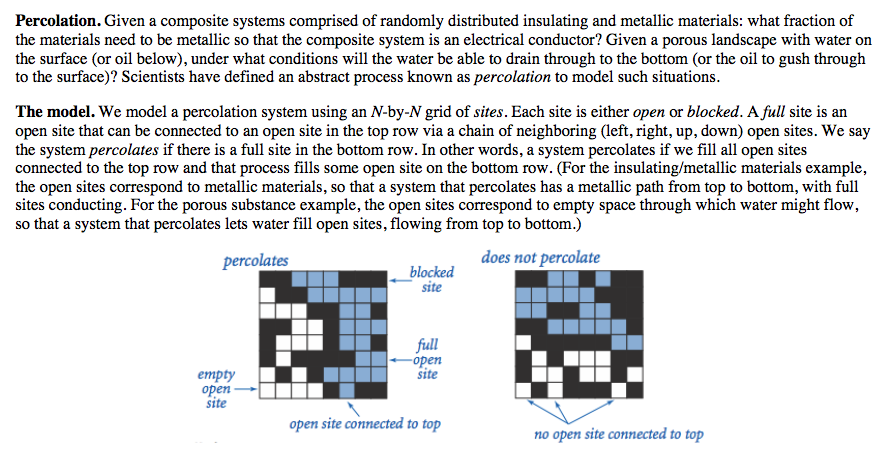


3种版本的答案,第一种使用virtual top and bottom site, 但有backwash的问题,解决这个问题有两种方法:
1. 使用2个WQUUF, 但会增加memory. One for checking if the system percolates(include virtual top and bottom), and the other to check if a given cell is full(only include virtual top). 而且要注意,判断site 是否open只能用boolean ,不然memory 就会超出限制。记住:选择合适的data structure 很重要!!
2. 仍然使用1个WQUUF, 但不使用virtual top and bottom site, 增加判断connect to top 和connect to bottom, 如果出现site 既connect to top 也connect to bottom, 那么percolate.
If any of the neighbors have connected to both set or (at least 1 is connected to top AND atleast 1 is connected to bottom) then set some local flag both to true
If connected to top is true set local flag top to true If connected to bottom is true set local flag bottom to true
Now after the unions with neighbors, find root of (I,j) And set its grid status to both or top or bottom.
If you do set it to both then you can also set a class variable percolatesFlag to true for use in the method percolates.
I haven't finished my implementation but it does seem like this will work.
java code
1. 有backwash
import edu.princeton.cs.algs4.WeightedQuickUnionUF;

public class Percolation {

    private boolean[] openSite; //if open is 1 , block 0

    private int N; //create N-by-N grid

    private WeightedQuickUnionUF uf;

    private int top;

    private int bottom;

    public Percolation(int N)  {             // create N-by-N grid, with all sites blocked

        if (N <= 0) {

            throw new IllegalArgumentException("N must be bigger than 0");

        }

         this.N = N;

         uf = new WeightedQuickUnionUF(N*N + 2);

         openSite = new boolean[N*N+2];   // 0 top_visual N*N+1 bottom_visual

         top = 0;

         bottom = N*N +1;

         for (int i = 1; i <= N*N; i++) {

             openSite[i] = false;   //initial all sites block

         }

    }

    public void open(int i, int j)  {        // open site (row i, column j) if it is not open already

        validateIJ(i, j);

        int index = xyTo1D(i, j);

        openSite[index] = true;

        if (i == 1) {

            uf.union(index, top);

        }

        if (!percolates()) {

            if (i == N) {

                uf.union(index, bottom);

            }

        }

        if (i < N && openSite[index+N]) {

             uf.union(index, index+N);

        }

        if (i > 1 && openSite[index-N]) {

             uf.union(index, index-N);

        }

        if (j < N && openSite[index+1]) {

             uf.union(index, index+1);

        }

        if (j > 1 && openSite[index-1]) {

             uf.union(index, index-1);

        }

    }

    private int xyTo1D(int i, int j) {

        validateIJ(i, j);

        return j + (i-1) * N;

    }

    private void validateIJ(int i, int j) {

        if (!(i >= 1 && i <= N && j >= 1 && j <= N)) {

            throw new IndexOutOfBoundsException("Index is not betwwen 1 and N");

        }

    }

    public boolean isOpen(int i, int j) {     // is site (row i, column j) open?

        validateIJ(i, j);

        return openSite[xyTo1D(i, j)];

    }

    /*A full site is an open site that can be connected to an open site in the top row

     * via a chain of neighboring (left, right, up, down) open sites.

    */

    public boolean isFull(int i, int j) {    // is site (row i, column j) full?

        validateIJ(i, j);

        return uf.connected(top, xyTo1D(i, j));

    }

    /* Introduce 2 virtual sites (and connections to top and bottom).

     * Percolates iff virtual top site is connected to virtual bottom site.

     */

    public boolean percolates()  {           // does the system percolate?

        return uf.connected(top, bottom);

    }

    public static void main(String[] args) { // test client (optional)

    }

}
2. 使用2个WQUUF
//use two WQUUF

//One way to fix this is two use two different WQUF.

//One for checking if the system percolates(include virtual top and bottom ),

//and the other to check if a given cell is full(only include virtual top).

import edu.princeton.cs.algs4.WeightedQuickUnionUF;

public class Percolation {

    private boolean[] openSite; //if open is true , block false

    private int N; //create N-by-N grid

    private WeightedQuickUnionUF uf;

    private WeightedQuickUnionUF ufNoBottom;

    private int top;

    private int bottom;

    public Percolation(int N)  {             // create N-by-N grid, with all sites blocked

        if (N <= 0) {

            throw new IllegalArgumentException("N must be bigger than 0");

        }

         this.N = N;

         uf = new WeightedQuickUnionUF(N*N + 2);

         ufNoBottom = new WeightedQuickUnionUF(N*N + 1);

         openSite = new boolean[N*N+2];   // 0 top_visual N*N+1 bottom_visual

         top = 0;

         bottom = N*N +1;

         for (int i = 1; i <= N*N; i++) {

             openSite[i] = false;   //initial all sites block

         }

    }

    public void open(int i, int j)  {        // open site (row i, column j) if it is not open already

        validateIJ(i, j);

        int index = xyTo1D(i, j);

        openSite[index] = true;

        if (i == 1) {

            uf.union(index, top);

            ufNoBottom.union(index, top);

        }

        if (!percolates()) {

            if (i == N) {

                uf.union(index, bottom);

            }

        }

        if (i < N && openSite[index+N]) {

             uf.union(index, index+N);

             ufNoBottom.union(index, index+N);

        }

        if (i > 1 && openSite[index-N]) {

             uf.union(index, index-N);

             ufNoBottom.union(index, index-N);

        }

        if (j < N && openSite[index+1]) {

             uf.union(index, index+1);

             ufNoBottom.union(index, index+1);

        }

        if (j > 1 && openSite[index-1]) {

             uf.union(index, index-1);

             ufNoBottom.union(index, index-1);

        }

    }

    private int xyTo1D(int i, int j) {

        validateIJ(i, j);

        return j + (i-1) * N;

    }

    private void validateIJ(int i, int j) {

        if (!(i >= 1 && i <= N && j >= 1 && j <= N)) {

            throw new IndexOutOfBoundsException("Index is not betwwen 1 and N");

        }

    }

    public boolean isOpen(int i, int j) {     // is site (row i, column j) open?

        validateIJ(i, j);

        return openSite[xyTo1D(i, j)];

    }

    /*A full site is an open site that can be connected to an open site in the top row

     * via a chain of neighboring (left, right, up, down) open sites.

    */

    public boolean isFull(int i, int j) {    // is site (row i, column j) full?

        validateIJ(i, j);

        return ufNoBottom.connected(top, xyTo1D(i, j));

    }

    /* Introduce 2 virtual sites (and connections to top and bottom).

     * Percolates iff virtual top site is connected to virtual bottom site.

     */

    public boolean percolates()  {           // does the system percolate?

        return uf.connected(top, bottom);

    }

    public static void main(String[] args) { // test client (optional)

    }

}
3. 最佳方法,增加flag, 只使用1个WQUUF
//use one WQUUF to avoid backwash

import edu.princeton.cs.algs4.WeightedQuickUnionUF;

public class Percolation {

    private boolean[] open; //blocked: false, open: true

    private boolean[] connectTop;

    private boolean[] connectBottom;

    private int N; //create N-by-N grid

    private WeightedQuickUnionUF uf;

    private boolean percolateFlag;

    public Percolation(int N)  {             // create N-by-N grid, with all sites blocked

        if (N <= 0) {

            throw new IllegalArgumentException("N must be bigger than 0");

        }

         this.N = N;

         uf = new WeightedQuickUnionUF(N*N);

         open = new boolean[N*N];

         connectTop = new boolean[N*N];

         connectBottom = new boolean[N*N];

         for (int i = 0; i < N*N; i++) {

             open[i] = false;

             connectTop[i] = false;

             connectBottom[i] = false;

         }

         percolateFlag = false;

    }

    public void open(int i, int j)  {        // open site (row i, column j) if it is not open already

        validateIJ(i, j);

        int index = xyTo1D(i, j);

        open[index] = true;  //open

        boolean top = false;

        boolean bottom = false;

        if (i < N && open[index+N]) {

            if (connectTop[uf.find(index+N)] || connectTop[uf.find(index)] ) {

                 top = true;

            }

            if (connectBottom[uf.find(index+N)] || connectBottom[uf.find(index)] ) {

                 bottom = true;

            }

             uf.union(index, index+N);

        }

        if (i > 1 && open[index-N]) {

            if (connectTop[uf.find(index-N)] || connectTop[uf.find(index)] ) {

                 top = true;

            }

            if (connectBottom[uf.find(index-N)] || connectBottom[uf.find(index)] ) {

                 bottom = true;

            }

             uf.union(index, index-N);

        }

        if (j < N && open[index+1]) {

            if (connectTop[uf.find(index+1)] || connectTop[uf.find(index)] ) {

                 top = true;

            }

            if (connectBottom[uf.find(index+1)] || connectBottom[uf.find(index)] ) {

                 bottom = true;

            }

             uf.union(index, index+1);

        }

        if (j > 1 && open[index-1]) {

            if (connectTop[uf.find(index-1)] || connectTop[uf.find(index)] ) {

                 top = true;

            }

            if (connectBottom[uf.find(index-1)] || connectBottom[uf.find(index)] ) {

                 bottom = true;

            }

             uf.union(index, index-1);

        }

        if(i == 1) {

            top = true;

        }

        if(i == N){

            bottom = true;

        }

        connectTop[uf.find(index)] = top;

        connectBottom[uf.find(index)] = bottom;

        if( connectTop[uf.find(index)] &&  connectBottom[uf.find(index)]) {

            percolateFlag = true;

        }

    }

    private int xyTo1D(int i, int j) {

        validateIJ(i, j);

        return j + (i-1) * N -1;

    }

    private void validateIJ(int i, int j) {

        if (!(i >= 1 && i <= N && j >= 1 && j <= N)) {

            throw new IndexOutOfBoundsException("Index is not betwwen 1 and N");

        }

    }

    public boolean isOpen(int i, int j) {     // is site (row i, column j) open?

        validateIJ(i, j);

        return open[xyTo1D(i, j)];

    }

    /*A full site is an open site that can be connected to an open site in the top row

     * via a chain of neighboring (left, right, up, down) open sites.

    */

    public boolean isFull(int i, int j) {    // is site (row i, column j) full?

        validateIJ(i, j);

        return connectTop[uf.find(xyTo1D(i, j))];

    }

    /* Introduce 2 virtual sites (and connections to top and bottom).

     * Percolates iff virtual top site is connected to virtual bottom site.

     */

    public boolean percolates()  {           // does the system percolate?

        return percolateFlag;

    }

    public static void main(String[] args) { // test client (optional)

    }

}
Reference:
1. http://tech-wonderland.net/blog/avoid-backwash-in-percolation.html
AlgorithmsI Programming Assignment 1: Percolation的更多相关文章
- Programming Assignment 1: Percolation
问题描述可以详见:http://coursera.cs.princeton.edu/algs4/assignments/percolation.html 关于QuickFindUF的javadoc:h ...
- AlgorithmsI Programming Assignment 1: PercolationStats.java
import edu.princeton.cs.algs4.StdOut; import edu.princeton.cs.algs4.StdRandom; import edu.princeton. ...
- Coursera Algorithms Programming Assignment 1: Percolation(100分)
题目来源http://coursera.cs.princeton.edu/algs4/assignments/percolation.html 作业分为两部分:建立模型和仿真实验. 最关键的部分就是建 ...
- 课程一(Neural Networks and Deep Learning),第三周(Shallow neural networks)—— 3.Programming Assignment : Planar data classification with a hidden layer
Planar data classification with a hidden layer Welcome to the second programming exercise of the dee ...
- Algorithms: Design and Analysis, Part 1 - Programming Assignment #1
自我总结: 1.编程的思维不够,虽然分析有哪些需要的函数,但是不能比较好的汇总整合 2.写代码能力,容易挫败感,经常有bug,很烦心,耐心不够好 题目: In this programming ass ...
- Algorithms : Programming Assignment 3: Pattern Recognition
Programming Assignment 3: Pattern Recognition 1.题目重述 原题目:Programming Assignment 3: Pattern Recogniti ...
- Programming Assignment 2: Randomized Queues and Deques
实现一个泛型的双端队列和随机化队列,用数组和链表的方式实现基本数据结构,主要介绍了泛型和迭代器. Dequeue. 实现一个双端队列,它是栈和队列的升级版,支持首尾两端的插入和删除.Deque的API ...
- 课程一(Neural Networks and Deep Learning),第二周(Basics of Neural Network programming)—— 2、编程作业常见问题与答案(Programming Assignment FAQ)
Please note that when you are working on the programming exercise you will find comments that say &q ...
- Programming Assignment 5: Kd-Trees
用2d-tree数据结构实现在2维矩形区域内的高效的range search 和 nearest neighbor search.2d-tree有许多的应用,在天体分类.计算机动画.神经网络加速.数据 ...
随机推荐
- eclipse 常见问题及解决
1. Target runtime Apache Tomcat v6.0 is not defined.错误解决方法 原文:http://blog.csdn.net/xw13106209/articl ...
- Python数据类型(元组、列表、字符串、字典)
元组tuple:不可修改的数据类型 ABC = ('a', 1, x, 'today') 列表list:可修改的数据类型 ABC = ['a', 1, x, 'today'] 字符串set: ABC ...
- Oracle修改被占用的临时表结构
这两天在修改临时表的类型时,提示”attempt to create,alter or drop an index on temporary table already in use“的错误,由于临时 ...
- css布局小技巧 2016.03.06
偶遇一个可爱的css布局学习网站,立刻学起来哟- max-width: 当页面左右宽度缩小时,为了避免出现左右滚动条的糟糕体验,就可以用到max-width啦!页面比宽度小时,会自动缩小哦- max- ...
- servlet的doPost 和doGet和web文件结构
doPost和doGet分别由 tomcat自己来决定调用post 还是get 方式查询 get:url有少量的参数信息,一般用到查询那里 (像百度.. post一般用来提交大文件数据(二进制数据 d ...
- 【BZOJ2653】【主席树+二分】middle
Description 一个长度为n的序列a,设其排过序之后为b,其中位数定义为b[n/2],其中a,b从0开始标号,除法取下整. 给你一个长度为n的序列s. 回答Q个这样的询问:s的左端点在[a,b ...
- 如何让低版本的IE浏览器(IE6/IE7/IE8)支持HTML5 header等新标签
html5提供的一些新标签(article,aside,dialog,footer,header,section,footer,nav,figure,menu)使用起来非常的方便,但是低版本的IE浏览 ...
- SQL Server 连接字符串和身份验证
SQL Server .NET Data Provider 连接字符串包含一个由一些属性名/值对组成的集合.每一个属性/值对都由分号隔开. PropertyName1=Value1;P ...
- linux下shapely的安装
错误 1.“from shapely.geometry import Point, LineString, Polygon”时报错: OSError: Could not find library g ...
- 2基本概念--python深度机器学习
参考彭亮老师的视频教程:转载请注明出处及彭亮老师原创 视频教程: http://pan.baidu.com/s/1kVNe5EJ 基本概念:训练集,测试集,特征值,监督学习,非监督学习,半监督学习,分 ...