
AlgorithmsI Programming Assignment 1: Percolation
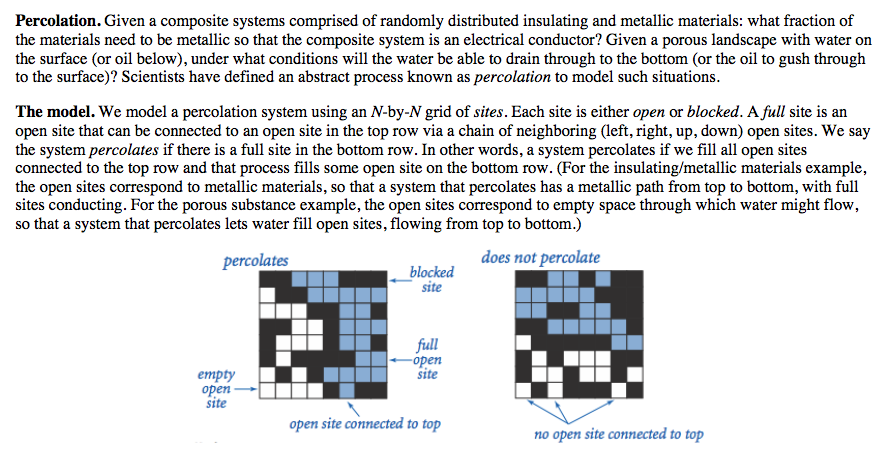


3种版本的答案,第一种使用virtual top and bottom site, 但有backwash的问题,解决这个问题有两种方法:
1. 使用2个WQUUF, 但会增加memory. One for checking if the system percolates(include virtual top and bottom), and the other to check if a given cell is full(only include virtual top). 而且要注意,判断site 是否open只能用boolean ,不然memory 就会超出限制。记住:选择合适的data structure 很重要!!
2. 仍然使用1个WQUUF, 但不使用virtual top and bottom site, 增加判断connect to top 和connect to bottom, 如果出现site 既connect to top 也connect to bottom, 那么percolate.
If any of the neighbors have connected to both set or (at least 1 is connected to top AND atleast 1 is connected to bottom) then set some local flag both to true
If connected to top is true set local flag top to true If connected to bottom is true set local flag bottom to true
Now after the unions with neighbors, find root of (I,j) And set its grid status to both or top or bottom.
If you do set it to both then you can also set a class variable percolatesFlag to true for use in the method percolates.
I haven't finished my implementation but it does seem like this will work.
java code
1. 有backwash
import edu.princeton.cs.algs4.WeightedQuickUnionUF;

public class Percolation {

    private boolean[] openSite; //if open is 1 , block 0

    private int N; //create N-by-N grid

    private WeightedQuickUnionUF uf;

    private int top;

    private int bottom;

    public Percolation(int N)  {             // create N-by-N grid, with all sites blocked

        if (N <= 0) {

            throw new IllegalArgumentException("N must be bigger than 0");

        }

         this.N = N;

         uf = new WeightedQuickUnionUF(N*N + 2);

         openSite = new boolean[N*N+2];   // 0 top_visual N*N+1 bottom_visual

         top = 0;

         bottom = N*N +1;

         for (int i = 1; i <= N*N; i++) {

             openSite[i] = false;   //initial all sites block

         }

    }

    public void open(int i, int j)  {        // open site (row i, column j) if it is not open already

        validateIJ(i, j);

        int index = xyTo1D(i, j);

        openSite[index] = true;

        if (i == 1) {

            uf.union(index, top);

        }

        if (!percolates()) {

            if (i == N) {

                uf.union(index, bottom);

            }

        }

        if (i < N && openSite[index+N]) {

             uf.union(index, index+N);

        }

        if (i > 1 && openSite[index-N]) {

             uf.union(index, index-N);

        }

        if (j < N && openSite[index+1]) {

             uf.union(index, index+1);

        }

        if (j > 1 && openSite[index-1]) {

             uf.union(index, index-1);

        }

    }

    private int xyTo1D(int i, int j) {

        validateIJ(i, j);

        return j + (i-1) * N;

    }

    private void validateIJ(int i, int j) {

        if (!(i >= 1 && i <= N && j >= 1 && j <= N)) {

            throw new IndexOutOfBoundsException("Index is not betwwen 1 and N");

        }

    }

    public boolean isOpen(int i, int j) {     // is site (row i, column j) open?

        validateIJ(i, j);

        return openSite[xyTo1D(i, j)];

    }

    /*A full site is an open site that can be connected to an open site in the top row

     * via a chain of neighboring (left, right, up, down) open sites.

    */

    public boolean isFull(int i, int j) {    // is site (row i, column j) full?

        validateIJ(i, j);

        return uf.connected(top, xyTo1D(i, j));

    }

    /* Introduce 2 virtual sites (and connections to top and bottom).

     * Percolates iff virtual top site is connected to virtual bottom site.

     */

    public boolean percolates()  {           // does the system percolate?

        return uf.connected(top, bottom);

    }

    public static void main(String[] args) { // test client (optional)

    }

}
2. 使用2个WQUUF
//use two WQUUF

//One way to fix this is two use two different WQUF.

//One for checking if the system percolates(include virtual top and bottom ),

//and the other to check if a given cell is full(only include virtual top).

import edu.princeton.cs.algs4.WeightedQuickUnionUF;

public class Percolation {

    private boolean[] openSite; //if open is true , block false

    private int N; //create N-by-N grid

    private WeightedQuickUnionUF uf;

    private WeightedQuickUnionUF ufNoBottom;

    private int top;

    private int bottom;

    public Percolation(int N)  {             // create N-by-N grid, with all sites blocked

        if (N <= 0) {

            throw new IllegalArgumentException("N must be bigger than 0");

        }

         this.N = N;

         uf = new WeightedQuickUnionUF(N*N + 2);

         ufNoBottom = new WeightedQuickUnionUF(N*N + 1);

         openSite = new boolean[N*N+2];   // 0 top_visual N*N+1 bottom_visual

         top = 0;

         bottom = N*N +1;

         for (int i = 1; i <= N*N; i++) {

             openSite[i] = false;   //initial all sites block

         }

    }

    public void open(int i, int j)  {        // open site (row i, column j) if it is not open already

        validateIJ(i, j);

        int index = xyTo1D(i, j);

        openSite[index] = true;

        if (i == 1) {

            uf.union(index, top);

            ufNoBottom.union(index, top);

        }

        if (!percolates()) {

            if (i == N) {

                uf.union(index, bottom);

            }

        }

        if (i < N && openSite[index+N]) {

             uf.union(index, index+N);

             ufNoBottom.union(index, index+N);

        }

        if (i > 1 && openSite[index-N]) {

             uf.union(index, index-N);

             ufNoBottom.union(index, index-N);

        }

        if (j < N && openSite[index+1]) {

             uf.union(index, index+1);

             ufNoBottom.union(index, index+1);

        }

        if (j > 1 && openSite[index-1]) {

             uf.union(index, index-1);

             ufNoBottom.union(index, index-1);

        }

    }

    private int xyTo1D(int i, int j) {

        validateIJ(i, j);

        return j + (i-1) * N;

    }

    private void validateIJ(int i, int j) {

        if (!(i >= 1 && i <= N && j >= 1 && j <= N)) {

            throw new IndexOutOfBoundsException("Index is not betwwen 1 and N");

        }

    }

    public boolean isOpen(int i, int j) {     // is site (row i, column j) open?

        validateIJ(i, j);

        return openSite[xyTo1D(i, j)];

    }

    /*A full site is an open site that can be connected to an open site in the top row

     * via a chain of neighboring (left, right, up, down) open sites.

    */

    public boolean isFull(int i, int j) {    // is site (row i, column j) full?

        validateIJ(i, j);

        return ufNoBottom.connected(top, xyTo1D(i, j));

    }

    /* Introduce 2 virtual sites (and connections to top and bottom).

     * Percolates iff virtual top site is connected to virtual bottom site.

     */

    public boolean percolates()  {           // does the system percolate?

        return uf.connected(top, bottom);

    }

    public static void main(String[] args) { // test client (optional)

    }

}
3. 最佳方法,增加flag, 只使用1个WQUUF
//use one WQUUF to avoid backwash

import edu.princeton.cs.algs4.WeightedQuickUnionUF;

public class Percolation {

    private boolean[] open; //blocked: false, open: true

    private boolean[] connectTop;

    private boolean[] connectBottom;

    private int N; //create N-by-N grid

    private WeightedQuickUnionUF uf;

    private boolean percolateFlag;

    public Percolation(int N)  {             // create N-by-N grid, with all sites blocked

        if (N <= 0) {

            throw new IllegalArgumentException("N must be bigger than 0");

        }

         this.N = N;

         uf = new WeightedQuickUnionUF(N*N);

         open = new boolean[N*N];

         connectTop = new boolean[N*N];

         connectBottom = new boolean[N*N];

         for (int i = 0; i < N*N; i++) {

             open[i] = false;

             connectTop[i] = false;

             connectBottom[i] = false;

         }

         percolateFlag = false;

    }

    public void open(int i, int j)  {        // open site (row i, column j) if it is not open already

        validateIJ(i, j);

        int index = xyTo1D(i, j);

        open[index] = true;  //open

        boolean top = false;

        boolean bottom = false;

        if (i < N && open[index+N]) {

            if (connectTop[uf.find(index+N)] || connectTop[uf.find(index)] ) {

                 top = true;

            }

            if (connectBottom[uf.find(index+N)] || connectBottom[uf.find(index)] ) {

                 bottom = true;

            }

             uf.union(index, index+N);

        }

        if (i > 1 && open[index-N]) {

            if (connectTop[uf.find(index-N)] || connectTop[uf.find(index)] ) {

                 top = true;

            }

            if (connectBottom[uf.find(index-N)] || connectBottom[uf.find(index)] ) {

                 bottom = true;

            }

             uf.union(index, index-N);

        }

        if (j < N && open[index+1]) {

            if (connectTop[uf.find(index+1)] || connectTop[uf.find(index)] ) {

                 top = true;

            }

            if (connectBottom[uf.find(index+1)] || connectBottom[uf.find(index)] ) {

                 bottom = true;

            }

             uf.union(index, index+1);

        }

        if (j > 1 && open[index-1]) {

            if (connectTop[uf.find(index-1)] || connectTop[uf.find(index)] ) {

                 top = true;

            }

            if (connectBottom[uf.find(index-1)] || connectBottom[uf.find(index)] ) {

                 bottom = true;

            }

             uf.union(index, index-1);

        }

        if(i == 1) {

            top = true;

        }

        if(i == N){

            bottom = true;

        }

        connectTop[uf.find(index)] = top;

        connectBottom[uf.find(index)] = bottom;

        if( connectTop[uf.find(index)] &&  connectBottom[uf.find(index)]) {

            percolateFlag = true;

        }

    }

    private int xyTo1D(int i, int j) {

        validateIJ(i, j);

        return j + (i-1) * N -1;

    }

    private void validateIJ(int i, int j) {

        if (!(i >= 1 && i <= N && j >= 1 && j <= N)) {

            throw new IndexOutOfBoundsException("Index is not betwwen 1 and N");

        }

    }

    public boolean isOpen(int i, int j) {     // is site (row i, column j) open?

        validateIJ(i, j);

        return open[xyTo1D(i, j)];

    }

    /*A full site is an open site that can be connected to an open site in the top row

     * via a chain of neighboring (left, right, up, down) open sites.

    */

    public boolean isFull(int i, int j) {    // is site (row i, column j) full?

        validateIJ(i, j);

        return connectTop[uf.find(xyTo1D(i, j))];

    }

    /* Introduce 2 virtual sites (and connections to top and bottom).

     * Percolates iff virtual top site is connected to virtual bottom site.

     */

    public boolean percolates()  {           // does the system percolate?

        return percolateFlag;

    }

    public static void main(String[] args) { // test client (optional)

    }

}
Reference:
1. http://tech-wonderland.net/blog/avoid-backwash-in-percolation.html
AlgorithmsI Programming Assignment 1: Percolation的更多相关文章
- Programming Assignment 1: Percolation
问题描述可以详见:http://coursera.cs.princeton.edu/algs4/assignments/percolation.html 关于QuickFindUF的javadoc:h ...
- AlgorithmsI Programming Assignment 1: PercolationStats.java
import edu.princeton.cs.algs4.StdOut; import edu.princeton.cs.algs4.StdRandom; import edu.princeton. ...
- Coursera Algorithms Programming Assignment 1: Percolation(100分)
题目来源http://coursera.cs.princeton.edu/algs4/assignments/percolation.html 作业分为两部分:建立模型和仿真实验. 最关键的部分就是建 ...
- 课程一(Neural Networks and Deep Learning),第三周(Shallow neural networks)—— 3.Programming Assignment : Planar data classification with a hidden layer
Planar data classification with a hidden layer Welcome to the second programming exercise of the dee ...
- Algorithms: Design and Analysis, Part 1 - Programming Assignment #1
自我总结: 1.编程的思维不够,虽然分析有哪些需要的函数,但是不能比较好的汇总整合 2.写代码能力,容易挫败感,经常有bug,很烦心,耐心不够好 题目: In this programming ass ...
- Algorithms : Programming Assignment 3: Pattern Recognition
Programming Assignment 3: Pattern Recognition 1.题目重述 原题目:Programming Assignment 3: Pattern Recogniti ...
- Programming Assignment 2: Randomized Queues and Deques
实现一个泛型的双端队列和随机化队列,用数组和链表的方式实现基本数据结构,主要介绍了泛型和迭代器. Dequeue. 实现一个双端队列,它是栈和队列的升级版,支持首尾两端的插入和删除.Deque的API ...
- 课程一(Neural Networks and Deep Learning),第二周(Basics of Neural Network programming)—— 2、编程作业常见问题与答案(Programming Assignment FAQ)
Please note that when you are working on the programming exercise you will find comments that say &q ...
- Programming Assignment 5: Kd-Trees
用2d-tree数据结构实现在2维矩形区域内的高效的range search 和 nearest neighbor search.2d-tree有许多的应用,在天体分类.计算机动画.神经网络加速.数据 ...
随机推荐
- MyEclipse_6.0.1GA_E3.3.1集成版下载地址
因在开发中经常使用到myeclipse 对比相关版本,还是觉得6.0 –6.5 比较适合开发,其他的开发起来比较卡,下面是下载地址 MyEclipse_6.0.1GA_E3.3.1集成版下载地址: ...
- JS的事件监听机制
很久以前有个叫Netscape的姑娘,她制订了Javascript的一套事件驱动机制(即事件捕获) 后来又有一个叫“IE”的小子,这孩子比较傲气,他认为“凭什么我要依照你的规则走”,于是他又创造了一套 ...
- (转)[开发笔记]-js判断用户的浏览设备是移动设备还是PC
<script type="text/javascript"> function browserRedirect() { var sUserAgent = naviga ...
- if elsif;报错;new赋值
1. IF INSERTING THEN BEGIN 中间不能为空 END;ELSIF DELETING THEN BEGIN E ...
- MYSQL命令行连接数据库
连接数据库 mysql -uroot -proot -P3306 -Dmydemo # 参数详解 -uuser 用户user -ppwd 密码 -P3306 端口 -Dmysql 数据库 #显示所有数 ...
- cc命令
多数UNIX平台都通过CC调用它们的C编译程序.除标准和CC以外,LINUX和FREEBSD还支持gcc. 基本的编译命令有以下几种: 1. -c 编译产生对象文件(*.obj)而不链接成可执行文件, ...
- 【转载】详细解读C#中的 .NET 弱事件模式
你可能知道,事件处理是内存泄漏的一个常见来源,它由不再使用的对象存留产生,你也许认为它们应该已经被回收了,但不是,并有充分的理由. 在这个短文中(期望如此),我会在 .Net 框架的上下文事件处理中展 ...
- PHP数据库
目录 1.创建数据库连接 2.创建数据库 3.选择数据库 4.设置当前连接使用的字符编码 5.创建表 6.插入数据 7.取得数据查询结果 8.关闭连接 1.创建数据库连接 //mysql_connec ...
- HTML5有语义的内联元素详解
HTML5有语义的内联元素详解 time标签 time 元素表示一个时间值,比如 5:35 P.M., EST, April 23, 2007.例如: Example Source Code:< ...
- 如何用DOS 链接mysql
1.Ctrl+R 打开DOS窗口 2.键入 cd\ 回车进入C盘根目录 3.进入mysql bin目录下 操作mysql命令 4.输入连接数据库命令 mysql -hlocalhost -uroot ...