
Callable、Future、RunnableFuture、FutureTask的原理及应用
1. Callable、Future、RunnableFuture、FutureTask的继承关系
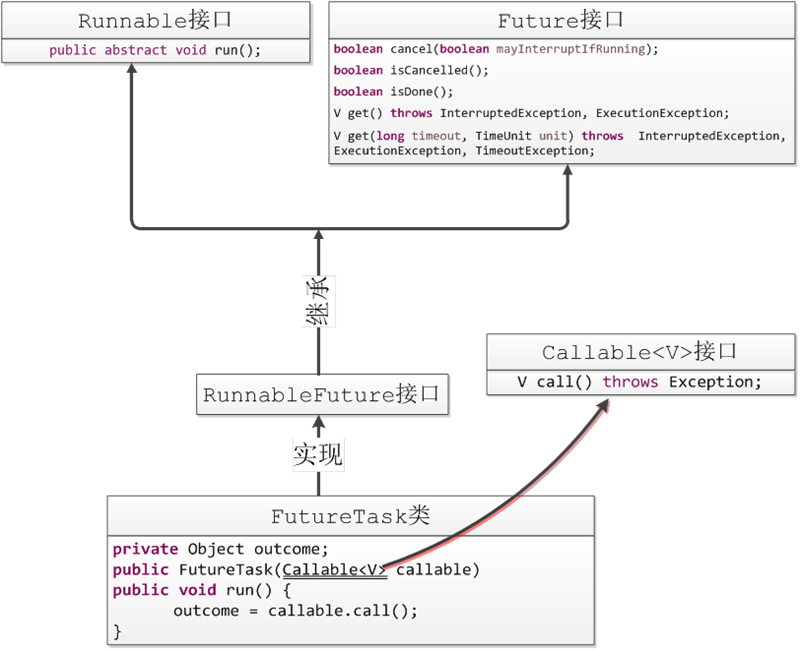
在多线程编程中,我们一般通过一个实现了Runnable接口的对象来创建一个线程,这个线程在内部会执行Runnable对象的run方法。如果说我们创建一个线程来完成某项工作,希望在完成以后该线程能够返回一个结果,但run方法的返回值是void类型,直接实现run方法并不可行,这时我们就要通过FutureTask类来间接实现。
FutureTask实现了RunnableFuture接口,而RunnableFuture接口实际上仅仅是Runnable接口和Future接口的合体。Future接口提供取消任务、检测任务是否执行完成、等待任务执行完成获得结果等方法。从图中可以看出,FutureTask类中的run方法已经实现好了(图中的代码仅仅是核心代码),这个run方法实际上就是调用了由构造函数传递进来的call方法,并将返回值存储在FutureTask的私有数据成员outcome中。这样一来我们将FutureTask传递给一个Thread时,表面上我们仍然执行的是run,但在run方法的内部实际上执行的是带有返回值的call方法,这样即使得java多线程的执行框架保持不变,又实现了线程完成后返回结果的功能。同时FutureTask又将结果存储在outcome中,我们可以通过调用FutureTask对象的get方法获取outcome(也就是call方法的返回结果)。
|
Future接口功能介绍 |
|
|
boolean cancel(boolean mayInterruptIfRunning); |
功能:设置线程的中断标志位 参数:mayInterruptIfRunning为ture,如果线程可以取消则设置线程的中断标志位 返回值:若线程已经完成,返回false;否则返回true 注意:要实现取消线程执行的功能,call函数需要在循环条件中检查中断标志位,以跳出循环 |
|
boolean isCancelled(); |
判断线程是否取消 |
|
boolean isDone(); |
线程执行完成,返回true;如果cancel方法返回true,则该方法也返回true |
|
V get() throws InterruptedException, ExecutionException; |
获取call方法的返回结果,如果call方法没有执行完成,则会阻塞当前线程,直到call方法执行完毕,才被唤醒 |
|
V get(long timeout, TimeUnit unit) |
设置时限的get方法。 |
2. Future及FutureTask的使用
Future以及FutureTask是线程池实现的基础元素,但不是说Future及FutureTask只能在线程池中才能使用,下面的例子就说明了FutureTask独立使用的情况。在这个例子中,我们首先随机产生了2000个整数存于数组中,然后创建了两个线程,一个线程寻找前1000个数的最大值,另个一线程寻找后1000个数的最大值。主线程比较这两个线程的返回结果来确定这2000个数的最大值值。
package javaleanning;

import java.util.Random;

import java.util.concurrent.Callable;

import java.util.concurrent.ExecutionException;

import java.util.concurrent.FutureTask;

public class FutureDemo {

	public static void main(String[] args) throws InterruptedException, ExecutionException{

		int[] a = new int[2000];

		Random rd = new Random();

		for(int i = 0; i < 2000; i++){

			a[i] = rd.nextInt(20000);

		}

		class FindMax implements Callable<Integer>{

			private int begin,end,int a[];

			public FindMax(int a[],int begin, int end){

				this.a = a;
this.begin = begin;
this.end = end;
}
@Override
public Integer call() throws Exception {
int maxInPart = a[begin];
for(int i = begin; i <= end; i++){
if(a[i] > maxInPart){
maxInPart = a[i];
}
}
return new Integer(maxInPart);
}
} FutureTask<Integer> findMaxInFirstPart =new FutureTask<Integer>(new FindMax(a,0,999));
FutureTask<Integer> findMaxInSecondPart =new FutureTask<Integer>(new FindMax(a,1000,1999)); new Thread(findMaxInFirstPart).start();
new Thread(findMaxInSecondPart).start(); int maxInFirst = (int) findMaxInFirstPart.get();
int maxInSecond = (int) findMaxInSecondPart.get();
System.out.println("Max is " +(maxInFirst > maxInSecond ? maxInFirst:maxInSecond));
//验证结果是否正确
int max = a[0];
for(int i = 0; i < 2000; i++){
if(a[i] > max){
max = a[i];
}
}
System.out.println(max);
}
}
3. FutureTask的实现原理
构造函数
public FutureTask(Callable<V> callable) {

    if (callable == null)

        throw new NullPointerException();

    this.callable = callable;

    this.state = NEW;       // ensure visibility of callable

}

public FutureTask(Runnable runnable, V result) {

    this.callable = Executors.callable(runnable, result);

    this.state = NEW;       // ensure visibility of callable

}
FutureTask有两个构造函数,通常来说我们使用第一个构造函数。这里要强调一下第二个构造函数,它有两个类型参数,分别是Runnable类型和泛型V,然后由这两个构造一个Callable对象。当线程运行结束以后会返回由构造函数传递进来的这个泛型result对象,也就是说返回的值并不是通过运行得到的,而是由构造函数获取的一个指定的对象。
重要数据成员
private volatile int state;

private Object outcome;

private volatile Thread runner;

private volatile WaitNode waiters;
state表明了线程运行call方法的状态,初始状态为0,完成后由run方法将其设置为1。通过get方法获取结果时就必须检查state的值,如果该值为0,表明需要等待该结果,get方法就会将当前线程阻塞。
outcome表示了call方法的返回结果
runner表示运行FutureTask方法的线程,其值会在run方法中进行初始化
waiters指向了因获取结果而等待的线程组成的队列
重要方法
public void run() {

    if (state != NEW ||

        !UNSAFE.compareAndSwapObject(this, runnerOffset,

                                     null, Thread.currentThread()))

        return;

    try {

        Callable<V> c = callable;

        if (c != null && state == NEW) {

            V result;

            boolean ran;

            try {

                result = c.call();

                ran = true;

            } catch (Throwable ex) {

                result = null;

                ran = false;

                setException(ex);

            }

            if (ran)

                set(result);

        }

    } finally {

        // runner must be non-null until state is settled to

        // prevent concurrent calls to run()

        runner = null;

        // state must be re-read after nulling runner to prevent

        // leaked interrupts

        int s = state;

        if (s >= INTERRUPTING)

            handlePossibleCancellationInterrupt(s);

    }

}
从代码中可以看出run方法中调用了从构造函数传递来的call方法。
protected void set(V v) {

    if (UNSAFE.compareAndSwapInt(this, stateOffset, NEW, COMPLETING)) {

        outcome = v;

        UNSAFE.putOrderedInt(this, stateOffset, NORMAL); // final state

        finishCompletion();

    }

}
当call方法执行完毕后,run方法调用又调用了set方法,它主要实现两个功能,一个是将结果赋值给outcome,另一个是通过finishCompletion唤醒由调用此FutureTask对象的get方法而阻塞的线程
private void finishCompletion() {

    // assert state > COMPLETING;

    for (WaitNode q; (q = waiters) != null;) {

        if (UNSAFE.compareAndSwapObject(this, waitersOffset, q, null)) {

            for (;;) {

                Thread t = q.thread;

                if (t != null) {

                    q.thread = null;

                    LockSupport.unpark(t);

                }

                WaitNode next = q.next;

                if (next == null)

                    break;

                q.next = null; // unlink to help gc

                q = next;

            }

            break;

        }

    }

    done();

    callable = null;        // to reduce footprint

}
public V get() throws InterruptedException, ExecutionException {
int s = state;
if (s <= COMPLETING)
s = awaitDone(false, 0L);
return report(s);
}在get方法中首先判断了state的值,如果call方法还未完成,就会通过awaitDone来阻塞自己。
private int awaitDone(boolean timed, long nanos)

        throws InterruptedException {

        final long deadline = timed ? System.nanoTime() + nanos : 0L;

        WaitNode q = null;

        boolean queued = false;

        for (;;) {

            if (Thread.interrupted()) {

                removeWaiter(q);

                throw new InterruptedException();

            }

            int s = state;

            if (s > COMPLETING) {

                if (q != null)

                    q.thread = null;

                return s;

            }

            else if (s == COMPLETING) // cannot time out yet

                Thread.yield();

            else if (q == null)

                q = new WaitNode();

            else if (!queued)

                queued = UNSAFE.compareAndSwapObject(this, waitersOffset,

                                                     q.next = waiters, q);

            else if (timed) {

                nanos = deadline - System.nanoTime();

                if (nanos <= 0L) {

                    removeWaiter(q);

                    return state;

                }

                LockSupport.parkNanos(this, nanos);

            }

            else

                LockSupport.park(this);

        }

    }
public boolean cancel(boolean mayInterruptIfRunning) {

    if (!(state == NEW &&

          UNSAFE.compareAndSwapInt(this, stateOffset, NEW,

              mayInterruptIfRunning ? INTERRUPTING : CANCELLED)))

        return false;

    try {    // in case call to interrupt throws exception

        if (mayInterruptIfRunning) {

            try {

                Thread t = runner;

                if (t != null)

                    t.interrupt();

            } finally { // final state

                UNSAFE.putOrderedInt(this, stateOffset, INTERRUPTED);

            }

        }

    } finally {

        finishCompletion();

    }

    return true;

}
在cannel方法中,如果允许对线程中断,则设置该线程的中断标志位,并通过finishCompletion方法唤醒因等待结果而阻塞的线程。
参考文章
[1] http://www.cnblogs.com/dolphin0520/p/3949310.html
[2] http://www.open-open.com/lib/view/open1384351141649.html
Callable、Future、RunnableFuture、FutureTask的原理及应用的更多相关文章
- Java并发编程:ThreadPoolExecutor + Callable + Future(FutureTask) 探知线程的执行状况
如题 (总结要点) 使用ThreadPoolExecutor来创建线程,使用Callable + Future 来执行并探知线程执行情况: V get (long timeout, TimeUnit ...
- Callable Future接口的设计原理
我们都知道Callable接口作为任务给线程池来执行,可以通过Future对象来获取返回值,他们背后的实现原理是什么?通过总结背后的实现原理有助于我们深入的理解相关技术,做到触类旁通和举一反三. 文章 ...
- Future、FutureTask实现原理浅析(源码解读)
前言 最近一直在看JUC下面的一些东西,发现很多东西都是以前用过,但是真是到原理层面自己还是很欠缺. 刚好趁这段时间不太忙,回来了便一点点学习总结. 前言 最近一直在看JUC下面的一些东西,发现很多东 ...
- java多线程系列(七)---Callable、Future和FutureTask
Callable.Future和FutureTask 前言:如有不正确的地方,还望指正. 目录 认识cpu.核心与线程 java多线程系列(一)之java多线程技能 java多线程系列(二)之对象变量 ...
- Java 并发编程——Callable+Future+FutureTask
Java 并发编程系列文章 Java 并发基础——线程安全性 Java 并发编程——Callable+Future+FutureTask java 并发编程——Thread 源码重新学习 java并发 ...
- Java并发编程:Callable、Future和FutureTask
作者:海子 出处:http://www.cnblogs.com/dolphin0520/ 本博客中未标明转载的文章归作者海子和博客园共有,欢迎转载,但未经作者同意必须保留此段声明,且在文章页面明显位置 ...
- Callable、Future和FutureTask
创建线程的2种方式,一种是直接继承Thread,另外一种就是实现Runnable接口.这2种方式都有一个缺陷就是:在执行完任务之后无法获取执行结果. 如果需要获取执行结果,就必须通过共享变量或者使用线 ...
- Callable与Future、FutureTask的学习 & ExecutorServer 与 CompletionService 学习 & Java异常处理-重要
Callable是Java里面与Runnable经常放在一起说的接口. Callable是类似于Runnable的接口,实现Callable接口的类和实现Runnable的类都是可被其他线程执行的任务 ...
- Java并发:Callable、Future和FutureTask
Java并发编程:Callable.Future和FutureTask 在前面的文章中我们讲述了创建线程的2种方式,一种是直接继承Thread,另外一种就是实现Runnable接口. 这2种方式都有一 ...
随机推荐
- 黑马程序员_Java基础:多线程总结
------- android培训.java培训.期待与您交流! ---------- 一.多线程的概念 进程和线程经常会被人混淆,那是因为对它们的概念不明确.就拿我们平时使用的操作系统来说,它是多任 ...
- 简单的比大小 shell 脚本和ping
#!/bin/bash echo "输入第一个数字"read Aecho "输入第二个数字"read B if [ $A -gt $B ] thenecho & ...
- delayed ack与nagle's算法
delayed ack和nagles算法都能减少tcp传输过程中的小数据包的问题 tcpip卷二25章中提到tcp为每个连接建立7个定时器: 1.connection established 2.re ...
- java调用Linux命令报错:java.io.IOException: Cannot run program "ps": CreateProcess error=2, ?????????
在idea里面,java代码:Runtime.getRuntime().exec("ps -aux") 是因为默认是用windows平台运行了,所以报错,得改成调用Linux平台运 ...
- poj 1806 分块模拟
Manhattan 2025 Time Limit: 1000MS Memory Limit: 30000K Total Submissions: 1318 Accepted: 703 Des ...
- android wireshark抓包和fiddler抓包
一 wireshark 1.把电脑的网络做为热点 2.开启wifi热点后,被测手机连接到该热点: 3.启动wireshark,选择做为热点的网卡,点击start开始抓包: 4.操作手机,可以抓取到手机 ...
- Mac中体验ASP.NET 5 beta2的K gen代码生成
ASP.NET 5 beta2中增加了一个新特性(详见ASP.NET 5 Beta2 发布),可以通过K命令生成MVC的代码,比如:k gen controller -name HomeControl ...
- Sensor(ORIENTATION)
package com.example.sensor01; import java.util.List; import android.hardware.Sensor; import android. ...
- [.net 面向对象编程基础] (12) 面向对象三大特性——继承
[.net 面向对象编程基础] (12) 面向对象三大特性——继承 上节我们说了面向对象的三大特性之一的封装,解决了将对同一对象所能操作的所有信息放在一起,实现统一对外调用,实现了同一对象的复用,降低 ...
- Python--命令行参数解析Demo
写没有操作界面的程序时,最讨厌的就是参数解析问题,尤其是很多参数那种,下面是一个小Demo,拿出来与各位分享: # -*- coding:utf8 -*- import os import datet ...