
python 基础之第二天
 [root@master script]# vim while_counter.py

 #!/usr/bin/python

 # coding: utf-8

 sum = 0

 counter = 0

 while counter < 101:

   sum += counter

   counter += 1

 print sum
 [root@master script]# cat game.py

 #!/usr/bin/python

 # coding: utf-8

 import random

 ch_list = ["剪刀","石头","布"]

 prompt = """

 (0) 剪刀

 (1) 石头

 (2) 布

 请选择(0/1/2):

 """

 win_list = [["石头","剪刀"],["布","石头"],['剪刀',"布"]]

 computer = random.choice(ch_list)

 ind = int(raw_input(prompt))

 player = ch_list[ind]

 print 'Your_choice:%s,computer_choice:%s' % (player,computer)

 if [player,computer] in win_list:

     print '\033[31;1mplayer win !!!!\033[0m'

 elif player == computer:

     print '\033[32;1m平局\033[0m'

 else:

     print '\033[33;1mcomputer win!!!\033[0m'
###############range用法################
 >>> range(10)

 [0, 1, 2, 3, 4, 5, 6, 7, 8, 9]

 >>> range(1,10,2)

 [1, 3, 5, 7, 9]

 >>> range(2,10,2)

 [2, 4, 6, 8]

 >>> range(10,1,-1)

 [10, 9, 8, 7, 6, 5, 4, 3, 2]
##################len用法###############
 [fush@xm35 ~ 11:11:47]$ vim alist.py

 #!/usr/bin/python

 # coding: utf-8

 alist = ['bob','jerry','hali','cherry']

 for i in range(len(alist)):

     print '%s: %s' %(i,alist[i])

 [fush@xm35 ~ 11:12:11]$ python alist.py

 0: bob

 1: jerry

 2: hali

 3: cherry
###############斐波那契数列##############

#!/usr/bin/python

# coding: utf-8

alist = [0,1]

for i in range(8):

    sum = alist[-1] + alist[-2]

    alist.append(sum)

for n in alist:

    print n,

[root@master script]# python fbnq.py

0 1 1 2 3 5 8 13 21 34

####改进#########

[root@master script]# vim  fbnq.py

#!/usr/bin/python

# coding: utf-8

alist = [0,1]

num = int(raw_input('Please a number: '))

for i in range(num):

    sum = alist[-1] + alist[-2]

    alist.append(sum)

for n in alist:

    print n,

[root@master script]# python fbnq.py

Please a number: 11

0 1 1 2 3 5 8 13 21 34 55 89 144

[root@master script]# python fbnq.py

Please a number: 9

0 1 1 2 3 5 8 13 21 34 55
###############os.system 返回码###############
os.system()操作的结果是一个等价于echo $? 的一个值,成功为0,不成功非0值
 [root@master script]# vim system.py

 #!/usr/bin/python

 # coding:utf-8

 import os

 result = os.system('cat /etc/passwd &> /dev/null')

 print result

 [root@master script]# python system.py

 0
ping 主机连通性例子:
 [root@master script]# vim ping.py

 #!/usr/bin/python

 # coding:utf-8

 import os

 for i in range(1,255):

     ip = '192.168.244.%s' % i

     result = os.system('ping -c2 %s &> /dev/null' % ip)

     if result:

         print '%s: down' % ip

     else:

         print '%s: up' % ip

 检测:

 [root@master script]# python ping.py

 192.168.244.1: down

 192.168.244.2: up

 192.168.244.3: down

 192.168.244.4: down

 192.168.244.5: down
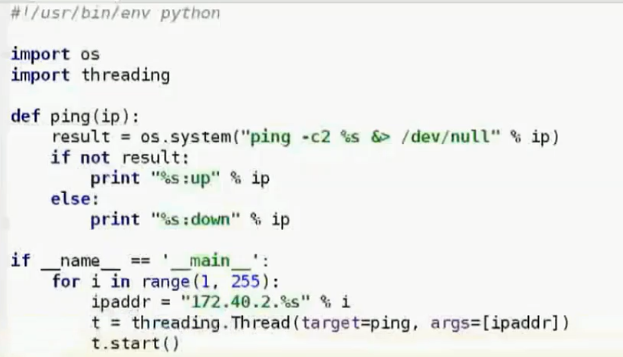
多线程:
##################解析列表##############
 >>> ['hello' for i in range(3)]

 ['hello', 'hello', 'hello']

 >>> [10 for i in range(3)]

 [10, 10, 10]

 >>> [i for i in range(10)]

 [0, 1, 2, 3, 4, 5, 6, 7, 8, 9]

 >>> [i**2 for i in range(10)]

 [0, 1, 4, 9, 16, 25, 36, 49, 64, 81]

 >>> [i**2 for i in range(10) if i%2]

 [1, 9, 25, 49, 81]
#############文件对象##############
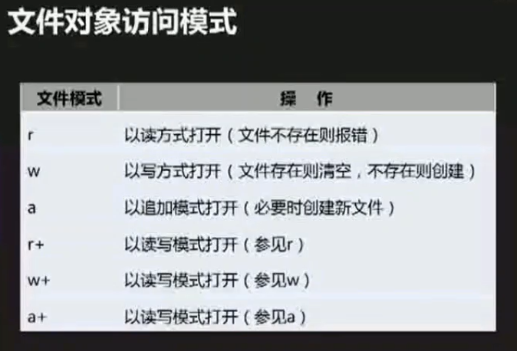
1.文件读取
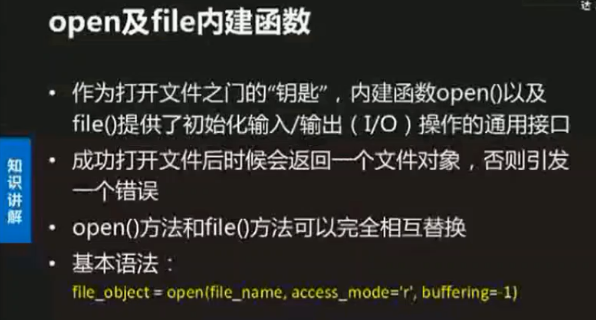
例子:
 >>> f = open('/etc/hosts')

 >>> data = f.read()

 >>> print data,

 127.0.0.1   localhost localhost.localdomain localhost4 localhost4.localdomain4

 ::1         localhost localhost.localdomain localhost6 localhost6.localdomain6

 192.168.244.200 master

 192.168.244.201 slave1

 192.168.244.202 slave2

 >>> f.close()
2.文件写入

 >>> f= open('hi.txt','w')

 >>> f.write('hello\n')

 >>> f.close()

 >>> f= open('hi.txt','a')

 >>> f.write('fush\n')

 >>> f.flush()
注释:‘w’表示以只写方式,不能读取,再次写入内容会覆盖前面的内容,‘a’ 追加内容
>>> f.writelines(['1st line.\n','2th line.\n'])
[root@master script]# cat /root/hi.txt
111
1st line.
2th line.
###########cp例子###########
 [root@master script]# vim cp.py

 #!/usr/bin/python

 # coding:utf-8

 f = open('/etc/passwd')

 k = open('/root/passwd','a')

 while True:

     data = f.read(4096)

     if not data:

         break

     k.write(data)

 f.close()

 k.close()

 检测:

 [root@master script]# python cp.py

 [root@master script]# cat /root/passwd

 root:x:0:0:root:/root:/bin/bash

 bin:x:1:1:bin:/bin:/sbin/nologin

 daemon:x:2:2:daemon:/sbin:/sbin/nologin

 adm:x:3:4:adm:/var/adm:/sbin/nologin

 lp:x:4:7:lp:/var/spool/lpd:/sbin/nologin

 sync:x:5:0:sync:/sbin:/bin/sync

 shutdown:x:6:0:shutdown:/sbin:/sbin/shutdown

 halt:x:7:0:halt:/sbin:/sbin/halt

 mail:x:8:12:mail:/var/spool/mail:/sbin/nologin

 uucp:x:10:14:uucp:/var/spool/uucp:/sbin/nologin

 operator:x:11:0:operator:/root:/sbin/nologin

 games:x:12:100:games:/usr/games:/sbin/nologin

 gopher:x:13:30:gopher:/var/gopher:/sbin/nologin

 ftp:x:14:50:FTP User:/var/ftp:/sbin/nologin

 nobody:x:99:99:Nobody:/:/sbin/nologin

 vcsa:x:69:69:virtual console memory owner:/dev:/sbin/nologin

 saslauth:x:499:76:Saslauthd user:/var/empty/saslauth:/sbin/nologin

 postfix:x:89:89::/var/spool/postfix:/sbin/nologin

 sshd:x:74:74:Privilege-separated SSH:/var/empty/sshd:/sbin/nologin
 改进版:函数方式

 [root@master script]# vim cp.py

 #!/usr/bin/python

 # coding:utf-8

 def cp(sfname,dfname):

     f = open(sfname)

     k = open(dfname,'w')

     while True:

          data = f.read(4096)

          if not data:

              break

          k.write(data)

     f.close()

     k.close()

 sname = raw_input('source_name: ')

 dname = raw_input('destination_name: ')

 cp(sname,dname)

 检测:

 [root@master script]# python cp.py

 source_name: /etc/passwd

 destination_name: /usr/local/src/passwd

 [root@master script]# cat /usr/local/src/passwd

 root:x:0:0:root:/root:/bin/bash

 bin:x:1:1:bin:/bin:/sbin/nologin

 daemon:x:2:2:daemon:/sbin:/sbin/nologin

 adm:x:3:4:adm:/var/adm:/sbin/nologin

 lp:x:4:7:lp:/var/spool/lpd:/sbin/nologin

 sync:x:5:0:sync:/sbin:/bin/sync

 shutdown:x:6:0:shutdown:/sbin:/sbin/shutdown

 halt:x:7:0:halt:/sbin:/sbin/halt

 mail:x:8:12:mail:/var/spool/mail:/sbin/nologin

 uucp:x:10:14:uucp:/var/spool/uucp:/sbin/nologin

 operator:x:11:0:operator:/root:/sbin/nologin

 games:x:12:100:games:/usr/games:/sbin/nologin

 gopher:x:13:30:gopher:/var/gopher:/sbin/nologin

 ftp:x:14:50:FTP User:/var/ftp:/sbin/nologin

 nobody:x:99:99:Nobody:/:/sbin/nologin

 vcsa:x:69:69:virtual console memory owner:/dev:/sbin/nologin

 saslauth:x:499:76:Saslauthd user:/var/empty/saslauth:/sbin/nologin

 postfix:x:89:89::/var/spool/postfix:/sbin/nologin

 sshd:x:74:74:Privilege-separated SSH:/var/empty/sshd:/sbin/nologin
 增强版:

 [root@master script]# vim cp.py

 #!/usr/bin/python

 # coding:utf-8

 import sys

 def cp(sfname,dfname):

     f = open(sfname)

     k = open(dfname,'w')

     while True:

          data = f.read(4096)

          if not data:

              break

          k.write(data)

     f.close()

     k.close()

 cp(sys.argv[1],sys.argv[2])

 检测:

 [root@master script]# python cp.py /etc/hosts /home/zhuji

 [root@master script]# cat !$

 cat /home/zhuji

 127.0.0.1   localhost localhost.localdomain localhost4 localhost4.localdomain4

 ::1         localhost localhost.localdomain localhost6 localhost6.localdomain6

 192.168.244.200 master

 192.168.244.201 slave1

 192.168.244.202 slave2
##############函数初识##################
[root@master ~]# vim func01.py

#!/usr/bin/python

# coding:utf-8

def pstar():

    print '*' * 20

    print '#' * 20

a= pstar()

print a

[root@master ~]# python func01.py

********************

####################

None
备注:当函数没有返回值,返回None
形参例子:
 1 [root@master ~]# vim func01.py

 #!/usr/bin/python

 # coding:utf-8

 def pstar(num):

     return '*' * num

 n = int(raw_input('number: '))

     print pstar(n)

 [root@master ~]# python func01.py

 number: 15

 ***************

默认参数例子:
[root@master ~]# vim func01.py
#!/usr/bin/python
# coding:utf-8
def pstar(num=20):
return '*' * num
n = int(raw_input('number: '))
print pstar()
print pstar(n)
[root@master ~]# python func01.py
number: 15
********************
***************
备注:调用函数不带参数时,用默认参数20;有带参数时,不用默认,会覆盖默认的参数
##############函数的位置参数#############
 [root@master script]# vim position.py

 #!/usr/bin/python

 # coding:utf-8

 import sys

 print sys.argv

 检测:

 [root@master script]# ./position.py

 ['./position.py']

 [root@master script]# ./position.py hello

 ['./position.py', 'hello']

 [root@master script]# ./position.py hello fush

 ['./position.py', 'hello', 'fush']
备注:sys.argv 是一个list
###############模块相关################
 >>> import string

 >>> string.upper('abc')

 'ABC'

 >>> string.__file__

 '/usr/lib64/python2.6/string.pyc'     ###string模块文件位置

 查看模块文件:

 [root@master script]# vim /usr/lib64/python2.6/string.py

 """A collection of string operations (most are no longer used).

 Warning: most of the code you see here isn't normally used nowadays.

 Beginning with Python 1.6, many of these functions are implemented as

 """A collection of string operations (most are no longer used).
 导入模块:

 >>> from random import choice    ##只导入random的choice

 >>> choice('adfe')

 'a'

 >>> choice('adfe')

 'a'

 >>> choice('adfe')

 'd'

 >>> choice('adfe')

 'd'

 >>> choice('adfe')

 'e'

 >>> choice('adfe')

 'f'

 >>> random.choice('fush')          ###前面没有导入random,会报错

 Traceback (most recent call last):

   File "<stdin>", line 1, in <module>

 NameError: name 'random' is not defined

 >>> import random as rdm     ##把random模块起了个别名rdm

 >>> rdm.choice('fush')

 's'

 >>> rdm.choice('fush')

 's'

 >>> rdm.choice('fush')

 'f'
python 基础之第二天的更多相关文章
- python基础学习——第二天
一.python种类 1.1 Cpython python官方版本,使用c语言实现,运行机制:先编译,py(源码文件)->pyc(字节码文件),最终执行时先将字节码转换成机器码,然后交给cpu执 ...
- python基础教程-第二章-列表和元组
本章将引入一个新的概念,:数据结构.数据结构是通过某种方式(例如对元素进行编号)组织在 一起的数据元素的集合,这些数据元素可以是数字或者字符,甚至可以是其他数据结构.在python中,最基本的数据结构 ...
- Python基础【第二篇】
一.Python的标准数据类型 Python 3中主要有以下6中数据类型: Number(数字).String(字符串).List(列表).Tuple(元组).Sets(集合).Dictionary( ...
- Python 基础【第二篇】python操作模式
一.交互模式 #python Python 2.6.6 (r266:84292, Jan 22 2014, 09:42:36) [GCC 4.4.7 20120313 (Red Hat 4.4.7-4 ...
- 第二章、元组和列表(python基础教程第二版 )
最基本的数据结构是序列,序列中每个元素被分配一个序号-元素的位置,也称索引.第一个索引为0,最后一个元素索引为-1. python中包含6种内建的序列:元组.列表.字符串.unicode字符串.buf ...
- python基础教程第二版 第一章
1.模块导入python以增强其功能的扩展:三种方式实现 (1). >>> Import math >>> math.floor(32.9) 32.0 #按照 模块 ...
- python基础自学 第二天
注释 分类 单行注释 多行注释 作用 使用自己熟悉的语言,在程序中对某些代码进行标注说明,增强程序可读性 单行注释(行注释) 以 # 开头,#右边所有的东西就被当成说明文字,而不是要执行的程序,只是说 ...
- python基础学习第二天
读文件 r 要以读文件的模式打开一个文件对象,使用Python内置的open()函数,传入文件名和标示符 写文件 w 写文件和读文件是一样的,唯一区别是调用open()函数时,传入标识符’w’或者’w ...
- python基础知识第二篇(字符串)
基本数据类型 数字 整形 int ---int 将字符串 ...
随机推荐
- iOS -- 十进制、十六进制字符串,byte,data等之间的转换
十进制->十六进制 Byte bytes[]={0xA6,0x27,0x0A}; NSString *strIdL = [NSStringstringWithFormat:]]]; 十六进制-& ...
- win10 配置pylucene
参考文章 http://lxsay.com/archives/269 Windows 10 64 Bit 编译安装 PyLucene 6.2, 6.4 或 6.5 POSTED ON 2017-02- ...
- SilverLight:基础控件使用(6)-Slider控件
ylbtech-SilverLight-Basic-Control:基础控件使用(6)-Slider控件 Slider 控件 Slider 控件的 ValueChanged 事件 1.A,返回顶部 S ...
- phpcms v9中 action="position" 和action="lists"有什么差别, 以及action 的属性和值
action值的含义: lists 内容数据(文章?)列表 relation 内容相关文章 hits 内容数据点击排行榜 category 内容栏目列表 position 内容推荐位列表
- vue2.0 vue-router
一.SPA中路由的简单实现 main.js import Vue from 'vue' import App from './App' import VueRouter from 'vue-route ...
- inch mil mm换算
inch:英寸 mil:密耳 mm:毫米 1mil=0.0254mm=25.4um 1mm=39.37mil 1inch=1000mil=25.4mm
- Java与设计模式-责任链模式
责任链模式属于行为型设计模式之中的一个,怎么理解责任链?责任链是能够理解成数个对象首尾连接而成,每个节点就是一个对象.每个对象相应不同的处理逻辑,直至有一个对象响应处理请求结束.这一种模式成为责任链模 ...
- GoogleFusionTablesAPI初探地图与云计算
http://developer.51cto.com/art/200906/129324.htm http://yexiaochai.iteye.com/blog/1893735 http://yex ...
- 第 1 章 第 2 题 空间敏感排序问题 位向量实现( bitset位向量 )
问题分析 在上篇文章中,给出了使用C语言中经典位运算符来实现位向量的方法.而本文,将介绍使用C++中的bitset容器来实现位向量的方法. 实现 // 请包含bitset头文件 #include &l ...
- Oracle学习(十三):闪回
1.知识点:能够对比以下的录屏进行阅读 SQL> --1. 错误地删除了记录 SQL> --2. 错误地删除了表 SQL> --3. 查询历史记录 SQL> --4. 怎样撤销 ...