
Linux System Programming 学习笔记(四) 高级I/O
1. Scatter/Gather I/O
#include <sys/uio.h>

struct iovec {

       void *iov_base;    /* pointer to start of buffer */

       size_t iov_len;    /* size of buffer in bytes */

};
/* The readv() function reads count segments from the file descriptor fd into the buffers described by iov */

ssize_t readv (int fd, const struct iovec *iov, int count);
/* The writev() function writes at most count segments from the buffers described by iov into the file descriptor fd */

ssize_t writev (int fd, const struct iovec *iov, int count);
注意:在Scatter/Gather I/O操作过程中,内核必须分配内部数据结构来表示每个buffer分段,正常情况下,是根据分段数count进行动态内存分配的,
但是当分段数count较小时(一般<=8),内核直接在内核栈上分配,这显然比在堆中动态分配要快
#include <stdio.h>

#include <unistd.h>

#include <sys/types.h>

#include <sys/stat.h>

#include <fcntl.h>

#include <string.h>

#include <sys/uio.h>

int main(int argc, char* argv[])

{

    struct iovec iov[];

    char* buf[] = {

        "The term buccaneer comes from the word boucan.\n",

        "A boucan is a wooden frame used for cooking meat.\n",

        "Buccaneer is the West Indies name for a pirate.\n" };

    int fd = open("wel.txt", O_WRONLY | O_CREAT | O_TRUNC);

    if (fd == -) {

        fprintf(stderr, "open error\n");

        return ;

    }

    /* fill out three iovec structures */

    for (int i = ; i < ; ++i) {

        iov[i].iov_base = buf[i];

        iov[i].iov_len  = strlen(buf[i]) + ;

    }

    /* with a single call, write them out all */

    ssize_t nwrite = writev(fd, iov, );

    if (nwrite == -) {

        fprintf(stderr, "writev error\n");

        return ;

    }

    fprintf(stdout, "wrote %d bytes\n", nwrite);

    if (close(fd)) {

        fprintf(stdout, "close error\n");

        return ;

    }

    return ;

}
#include <stdio.h>

#include <unistd.h>

#include <string.h>

#include <fcntl.h>

#include <sys/uio.h>

#include <sys/stat.h>

int main(int argc, char* argv[])

{

    char foo[], bar[], baz[];

    struct iovec iov[];

    int fd = open("wel.txt", O_RDONLY);

    if (fd == -) {

        fprintf(stderr, "open error\n");

        return ;

    }

    /* set up our iovec structures */

    iov[].iov_base = foo;

    iov[].iov_len =  sizeof(foo);

    iov[].iov_base = bar;

    iov[].iov_len =  sizeof(bar);

    iov[].iov_base = baz;

    iov[].iov_len =  sizeof(baz);

    /* read into the structures with a single call */

    ssize_t nread = readv(fd, iov, );

    if (nread == -) {

        fprintf(stderr, "readv error\n");

        return ;

    }

    for (int i = ; i < ; ++i) {

        fprintf(stdout, "%d: %s", i, (char*)iov[i].iov_base);

    }

    if (close(fd)) {

        fprintf(stderr, "close error\n");

        return ;

    }

    return ;

}
writev的简单实现:
#include <unistd.h>

#include <sys/uio.h>

ssize_t my_writev(int fd, const struct iovec* iov, int count)

{

    ssize_t ret = ;

    for (int i = ; i < count; ++i) {

        ssize_t nr = write(fd, iov[i].iov_base, iov[i].iov_len);

        if (nr == -) {

            if (errno == EINTR)

                continue;

            ret -= ;

            break;

        }

        ret += nr;

    }

    return nr;

}
In fact, all I/O inside the Linux kernel is vectored; read() and write() are implemented as vectored I/O with a vector of only one segment
2. epoll
/* A successful call to epoll_create1() instantiates a new epoll instance and returns a file descriptor associated with the instance */

#include <sys/epoll.h>

int epoll_create(int size);
parameter size used to provide a hint about the number of file descriptors to be watched;
nowadays the kernel dynamically sizes the required data structures and this parameter just needs to be greater than zero
(2) controling epoll
/* The epoll_ctl() system call can be used to add file descriptors to and remove file descriptors from a given epoll context */

#include <sys/epoll.h>

int epoll_ctl(int epfd, int op, int fd, struct epoll_event* event);

struct epoll_event {

    __u32 events;    /* events */

    union {

              void* ptr;

              int     fd;

              __u32 u32;

              __u64 u64;

    } data;

};
a. op parameter
EPOLL_CTL_ADD   // Add a monitor on the file associated with the file descriptor fd to the epoll instance associated with epfd

EPOLL_CTL_DEL  // Remove a monitor on the file associated with the file descriptor fd from the epoll instance associated with epfd

EPOLL_CTL_MOD  //  Modify an existing monitor of fd with the updated events specified by event
b. event parameter
EPOLLET     // Enables edge-triggered behavior for the monitor of the file ,The default behavior is level-triggered

EPOLLIN     // The file is available to be read from without blocking

EPOLLOUT  // The file is available to be written to without blocking
对于结构体struct epoll_event 里的data成员,通常做法是将data联合体里的fd设置为第二个参数fd,即 event.data.fd = fd
To add a new watch on the file associated with fd to the epoll instance epfd :
#include <sys/epoll.h>

struct epoll_event event;

event.data.fd = fd;

event.events = EPOLLIN | EPOLLOUT

int ret = epll_ctl(epfd, EPOLL_CTL_ADD, fd, &event);

if (ret) {

    fprintf(stderr, "epll_ctl error\n");

}
To modify an existing event on the file associated with fd on the epoll instance epfd :
#include <sys/epoll.h>

struct epoll_event event;

event.data.fd = fd;

event.events = EPOLLIN;

int ret = epoll_ctl(epfd, EPOLL_CTL_MOD, fd, &event);

if (ret) {

    fprintf(stderr, "epoll_ctl error\n");

}
To remove an existing event on the file associated with fd from the epoll instance epfd :
#include <sys/epoll.h>

struct epoll_event event;

int ret = epoll_ctl(epfd, EPOLL_CTL_DEL, fd, &event);

if (ret) {

    fprintf(stderr, "epoll_ctl error\n");

}
(3) waiting for events with epoll
#include <sys/epoll.h>

int epoll_wait(int epfd, struct epoll_event* events, int maxevents, int timeout);
The return value is the number of events, or −1 on error
#include <sys/epoll.h>

#define MAX_EVENTS 64

struct epoll_event* events = malloc(sizeof(struct epoll_event) * MAX_EVENTS);

if (events == NULL) {

    fprintf(stdout, "malloc error\n");

    return ;

}

int nready = epoll_wait(epfd, events, MAX_EVENTS, -);

if (nready < ) {

    fprintf(stderr, "epoll_wait error\n");

    free(events);

    return ;

}

for (int i = ; i < nready; ++i) {

    fprintf(stdout, "event=%ld on fd=%d\n", events[i].events, events[i].data.fd);

    /* we now can operate on events[i].data.fd without blocking */

}

free(events);
3. Mapping Files into Memory
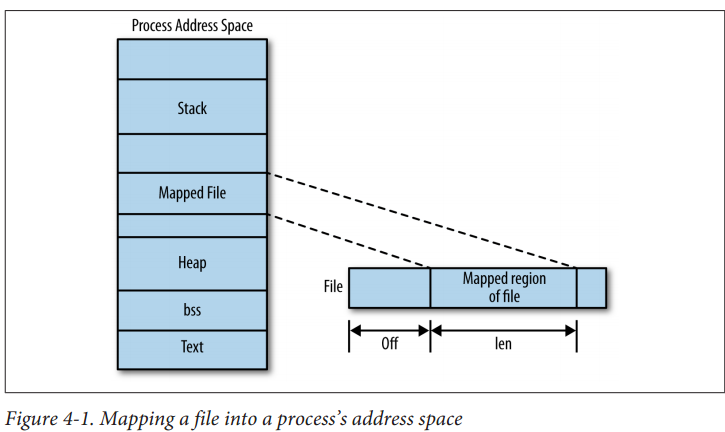
/* A call to mmap() asks the kernel to map len bytes of the object represented by the file  descriptor fd,
   starting at offset bytes into the file, into memory
*/

#include <sys/mman.h>

void* mmap(void* addr, size_t len, int prot, int flags, int fd, off_t offset);
void* ptr = mmap(, len, PROT_READ, MAP_SHARED, fd, );
int munmap (void *addr, size_t len);
munmap() removes any mappings that contain pages located anywhere in the process address space starting at addr,
which must be page-aligned, and continuing for len bytes
#include <stdio.h>

#include <unistd.h>

#include <sys/types.h>

#include <sys/stat.h>

#include <sys/mman.h>

#include <fcntl.h>

int main(int argc, char* argv[])

{

    if (argc < ) {

        fprintf(stderr, "usage:%s <file>\n", argv[]);

        return ;

    }

    int fd = open(argv[], O_RDONLY);

    if (fd == -) {

        fprintf(stderr, "open error\n");

        return ;

    }

    struct stat sbuf;

    if (fsat(fd, &sbuf) == -) {

        fprintf(stderr, "fstat error\n");

        return ;

    }

    if (!S_ISREG(sbuf.st_mode)) {

        fprintf(stderr, "%s is not a file\n", argv[]);

        return ;

    }

    void* ptr = mmap(, sbuf.st_size, PROT_READ, MAP_SHARED, fd, );

    if (ptr == MAP_FAILED) {

        fprintf(stderr, "mmap error\n");

        return ;

    }

    if (close(fd)) {

        fprintf(stderr, "close error\n");

        return ;

    }

    for (int i = ; i < sbuf.st_size; ++i) {

        fputc(ptr[i], stdout);

    }

    if (munmap(ptr, sbuf.st_size) == -) {

        fprintf(stderr, "munmap error\n");

        return ;

    }

    return ;

}
#include <sys/mman.h>

int msync (void *addr, size_t len, int flags);
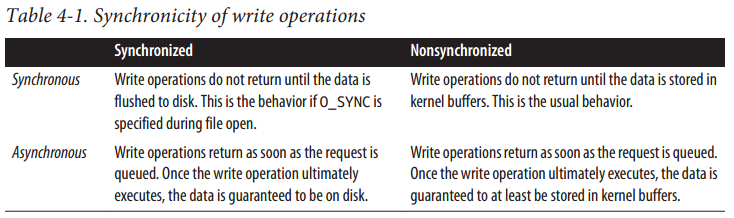
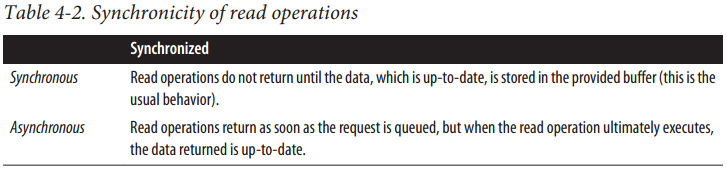
4. 同步 异步
5. I/O调度和I/O性能
Linus Elevator I/O scheduler

The Deadline I/O Scheduler

The Anticipatory I/O Scheduler

The CFQ I/O Scheduler

The Noop I/O Scheduler
Linux System Programming 学习笔记(四) 高级I/O的更多相关文章
- Linux System Programming 学习笔记(十一) 时间
1. 内核提供三种不同的方式来记录时间 Wall time (or real time):actual time and date in the real world Process time:the ...
- Linux System Programming 学习笔记(七) 线程
1. Threading is the creation and management of multiple units of execution within a single process 二 ...
- Linux System Programming 学习笔记(六) 进程调度
1. 进程调度 the process scheduler is the component of a kernel that selects which process to run next. 进 ...
- Linux System Programming 学习笔记(二) 文件I/O
1.每个Linux进程都有一个最大打开文件数,默认情况下,最大值是1024 文件描述符不仅可以引用普通文件,也可以引用套接字socket,目录,管道(everything is a file) 默认情 ...
- Linux System Programming 学习笔记(一) 介绍
1. Linux系统编程的三大基石:系统调用.C语言库.C编译器 系统调用:内核向用户级程序提供服务的唯一接口.在i386中,用户级程序执行软件中断指令 INT n 之后切换至内核空间 用户程序通过寄 ...
- Linux System Programming 学习笔记(十) 信号
1. 信号是软中断,提供处理异步事件的机制 异步事件可以是来源于系统外部(例如用户输入Ctrl-C)也可以来源于系统内(例如除0) 内核使用以下三种方法之一来处理信号: (1) 忽略该信号.SIG ...
- Linux System Programming 学习笔记(九) 内存管理
1. 进程地址空间 Linux中,进程并不是直接操作物理内存地址,而是每个进程关联一个虚拟地址空间 内存页是memory management unit (MMU) 可以管理的最小地址单元 机器的体系 ...
- Linux System Programming 学习笔记(八) 文件和目录管理
1. 文件和元数据 每个文件都是通过inode引用,每个inode索引节点都具有文件系统中唯一的inode number 一个inode索引节点是存储在Linux文件系统的磁盘介质上的物理对象,也是L ...
- Linux System Programming 学习笔记(五) 进程管理
1. 进程是unix系统中两个最重要的基础抽象之一(另一个是文件) A process is a running program A thread is the unit of activity in ...
随机推荐
- IE下contentWindow对象与FF、Chrome下的区别
在ie中frame(iframe)标签通过name和id获取的对象是不同的. 通过name获取的本身就是contentWindow对象.所以 在ie中不用再找contentWindow了 例: let ...
- ovx openVirtex的阅读文档
由于flowvisor只有4个版本, 最新更新都是2013年的, 跟底层ovs版本不跟进, 最近斯坦福post一个 ovx, 猜测是flowvisor的加强版, 所以看一下文档说明 文档详见http: ...
- HTML5语义
语义通俗化为意义,也就是语义化的元素等于意义化的元素,看到这个元素的名称,就知道这个元素的意义,是拿来做什么用的,这就是HTML5的一个新特性,一个具有语义化的元素能够清楚的把元素的意义告诉浏览器和开 ...
- 【转】Matlab的regionprops详解
matlab函数_连通区域 1. matlab函数bwareaopen──删除小面积对象格式:BW2 = bwareaopen(BW,P,conn)作用:删除二值图像BW中面积小于P的对象,默认情况下 ...
- 在Keras中导入测试数据的方法
https://blog.csdn.net/ethantequila/article/details/80322425?utm_source=blogxgwz2
- java工作环境配置jdk,idea
下载 jdk 1.8 https://www.oracle.com/technetwork/java/javase/downloads/jdk8-downloads-2133151.html 配置环境 ...
- Linux-缓存服务
Memcached 基本操作 解释 命令 安装 yum install memcached 启动 memcached -d -l -m -p 停止 kill pid 查看某个端口是否通:telnet ...
- mysql替换表中某字段的某值
UPDATE `cases` SET `case_desc` = replace(`case_desc`, 'src="//tuku-assets.m.jia.com/assets/i ...
- apicloud入门学习笔记1:简单介绍
官网地址:https://www.apicloud.com/ 新手开发指南:https://docs.apicloud.com/APICloud/junior-develop-guide 开发语言:H ...
- 线段树:HDU2795-Billboard(建树方式比较新奇)
Billboard Time Limit: 20000/8000 MS (Java/Others) Memory Limit: 32768/32768 K (Java/Others) Total Su ...