
Linux System Programming 学习笔记(九) 内存管理
1. 进程地址空间
2. 动态内存
/* obtaining dynamic memory */

#include <stdlib.h>

void * malloc (size_t size);
/* returns a pointer to a block of memory suitable for holding an array of nr elements, each of size bytes */

#include <stdlib.h>

void * calloc (size_t nr, size_t size);
/* resizing (making larger or smaller) existing allocations */

#include <stdlib.h>

void * realloc (void *ptr, size_t size);
3. 数据对齐
/* actual allocation size of the chunk of memory pointed to by ptr */

#include <malloc.h>

size_t malloc_usable_size (void *ptr);
4. 管理数据段
#include <unistd.h>

int brk (void *end);

void * sbrk (intptr_t increment);
5. 匿名内存映射
void *p;

p = mmap (NULL,                        /* do not care where */

           * ,                  /* 512 KB */

          PROT_READ | PROT_WRITE,      /* read/write */

          MAP_ANONYMOUS | MAP_PRIVATE, /* anonymous, private */

          −,                          /* fd (ignored) */

          );                          /* offset (ignored) */

if (p == MAP_FAILED)

        perror ("mmap");

else

        /* 'p' points at 512 KB of anonymous memory... */
6. 基于栈的动态内存分配
/* make a dynamic memory allocation from the stack */

#include <alloca.h>

void * alloca (size_t size);
7. 变长数组 Variable-Length Arrays
for (i = ; i < n; ++i) {

        char foo[i + ];

        /* use 'foo'... */

}
8. 选择内存分配机制
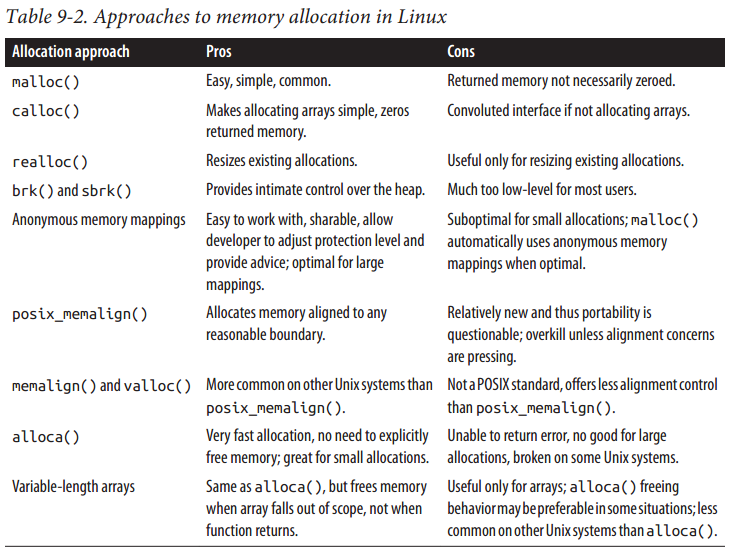
9. 内存操作
/* memset() sets the n bytes starting at s to the byte c and returns s */

#include <string.h>

void * memset (void *s, int c, size_t n);
/* compares two chunks of memory for equivalence */

#include <string.h>

int memcmp (const void *s1, const void *s2, size_t n);
因为结构体通常涉及到数据对齐,所以使用memcmp来比较两个结构体是不安全的
/* are two dinghies identical? (BROKEN) */

int compare_dinghies (struct dinghy *a, struct dinghy *b)

{

        return memcmp (a, b, sizeof (struct dinghy));

}
上述代码不安全,应该分别比较每个结构体成员:
/* are two dinghies identical? */

int compare_dinghies (struct dinghy *a, struct dinghy *b)

{

        int ret;

        if (a->nr_oars < b->nr_oars)

                return −;

        if (a->nr_oars > b->nr_oars)

                return ;

        ret = strcmp (a->boat_name, b->boat_name);

        if (ret)

                return ret;

        /* and so on, for each member... */

}
/* copies the first n bytes of src to dst, returning dst */

#include <string.h>

void * memmove (void *dst, const void *src, size_t n);
memmove可以正确处理内存区重叠的情况(部分dst位于src之内)
#include <string.h>

void * memcpy (void *dst, const void *src, size_t n)
memcpy在内存区出现重叠时 属于未定义行为
/* scans the n bytes of memory pointed at by s for the character c */

#include <string.h>

void * memchr (const void *s, int c, size_t n);
10. 锁定内存
/* “locking”one or more pages into physical memory, ensuring that they are never paged out to disk */

#include <sys/mman.h>

int mlock (const void *addr, size_t len);
mlock() locks the virtual memory starting at addr and extending for len bytes into physical memory
/*  mlockall() locks all of the pages in the current process's address space into physical memory. */

#include <sys/mman.h>

int mlockall (int flags);
Linux System Programming 学习笔记(九) 内存管理的更多相关文章
- Linux System Programming 学习笔记(五) 进程管理
1. 进程是unix系统中两个最重要的基础抽象之一(另一个是文件) A process is a running program A thread is the unit of activity in ...
- Linux System Programming 学习笔记(八) 文件和目录管理
1. 文件和元数据 每个文件都是通过inode引用,每个inode索引节点都具有文件系统中唯一的inode number 一个inode索引节点是存储在Linux文件系统的磁盘介质上的物理对象,也是L ...
- Linux System Programming 学习笔记(一) 介绍
1. Linux系统编程的三大基石:系统调用.C语言库.C编译器 系统调用:内核向用户级程序提供服务的唯一接口.在i386中,用户级程序执行软件中断指令 INT n 之后切换至内核空间 用户程序通过寄 ...
- Linux System Programming 学习笔记(七) 线程
1. Threading is the creation and management of multiple units of execution within a single process 二 ...
- Linux System Programming 学习笔记(四) 高级I/O
1. Scatter/Gather I/O a single system call to read or write data between single data stream and mu ...
- Linux System Programming 学习笔记(十一) 时间
1. 内核提供三种不同的方式来记录时间 Wall time (or real time):actual time and date in the real world Process time:the ...
- Linux System Programming 学习笔记(十) 信号
1. 信号是软中断,提供处理异步事件的机制 异步事件可以是来源于系统外部(例如用户输入Ctrl-C)也可以来源于系统内(例如除0) 内核使用以下三种方法之一来处理信号: (1) 忽略该信号.SIG ...
- Linux System Programming 学习笔记(六) 进程调度
1. 进程调度 the process scheduler is the component of a kernel that selects which process to run next. 进 ...
- Linux System Programming 学习笔记(二) 文件I/O
1.每个Linux进程都有一个最大打开文件数,默认情况下,最大值是1024 文件描述符不仅可以引用普通文件,也可以引用套接字socket,目录,管道(everything is a file) 默认情 ...
随机推荐
- OO作业第三单元总结
目录 一.JML语言理论基础及应用工具链 二.部署JMLUnitNG,自动生成测试用例 三.架构设计 第一次作业 第二次作业 第三次作业 四.Bug分析 五.心得体会 一.JML语言理论基础及应用工具 ...
- ES6 -- 模板字符串(反单引号)
1)直接使用变量 // before var str = 'test'; console.log(str + "123"); // now var str = 'test'; co ...
- 【卡常 bitset 分块】loj#6499. 「雅礼集训 2018 Day2」颜色
好不容易算着块大小,裸的分块才能过随机极限数据:然而这题在线的数据都竟然是构造的…… 题目描述 有 $n$ 个数字,第 $i$ 个数字为 $a_i$. 有 $m$ 次询问,每次给出 $k_i$ 个区间 ...
- Docker系列一:Docker的介绍和安装
Docker介绍 Docker是指容器化技术,用于支持创建和实验Linux Container.借助Docker,你可以将容器当做重量轻.模块化的虚拟机来使用,同时,你还将获得高度的灵活性,从而实现对 ...
- mac Parallels Desttop 13 win7/win8 无法连接网络
把 “源” 从共享网络改为"Wi-Fi" 在mac 这边点击菜单栏windows图标,选配置(如果没有配置,点控制中心,在点控制中心的齿轮,)选 硬件 找到网络 解锁,上边第一行就 ...
- 使用Spring MVC后实现一个BaseController
使用Spring MVC技术后,可以实现一个基类的Controller类来分装一些MVC常用的方法,其他的Controller都继承自这个BaseController,这样在使用常用的方法时将会变得非 ...
- Linux异常体系之vector_stub宏解析
ARM-Linux汇编的宏定义语法说明如下: 使用注意: 1.宏定义以.macro开始,以.endm结束 2.可带参数,参数可有默认值 3.直接使用参数的名字\arg vector_stub宏的功能: ...
- PAT Basic 1074
1074 宇宙无敌加法器 地球人习惯使用十进制数,并且默认一个数字的每一位都是十进制的.而在 PAT 星人开挂的世界里,每个数字的每一位都是不同进制的,这种神奇的数字称为“PAT数”.每个 PAT 星 ...
- python面试题解析(前端、框架和其他)
答: HTTP是一个属于应用层的面向对象的协议,由于其简捷.快速的方式,适用于分布式超媒体信息系统.它于1990年提出,经过几年的使用与发展,得到不断地完善和扩展.目前在WWW中使用的是HTTP/1. ...
- 反射的妙用-类名方法名做参数进行方法调用实例demo
首先声明一点,大家都会说反射的效率低下,但是大多数的框架能少了反射吗?当反射能为我们带来代码上的方便就可以用,如有不当之处还望大家指出 1,项目结构图如下所示:一个ClassLb类库项目,一个为测试用 ...