
What are long running processes?
转自:https://blog.bernd-ruecker.com/what-are-long-running-processes-b3ee769f0a27
Some communities have big reservations when using terms like workflow(overloaded), Business Process Management or BPM (automatically considered to be a BPM monolith, see The 7 sins of workflow) or orchestration (reminds people of old SOA days, smart pipes or central engines). So I started using the term long running process, but now people are asking me: “Is this a long running process?” In this article I list typical use cases and clarify terminology.
Hint: My goal is not to give a scientific definition. I just want to write down my current thoughts as an anchor for potential discussions, so I’m looking forward to get your feedback!
Sprint or Marathon? About short, long and very long running processes.
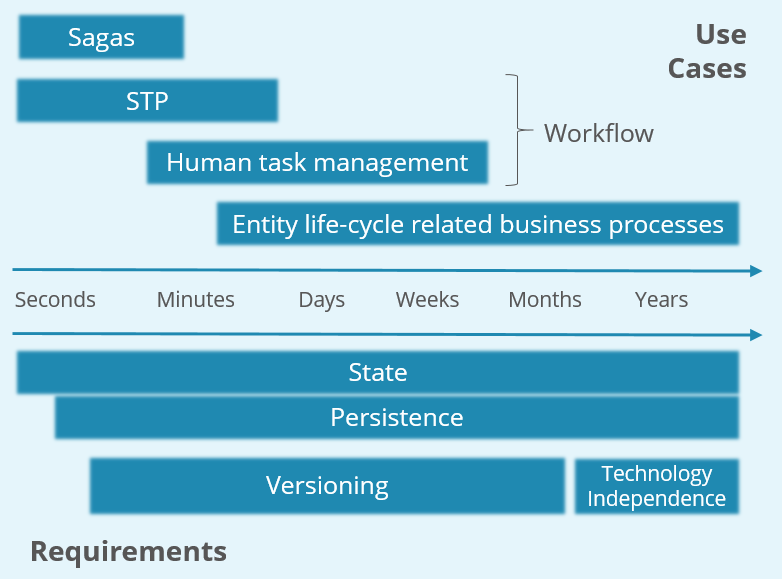
Must a long running process be a business process spanning days, weeks, months or even years? Or can it solely be an automated processes typically finished within milliseconds, but potentially waiting for system availability for a few seconds, minutes or sometimes hours?
Well, both! But doesn’t this pose different requirements on the solution? Only to a minor extent. Let’s dive into more details.
Use Cases
Edit: I published 5 Workflow Automation Use Cases You Might Not Have Considered on TheNewStack in the meanwhile, which gives an improved overview on use cases.
Straight through processing (STP) refers to processes that are fully automated. There are no human steps involved (in the best case). You might also call this service orchestration (German insurance companies even have another nice word for this: “Dunkelverarbeitung” —translated with “processing in the dark”).
Why do I consider these processes to be long running? Well, STP normally involves some kind of service invocation. As soon as we invoke services, there is the risk of waiting, either because we use an asynchronous channel (e.g. messaging) or we run into a service outage and have to incorporate some retry mechanism. Waiting immediately means long running, I’ll come back to the question of “how long?” in a minute.
Human task management means to push tasks on a todo list of some user. I never know when he is going to pick it up, so we have to wait and voila: long running. For the sake of simplicity I consider case management to be part of this category in this post.
The term workflow is typically used for a STP and human task management. Very often these use cases are mixed anyway. The most common example is that you might involve the human whenever STP hits an undefined problem, hence: long running.
Sagas are a quite old but a relatively unknown concept (except in the Domain Driven Design community). Sagas solve the problem that technical two-phase commit does not scale. Therefor
“a saga is a long lived transaction that can be broken up into a collection of sub-transactions that can be interleaved. All transactions in the sequence complete successfully or compensating transactions are ran to amend a partial execution.”
Quoted from Caitie McCaffrey. Long lived = long running.
Long running basically means waiting!
Edit: I added this section as I get this question very often.

Long running doesn’t mean there is real action all the time. Typically long running means that the process is waiting most of the time. This is not done by blocking any threads but typically by persisting state to some storage mechanism. So the term “long lived” might be even easier to understand for some readers.
So don’t get confused: long running basically means waiting most of the time.
Requirements
For all use cases you have to solve the same basic problems:
State handling & persistence: Whenever you have to wait, you need some kind of state handling. Typically you do not want to lose this state during a system hiccup — so you make it persistent. This might not be true for some systems only handling short-lived sagas within milliseconds where you trade performance for consistency. But most often, the duration of waiting doesn’t make a big difference; as soon as you wait, you persist.
When persisting state, you have to handle situations when the process does not progress or recover, so you have to handle timeouts & escalations. This is also true for STP when a bug in a third party system causes a missing response message. And as soon as you have processes waiting, you typically want to see what is going on, so you need some monitoring.
Versioning: Whenever you store state, you might run into situations where you develop a new version of your process and put it live, but still have instances of the old model running. Of course this is a much more pressing issue with very long running processes, but you normally also have to tackle it with shorter long running processes.
If you handle processes spanning huge time frames, things start to change. Think of life insurance; the process from applying for the contract till the payment (when you are dead) might (hopefully) span decades. Within this time frame you will definitely experience some major paradigm shifts in the IT industry (e.g. Mainframe to 3-tier-architectures to serverless, nosql and cloud). So I typically recommend to save state in long periods of inactivity as simple as possible. This will make it easier to transition to these new paradigms. Independent of the concrete product used, the simpler the state can be extracted, the simpler the migration will be.
By the way: I am still searching for a name for these very long processes. For now I have put them into a category called “entity life-cycle related business processes” —I don’t like this for several reasons so if you have a good idea, please let me know!
These very long running processes typically have a high level of activity only within shorter periods. So we can perfectly slice the overall process into pieces of activity (long running processes) and waiting (simple state). Typically the phases of activity do not extend 6 months.
But up to this time frame, the requirements are identical for all durations, ranging from milliseconds to months. That also means, that you can apply the same solution for a big variety of problems.
Implementing long running processes
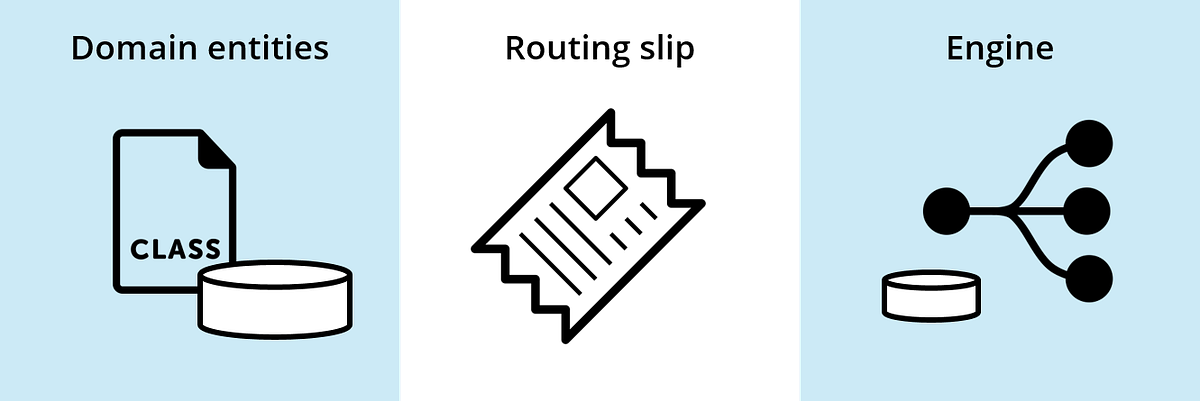
There are various solutions to tackle long running processes. I want to dedicate a later blog post on these, including forces and consequences. As a teaser I highlight three options:
- Save state within your own domain entities.
- Do not save any central state but add information about it to all messages passed around (pattern: routing slip).
- Use an engine (pattern: process manager), which might be a workflow engine, a process engine, a case engine, an orchestration engine or even a homegrown custom engine.
Having co-founded an Open Source BPM vendor, I only want to note in this post that a proper engine works for all use cases explained above :-)
Summary
A long running process can span from a few milliseconds up to decades. So duration is less important than the fact that you potentially have to wait, which is the case in almost any situation when humans or remote communication is involved.
Let me know what you think!
What are long running processes?的更多相关文章
- Show All Running Processes in Linux
ps由于历史的原因,所以很奇特,有些命令必须加"-",比如: ps A 上面的写法是错误的 ********* simple selection ********* ******* ...
- check running processes in Ubuntu
Check processes If you want to see what processes are running use the command ps -ef If you want to ...
- How to implement long running flows, sagas, business processes or similar
转自:https://blog.bernd-ruecker.com/how-to-implement-long-running-flows-sagas-business-processes-or-si ...
- Working with Python subprocess - Shells, Processes, Streams, Pipes, Redirects
Posted: 2009-04-28 15:20 Tags: Python Note Much of the "What Happens When you Execute a Command ...
- 创建hbase-indexer出现 0 running
新建hbase-indexer后通过hbase-indexer list-indexers发现SEP subscription ID: null并且0 running processes,如下: IN ...
- Show tree of processes in linux
pstree(1): tree of processes - Linux man pagehttps://linux.die.net/man/1/pstree How to view process ...
- linux processes
So that Linux can manage the processes in the system, each process is represented by a task_struct ...
- Inno Setup Pascal Script to search for running process
I am currently trying to do a validation at the uninstall moment. In a Pascal script function, in In ...
- Uniform synchronization between multiple kernels running on single computer systems
The present invention allocates resources in a multi-operating system computing system, thereby avoi ...
随机推荐
- 图解前序遍历线索化二叉树,前序线索二叉树遍历,C\C++描述
body, table{font-family: 微软雅黑; font-size: 13.5pt} table{border-collapse: collapse; border: solid gra ...
- 装饰器-wrapper
我跟别人说我精通python,别人问我wrapper是啥,我说不知道,尼玛,原来wrapper就是装饰器,熟的不得了啊,英语真是我的克星啊. 闭包 closure 在认识装饰器之前先认识下闭包 闭包, ...
- jmeter中测试接口
本文主要介绍在jmeter中测试接口:主要从以下几个方面进行说明: 1.jmeter简介 2.jmeter怎么做接口测试 3.jmeter进行参数化的几种形式 4.jmeter中处理乱码方法 5.jm ...
- python 字典,列表,集合,字符串,基础进阶
python列表基础 首先当然是要说基础啦 列表list 1.L.append(object) -> None 在列表末尾添加单个元素,任何类型都可以,包括列表或元组等 2.L.extend(i ...
- python day07作业答案
1. sum=0 a=input() for i in a: sum=sum+int(i)**3 if sum==int(a): print('水仙数') 2. lst=[100,2,6,9,1,10 ...
- Python 内置函数2
print(list("胡辣汤")) lst = ["河南话", "四川话", "东北", "山东" ...
- Strut2在Action-Result的配置文件内转到jsp页面时用URL传递参数
Struts.2.5.5版本在Action配置文件中内有如下result,其中role是Action类中的属性,在配置文件中用到OGNL表达式 <result name="input& ...
- js- caller、 callee
caller 返回一个对函数的引用,该函数调用了当前函数. functionName.caller functionName对象 是所执行函数的名称. 说明 对于函数来说 ...
- 数据结构中的列表、元组、字典、集合 ,深浅copy
数据结构:数据结构是计算机存储数据和组织数据的方式.数据结构是指相互之间存在一种或多种特定关系的数据元素的集合.在python中主要的数据类型统称为容器. 而序列(如列表.元组).映射(如字典).集合 ...
- python list和numpy互换
http://blog.csdn.net/baiyu9821179/article/details/53365476