
强化学习--Policy Gradient
Policy Gradient综述:
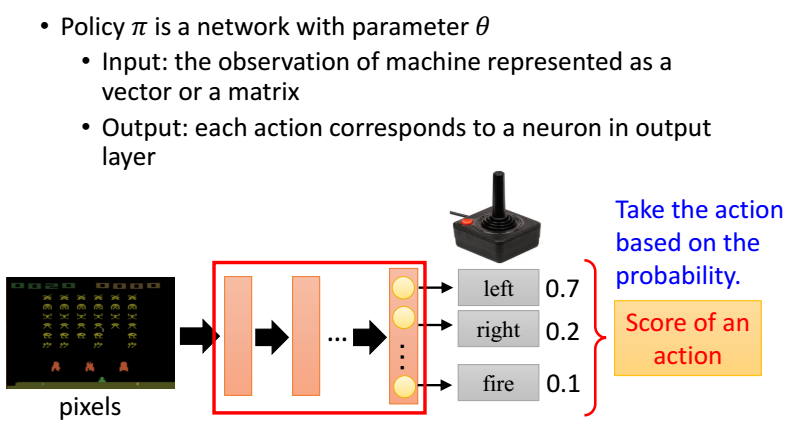
Policy Gradient,通过学习当前环境,直接给出要输出的动作的概率值。
Policy Gradient 不是单步更新,只能等玩完一个epoch,再更新参数,采取动作与动作评价是同一个函数,所以是一个on-policy
Policy Gradient 需要计算每一个state的期望reward,这个期望reward通过整个epoch的reward_list计算。所以只能等玩完1个epoch才能更新。
数学推导
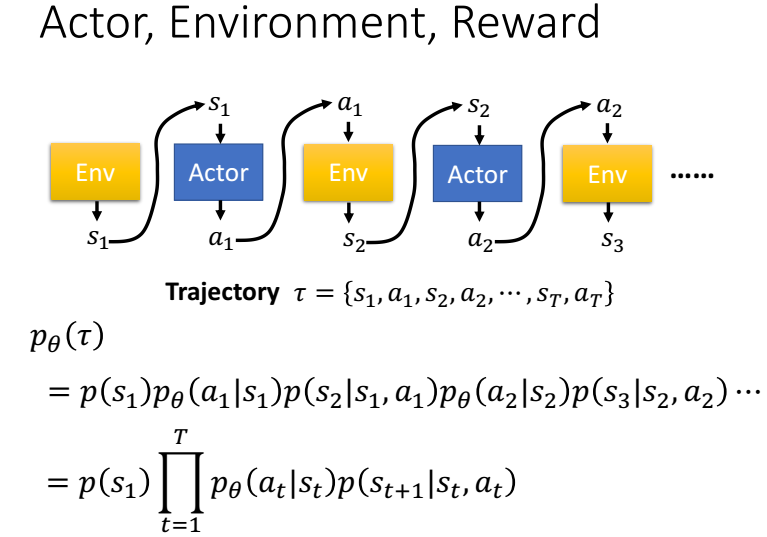
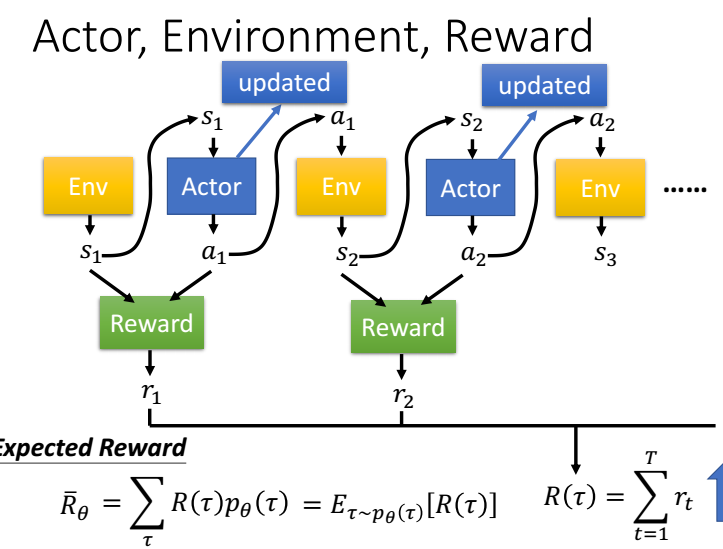
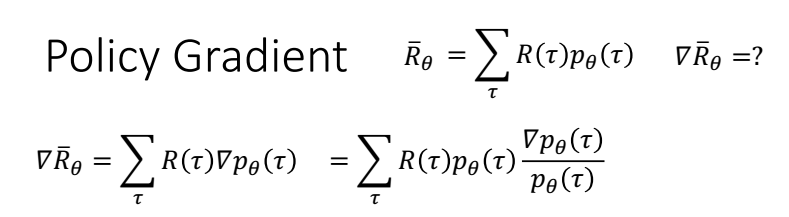
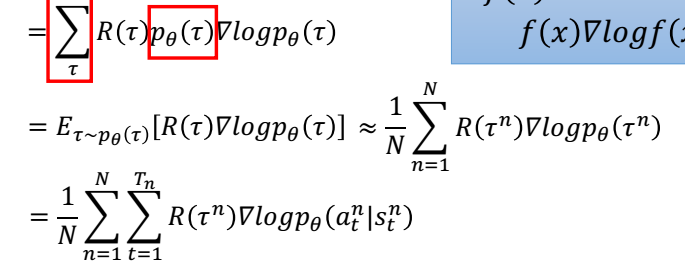
最大化R,,用梯度下降,需要求R的梯度。
vt的计算
Policy Gradient 不是单步更新,只能等玩完一个epoch,得到每个epoch的observation_list \ action\_list reward_list
学习的时候,根据这三个list更新参数,其中下图公式中的vt 根据reward_list算出来。
vt的计算
Policy Gradient 不是单步更新,只能等玩完一个epoch,得到每个epoch的observation_list \ action\_list reward_list
学习的时候,根据这三个list更新参数,其中下图公式中的vt 根据reward_list算出来。
实现方式
神经网络分类模型,但是在算loss 的时候,logloss需要乘一个系数vt,这个系数与奖励Reward相关,如果采用当前动作,
在接下来的游戏中获得的Reward越大,那么在更新梯度的时候加大当前梯度下降的速度。
算法步骤
vt的计算
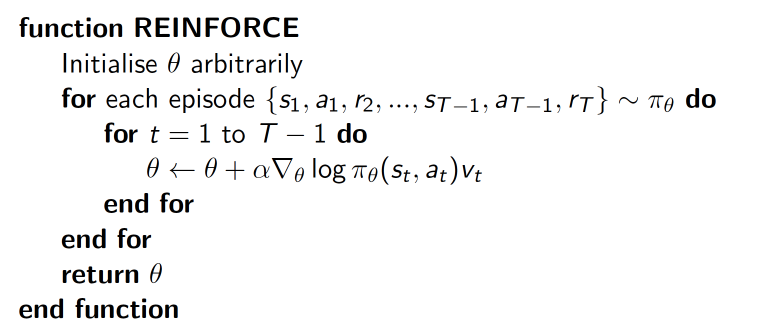
Policy Gradient 不是单步更新,只能等玩完一个epoch,得到每个epoch的observation_list \ action\_list reward_list
学习的时候,根据这三个list更新参数,其中下图公式中的vt 根据reward_list算出来。
代码
 """

 This part of code is the reinforcement learning brain, which is a brain of the agent.

 All decisions are made in here.

 Policy Gradient, Reinforcement Learning.

 View more on my tutorial page: https://morvanzhou.github.io/tutorials/

 Using:

 Tensorflow: 1.0

 gym: 0.8.0

 """

 import numpy as np

 import tensorflow as tf

 # reproducible

 np.random.seed(1)

 tf.set_random_seed(1)

 class PolicyGradient:

     def __init__(

             self,

             n_actions,

             n_features,

             learning_rate=0.01,

             reward_decay=0.95,

             output_graph=False,

     ):

         self.n_actions = n_actions

         self.n_features = n_features

         self.lr = learning_rate

         self.gamma = reward_decay

         #每个epoch的observation \ action\ reward

         self.ep_obs, self.ep_as, self.ep_rs = [], [], []

         self._build_net()

         self.sess = tf.Session()

         if output_graph:

             # $ tensorboard --logdir=logs

             # http://0.0.0.0:6006/

             # tf.train.SummaryWriter soon be deprecated, use following

             tf.summary.FileWriter("logs/", self.sess.graph)

         self.sess.run(tf.global_variables_initializer())

     def _build_net(self):

         with tf.name_scope('inputs'):

             self.tf_obs = tf.placeholder(tf.float32, [None, self.n_features], name="observations")

             self.tf_acts = tf.placeholder(tf.int32, [None, ], name="actions_num")

             self.tf_vt = tf.placeholder(tf.float32, [None, ], name="actions_value")

         # fc1

         layer = tf.layers.dense(

             inputs=self.tf_obs,

             units=10,

             activation=tf.nn.tanh,  # tanh activation

             kernel_initializer=tf.random_normal_initializer(mean=0, stddev=0.3),

             bias_initializer=tf.constant_initializer(0.1),

             name='fc1'

         )

         # fc2

         all_act = tf.layers.dense(

             inputs=layer,

             units=self.n_actions,

             activation=None,

             kernel_initializer=tf.random_normal_initializer(mean=0, stddev=0.3),

             bias_initializer=tf.constant_initializer(0.1),

             name='fc2'

         )

         self.all_act_prob = tf.nn.softmax(all_act, name='act_prob')  # use softmax to convert to probability

         with tf.name_scope('loss'):

             # to maximize total reward (log_p * R) is to minimize -(log_p * R), and the tf only have minimize(loss)

             neg_log_prob = tf.nn.sparse_softmax_cross_entropy_with_logits(logits=all_act, labels=self.tf_acts)   # this is negative log of chosen action

             # or in this way:

             # neg_log_prob = tf.reduce_sum(-tf.log(self.all_act_prob)*tf.one_hot(self.tf_acts, self.n_actions), axis=1)

             loss = tf.reduce_mean(neg_log_prob * self.tf_vt)  # reward guided loss

         with tf.name_scope('train'):

             self.train_op = tf.train.AdamOptimizer(self.lr).minimize(loss)

     def choose_action(self, observation):

         prob_weights = self.sess.run(self.all_act_prob, feed_dict={self.tf_obs: observation[np.newaxis, :]})

         action = np.random.choice(range(prob_weights.shape[1]), p=prob_weights.ravel())  # select action w.r.t the actions prob

         return action

     def store_transition(self, s, a, r):

         self.ep_obs.append(s)

         self.ep_as.append(a)

         self.ep_rs.append(r)

     def learn(self):

         # discount and normalize episode reward

         discounted_ep_rs_norm = self._discount_and_norm_rewards()

         # train on episode

         self.sess.run(self.train_op, feed_dict={

              self.tf_obs: np.vstack(self.ep_obs),  # shape=[None, n_obs]

              self.tf_acts: np.array(self.ep_as),  # shape=[None, ]

              self.tf_vt: discounted_ep_rs_norm,  # shape=[None, ]

         })

         self.ep_obs, self.ep_as, self.ep_rs = [], [], []    # empty episode data

         return discounted_ep_rs_norm

     def _discount_and_norm_rewards(self):

         # discount episode rewards

         discounted_ep_rs = np.zeros_like(self.ep_rs)

         running_add = 0

         for t in reversed(range(0, len(self.ep_rs))):

             running_add = running_add * self.gamma + self.ep_rs[t]

             discounted_ep_rs[t] = running_add

         # normalize episode rewards

         discounted_ep_rs -= np.mean(discounted_ep_rs)

         discounted_ep_rs /= np.std(discounted_ep_rs)

         return discounted_ep_rs
强化学习--Policy Gradient的更多相关文章
- 深度增强学习--Policy Gradient
前面都是value based的方法,现在看一种直接预测动作的方法 Policy Based Policy Gradient 一个介绍 karpathy的博客 一个推导 下面的例子实现的REINFOR ...
- 强化学习(十三) 策略梯度(Policy Gradient)
在前面讲到的DQN系列强化学习算法中,我们主要对价值函数进行了近似表示,基于价值来学习.这种Value Based强化学习方法在很多领域都得到比较好的应用,但是Value Based强化学习方法也有很 ...
- 深度学习课程笔记(十三)深度强化学习 --- 策略梯度方法(Policy Gradient Methods)
深度学习课程笔记(十三)深度强化学习 --- 策略梯度方法(Policy Gradient Methods) 2018-07-17 16:50:12 Reference:https://www.you ...
- 强化学习读书笔记 - 13 - 策略梯度方法(Policy Gradient Methods)
强化学习读书笔记 - 13 - 策略梯度方法(Policy Gradient Methods) 学习笔记: Reinforcement Learning: An Introduction, Richa ...
- Deep Learning专栏--强化学习之从 Policy Gradient 到 A3C(3)
在之前的强化学习文章里,我们讲到了经典的MDP模型来描述强化学习,其解法包括value iteration和policy iteration,这类经典解法基于已知的转移概率矩阵P,而在实际应用中,我们 ...
- 深度学习-深度强化学习(DRL)-Policy Gradient与PPO笔记
Policy Gradient 初始学习李宏毅讲的强化学习,听台湾的口音真是费了九牛二虎之力,后来看到有热心博客整理的很细致,于是转载来看,当作笔记留待复习用,原文链接在文末.看完笔记再去听一听李宏毅 ...
- 强化学习七 - Policy Gradient Methods
一.前言 之前我们讨论的所有问题都是先学习action value,再根据action value 来选择action(无论是根据greedy policy选择使得action value 最大的ac ...
- 深度学习课程笔记(十四)深度强化学习 --- Proximal Policy Optimization (PPO)
深度学习课程笔记(十四)深度强化学习 --- Proximal Policy Optimization (PPO) 2018-07-17 16:54:51 Reference: https://b ...
- DRL之:策略梯度方法 (Policy Gradient Methods)
DRL 教材 Chpater 11 --- 策略梯度方法(Policy Gradient Methods) 前面介绍了很多关于 state or state-action pairs 方面的知识,为了 ...
随机推荐
- GIt如何进行代码管理
一:Git账号设置(仅第一次需设置): 1.首先打开GIt Bash 界面
- java 网络编程(四)TCP通讯
客户端: package cn.sasa.TcpDemo; import java.io.IOException; import java.io.InputStream; import java.io ...
- php获取数据库结构
<!DOCTYPE html PUBLIC "-//W3C//DTD XHTML 1.0 Transitional//EN" "http://www.w3.org/ ...
- 第 9 章 DOM 的增删改查
DOM 的增删改查 本文不会详细讲解,只是简单提及知识要点,详细可以参考<dom高级编程>. 1. document.write document.write('<h1>创建节 ...
- oracle中varchar2(2)存不了一个汉字的原因
错误提示: 一个汉字占了三个字节,而不是两个,这跟字符集有关. 查一下字符集:select userenv('language') from dual; 结果显示,本机Oracle的字符集是UTF-8 ...
- Servlet----------通过 GenericServlet 开发Servlet
通过继承GenericServlet抽象类.只需要重写service()方法即可.(这个知识点了解即可) package cn.servlet; import java.io.IOException; ...
- Docker For Mac没有docker0网桥
在使用Docker时,要注意平台之间实现的差异性,如Docker For Mac的实现和标准Docker规范有区别,Docker For Mac的Docker Daemon是运行于虚拟机(xhyve) ...
- 【雅思】【写作】【大作文】Report
•Report •主要分类 •两个问题 • •1. 原因,解决办法 • •2. 原因,积极还是消极 • •3. Freestyle •报告型 •In cities and towns all over ...
- 帝国cms添加修改会员字段时字段名不能带数字,否则注册页会出现空白
这几天ytkah在整帝国cms会员模块,根据客户需求添加不同的字段,这个相对不难,可还是遇到了点问题.当时添加会员字段时,在字段名用数字“1”来代表第一次,如下图的字段名“1rwsdy” 但是添加以后 ...
- Java基础知识(重载和覆盖)
重载(overload): 在一个类中,如果出现了两个或者两个以上的同名函数,只要它们的参数的个数,或者参数的类型不同,即可称之为该函数重载了. 即当函数同名时,只看参数列表.和返回值类型没关系. 重 ...