
北大poj-1021
2D-Nim
| Time Limit: 1000MS | Memory Limit: 10000K | |
| Total Submissions: 4066 | Accepted: 1851 |
Description
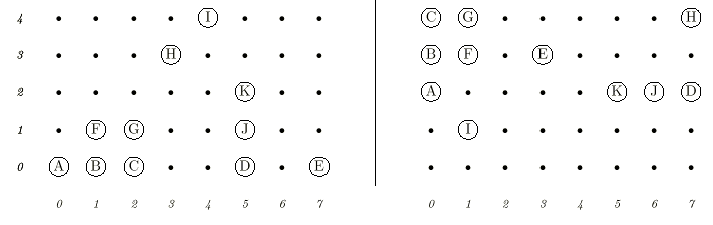
The player on move may remove (A), (B), (A, B), (A, B, C), or (B,F), etc., but may not remove (A, C), (D, E), (H, I) or (B, G).
For purposes of writing 2D-Nim-playing software, a certain
programmer wants to be able to tell whether or not a certain position
has ever been analyzed previously. Because of the rules of 2D-Nim, it
should be clear that the two boards above are essentially equivalent.
That is, if there is a winning strategy for the left board, the same one
must apply to the right board. The fact that the contiguous groups of
pieces appear in different places and orientations is clearly
irrelevant. All that matters is that the same clusters of pieces (a
cluster being a set of contiguous pieces that can be reached from each
other by a sequence of one-square vertical or horizontal moves) appear
in each. For example, the cluster of pieces (A, B, C, F, G) appears on
both boards, but it has been reflected (swapping left and right),
rotated, and moved. Your task is to determine whether two given board
states are equivalent in this sense or not.
Input
first line of the input file contains a single integer t (1 ≤ t ≤ 10),
the number of test cases, followed by the input data for each test case.
The first line of each test case consists of three integers W, H, and n
(1 ≤ W, H ≤ 100). W is the width, and H is the height of the grid in
terms of the number of grid points. n is the number of pieces on each
board. The second line of each test case contains a sequence of n pairs
of integers xi , yi, giving the coordinates of the pieces on the first
board (0 ≤ xi < W and 0 ≤ yi < H). The third line of the test case
describes the coordinates of the pieces on the second board in the same
format.
Output
program should produce a single line for each test case containing a
word YES or NO indicating whether the two boards are equivalent or not.
Sample Input
2

8 5 11

0 0 1 0 2 0 5 0 7 0 1 1 2 1 5 1 3 3 5 2 4 4

0 4 0 3 0 2 1 1 1 4 1 3 3 3 5 2 6 2 7 2 7 4

8 5 11

0 0 1 0 2 0 5 0 7 0 1 1 2 1 5 1 3 3 6 1 4 4

0 4 0 3 0 2 1 1 1 4 1 3 3 3 5 2 6 2 7 2 7 4
Sample Output
YES

NO
Source
 #include <stdio.h>

 #include <stdlib.h>

 #include <string.h>

 typedef struct

 {

     int width;

     int height;

     int num;

     int map[][][];

 }Picture;

 typedef struct

 {

     int x;

     int y;

     int factor;

 }Piont;

 Picture pic;

 Piont points[][];

 int factorCnt[][];

 int connectCnt[][];

 int connectMax[];

 void Input()

 {

     int i, j, x, y = ;

     memset(&pic, , sizeof(pic));

     scanf("%d %d %d", &pic.width, &pic.height, &pic.num);

     for(j = ; j < ; j++)

     {

         for(i = ; i < pic.num; i++)

         {

             scanf("%d %d", &x, &y);

             pic.map[j][y][x] = ;

             points[j][i].x = x;

             points[j][i].y = y;

         }

     }

 /*

     for(j = 0; j < 2; j++)

     {

         for(y = pic.height-1; y >= 0; y--)

         {

             for(x = 0; x < pic.width; x++)

             {

                 printf("%d ", pic.map[j][y][x]);

             }

             printf("\n");

         }

         printf("------------------------\n");

     }

 */

 }

 void CalcFactor()

 {

     int i, j, x, y, factor;

     memset(factorCnt, , sizeof(factorCnt));

     for(j = ; j < ; j++)

     {

         for(i = ; i < pic.num; i++)

         {

             x = points[j][i].x;

             y = points[j][i].y;

             factor = (x > ) ? pic.map[j][y][x-] : ;

             factor += (x < pic.width-) ? pic.map[j][y][x+] : ;

             factor += (y > ) ? pic.map[j][y-][x] : ;

             factor += (y < pic.height-) ? pic.map[j][y+][x] : ;

             points[j][i].factor = factor;

             factorCnt[j][factor]++;

         }

     }

 /*

     for(j = 0; j < 2; j++)

     {

         for(i = 0; i < pic.num; i++)

         {

             printf("%d   ", points[j][i].factor);

         }

         printf("\n");

     }

     printf("------------------------\n");

 */

 }

 void CheckResult()

 {

     int i, j = ;

     for(i = ; i < ; i++)

     {

         if(factorCnt[][i] != factorCnt[][i]) break;

     }

     if(connectMax[] != connectMax[])

     {

         printf("NO\n");

         return;

     }

     for(j = ; j < connectMax[]; j++)

     {

         if(connectCnt[][j] != connectCnt[][j]) break;

     }

     if(i !=  || j != connectMax[])

     {

         printf("NO\n");

     }

     else

     {

         printf("YES\n");

     }

 }

 void CalcConnect()

 {

     int j, x, y, connect;

     memset(connectMax, , sizeof(connectMax));

     memset(connectCnt, , sizeof(connectCnt));

     for(j = ; j < ; j++)

     {

         for(y = ; y < pic.height; y++)

         {

             for(x = ; x < pic.width; x++)

             {

                 if(pic.map[j][y][x] != ) continue;

                 connect = ;

                 while(++x < pic.width && pic.map[j][y][x] == )

                 {

                     connect++;

                 }

                 connectCnt[j][connect]++;

                 if(connect > connectMax[j]) connectMax[j] = connect;

             }

         }

         for(x = ; x < pic.width; x++)

         {

             for(y = ; y < pic.height; y++)

             {

                 if(pic.map[j][y][x] != ) continue;

                 connect = ;

                 while(++y < pic.height && pic.map[j][y][x] == )

                 {

                     connect++;

                 }

                 connectCnt[j][connect]++;

                 if(connect > connectMax[j]) connectMax[j] = connect;

             }

         }

     }

 }

 void Proc()

 {

     CalcFactor();

     CalcConnect();

     CheckResult();

 }

 int main()

 {

     int num = ;

     scanf("%d", &num);

     while(num--)

     {

         Input();

         Proc();

     }

     return ;

 }
北大poj-1021的更多相关文章
- 北大POJ题库使用指南
原文地址:北大POJ题库使用指南 北大ACM题分类主流算法: 1.搜索 //回溯 2.DP(动态规划)//记忆化搜索 3.贪心 4.图论 //最短路径.最小生成树.网络流 5.数论 //组合数学(排列 ...
- poj 1021矩阵平移装换后是否为同一个矩阵
2D-Nim Time Limit: 1000MS Memory Limit: 10000K Total Submissions: 3081 Accepted: 1398 Descriptio ...
- POJ 1021 2D-Nim
Description The 2D-Nim board game is played on a grid, with pieces on the grid points. On each move, ...
- POJ 1021 人品题
报告见代码.. #include <iostream> #include <cstdio> #include <cstring> #include <algo ...
- 【Java】深深跪了,OJ题目Java与C运行效率对比(附带清华北大OJ内存计算的对比)
看了园友的评论之后,我也好奇清橙OJ是怎么计算内存占用的.重新测试的情况附在原文后边. -------------------------------------- 这是切割线 ----------- ...
- POJ 1861 Network (Kruskal算法+输出的最小生成树里最长的边==最后加入生成树的边权 *【模板】)
Network Time Limit: 1000MS Memory Limit: 30000K Total Submissions: 14021 Accepted: 5484 Specia ...
- 各大OJ
北大POJ 杭电HDU 浙大ZOj 蓝桥杯 PAT
- leetcode学习笔记--开篇
1 LeetCode是什么? LeetCode是一个在线的编程测试平台,国内也有类似的Online Judge平台.程序开发人员可以通过在线刷题,提高对于算法和数据结构的理解能力,夯实自己的编程基础. ...
- OJ题目JAVA与C运行效率对比
[JAVA]深深跪了,OJ题目JAVA与C运行效率对比(附带清华北大OJ内存计算的对比) 看了园友的评论之后,我也好奇清橙OJ是怎么计算内存占用的.重新测试的情况附在原文后边. ----------- ...
- C++ 指针常见用法小结
1. 概论 2.指针基础 3. 指针进阶 4. 一维数组的定义与初始化 5. 指针和数组 6. 指针运算 7. 多维数组和指针 8. 指针形参 9. 数组形参 10. 返回指针和数组 11. 结语 ...
随机推荐
- 腾讯云centos7.2安装宝塔面板和LAMP
1.安装好centos7.2系统后,登录centos系统输入如下命令: yum install -y wget && wget -O install.sh http://downloa ...
- Jquery封装的Ajax
$.get方法 语法: $.get(url,data,function(e){ //e就是服务器返回的数据 },dataType); 四个参数: url: 请求的服务器地址 data: 发送给服务器的 ...
- Adb工具的简单使用
Adb全称为Android Debug Bridge adb就是连接android手机与PC机的桥梁,可以在pc端对手机进行全面的操作 借助adb工具,可以管理设备或者手机模拟器的状态,进行手机操作, ...
- Redis 知识整理
1. 什么是Redis Redis是开源的.基于内存的键值对数据库. 2. Redis 的基本操作 set key value => mset, setbit, hset get key =&g ...
- mac常用操作
Command+Shift+. 可以显示隐藏文件.文件夹 touch a.txt 新建txt文件
- javascript高级程序设计第3版——第7章 函数表达式
此张内容的难点在于闭包.而闭包又涉及到原型,原型链,执行上下环境,this的取值等知识点.(此章节对于闭包的内容篇幅较少,且写的很是艰涩难懂,推荐一位大牛的博客,对于闭包的前因后果以及作用机制写的很明 ...
- Redhat 6.3上安装libssh
遇到了很多坑,决定记录下来,有些经验还是很有帮助的. 最重要的一条就是:安装rpm包,总是比编译源码安装(make&make install)更快.记住两个rpm网站:https://pkgs ...
- iOS 性能优化总结
卡顿产生的原因 在 VSync信号到来后,系统图形服务会通过 CADisplayLink等机制通知 App,App主线程开始在 CPU中计算显示内容,比如视图的创建.布局计算.图片解码.文本绘制等.随 ...
- CouchDB客户端开发—Java版
在Fedora上安装CouchDB: yum update yum install couchdb 修改/etc/couchdb下local.ini文件: port = 5984bind_addres ...
- 跟随我在oracle学习php(18)
修改表: 一般概述 通常,创建一个表,能搞定(做到)的事情,修改表也能做到.大体来说,就可以做到: 增删改字段: 增:alter table 表名 add [column] 字段名 字段类 ...