
+5v to +13v Converter
http://www.romanblack.com/smps/conv.htm
What is it?
This is a simple smps voltage converter, it makes an output voltage of +13.3v from a "standard" +5v supply as used with logic chips.
I was contacted by hobby PIC programmer legend Myke Predko about designing a simple and cheap circuit to produce the 13v Vpp voltage needed to program PIC chips from a standard 5v regulated supply. This would eliminate the need for an smps 13v converter chip.
The circuit I settled on worked out very cheap, using a cheap 470uH "RF choke" type inductor and a very cheap 1N4148 small signal diode as the rectifier. The two transistor types are not critical. Measured efficiency was 72% which is quite reasonable from such a simple low power circuit.

The inductor can be a cheap small "RF choke" type.
Specs
- Tiny cheap RF type inductor
- Very cheap circuit (under 50 cents in parts!)
- Reliable self-starting
- 72% efficiency
- Input: 5v regulated
- Output: 13.3v @ 12mA maximum
The Circuit
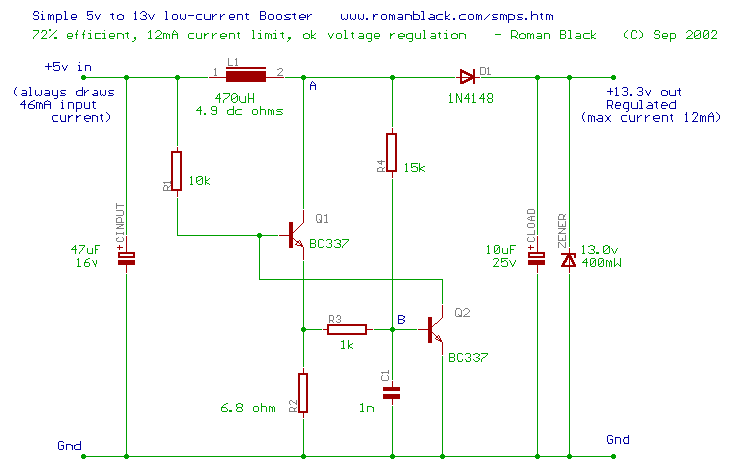
How it works
The circuit regulates around peak inductor current, and since input voltage remains constant it also regulates input current and hence input power.
The regulation mechanism is R2, by ensuring that if R2 volts exceeds 0.6v main switch Q1 will turn off. The input current path is via L1, Q1 and R2.
Oscillation duty cycle is close to 50:50 so with an R2 of 6.8 ohms, peak inductor current is about 90mA and the average input current is about 46mA. Total current requirements can be reduced by increasing R2.
Notes
DO NOT run the circuit with no zener, and do not remove the zener when the circuit is running! Like any boost converter it may produce high voltages without the zener output clamp, and may damage transistors or the diode etc.
The circuit oscillates mainly based on inductor characteristics, and the cap C1 is not really a tuning cap, instead it provides some stability of oscillation waveform at a frequency determined mainly by inductance and the total load.
This booster is a CONSTANT POWER regulator. It always draws 46mA from the 5v supply (230mW), and delivers this power to the load at about 72% efficiency. So the load always gets about 13.3v and 12mA. If the output is overloaded at currents greater than 12mA the output voltage drops, providing a crude current regulation. If the output voltage is further overloaded to the point where it drops below 5v the diode starts passing current directly from the 5v supply and input current rises a LOT. Overloads like this should be avoided!
Important Notes!
The 13.3v output can be turned on or off by attaching the R1 resistor to +5v (as shown) or to 0v to turn it off. R1 can be attached to a PIC output pin to control the circuit.
When the circuit is OFF the output is about 4.3v and total current consumption is about 0.4mA.
When the circuit is ON the output is 13.3v and total current consumption is about 46mA.
For a PIC programmer application; the MCLR must rise very quickly to 13v to initiate programming. Use a 3k3 resistor in series with the output, going to the MCLR pin. Then use an additional NPN transistor to hold MCLR low as an open-collector pull-down. This transistor can then be switched and will switch the output voltage very quickly from 0v to 13v. (This is necessary with the smps 13v generator chips also.)
High Power / High Voltage?
Note! This circuit can be quite usable for higher power applications, and will oscillate reliably with a larger (high power) version of Q1 like a TO-220 darlington type. Remember it regulates INPUT current, and will provide a fairly regulated amount of power to the high voltage output load. It can be used as a simple 4 watt fluoro tube driver with a 12 volt input (for example). If you try this, try these values;
- Q1 = TIP122 darlington (see note)
- L1 = 470uH 500mA ferrite core inductor
- D1 = 1N4937 600v 1A fast rectifier
- R1 = 4k7
- R2 = 3.3 ohm
- R4 = 56k
- CLOAD = 0.1uF (not critical) but must be 630 volt type
With a 12v input this will run about 2 watts and make a usable light from the fluoro tube. Remove the zener and connect the output to a 4 watt (5 inch) fluoro tube like a F4T5 type. You may need a heatsink for Q1. I used a TIP-122 as it was lying around, but a high voltage darlington (>300v) is better. Remember this produces high voltages and you MUST always have the tube connected. Have fun and work safely with high voltages!
- end -
+5v to +13v Converter的更多相关文章
- USB ISP(ICSP) Open Programmer < PWM ADC HV PID >
http://sourceforge.net/projects/openprogrammer/?source=navbar Open Programmer http://openprog.alterv ...
- TPS54331 TPS54332 3.5V to 28V Input, 3A, 570kHz Step-Down Converter with Eco-mode
The TPS54331 is a 28-V, 3-A non-synchronous buck converter that integrates a low RDS(on) high side M ...
- Tracking Boost Regulator TYPICAL 5V REGULATION WITH BOOST CONVERTER AND LDO
Cs5171: Tracking Boost Regulator Adding a current mirror circuit to a typical boost circuit allows t ...
- Digital Adjustment of DC-DC Converter Output Voltage in Portable Applications
http://pdfserv.maximintegrated.com/en/an/AN818.pdf http://www.maximintegrated.com/app-notes/index.mv ...
- Practice safe dc/dc converter
Short-circuit protection is an obvious requirement for a power supply, especially when its load conn ...
- Simple dc/dc converter increases available power in dual-voltage system
The schematic in Figure 1 shows a way to increase the power available from a current-limited 5V supp ...
- LT1946A-- Transformerless dc/dc converter produces bipolar outputs
Dual-polarity supply provides ±12V from one IC VC (Pin 1): Error Amplifier Output Pin. Tie external ...
- Add margining capability to a dc/dc converter
You can easily add margining capability—that is, the ability to digitally adjust the output voltage— ...
- MP2359 1.2A, 24V, 1.4MHz Step-Down Converter in a TSOT23-6
The MP2359 is a monolithic step-down switch mode converter with a built-in power MOSFET.It achieves ...
随机推荐
- ibm x3550m4 开启cpu高性能模式
1.必须进bios里调整,和调整超线程一样,重启服务器按F1进bios界面,选择system settings 2.选择最大性能模式:Operating Modes>Choose Operati ...
- 使用html+css+js实现魔性的舞蹈
使用html+css+js实现魔性的舞蹈,让我们燥起来!!! 效果图: 代码如下,复制代码即可使用: <!DOCTYPE html> <html > <head> ...
- MinGW-MSYS Bundle Win32编译ffmpeg 生成DLL并加入X264模块
组件资源站点 1)MinGW-MSYS Bundle http://sourceforge.net/projects/mingwbundle/files/ 2)yasm汇编器 http://yasm. ...
- Django杂记
django 中 slice 和 truncatewords 不同用法 django中取一段字符串中的前 N 个字符,可以用 slice和truncatewords ,但是两者是有区别的. djang ...
- 浅谈C#中的值类型和引用类型
在C#中,值类型和引用类型是相当重要的两个概念,必须在设计类型的时候就决定类型实例的行为.如果在编写代码时不能理解引用类型和值类型的区别,那么将会给代码带来不必要的异常.很多人就是因为没有弄清楚这两个 ...
- Owin 自定义中间件
/// <summary> /// 自定义的中间件 /// </summary> public class CustomMiddleware : OwinMiddleware ...
- Hive(八)Hive的Shell操作与压缩存储
一.Hive的命令行 1.Hive支持的一些命令 Command Description quit Use quit or exit to leave the interactive shell. s ...
- 使用VSCode配置简单的vue项目
由于最近要使用的项目框架为前后端分离的,采用的是vue.js+webAPI的形式进行开发的.因为之前我没有接触过vue.js,也只是通过视频文档做了一些简单的练习.今天技术主管说让大家熟悉下VSCod ...
- 全局设置axios发送cookie(axios 默认不发送cookie)
import axios from 'axios' axios.defaults.withCredentials=true; 如图:
- ref:CodeIgniter框架内核设计缺陷可能导致任意代码执行
ref:https://www.seebug.org/vuldb/ssvid-96217 简要描述: 为准备乌云深圳沙龙,准备几个0day做案例. 官方承认这个问题,说明会发布补丁,但不愿承认这是个『 ...