
Spark MLlib基本算法【相关性分析、卡方检验、总结器】
一.相关性分析
1.简介
计算两个系列数据之间的相关性是统计中的常见操作。在spark.ml中提供了很多算法用来计算两两的相关性。目前支持的相关性算法是Pearson和Spearman。Correlation使用指定的方法计算输入数据集的相关矩阵。输出是一个DataFrame,其中包含向量列的相关矩阵。
2.代码实现
 package ml

 import org.apache.log4j.{Level, Logger}

 import org.apache.spark.ml.linalg.{Matrix, Vectors}

 import org.apache.spark.ml.stat.Correlation

 import org.apache.spark.sql.{Row, SparkSession}

 /**

   * Created by Administrator on 2019/11/28.

   */

 object CorrelationDemo {

   Logger.getLogger("org").setLevel(Level.WARN)

   def main(args: Array[String]) {

     val spark = SparkSession.builder().appName(s"${this.getClass.getSimpleName}").master("local[2]").getOrCreate()

     import spark.implicits._ // 导入,否则无法使用toDF算子

     val data = Seq(

       Vectors.sparse(4, Seq((0, 1.0), (3, -2.0))),

       Vectors.dense(4.0, 5.0, 0.0, 3.0),

       Vectors.dense(6.0, 7.0, 0.0, 8.0),

       Vectors.sparse(4, Seq((0, 9.0), (3, 1.0)))

     )

     val df = data.map(Tuple1.apply).toDF("features")

     val Row(coeff : Matrix) = Correlation.corr(df, "features").head

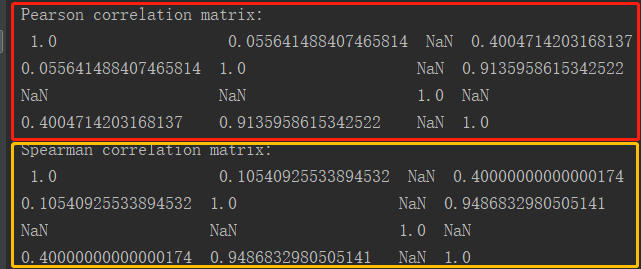
     println(s"Pearson correlation matrix:\n $coeff")

     df.cache()

     val Row(coeff2 : Matrix) = Correlation.corr(df, "features", "spearman").head

     println(s"Spearman correlation matrix:\n $coeff2")

   }

 }
3.源码分析
package org.apache.spark.ml.stat

import scala.collection.JavaConverters._

import org.apache.spark.annotation.{Experimental, Since}

import org.apache.spark.ml.linalg.{SQLDataTypes, Vector}

import org.apache.spark.mllib.linalg.{Vectors => OldVectors}

import org.apache.spark.mllib.stat.{Statistics => OldStatistics}

import org.apache.spark.sql.{DataFrame, Dataset, Row}

import org.apache.spark.sql.types.{StructField, StructType}

/**

 * API for correlation functions in MLlib, compatible with DataFrames and Datasets.

 *

 * The functions in this package generalize the functions in [[org.apache.spark.sql.Dataset#stat]]

 * to spark.ml's Vector types.

 */

@Since("2.2.0")

@Experimental

object Correlation {

  /**

   * :: Experimental ::

   * Compute the correlation matrix for the input Dataset of Vectors using the specified method.

   * Methods currently supported: `pearson` (default), `spearman`.

   *

   * @param dataset A dataset or a dataframe

   * @param column The name of the column of vectors for which the correlation coefficient needs

   *               to be computed. This must be a column of the dataset, and it must contain

   *               Vector objects.

   * @param method String specifying the method to use for computing correlation.

   *               Supported: `pearson` (default), `spearman`

   * @return A dataframe that contains the correlation matrix of the column of vectors. This

   *         dataframe contains a single row and a single column of name

   *         '$METHODNAME($COLUMN)'.

   * @throws IllegalArgumentException if the column is not a valid column in the dataset, or if

   *                                  the content of this column is not of type Vector.

   *

   *  Here is how to access the correlation coefficient:

   *  {{{

   *    val data: Dataset[Vector] = ...

   *    val Row(coeff: Matrix) = Correlation.corr(data, "value").head

   *    // coeff now contains the Pearson correlation matrix.

   *  }}}

   *

   * @note For Spearman, a rank correlation, we need to create an RDD[Double] for each column

   * and sort it in order to retrieve the ranks and then join the columns back into an RDD[Vector],

   * which is fairly costly. Cache the input Dataset before calling corr with `method = "spearman"`

   * to avoid recomputing the common lineage.

   */

  @Since("2.2.0")

  def corr(dataset: Dataset[_], column: String, method: String): DataFrame = {

    val rdd = dataset.select(column).rdd.map {

      case Row(v: Vector) => OldVectors.fromML(v)

    }

    val oldM = OldStatistics.corr(rdd, method)

    val name = s"$method($column)"

    val schema = StructType(Array(StructField(name, SQLDataTypes.MatrixType, nullable = false)))

    dataset.sparkSession.createDataFrame(Seq(Row(oldM.asML)).asJava, schema)

  }

  /**

   * Compute the Pearson correlation matrix for the input Dataset of Vectors.

   */

  @Since("2.2.0")

  def corr(dataset: Dataset[_], column: String): DataFrame = {

    corr(dataset, column, "pearson")

  }

}
4.执行结果
二.卡方检验
1.简介
ChiSquareTest针对标签上的每个功能进行Pearson独立性检验。对于每个特征,将(特征,标签)对转换为列矩阵,针对该列矩阵计算卡方统计量。所有标签和特征必须是分类数据。
2.代码实现
 package ml

 import org.apache.log4j.{Level, Logger}

 import org.apache.spark.ml.linalg.Vectors

 import org.apache.spark.ml.stat.ChiSquareTest

 import org.apache.spark.sql.SparkSession

 /**

   * Created by Administrator on 2019/11/28.

   */

 object ChiSquare {

   Logger.getLogger("org").setLevel(Level.WARN)

   def main(args: Array[String]) {

     val spark = SparkSession.builder().appName(s"${this.getClass.getSimpleName}").master("local[2]").getOrCreate()

     import spark.implicits._// 导入,否则无法使用toDF算子

     val data = Seq(

       (0.0, Vectors.dense(0.5, 10.0)),

       (0.0, Vectors.dense(1.5, 20.0)),

       (1.0, Vectors.dense(1.5, 30.0)),

       (0.0, Vectors.dense(3.5, 30.0)),

       (0.0, Vectors.dense(3.5, 40.0)),

       (1.0, Vectors.dense(3.5, 40.0))

     )

     val df = data.toDF("label", "features")

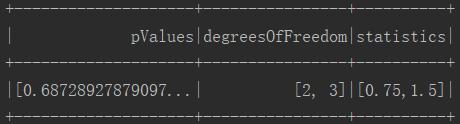
     val chi = ChiSquareTest.test(df, "features", "label") // 卡方检验

     chi.show()

   }

 }
3.源码分析
package org.apache.spark.ml.stat

import org.apache.spark.annotation.{Experimental, Since}

import org.apache.spark.ml.linalg.{Vector, Vectors, VectorUDT}

import org.apache.spark.ml.util.SchemaUtils

import org.apache.spark.mllib.linalg.{Vectors => OldVectors}

import org.apache.spark.mllib.regression.{LabeledPoint => OldLabeledPoint}

import org.apache.spark.mllib.stat.{Statistics => OldStatistics}

import org.apache.spark.sql.DataFrame

import org.apache.spark.sql.functions.col

/**

 * :: Experimental ::

 *

 * Chi-square hypothesis testing for categorical data.

 *

 * See <a href="http://en.wikipedia.org/wiki/Chi-squared_test">Wikipedia</a> for more information

 * on the Chi-squared test.

 */

@Experimental

@Since("2.2.0")

object ChiSquareTest {

  /** Used to construct output schema of tests */

  private case class ChiSquareResult(

      pValues: Vector,

      degreesOfFreedom: Array[Int],

      statistics: Vector)

  /**

   * Conduct Pearson's independence test for every feature against the label. For each feature, the

   * (feature, label) pairs are converted into a contingency matrix for which the Chi-squared

   * statistic is computed. All label and feature values must be categorical.

   *

   * The null hypothesis is that the occurrence of the outcomes is statistically independent.

   *

   * @param dataset  DataFrame of categorical labels and categorical features.

   *                 Real-valued features will be treated as categorical for each distinct value.

   * @param featuresCol  Name of features column in dataset, of type `Vector` (`VectorUDT`)

   * @param labelCol  Name of label column in dataset, of any numerical type

   * @return DataFrame containing the test result for every feature against the label.

   *         This DataFrame will contain a single Row with the following fields:

   *          - `pValues: Vector`

   *          - `degreesOfFreedom: Array[Int]`

   *          - `statistics: Vector`

   *         Each of these fields has one value per feature.

   */

  @Since("2.2.0")

  def test(dataset: DataFrame, featuresCol: String, labelCol: String): DataFrame = {

    val spark = dataset.sparkSession

    import spark.implicits._

    SchemaUtils.checkColumnType(dataset.schema, featuresCol, new VectorUDT)

    SchemaUtils.checkNumericType(dataset.schema, labelCol)

    val rdd = dataset.select(col(labelCol).cast("double"), col(featuresCol)).as[(Double, Vector)]

      .rdd.map { case (label, features) => OldLabeledPoint(label, OldVectors.fromML(features)) }

    val testResults = OldStatistics.chiSqTest(rdd)

    val pValues: Vector = Vectors.dense(testResults.map(_.pValue))

    val degreesOfFreedom: Array[Int] = testResults.map(_.degreesOfFreedom)

    val statistics: Vector = Vectors.dense(testResults.map(_.statistic))

    spark.createDataFrame(Seq(ChiSquareResult(pValues, degreesOfFreedom, statistics)))

  }

}
4.执行结果
三.总结器
1.简介
其提供矢量列汇总统计DataFrame的Summarizer。可以度量按列的最大值、最小值、平均值、方差和非零个数,以及总数。
2.代码实现
 package ml

 import org.apache.log4j.{Level, Logger}

 import org.apache.spark.ml.linalg.Vectors

 import org.apache.spark.ml.stat.Summarizer._  // 导入总结器

 import org.apache.spark.sql.SparkSession

 import org.apache.spark.ml.linalg.Vector

 /**

   * Created by Administrator on 2019/11/28.

   */

 object Summary {

   Logger.getLogger("org").setLevel(Level.WARN)

   def main(args: Array[String]) {

     val spark = SparkSession.builder().appName(s"${this.getClass.getSimpleName}").master("local[2]").getOrCreate()

     import spark.implicits._// 导入,否则无法使用toDF算子

     /**

       * features数据个数不一致时报错:

       * Dimensions mismatch when merging with another summarizer. Expecting 3 but got 2.

       */

     val data = Seq(

       (Vectors.dense(2.0, 3.0, 5.0), 1.0),

       (Vectors.dense(4.0, 6.0, 8.0), 2.0)

     )

     val df = data.toDF("features", "weight")

     /**

       * 计算均值时考虑权重

       * [(2.0*1+4.0*2)/3,(3.0*1+6.0*2)/3,(5.0*1+8.0*2)/3) = [3.333333333333333,5.0,7.0]

       * 方差的计算不考虑权重

       */

     val (meanVal, varianceVal) = df.select(metrics("mean", "variance").summary($"features", $"weight").as("summary"))

       .select("summary.mean", "summary.variance")

       .as[(Vector, Vector)].first()

     println(s"with weight:mean = ${meanVal},variance = ${varianceVal}")

     /**

       * 计算均值,无权重

       * [(2.0+4.0)/2,(3.0+6.0)/2,(5.0+8.0)/2) = [3.0,4.5,6.5]

       */

     val (meanVal2, varianceVal2) = df.select(mean($"features"), variance($"features"))

       .as[(Vector, Vector)].first()

     println(s"with weight:mean = ${meanVal2}, variance = ${varianceVal2}")

   }

 }
3.源码分析
/**

 * Tools for vectorized statistics on MLlib Vectors.

 *

 * The methods in this package provide various statistics for Vectors contained inside DataFrames.

 *

 * This class lets users pick the statistics they would like to extract for a given column. Here is

 * an example in Scala:

 * {{{

 *   import org.apache.spark.ml.linalg._

 *   import org.apache.spark.sql.Row

 *   val dataframe = ... // Some dataframe containing a feature column and a weight column

 *   val multiStatsDF = dataframe.select(

 *       Summarizer.metrics("min", "max", "count").summary($"features", $"weight")

 *   val Row(Row(minVec, maxVec, count)) = multiStatsDF.first()

 * }}}

 *

 * If one wants to get a single metric, shortcuts are also available:

 * {{{

 *   val meanDF = dataframe.select(Summarizer.mean($"features"))

 *   val Row(meanVec) = meanDF.first()

 * }}}

 *

 * Note: Currently, the performance of this interface is about 2x~3x slower than using the RDD

 * interface.

 */

@Experimental

@Since("2.3.0")

object Summarizer extends Logging {

  import SummaryBuilderImpl._

  /**

   * Given a list of metrics, provides a builder that it turns computes metrics from a column.

   *

   * See the documentation of [[Summarizer]] for an example.

   *

   * The following metrics are accepted (case sensitive):

   *  - mean: a vector that contains the coefficient-wise mean.

   *  - variance: a vector tha contains the coefficient-wise variance.

   *  - count: the count of all vectors seen.

   *  - numNonzeros: a vector with the number of non-zeros for each coefficients

   *  - max: the maximum for each coefficient.

   *  - min: the minimum for each coefficient.

   *  - normL2: the Euclidean norm for each coefficient.

   *  - normL1: the L1 norm of each coefficient (sum of the absolute values).

   * @param metrics metrics that can be provided.

   * @return a builder.

   * @throws IllegalArgumentException if one of the metric names is not understood.

   *

   * Note: Currently, the performance of this interface is about 2x~3x slower then using the RDD

   * interface.

   */

  @Since("2.3.0")

  @scala.annotation.varargs

  def metrics(metrics: String*): SummaryBuilder = {

    require(metrics.size >= 1, "Should include at least one metric")

    val (typedMetrics, computeMetrics) = getRelevantMetrics(metrics)

    new SummaryBuilderImpl(typedMetrics, computeMetrics)

  }

  @Since("2.3.0")

  def mean(col: Column, weightCol: Column): Column = {

    getSingleMetric(col, weightCol, "mean")

  }

  @Since("2.3.0")

  def mean(col: Column): Column = mean(col, lit(1.0))

  @Since("2.3.0")

  def variance(col: Column, weightCol: Column): Column = {

    getSingleMetric(col, weightCol, "variance")

  }

  @Since("2.3.0")

  def variance(col: Column): Column = variance(col, lit(1.0))

...
4.执行结果

Spark MLlib基本算法【相关性分析、卡方检验、总结器】的更多相关文章
- Spark MLlib回归算法------线性回归、逻辑回归、SVM和ALS
Spark MLlib回归算法------线性回归.逻辑回归.SVM和ALS 1.线性回归: (1)模型的建立: 回归正则化方法(Lasso,Ridge和ElasticNet)在高维和数据集变量之间多 ...
- Spark MLlib之线性回归源代码分析
1.理论基础 线性回归(Linear Regression)问题属于监督学习(Supervised Learning)范畴,又称分类(Classification)或归纳学习(Inductive Le ...
- Spark MLlib回归算法LinearRegression
算法说明 线性回归是利用称为线性回归方程的函数对一个或多个自变量和因变量之间关系进行建模的一种回归分析方法,只有一个自变量的情况称为简单回归,大于一个自变量情况的叫做多元回归,在实际情况中大多数都是多 ...
- spark mllib k-means算法实现
package iie.udps.example.spark.mllib; import java.util.regex.Pattern; import org.apache.spark.SparkC ...
- Spark MLlib架构解析(含分类算法、回归算法、聚类算法和协同过滤)
Spark MLlib架构解析 MLlib的底层基础解析 MLlib的算法库分析 分类算法 回归算法 聚类算法 协同过滤 MLlib的实用程序分析 从架构图可以看出MLlib主要包含三个部分: 底层基 ...
- Spark入门实战系列--8.Spark MLlib(上)--机器学习及SparkMLlib简介
[注]该系列文章以及使用到安装包/测试数据 可以在<倾情大奉送--Spark入门实战系列>获取 .机器学习概念 1.1 机器学习的定义 在维基百科上对机器学习提出以下几种定义: l“机器学 ...
- Spark 实践——基于 Spark MLlib 和 YFCC 100M 数据集的景点推荐系统
1.前言 上接 YFCC 100M数据集分析笔记 和 使用百度地图api可视化聚类结果, 在对 YFCC 100M 聚类出的景点信息的基础上,使用 Spark MLlib 提供的 ALS 算法构建推荐 ...
- Spark MLlib介绍
Spark MLlib介绍 Spark之所以在机器学习方面具有得天独厚的优势,有以下几点原因: (1)机器学习算法一般都有很多个步骤迭代计算的过程,机器学习的计算需要在多次迭代后获得足够小的误差或者足 ...
- FP-Growth in Spark MLLib
并行FP-Growth算法思路 上图的单线程形成的FP-Tree. 分布式算法事实上是对FP-Tree进行分割,分而治之 首先,假设我们只关心...|c这个conditional transactio ...
随机推荐
- Linux下Nginx的安装(二)
一.安装Nginx ## 安装前准备 ## #GNU编译器集合 #Nginx编译需要PCRE #在Nginx的各种模块中需要使用gzip压缩 #在Nginx中,如果服务器提供安全网页时则会用到Open ...
- JDOJ 2254 Who am I?
JDOJ 2254: Who am I? Description 输出程序自己本身的源代码. Input 无 Output 输出程序自己本身的源代码. 我真是搞不懂了出这道题还把它归到程序语法基础题里 ...
- 点云深度学习的3D场景理解
转载请注明本文链接: https://www.cnblogs.com/Libo-Master/p/9759130.html PointNet: Deep Learning on Point Sets ...
- 01.JAVA语言基础相关解答
1.首先,第一个问题谈到一个java类文件中真的只能有一个公有类吗?并给出了以下代码.可以看出这个程序里有两个public类: 我进行了不同的调试: ...
- wafer2的keng
一.之前用wafer2开发的小程序,今天突然Error: 用户未登录过,请先使用 login() 登录? 答:改用qcloud.login, 替换掉qcloud.loginWithCode (小程序代 ...
- Burst Balloons(leetcode戳气球,困难)从指数级时间复杂度到多项式级时间复杂度的超详细优化思路(回溯到分治到动态规划)
这道题目做了两个晚上,发现解题思路的优化过程非常有代表性.文章详细说明了如何从回溯解法改造为分治解法,以及如何由分治解法过渡到动态规划解法.解法的用时从 超时 到 超过 95.6% 提交者,到超过 9 ...
- ESA2GJK1DH1K升级篇: 快速的移植升级程序到自己的项目(BootLoader程序制作)
前言 此代码兼容STM32F103全系列 为避免添加上升级程序造成内存不足,请使用128KB Flash及其以上的型号 这篇文章是为了能够让大家快速移植我的升级模板程序到自己的项目 BootLoade ...
- Linux性能优化实战学习笔记:第十三讲
问题1:性能工具版本太低,导致指标不全 解决方案1: 这是使用 CentOS 的同学普遍碰到的问题.在文章中,我的pidstat 输出里有一个 %wait 指标,代表进程等待 CPU 的时间百分比, ...
- shell脚本特殊变量($0、$1、$2、 $?、 $# 、$@、 $*)
$0 Shell本身的文件名$1-$n 添加到Shell的各参数值.$1是第1参数.$2是第2参数…$$ Shell本身的PID(ProcessID) $! ...
- WPF DataGrid 鼠标对表格双击导致客户端崩溃
该问题是由于在创建DataGrid时没有设置为只读属性 解决: <DataGrid Name="switchInfoList" MouseLeftBu ...