
What's the difference between @Component, @Repository & @Service annotations in Spring?
@Component is equivalent to
<bean>@Service, @Controller , @Repository = {@Component + some more special functionality}
That mean Service,Controller and Repository are functionally the same.
The three annotations are used to separate "Layers" in your application,
- Controllers just do stuff like dispatching, forwarding, calling service methods etc.
- Service Hold business Logic, Calculations etc.
- Repository are the DAOs(Data Access Objects), they access the database directly.
Now you may ask why separate them:(I assume you know AOP-Aspect Oriented Programming)
Lets say you want to Monitors the Activity of the DAO Layer only. You will write an Aspect(A class) class that does some logging before and after every method of your DAO is invoked, you are able to do that using AOP as you have three distinct Layers and are not mixed.
So you can do logging of DAO "around", "before" or "after" the DAO methods. You could do that because you had a DAO in the first place. What you just achieved is Separation of concerns or tasks.
Imagine if there were only one annotation @Controller, then this component will have dispatching, business logic and accessing database all mixed, so dirty code!
Above mentioned is one very common scenario, there are many more use cases of why to use three annotations.
In Spring @Component, @Service, and @Controller. @Component are Stereotype annotations which is used for:
@Controller: where your request mapping from presentation page done i.e. Presentation layer won't go to any other file it goes directly to @Controller class and check for requested path in @RequestMapping annotation which written before method calls if necessary.
@Service: All business logic is here i.e. Data related calculations and all.This annotation of business layer in which our user not directly call persistence method so it will call this methods using this annotation. It will request @Repository as per user request
@Repository:This is Persistence layer(Data Access Layer) of application which used to get data from database. i.e. all the Database related operations are done by repository.
@Component - Annotate your other components (for example REST resource classes) with component stereotype.
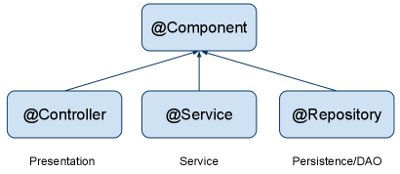
From Spring Documentation:
In Spring 2.0 and later, the @Repository annotation is a marker for any class that fulfills the role or stereotype (also known as Data Access Object or DAO) of a repository. Among the uses of this marker is the automatic translation of exceptions.
Spring 2.5 introduces further stereotype annotations: @Component, @Service, and @Controller. @Component is a generic stereotype for any Spring-managed component. @Repository, @Service, and @Controller are specializations of @Component for more specific use cases, for example, in the persistence, service, and presentation layers, respectively.
Therefore, you can annotate your component classes with @Component, but by annotating them with @Repository, @Service, or @Controller instead, your classes are more properly suited for processing by tools or associating with aspects. For example, these stereotype annotations make ideal targets for pointcuts.
Thus, if you are choosing between using @Component or @Service for your service layer, @Service is clearly the better choice. Similarly, as stated above, @Repository is already supported as a marker for automatic exception translation in your persistence layer.
| Annotation | Meaning                                             |

+------------+-----------------------------------------------------+

| @Component | generic stereotype for any Spring-managed component |

| @Repository| stereotype for persistence layer                    |

| @Service   | stereotype for service layer                        |

| @Controller| stereotype for presentation layer (spring-mvc)      |
Spring 2.5 introduces further stereotype annotations: @Component, @Service and @Controller. @Component serves as a generic stereotype for any Spring-managed component; whereas, @Repository, @Service, and @Controller serve as specializations of @Component for more specific use cases (e.g., in the persistence, service, and presentation layers, respectively). What this means is that you can annotate your component classes with @Component, but by annotating them with @Repository, @Service, or @Controller instead, your classes are more properly suited for processing by tools or associating with aspects. For example, these stereotype annotations make ideal targets for pointcuts. Of course, it is also possible that @Repository, @Service, and @Controller may carry additional semantics in future releases of the Spring Framework. Thus, if you are making a decision between using @Component or @Service for your service layer, @Service is clearly the better choice. Similarly, as stated above, @Repository is already supported as a marker for automatic exception translation in your persistence layer.
@Component – Indicates a auto scan component.

@Repository – Indicates DAO component in the persistence layer.

@Service – Indicates a Service component in the business layer.

@Controller – Indicates a controller component in the presentation layer.
reference :- http://static.springsource.org/spring/docs/3.0.0.M3/reference/html/ch04s12.html
http://stackoverflow.com/questions/25633477/security-configuration-with-spring-boot?rq=1
What's the difference between @Component, @Repository & @Service annotations in Spring?的更多相关文章
- [转]what’s the difference between @Component ,@Repository & @Service annotations in Spring
原文地址:https://www.cnblogs.com/softidea/p/6070314.html @Component is equivalent to <bean> @Servi ...
- 【转载】@Component, @Repository, @Service的区别
@Component, @Repository, @Service的区别 官网引用 引用spring的官方文档中的一段描述: 在Spring2.0之前的版本中,@Repository注解可以标记在任何 ...
- SpringAnnotation注解之@Component,@Repository,@Service,@Controller
@Component:组件,表示此写上了此注解的bean,作为一个组件存在于容器中.这样的话别的地方就可以使用@Resource这个注解来把这个组件作为一个资源来使用了.初始化bean的名字为类名首字 ...
- @Component @Repository @Service @Controller
Spring 2.5 中除了提供 @Component 注释外,还定义了几个拥有特殊语义的注释,它们分别是:@Repository.@Service 和 @Controller.在目前的 Spring ...
- @Component, @Repository, @Service的区别
注解 含义 @Component 最普通的组件,可以被注入到spring容器进行管理 @Repository 作用于持久层 @Service 作用于业务逻辑层 @Controller 作用于表现层(s ...
- @Component, @Repository, @Service,@Controller的区别
@Component, @Service, @Controller, @Repository是spring注解,注解后可以被spring框架所扫描并注入到spring容器来进行管理 @Componen ...
- 从头认识Spring-2.7 自己主动检測Bean(1)-@Component @Repository @Service @Controller
这一章节我们来讨论一下自己主动检測Bean. 1.domain 厨师类: package com.raylee.my_new_spring.my_new_spring.ch02.topic_1_19; ...
- @Component @Controller @Service @Repository@Resourse
@Component @Controller @Service @Repository@Resourse这些全部是Spring提供的注解. 其中@Component用来表示把一个类纳入spring容器 ...
- Spring注解详解@Repository、@Component、@Service 和 @Constroller
概述 注释配置相对于 XML 配置具有很多的优势: 它可以充分利用 Java 的反射机制获取类结构信息,这些信息可以有效减少配置的工作.如使用 JPA 注释配置 ORM 映射时,我们就不需要指定 PO ...
随机推荐
- NSCache 缓存
前言 NSCache 是苹果提供的一个专门用来做缓存的类,当内存 "不足" 或超过限制的时候,会自动清理缓存,使用时可以指定缓存的数量和成本. 用法与 NSMutableDicti ...
- NSValue 值
前言 将任意数据类型包装成 OC 对象 1.比较两个 NSValue 类型数据的大小 NSValue *value1 = [NSValue valueWithPoint:NSMakePoint(10, ...
- luoguP4396 [AHOI2013]作业
https://www.luogu.org/problemnew/show/P4396 简单的莫队+树状数组,但博主被卡常了,不保证代码在任何时候都能AC #include <bits/stdc ...
- P4855 MloVtry的idea
$ \color{#0066ff}{ 题目描述 }$ MloVtry是一个脑洞很大的人,它总会想出一些奇奇怪怪的idea. 可问题是,MloVtry作为一个蒟蒻,很多时候都没办法解决自己提出的问题,所 ...
- mysql主从复制简单配置,满满的干货
mysql主从备份(复制)的基本原理 mysql支持单向.异步复制,复制过程中一个服务器充当主服务器,而一个或多个其它服务器充当从服务器.mysql复制基于主服务器在二进制日志中跟踪所有对数据库的更改 ...
- django form tips
1.form将获取的参数传递到field 2.field中的函数 to_python 数据库到python中变量 get_prep_value python变量到数据库 validate 验证,也可以 ...
- Hive内置函数和自定义函数的使用
一.内置函数的使用 查看当前hive版本支持的所有内置函数 show function; 查看某个函数的使用方法及作用,比如查看upper函数 desc function upper; 查看upper ...
- AngularJS 1.x系列:AngularJS服务-Service
1. AngularJS服务 AngularJS可注入类型包括:Service.Factory.Provider.Value及Constant. 2. Service AngularJS Servic ...
- payload指安全测试数据
payload,翻译过来是有效载荷 通常在传输数据时,为了使数据传输更可靠,要把原始数据分批传输,并且在每一批数据的头和尾都加上一定的辅助信息,比如数据量的大小.校验位等,这样就相当于给已经分批的原始 ...
- opencv基本操作
src.convertTo(dst, type, scale, shift) 缩放并转换到另外一种数据类型: dst:目的矩阵 type:需要的输出矩阵类型,或者更明确的,是输出矩阵的深度,如果是负值 ...