
[转]what’s the difference between @Component ,@Repository & @Service annotations in Spring
原文地址:https://www.cnblogs.com/softidea/p/6070314.html
@Component is equivalent to
<bean>@Service, @Controller , @Repository = {@Component + some more special functionality}
That mean Service,Controller and Repository are functionally the same.
The three annotations are used to separate "Layers" in your application,
- Controllers just do stuff like dispatching, forwarding, calling service methods etc.
- Service Hold business Logic, Calculations etc.
- Repository are the DAOs(Data Access Objects), they access the database directly.
Now you may ask why separate them:(I assume you know AOP-Aspect Oriented Programming)
Lets say you want to Monitors the Activity of the DAO Layer only. You will write an Aspect(A class) class that does some logging before and after every method of your DAO is invoked, you are able to do that using AOP as you have three distinct Layers and are not mixed.
So you can do logging of DAO "around", "before" or "after" the DAO methods. You could do that because you had a DAO in the first place. What you just achieved is Separation of concerns or tasks.
Imagine if there were only one annotation @Controller, then this component will have dispatching, business logic and accessing database all mixed, so dirty code!
Above mentioned is one very common scenario, there are many more use cases of why to use three annotations.
In Spring @Component, @Service, and @Controller. @Component are Stereotype annotations which is used for:
@Controller: where your request mapping from presentation page done i.e. Presentation layer won't go to any other file it goes directly to @Controller class and check for requested path in @RequestMapping annotation which written before method calls if necessary.
@Service: All business logic is here i.e. Data related calculations and all.This annotation of business layer in which our user not directly call persistence method so it will call this methods using this annotation. It will request @Repository as per user request
@Repository:This is Persistence layer(Data Access Layer) of application which used to get data from database. i.e. all the Database related operations are done by repository.
@Component - Annotate your other components (for example REST resource classes) with component stereotype.
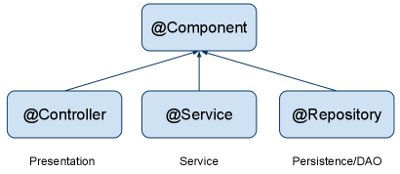
From Spring Documentation:
In Spring 2.0 and later, the @Repository annotation is a marker for any class that fulfills the role or stereotype (also known as Data Access Object or DAO) of a repository. Among the uses of this marker is the automatic translation of exceptions.
Spring 2.5 introduces further stereotype annotations: @Component, @Service, and @Controller. @Component is a generic stereotype for any Spring-managed component. @Repository, @Service, and @Controller are specializations of @Component for more specific use cases, for example, in the persistence, service, and presentation layers, respectively.
Therefore, you can annotate your component classes with @Component, but by annotating them with @Repository, @Service, or @Controller instead, your classes are more properly suited for processing by tools or associating with aspects. For example, these stereotype annotations make ideal targets for pointcuts.
Thus, if you are choosing between using @Component or @Service for your service layer, @Service is clearly the better choice. Similarly, as stated above, @Repository is already supported as a marker for automatic exception translation in your persistence layer.
| Annotation | Meaning                                             |

+------------+-----------------------------------------------------+

| @Component | generic stereotype for any Spring-managed component |

| @Repository| stereotype for persistence layer                    |

| @Service   | stereotype for service layer                        |

| @Controller| stereotype for presentation layer (spring-mvc)      |
Spring 2.5 introduces further stereotype annotations: @Component, @Service and @Controller. @Component serves as a generic stereotype for any Spring-managed component; whereas, @Repository, @Service, and @Controller serve as specializations of @Component for more specific use cases (e.g., in the persistence, service, and presentation layers, respectively). What this means is that you can annotate your component classes with @Component, but by annotating them with @Repository, @Service, or @Controller instead, your classes are more properly suited for processing by tools or associating with aspects. For example, these stereotype annotations make ideal targets for pointcuts. Of course, it is also possible that @Repository, @Service, and @Controller may carry additional semantics in future releases of the Spring Framework. Thus, if you are making a decision between using @Component or @Service for your service layer, @Service is clearly the better choice. Similarly, as stated above, @Repository is already supported as a marker for automatic exception translation in your persistence layer.
@Component – Indicates a auto scan component.

@Repository – Indicates DAO component in the persistence layer.

@Service – Indicates a Service component in the business layer.

@Controller – Indicates a controller component in the presentation layer.
reference :- http://static.springsource.org/spring/docs/3.0.0.M3/reference/html/ch04s12.html
总的来说就是 @Service, @Controller , @Repository = {@Component + 特殊的功能} ,文章提到我们应该结合Spring中到的切面编程思想(AOP), 我们的controller 承担着分发请求的任务后,又要处理业务逻辑,同时还要与数据库持久层作交互,这样的代码是糟糕的,所以文档中主张是使用这几个注解类,更好地区分开各自的功能
- @Component : 将自动扫描组件
- @Repository : 指示为在持久层的Dao层的组件(它的好处是捕抓到持久层交互中出现的异常,并把异常友好地表示出来,假如没有这个注释,数据库抛出的异常常常难以理解)
- @Service : 业务逻辑
- @Controller : 分发请求
[转]what’s the difference between @Component ,@Repository & @Service annotations in Spring的更多相关文章
- What's the difference between @Component, @Repository & @Service annotations in Spring?
@Component is equivalent to <bean> @Service, @Controller , @Repository = {@Component + some mo ...
- 【转载】@Component, @Repository, @Service的区别
@Component, @Repository, @Service的区别 官网引用 引用spring的官方文档中的一段描述: 在Spring2.0之前的版本中,@Repository注解可以标记在任何 ...
- SpringAnnotation注解之@Component,@Repository,@Service,@Controller
@Component:组件,表示此写上了此注解的bean,作为一个组件存在于容器中.这样的话别的地方就可以使用@Resource这个注解来把这个组件作为一个资源来使用了.初始化bean的名字为类名首字 ...
- @Component @Repository @Service @Controller
Spring 2.5 中除了提供 @Component 注释外,还定义了几个拥有特殊语义的注释,它们分别是:@Repository.@Service 和 @Controller.在目前的 Spring ...
- @Component, @Repository, @Service的区别
注解 含义 @Component 最普通的组件,可以被注入到spring容器进行管理 @Repository 作用于持久层 @Service 作用于业务逻辑层 @Controller 作用于表现层(s ...
- @Component, @Repository, @Service,@Controller的区别
@Component, @Service, @Controller, @Repository是spring注解,注解后可以被spring框架所扫描并注入到spring容器来进行管理 @Componen ...
- 从头认识Spring-2.7 自己主动检測Bean(1)-@Component @Repository @Service @Controller
这一章节我们来讨论一下自己主动检測Bean. 1.domain 厨师类: package com.raylee.my_new_spring.my_new_spring.ch02.topic_1_19; ...
- @Component @Controller @Service @Repository@Resourse
@Component @Controller @Service @Repository@Resourse这些全部是Spring提供的注解. 其中@Component用来表示把一个类纳入spring容器 ...
- Spring注解详解@Repository、@Component、@Service 和 @Constroller
概述 注释配置相对于 XML 配置具有很多的优势: 它可以充分利用 Java 的反射机制获取类结构信息,这些信息可以有效减少配置的工作.如使用 JPA 注释配置 ORM 映射时,我们就不需要指定 PO ...
随机推荐
- 使用adb工具调试出现error:device offline
使用adb工具调试设备的时候会出现error:device offline,网上找了很多办法,最后终于解决了. 如果你也遇到这样的问题,先试试简单的办法,不行的话,试试这个..<.< ad ...
- spring-第二章-AOP
一,回顾 1.控制反转(IOC) 以前创建对象,由我们自己决定,现在我们把管理对象的声明周期权力交给spring; 2.依赖注入(DI) A对象需要B对象的支持,spring就把B注入给A,那么A就拥 ...
- 【转】C#具名参数和可选参数
源地址:https://www.cnblogs.com/similar/p/5006705.html 另:可选参数的一个陷阱 参考:https://www.cnblogs.com/still-wind ...
- python3的enumerate函数
enumerate() 函数用于将一个可遍历的数据对象(如列表.元组或字符串)组合为一个索引序列,同时列出数据和数据下标,一般用在 for 循环当中.
- js的常用方法和对象学习
js的常用方法和对象学习String对象:操作字符的. 使用:字符串.函数名. 大小写转换: toUpperCase() 转换大写 toLowerCase() 转换小写 function testSt ...
- Linux rsync 企业级应用
简介 rsync 是 Linux 下的数据同步工具, 其支持本地同步和远程同步, 远程同步分为 daemon 和 ssh 同步方式 rsync 可以代替 cp, scp 等命令, 且具有更高的可 ...
- MySql 的操作日志 历史记录
如何查看mysql数据库操作记录日志 1.首先确认你日志是否启用了mysql>show variables like 'log_bin'. 2.如果启用了,即ON,那日志文件就在mysql的安装 ...
- 高阶篇:4.2.3)DFMEA现有设计:预防控制与探测控制
本章目的:在现有设计中,明确预防控制与探测控制的定义和手段. 1.现有控制的填写部位: 2.现行设计控制(h)定义: 作为设计过程的一部分,现行设计控制是已经实施或承诺的活动,它将确保设计充分考虑设计 ...
- Angular material mat-icon 资源参考_Places
ul,li>ol { margin-bottom: 0 } dt { font-weight: 700 } dd { margin: 0 1.5em 1.5em } img { height: ...
- 洛谷 P3201 [HNOI2009]梦幻布丁(启发式合并)
题面 luogu 题解 什么是启发式合并? 小的合并到大的上面 复杂度\(O(nlogn)\) 这题颜色的修改,即是两个序列的合并 考虑记录每个序列的\(size\) 小的合并到大的 存序列用链表 但 ...