
Deeplearning - Overview of Convolution Neural Network
Finally pass all the Deeplearning.ai courses in March! I highly recommend it!
If you already know the basic then you may be interested in course 4 & 5, which shows many interesting cases in CNN and RNN. Although I do think that 1 & 2 is better structured than others, which give me more insight into NN.
I have uploaded the assignment of all the deep learning courses to my GitHub. You can find the assignment for CNN here. Hopefully it can give you some help when you struggle with the grader. For a new course, you indeed need more patience to fight with the grader. Don't ask me how I know this ... >_<
I have finished the summary of the first course in my pervious post:
I will keep working on the others. Since I am using CNN at work recently, let's go through CNN first. Any feedback is absolutely welcomed! And please correct me if I make any mistake.
When talking about CNN, image application is usually what comes to our mind first. While actually CNN can be more generally applied to different data that fits certain assumption. what assumption? You will know later.
1. CNN Features
CNN stands out from traditional NN in 3 area:
- sparse interaction (connection)
- parameter sharing
- equivariant representation.
Actually the third feature is more like a result of the first 2 features. Let's go through them one by one.
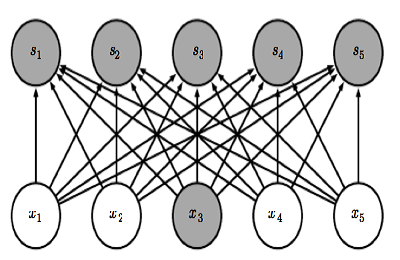
| Fully Connected NN | NN with Sparse connection |
|---|---|
 |
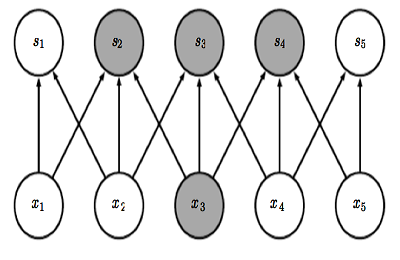 |
Sparse interaction, unlike fully connected neural network, for Convolution layer each output is only connected to limited inputs like above. For a hidden layer that takes \(m\) neurons as input and \(n\) neurons as output, a fully connected hidden layer has a weight matrix of size \(m*n\) to compute each output. When \(m\) is very big, the weight can be a huge matrix. With sparse connection, only \(k\) input is connected to each output, leading to a decrease in computation scale from \(O(m*n)\) to \(O(k*n)\). And a decrease in memory usage from \(m*n\) to \(k*n\).
Parameter sharing has more insight when considered together with sparse connection. Because sparse connection creates segmentation among data. For example \(x_1\) \(x_5\) is independent in above plot due to sparse connection. However with parameter sharing, same weight matrix is used across all positions, leading to a hidden connectivity. Additionally, it can further reduces the memory storage of weight matrix from \(k*n\) to \(k\). Especially when dealing with image, from \(m*n\) to \(k\) can be a huge improvement in memory usage.
Equivariant representation is a result of parameter sharing. Because same weight matrix is used at different position across input. So the output is invaritate to parallel movement. Say \(g\) represent parallel shift and \(f\) is the convolution function, then \(f(g(x)) = g(f(x))\). This feature can be very useful when we only care about the presence of feature not their position. But on the other hand this can be a big flaw of CNN that it is not good at detecting position.
2. CNN Components
Given the above 3 features, let's talk about how to implement CNN.
(1).Kernel
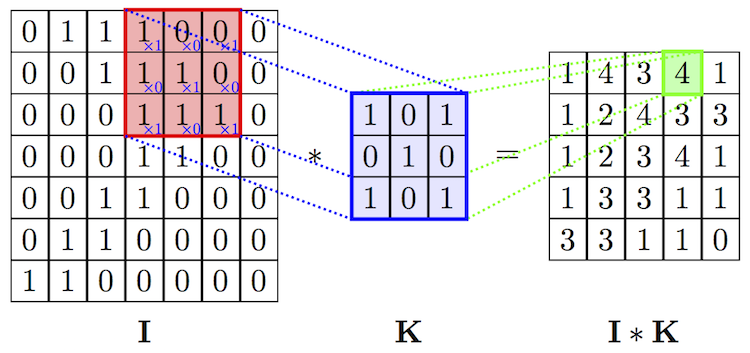
Kernel, or so-called filter, is the weight matrix in CNN. It implements element-wise computation across input matrix and output the sum. Kernel usually has a size that is much smaller than the original input so that we can take advantage of decrease in memory.
Below is a 2D input of convolution layer. It can be greyscale image, or multivarate timeseries.
When input is 3D dimension, we call the 3rd dimension Channel(volume). The most common case is the RGB image input, where each channel is a 2D matrix representing one color. See below:
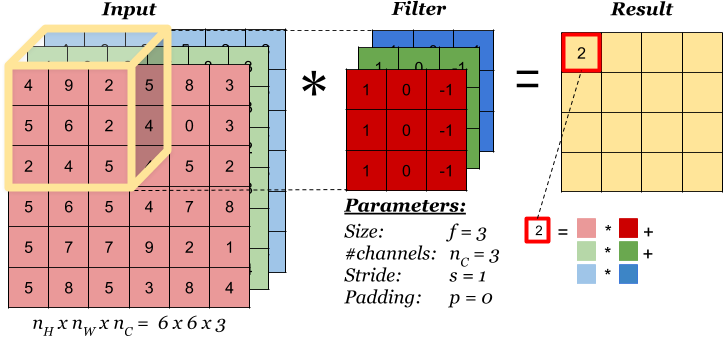
Please keep in mind that Kernel always have same number of channel as input! Therefore it leads to dimension reduction in all dimensions (unless you use 1*1 kernel). But we can have multiple kernels to capture different features. Like below, we have 2 kernels(filters), each has dimension (3,3,3).
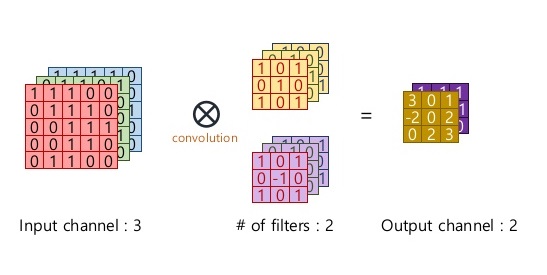
Dimension Cheatsheet of Kernel
- Input Dimension ( n_w, n_h, n_channel ). When n_channel = 1, it is a 2D input.
- Kernel Dimension ( n_k, n_k, n_channel ). Kernel is not always a square, it can be ( n_k1, n_k2, n_channel )
- Output Dimension (n_w - n_k + 1, n_h - n_k + 1, 1 )
- When we have n different kernels, output dimension will be (n_w - n_k + 1, n_h - n_k + 1, n)
(2). Stride
Like we mention before, one key advantage of CNN is to speed up computation using dimension reduction. Can we be more aggressive on this ?! Yes we can use Stride! Basically stride is when moving kernel across input, it skips certain input by certain length.
We can easily tell how stride works by below comparison:
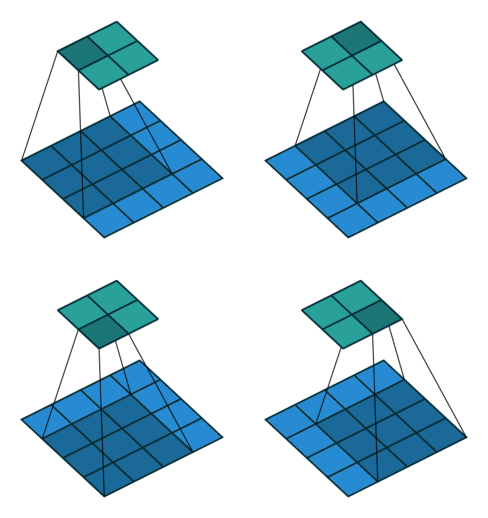 No Stride
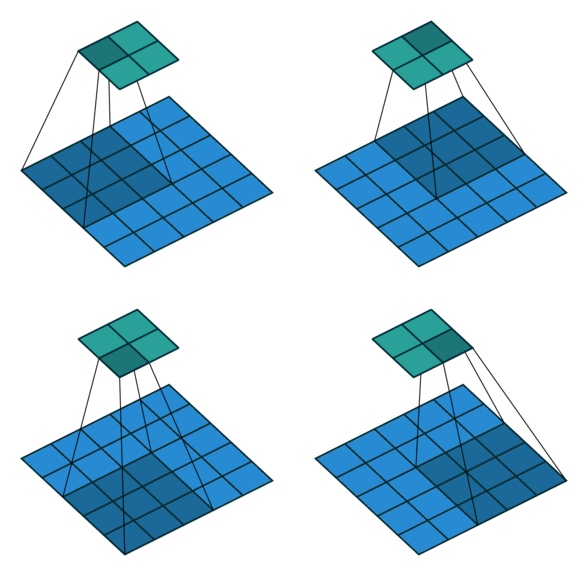 Stride = 1
Thanks vdumoulin for such great animation. You can find more at his GitHub
Stride can further speed up computation, but it will lose some feature in the output. We can consider it as output down-sampling.
(3). Padding
Both Kernel and Stride function as dimension reduction technic. So for each convolution layer, the output dimension will always be smaller than input. However if we want to build a deep convolution network, we don't want the input size to shrink too fast. A small kernel can partly solve this problem. But in order to maintain certain dimension we need zero padding. Basically it is adding zero to your input, like below:
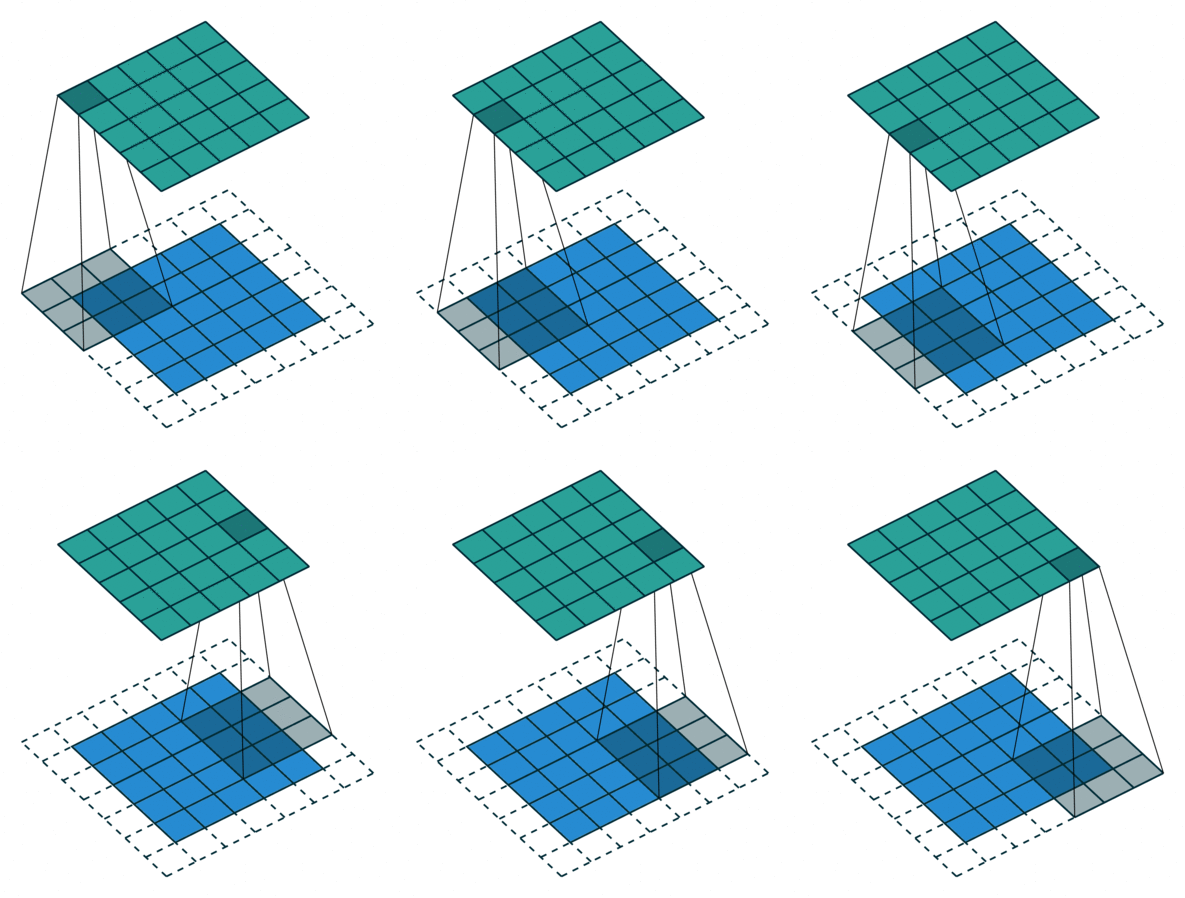 Padding = 1
There is a few types of padding that are frequently used:
- Valid padding: no padding at all, output = input - (K - 1)
- Same padding: maintain samesize, output = input
- Full padding: each input is visited k times, output = input + (k - 1)
To summarize, We use \(s\) to denote stride, and \(p\) denotes padding. \(n\) is the input size, \(k\) is kernel size (kernel and input are both square for simplicity). Then output dimension will be following:
\[\lfloor (n+2p-k)/s\rfloor +1\]
(4). Pooling
I remember in a latest paper of CNN, the author says that I can't explain why I add pooling layer, but a good CNN structure always comes with a pooling layer.
Pooling functions as a dimension reduction Technic. But unlike Kernel which reduces all dimensions, pooling keep channel dimension untouched. Therefore it can further accelerate computation.
Basically Pooling outputs a certain statistics for a certain among of input. This introduces a feature stronger than Equivariant representation -- Invariant representation.
The mainly used Pooling is max and average pooling. And there is L2, and weighted average, and etc.
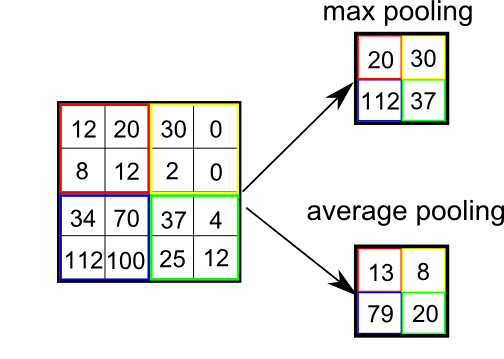
3. CNN structure
(1). Intuition of CNN
In Deep Learning book, author gives a very interesting insight. He consider convolution and pooling as a infinite strong prior distribution. The distribution indicates that all hidden units share the same weight, derived from certain amount of the input and have parallel invariant feature.
Under Bayesian statistics, prior distribution is a subjective preference of the model based on experience. And the stronger the prior distribution is, the higher impact it will have on the optimal model. So before we use CNN, we have to make sure that our data fits the above assumption.
(2). classic structure
A classic convolution neural network has a convolutional layer, a non-linear activation layer, and a pooling layer. For deep NN, we can stack a few convolution layer together. like below
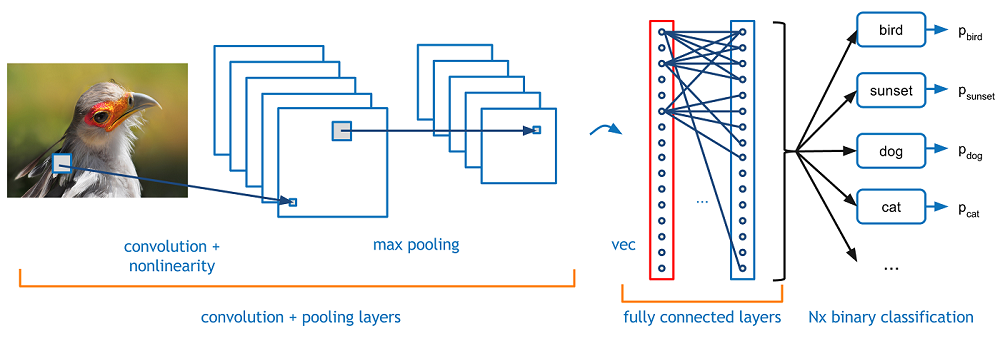
The above plot is taken from Adit Deshpande's A Beginner's Guide To Understanding Convolutional Neural Networks, one of my favorite blogger of ML.
The interesting part of deep CNN is that deep hidden layer can receive more information from input than shallow layer, meaning although the direct connection is sparse, the deeper hidden neuron are still able to receive nearly all the features from input.
(3). To be continue
With learning more and more about NN, I gradually realize that NN is more flexible than I thought. It is like LEGO, convolution, pooling, they are just different basic tools with different assumption. You need to analyze your data and select tools that fits your assumption, and try combining them to improve performance interatively. Later I will open a new post to collect all the NN structure that I ever read about.
Reference
1 Vincent Dumoulin, Francesco Visin - A guide to convolution arithmetic for deep learning (BibTeX)
2 Adit Deshpande - A Beginner's Guide To Understanding Convolutional Neural Networks
3 Ian Goodfellow, Yoshua Bengio, Aaron Conrville - Deep Learning
Deeplearning - Overview of Convolution Neural Network的更多相关文章
- Spark MLlib Deep Learning Convolution Neural Network (深度学习-卷积神经网络)3.1
3.Spark MLlib Deep Learning Convolution Neural Network (深度学习-卷积神经网络)3.1 http://blog.csdn.net/sunbow0 ...
- Convolution Neural Network (CNN) 原理与实现
本文结合Deep learning的一个应用,Convolution Neural Network 进行一些基本应用,参考Lecun的Document 0.1进行部分拓展,与结果展示(in pytho ...
- Spark MLlib Deep Learning Convolution Neural Network (深度学习-卷积神经网络)3.2
3.Spark MLlib Deep Learning Convolution Neural Network(深度学习-卷积神经网络)3.2 http://blog.csdn.net/sunbow0 ...
- Spark MLlib Deep Learning Convolution Neural Network (深度学习-卷积神经网络)3.3
3.Spark MLlib Deep Learning Convolution Neural Network(深度学习-卷积神经网络)3.3 http://blog.csdn.net/sunbow0 ...
- 【面向代码】学习 Deep Learning(三)Convolution Neural Network(CNN)
========================================================================================== 最近一直在看Dee ...
- keras02 - hello convolution neural network 搭建第一个卷积神经网络
本项目参考: https://www.bilibili.com/video/av31500120?t=4657 训练代码 # coding: utf-8 # Learning from Mofan a ...
- 深度学习:卷积神经网络(convolution neural network)
(一)卷积神经网络 卷积神经网络最早是由Lecun在1998年提出的. 卷积神经网络通畅使用的三个基本概念为: 1.局部视觉域: 2.权值共享: 3.池化操作. 在卷积神经网络中,局部接受域表明输入图 ...
- 斯坦福大学卷积神经网络教程UFLDL Tutorial - Convolutional Neural Network
Convolutional Neural Network Overview A Convolutional Neural Network (CNN) is comprised of one or mo ...
- 论文阅读(Weilin Huang——【TIP2016】Text-Attentional Convolutional Neural Network for Scene Text Detection)
Weilin Huang--[TIP2015]Text-Attentional Convolutional Neural Network for Scene Text Detection) 目录 作者 ...
随机推荐
- Java中InputStream和String之间的转化
https://blog.csdn.net/lmy86263/article/details/60479350 在Java中InputStream和String之间的转化十分普遍,本文主要是总结一下转 ...
- hdu Exponentiation高精度实数乘幂(用了带小数的高精度模板)
#include <cstdio> #include <cstring> #include <iostream> #include <cmath> #i ...
- 网络的可靠性nyoj170
网络的可靠性 时间限制:3000 ms | 内存限制:65535 KB 难度:3 描述 A公司是全球依靠的互联网解决方案提供商,也是2010年世博会的高级赞助商.它将提供先进的网络协作技术,展 ...
- iPhone Plus手机的分辨率到底是多少,是1080×1920还是1242×2208?
近日在准备AppStore上架的时候,需要提供屏幕快照,苹果官方的要求是: 5.5寸的iOS设备的分辨率是:是1080×1920:然而我们如果找一张Plus的屏幕截图,会发现截图的分辨率是1242×2 ...
- j使用数组实现约瑟夫环 java
我们首先来看一下约瑟夫环问题: 给定m个人,m个人围成一圈,在给定一个数n,从m个人中的第一个人每第n个人便将其除去,求被最后一个出去的人的编号. 思路: 建立一个长度为m+1的数组,将其的内容初始化 ...
- GD32F450 200M时USB不稳定
使用GD32F450的demo修改usb驱动,发现120M和168M时正常,200M时很不稳定.怀疑USB时钟分频有问题,一查果然是,记录如下: 200M是库函数主时钟分频代码如下 static vo ...
- 20155306 实验三 敏捷开发与XP实践
20155306 实验三 敏捷开发与XP实践 实验内容 XP基础 XP核心实践 相关工具 实验要求 1.没有Linux基础的同学建议先学习<Linux基础入门(新版)><Vim编辑器 ...
- 20145209 实验二 《Java面向对象程序设计》 实验报告
20145209 实验二 <Java面向对象程序设计> 实验报告 实验内容 1.初步掌握单元测试和TDD. 2.理解并掌握面向对象三要素:封装.继承.多态. 3.初步掌握UML建模. 4. ...
- 为什么说private方法是有罪的
具体的这句话从什么地方获得,我已经无从考证了,但是想想我们现在使用private的场景,你慢慢的就会发现,private的方法,大多数都是copy代码,当然我只是说大多数,还有就是大多数private ...
- 【LG4148】简单题
[LG4148]简单题 题面 洛谷 题解 \(kdt\)模板题呀... #include <iostream> #include <cstdio> #include <c ...