
第六周周赛——AK机会不易得,好好把握题解(出自HDU5650,codeforces 616A,624A,659A,655A,658A)
A题:
题目描写叙述:
位运算
已知一个包括 n 个元素的正整数集合S。设 f(S) 为集合S中全部元素的异或(XOR)的结果。
如:S={1,2,3}, 则 f(S) = 0。
给出集合S,你须要计算 将全部f(s)进行异或后的值, 这里 s⊆S.
多组測试数据。第一行包括一个整数T(T≤20) 表示组数。
每组測试数据第一行包括一个数 n(1≤n≤1,000) 表示集合的大小,第二行为 n个数表示集合
元素。第 i(1≤i≤n) 个数 0 ≤ai ≤1000,000,000 且数据保证所给集合中没有反复元素。
对于每组測试数据,输出一个数,表示将全部的 f(s)异或之后的值。
1

3

1  2  3
0

例子中,S={1,2,3}, 它的子集有∅, {1}, {2}, {3}, {1, 2}, {1, 3}, {2, 3}, {1, 2, 3}
解析:
这道题乍看上去让人摸不着头脑,事实上却是一道很easy的题目。
一開始做题目没有头绪的时候。我们能够从简单枚举開始。从而
寻找一般规律。
首先,须要了解的是一些异或运算的基本性质:
异或运算是满足结合律和交换律的,能够用卡诺图和真值表进行证明,这里就不细说了。
当集合S中仅仅有一个元素的时候,子集仅仅有空集和其本身。非常明显。全部f(s)异或后的值就是其本身
当集合S中有两个元素{a1,a2}的时候,子集有空集,{a1},{a2},{a1。a2}。那么全部集合进行异或运算的结果即为:
a1 ^ a2 ^ a1 ^ a2 = a1 ^ a1 ^ a2 ^ a2 = 0
当集合S中有三个元素{a1,a2,a3}的时候,子集有空集。{a1},{a2},{a3},{a1,a2},{a1。a3},{a2,a3}。{a1,a2。a3}。
那么所
有集合进行异或运算的结果即为:
a1 ^ a2 ^ a3 ^ a1 ^ a2 ^ a1 ^ a3 ^ a2 ^ a3 ^ a1 ^ a2 ^ a3= a1 ^ a1 ^ a1 ^ a1 ^ a2 ^ a2 ^ a2 ^ a2 ^ a3 ^ a3^ a3 ^ a3 = 0
枚举到这里,因此我们能够猜想,集合S中元素个数大于1时。全部子集异或后的结果为0。否则则为其本身。
简单证明:
如果集合S中有n个元素,对于当中的任一元素x,则总共2^(n-1)个子集包括元素x(排列组合证明,这里不具体说。有兴趣的可
以自己证明。结合二项式定理),那么当n>1时,x在全部子集中个数之和为偶数。那么全部x异或后的结果必为0,当n = 1时,则
特判仅仅含有一个元素的情况。
完整代码实现:
#include<cstdio>

int main(){

    int T,n,value;

    scanf("%d",&T);

    while(T--){

        scanf("%d",&n);

        for(int i = 1;i <= n;++i){

            scanf("%d",&value);

        }

        if(n==1){

            printf("%d\n",value);

        }

        else{

            printf("0\n");

        }

    }

}
B题:
题目描写叙述:
Comparing Two Long Integers
You are given two very long integers a, b (leading zeroes are allowed). You should check what number a or b is
greater or determine that they are equal.
The input size is very large so don't use the reading of symbols one by one. Instead of that use the reading of a whole line or token.
As input/output can reach huge size it is recommended to use fast input/output methods: for example, prefer to usescanf/printf instead of cin/cout in
C++, prefer to use BufferedReader/PrintWriter instead of Scanner/System.out in Java. Don't use the function input() in Python2 instead
of it use the function raw_input().
The first line contains a non-negative integer a.
The second line contains a non-negative integer b.
The numbers a, b may contain leading zeroes. Each of them contains no more than 106 digits.
Print the symbol "<" if a < b and the symbol ">"
if a > b. If the numbers are equal print the symbol "=".
9
10
<
11
10
>
00012345
12345
=
0123
9
>
0123
111
>
题意:
给定两个整数,这两个整数可能含有前缀0。然后比較这两个数的大小,输出对应符号(< > =)
解析:
用字符串处理,分三种情况,除去前缀0之后。长者更大。反之短者更小。相同长则调用strcmp函数推断。
完整代码实现:
#include <cstdio>

#include <cstring>

char s[1000001], t[1000001];

int main()

{

	scanf("%s %s", s, t);

	int n = 0, m = 0;

	while (s[n] == '0')

		n++;

	while (t[m] == '0')

		m++;

	int l1 = strlen(s + n);

	int l2 = strlen(t + m);

	if (l1 < l2)

		puts("<");

	else if (l1 > l2)

		puts(">");

	else

	{

		int cmp = strcmp(s + n, t + m);

		puts(cmp > 0 ?

">" : (cmp == 0 ? "=" : "<"));

	}

	return 0;

}
C题:
题目描写叙述:
Save Luke
Luke Skywalker got locked up in a rubbish shredder between two presses. R2D2 is already working on his rescue, but Luke needs to stay alive as long as possible. For simplicity we will assume that everything happens
on a straight line, the presses are initially at coordinates 0 and L, and they move towards each other with speed v1 and v2,
respectively. Luke has width d and is able to choose any position between the presses. Luke dies as soon as the distance between the presses is less than his width. Your task is to determine for
how long Luke can stay alive.
The first line of the input contains four integers d, L, v1, v2 (1 ≤ d, L, v1, v2 ≤ 10 000, d < L) —
Luke's width, the initial position of the second press and the speed of the first and second presses, respectively.
Print a single real value — the maximum period of time Luke can stay alive for. Your answer will be considered correct if its absolute or relative error does not exceed 10 - 6.
Namely: let's assume that your answer is a, and the answer of the jury is b. The checker
program will consider your answer correct, if  .
.
2 6 2 2
1.00000000000000000000
1 9 1 2
2.66666666666666650000
NoteIn the first sample Luke should stay exactly in the middle of the segment, that is at coordinates [2;4], as the presses move with the same speed. In the second sample he needs to occupy the position. In this case both presses move to his edges at the same time.
题意:
两个人分别从A,B两地相向而行,当两个人的距离达到d时,停止运动,问此时两个人运动的时间,距离L,两人速度v1,v2均给出。
解析:
相遇问题,列个一元一次方程求解就可以
完整代码实现:
#include<cstdio>

int main(){

    int d,L,v1,v2;

    while(scanf("%d %d %d %d",&d,&L,&v1,&v2)==4){

        printf("%.20f\n",double(L-d)/(v1+v2));

    }

    return 0;

}
D题:
题目描写叙述:
Round House
Vasya lives in a round building, whose entrances are numbered sequentially by integers from 1 to n. Entrance n and
entrance 1 are adjacent.
Today Vasya got bored and decided to take a walk in the yard. Vasya lives in entrance a and he decided that during his walk he will move around the house b entrances
in the direction of increasing numbers (in this order entrance n should be followed by entrance 1). The negative value of b corresponds
to moving |b| entrances in the order of decreasing numbers (in this order entrance 1 is followed by entrance n).
If b = 0, then Vasya prefers to walk beside his entrance.
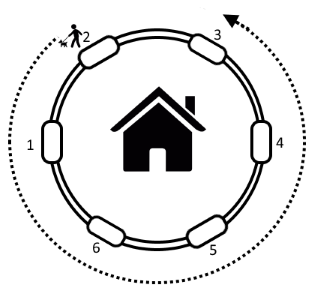 Illustration
for n = 6, a = 2, b = - 5.
Help Vasya to determine the number of the entrance, near which he will be at the end of his walk.
The single line of the input contains three space-separated integers n, a and b (1 ≤ n ≤ 100, 1 ≤ a ≤ n, - 100 ≤ b ≤ 100) —
the number of entrances at Vasya's place, the number of his entrance and the length of his walk, respectively.
Print a single integer k (1 ≤ k ≤ n) — the number of the entrance where
Vasya will be at the end of his walk.
6 2 -5
3
5 1 3
4
3 2 7
3
NoteThe first example is illustrated by the picture in the statements.
题意:
给定n,a,b分别表示入口的个数,初始位置以及要走过的路口数。b值为负时逆时针走动,否则则顺时针走动。
问最后走到的路口
的标号。
解析:
直接模拟题意就可以,注意防止标号为负。
完整代码实现:
#include<cstdio>

int main(){

    int n,a,b;

    while(scanf("%d %d %d",&n,&a,&b)==3){

        printf("%d\n",(a+100*n+b)%n ? (a+100*n+b)%n : n);

    }

    return 0;

}
E题:
题目描写叙述:
Amity Assessment
Bessie the cow and her best friend Elsie each received a sliding puzzle on Pi Day. Their puzzles consist of a 2 × 2 grid and three tiles labeled 'A',
'B', and 'C'. The three tiles sit on top of the grid, leaving one grid cell empty. To make a move, Bessie or Elsie can slide a tile adjacent to the empty cell into
the empty cell as shown below:

In order to determine if they are truly Best Friends For Life (BFFLs), Bessie and Elsie would like to know if there exists a sequence of moves that takes their puzzles to the same configuration (moves can be performed
in both puzzles). Two puzzles are considered to be in the same configuration if each tile is on top of the same grid cell in both puzzles. Since the tiles are labeled with letters, rotations and reflections are not allowed.
The first two lines of the input consist of a 2 × 2 grid describing the initial configuration of Bessie's puzzle. The next two lines contain a 2 × 2 grid
describing the initial configuration of Elsie's puzzle. The positions of the tiles are labeled 'A', 'B', and 'C',
while the empty cell is labeled 'X'. It's guaranteed that both puzzles contain exactly one tile with each letter and exactly one empty position.
Output "YES"(without quotes) if the puzzles can reach the same configuration (and Bessie and Elsie are truly BFFLs). Otherwise, print "NO"
(without quotes).
AB
XC
XB
AC
YES
AB
XC
AC
BX
NO
NoteThe solution to the first sample is described by the image. All Bessie needs to do is slide her 'A' tile down. In the second sample, the two puzzles can never be in the same configuration. Perhaps Bessie and Elsie are not meant to be friends after all...
题意:
给定两个2*2的宫格,问左边的宫格通过若干次移动之后,是否可以移成右边宫格的形状。
解析:
因为宫格仅仅有2*2。直接暴力模拟就可以。
完整代码实现:
#include<iostream>

#include<string>

#include<algorithm>

using namespace std;

string a[2], b[2];

int main()

{

    cin >> a[0] >> a[1] >> b[0] >> b[1];

    for (int i = 0; i < 1000; ++i) {

        if (a[0] == b[0] && a[1] == b[1]) {

            cout << "YES";

            return 0;

        }

        if (a[0][0] == 'X') swap(a[0][0], a[0][1]);

        else if (a[0][1] == 'X') swap(a[0][1], a[1][1]);

        else if (a[1][1] == 'X') swap(a[1][1], a[1][0]);

        else if (a[1][0] == 'X') swap(a[1][0], a[0][0]);

    }

    cout << "NO";

    return 0;

}
F题:
题目描写叙述:
Bear and Reverse Radewoosh
Limak and Radewoosh are going to compete against each other in the upcoming algorithmic contest. They are equally skilled but they won't solve problems in the same order.
There will be n problems. The i-th problem has initial score pi and
it takes exactly ti minutes to solve it. Problems
are sorted by difficulty — it's guaranteed that pi < pi + 1 and ti < ti + 1.
A constant c is given too, representing the speed of loosing points. Then, submitting the i-th
problem at time x (x minutes after the start of the contest) gives max(0, pi - c·x) points.
Limak is going to solve problems in order 1, 2, ..., n (sorted increasingly by pi).
Radewoosh is going to solve them in ordern, n - 1, ..., 1 (sorted decreasingly by pi).
Your task is to predict the outcome — print the name of the winner (person who gets more points at the end) or a word "Tie" in case of a tie.
You may assume that the duration of the competition is greater or equal than the sum of all ti.
That means both Limak and Radewoosh will accept all n problems.
The first line contains two integers n and c (1 ≤ n ≤ 50, 1 ≤ c ≤ 1000) —
the number of problems and the constant representing the speed of loosing points.
The second line contains n integers p1, p2, ..., pn (1 ≤ pi ≤ 1000, pi < pi + 1) —
initial scores.
The third line contains n integers t1, t2, ..., tn (1 ≤ ti ≤ 1000, ti < ti + 1)
where ti denotes the number of minutes one
needs to solve the i-th problem.
Print "Limak" (without quotes) if Limak will get more points in total. Print "Radewoosh" (without quotes) if Radewoosh
will get more points in total. Print "Tie" (without quotes) if Limak and Radewoosh will get the same total number of points.
3 2
50 85 250
10 15 25
Limak
3 6
50 85 250
10 15 25
Radewoosh
8 1
10 20 30 40 50 60 70 80
8 10 58 63 71 72 75 76
Tie
NoteIn the first sample, there are 3 problems. Limak solves them as follows:So, Limak got 30 + 35 + 150 = 215 points. Radewoosh solves problem in the reversed order:
- Limak spends 10 minutes on the 1-st problem and he gets 50 - c·10 = 50 - 2·10 = 30 points.
- Limak spends 15 minutes on the 2-nd problem so he submits it 10 + 15 = 25 minutes after the start of the contest. For the 2-nd problem he gets 85 - 2·25 = 35 points.
- He spends 25 minutes on the 3-rd problem so he submits it 10 + 15 + 25 = 50 minutes after the start. For this problem he gets 250 - 2·50 = 150 points.
Radewoosh got 200 + 5 + 0 = 205 points in total. Limak has 215 points so Limak wins. In the second sample, Limak will get 0 points for each problem and Radewoosh will first solve the hardest problem and he will get 250 - 6·25 = 100 points for that. Radewoosh will get 0 points for other two problems but he is the winner anyway. In the third sample, Limak will get 2 points for the 1-st problem and 2 points for the 2-nd problem. Radewoosh will get 4 points for the 8-th problem. They won't get points for other problems and thus there is a tie because 2 + 2 = 4.
- Radewoosh solves 3-rd problem after 25 minutes so he gets 250 - 2·25 = 200 points.
- He spends 15 minutes on the 2-nd problem so he submits it 25 + 15 = 40 minutes after the start. He gets 85 - 2·40 = 5 points for this problem.
- He spends 10 minutes on the 1-st problem so he submits it 25 + 15 + 10 = 50 minutes after the start. He gets max(0, 50 - 2·50) = max(0, - 50) = 0 points.
解析:
因为在题目后方,题意已经解释得很清楚。因此题意不再多说。事实上这就是codeforces本地比赛的规则(codeforces daily 、
round)。因此在处理从前往后做题和从后往前做题的两种情况时,我们分别能够用后缀和以及前缀和先预处理一下就可以。
完整代码实现:
#include<cstdio>

#include<algorithm>

using namespace std;

const int maxn = int(1e3) + 10;

int p[maxn],t[maxn],t1[maxn],t2[maxn];

int main(){

    int n,c;

    while(scanf("%d %d",&n,&c)==2){

        for(int i = 1;i <= n;++i){

            scanf("%d",&p[i]);

        }

        for(int i = 1;i <= n;++i){

            scanf("%d",&t[i]);

            t1[i] = t[i];

            t2[i] = t[i];

        }

        for(int i = 1;i < n;++i){

            t1[i+1] += t1[i];

        }

        for(int i = n;i > 1;--i){

            t2[i-1] += t2[i];

        }

        int score1 = 0,score2 = 0;

        for(int i = 1;i <= n;++i){

            score1 += max(0,p[i]-c*t1[i]);

        }

        for(int i = n;i >= 1;--i){

            score2 += max(0,p[i]-c*t2[i]);

        }

        if(score1 > score2){

            printf("Limak\n");

        }

        else if(score1 < score2){

            printf("Radewoosh\n");

        }

        else{

            printf("Tie\n");

        }

    }

    return 0;

}
如有错误,还请指正,O(∩_∩)O谢谢
第六周周赛——AK机会不易得,好好把握题解(出自HDU5650,codeforces 616A,624A,659A,655A,658A)的更多相关文章
- 20145330第六周《Java学习笔记》
20145330第六周<Java学习笔记> . 这周算是很忙碌的一周.因为第六周陆续很多实验都开始进行,开始要准备和预习的科目日渐增多,对Java分配的时间不知不觉就减少了,然而第十和十一 ...
- 20145337 《Java程序设计》第六周学习总结
20145337 <Java程序设计>第六周学习总结 教材学习内容总结 输入\输出 InputStream与OutputStream 从应用程序角度来看,如果要将数据从来源取出,可以使用输 ...
- 20145218 《Java程序设计》第六周学习总结
20145218 <Java程序设计>第六周学习总结 教材学习内容总结 第十章 输入/输出 10.1 InputStream与OutputStream 10.1.1 串流设计的概念 Jav ...
- 《Java程序设计》第六周学习总结
20145224 <Java程序设计>第六周学习总结 教材学习内容总结 第十章输入和输出 10.1.1 ·若要将数据从来源中取出,可以使用输入串流:若要将数据写入目的地,可以使用输出串流. ...
- 第六周java学习总结
学号 20175206 <Java程序设计>第六周学习总结 教材学习内容总结 第七章: 主要内容 内部类 匿名类 异常类 断言 重点和难点 重点:内部类和异常类的理解 难点:异常类的使用 ...
- 20175211 2018-2019-2 《Java程序设计》第六周学习总结
目录 教材学习内容总结 第七章 内部类与异常类 第十章 输入.输出流 教材学习中的问题和解决过程 代码托管 学习进度条 参考资料 教材学习内容总结 第七章 内部类与异常类 第十章 输入.输出流 教材学 ...
- 20175227张雪莹 2018-2019-2 《Java程序设计》第六周学习总结
20175227张雪莹 2018-2019-2 <Java程序设计>第六周学习总结 教材学习内容总结 第七章 内部类与异常类 内部类:在一个类中定义另一个类:包含内部类的类为外嵌类 内部类 ...
- 《Linux内核分析》第六周学习笔记
<Linux内核分析>第六周学习笔记 进程的描述和创建 郭垚 原创作品转载请注明出处 <Linux内核分析>MOOC课程http://mooc.study.163.com/co ...
- 20155211 2016-2017-2 《Java程序设计》第六周学习总结
20155211 2016-2017-2 <Java程序设计>第六周学习总结 教材学习内容总结 第十章 输入/输出 一.InputStream与OutputStream (一)串流设计的概 ...
随机推荐
- 045 RDD与DataFrame互相转换
一:RDD与DataFrame互相转换 1.总纲 二:DataFrame转换为RDD 1.rdd 使用schema可以获取DataFrame的schema 使用rdd可以获取DataFrame的数据 ...
- 基于Docker的服务器搭建
-----------基于Docker的多种服务器搭建----------- 开发环境 本机上的虚拟机 Centos7.4 Docker1.13.1 Openssl1.1.1 1 Nginx 1.1 ...
- GYM 101755 K.Video Reviews 【贪心】+【二分】
<题目链接> 题目大意: 一家公司想让n个人给他们的产品评论,所以依次去找这n个人,第i个人会评论当且仅当已经有ai个人评论或他确实对这个产品感兴趣,但是这n个人都不对这个产品感兴趣,问这 ...
- Mybatis之占位符与拼接符
1.占位符 1.1 含义: 在持久化框架中,为了将约束条件中的可变参数从sql中分离出来,在原有的参数位置使用特殊的标记来标记该位置,后期通过代码给sql传递参数(即实现sql与代码分离开).这个特 ...
- ELK日志分析方案
针对公司项目微服务化,随着项目及服务器的不断增多,决定采用ELK(Elasticsearch+Logstash+Kibana)日志分析平台进行微服务日志分析. 1.ELK整体方案 1.1 ELK架构图 ...
- JS 对象引用问题
var a = {n:1}; var b = a; a = {n:2}; a.x = a ;console.log(a.x);console.log(b.x); var a = {n:1}; var ...
- java 分布式与集群的区别和联系(转)
本文主要介绍了java分布式与集群的区别和联系,具有很好的参考价值,下面跟着小编一起来看下吧 一.先说区别: 一句话:分布式是并联工作的,集群是串联工作的. 1.分布式是指将不同的业务分布在不同的地方 ...
- [OPENCV]cvHoughLines2使用说明
1.cvHoughLines2函数定义: CvSeq *cvHoughLines2 { CvArr *image, void *line_storage, int method, double rho ...
- = =用createJS写个flyppyPeople
声明:本文为原创文章,如需转载,请注明来源WAxes,谢谢! 最近flyppybird很流行啊,今天中午闲着没事干,就用现有的素材写了个flyppyPeople,因为角色是个人,所以就叫People啦 ...
- python网络编程(十二)
协程 协程,又称微线程,纤程.英文名Coroutine. 协程是啥 首先我们得知道协程是啥?协程其实可以认为是比线程更小的执行单元. 为啥说他是一个执行单元,因为他自带CPU上下文.这样只要在合适的时 ...