
POJ1080(LCS变形)
Human Gene Functions
Time Limit: 2000/1000 MS (Java/Others) Memory Limit: 65536/32768 K (Java/Others)
Total Submission(s): 2799 Accepted Submission(s): 1587
A human gene can be identified through a series of time-consuming biological experiments, often with the help of computer programs. Once a sequence of a gene is obtained, the next job is to determine its function. One of the methods for biologists to use in determining the function of a new gene sequence that they have just identified is to search a database with the new gene as a query. The database to be searched stores many gene sequences and their functions – many researchers have been submitting their genes and functions to the database and the database is freely accessible through the Internet.
A database search will return a list of gene sequences from the database that are similar to the query gene. Biologists assume that sequence similarity often implies functional similarity. So, the function of the new gene might be one of the functions that the genes from the list have. To exactly determine which one is the right one another series of biological experiments will be needed.
Your job is to make a program that compares two genes and determines their similarity as explained below. Your program may be used as a part of the database search if you can provide an efficient one.
Given two genes AGTGATG and GTTAG, how similar are they? One of the methods to measure the similarity of two genes is called alignment. In an alignment, spaces are inserted, if necessary, in appropriate positions of the genes to make them equally long and score the resulting genes according to a scoring matrix.
For example, one space is inserted into AGTGATG to result in AGTGAT-G, and three spaces are inserted into GTTAG to result in –GT--TAG. A space is denoted by a minus sign (-). The two genes are now of equal length. These two strings are aligned:
AGTGAT-G
-GT--TAG
In this alignment, there are four matches, namely, G in the second position, T in the third, T in the sixth, and G in the eighth. Each pair of aligned characters is assigned a score according to the following scoring matrix.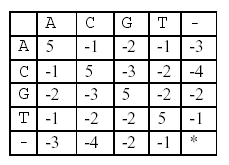
* denotes that a space-space match is not allowed. The score of the alignment above is (-3)+5+5+(-2)+(-3)+5+(-3)+5=9.
Of course, many other alignments are possible. One is shown below (a different number of spaces are inserted into different positions):
AGTGATG
-GTTA-G
This alignment gives a score of (-3)+5+5+(-2)+5+(-1) +5=14. So, this one is better than the previous one. As a matter of fact, this one is optimal since no other alignment can have a higher score. So, it is said that the similarity of the two genes is 14.
/*

ID: LinKArftc

PROG: 1080.cpp

LANG: C++

*/

#include <map>

#include <set>

#include <cmath>

#include <stack>

#include <queue>

#include <vector>

#include <cstdio>

#include <string>

#include <utility>

#include <cstdlib>

#include <cstring>

#include <iostream>

#include <algorithm>

using namespace std;

#define eps 1e-8

#define randin srand((unsigned int)time(NULL))

#define input freopen("input.txt","r",stdin)

#define debug(s) cout << "s = " << s << endl;

#define outstars cout << "*************" << endl;

const double PI = acos(-1.0);

const double e = exp(1.0);

const int inf = 0x3f3f3f3f;

const int INF = 0x7fffffff;

typedef long long ll;

const int maxn = ;

int score[][] = {

    {, -, -, -, -},

    {-, , -, -, -},

    {-, -, , -, -},

    {-, -, -, , -},

    {-, -, -, -, }

};

char ch_str1[maxn], ch_str2[maxn];

int str1[maxn], str2[maxn];

int dp[maxn][maxn];

int main() {

    int T;

    int len1, len2;

    scanf("%d", &T);

    while (T --) {

        scanf("%d %s", &len1, ch_str1);

        scanf("%d %s", &len2, ch_str2);

        for (int i = ; i < len1; i ++) {

            if (ch_str1[i] == 'A') str1[i] = ;

            else if (ch_str1[i] == 'C') str1[i] = ;

            else if (ch_str1[i] == 'G') str1[i] = ;

            else if (ch_str1[i] == 'T') str1[i] = ;

            else str1[i] = ;

        }

        for (int i = ; i < len2; i ++) {

            if (ch_str2[i] == 'A') str2[i] = ;

            else if (ch_str2[i] == 'C') str2[i] = ;

            else if (ch_str2[i] == 'G') str2[i] = ;

            else if (ch_str2[i] == 'T') str2[i] = ;

            else str2[i] = ;

        }

        memset(dp, , sizeof(dp));

        for (int i = ; i <= len1; i ++) dp[i][] = dp[i-][] + score[str1[i-]][];

        for (int i = ; i <= len2; i ++) dp[][i] = dp[][i-] + score[][str2[i-]];

        for (int i = ; i <= len1; i ++) {

            for (int j = ; j <= len2; j ++) {

                dp[i][j] = max(dp[i-][j-] + score[str1[i-]][str2[j-]],

                            max(dp[i][j-] + score[][str2[j-]], dp[i-][j] + score[str1[i-]][]));

            }

        }

        printf("%d\n", dp[len1][len2]);

    }

    return ;

}
POJ1080(LCS变形)的更多相关文章
- poj 1080 (LCS变形)
Human Gene Functions 题意: LCS: 设dp[i][j]为前i,j的最长公共序列长度: dp[i][j] = dp[i-1][j-1]+1;(a[i] == b[j]) dp[i ...
- POJ 1080( LCS变形)
题目链接: http://poj.org/problem?id=1080 Human Gene Functions Time Limit: 1000MS Memory Limit: 10000K ...
- UVA-1625-Color Length(DP LCS变形)
Color Length(UVA-1625)(DP LCS变形) 题目大意 输入两个长度分别为n,m(<5000)的颜色序列.要求按顺序合成同一个序列,即每次可以把一个序列开头的颜色放到新序列的 ...
- Advanced Fruits(HDU 1503 LCS变形)
Advanced Fruits Time Limit: 2000/1000 MS (Java/Others) Memory Limit: 65536/32768 K (Java/Others)T ...
- poj1080--Human Gene Functions(dp:LCS变形)
Human Gene Functions Time Limit: 1000MS Memory Limit: 10000K Total Submissions: 17206 Accepted: ...
- HDU 5791 Two ——(LCS变形)
感觉就是最长公共子序列的一个变形(虽然我也没做过LCS啦= =). 转移方程见代码吧.这里有一个要说的地方,如果a[i] == a[j]的时候,为什么不需要像不等于的时候那样减去一个dp[i-1][j ...
- uva 10723 Cyborg Genes(LCS变形)
题目:http://acm.hust.edu.cn/vjudge/contest/view.action?cid=107450#problem/C 题意:输入两个字符串,找一个最短的串,使得输入的两个 ...
- Combine String---hdu5727 &&& Zipper(LCS变形)
题目链接:http://poj.org/problem?id=2192 http://acm.split.hdu.edu.cn/showproblem.php?pid=5707 http://acm. ...
- HUST 4681 String (DP LCS变形)
题目链接:http://acm.hdu.edu.cn/showproblem.php?pid=4681 题目大意:给定三个字符串A,B,C 求最长的串D,要求(1)D是A的字序列 (2)D是B的子序列 ...
随机推荐
- Freemarker 的 Shiro 标签使用详解
一.引入依赖(已解决版本冲突) <!-- shiro-freemarker-tags start --> <dependency> <groupId>net.min ...
- nginx初探,下载安装配置负载均衡
上一篇我讲了正向代理和反向代理的概念,这个是为nginx做准备的前置技能,网上百度nginx可以知道nginx是什么: Nginx是一款轻量级的Web 服务器/反向代理服务器及电子邮件(IMAP/PO ...
- Mybatis实例教程整体说明
什么是mybatisMyBatis是支持普通SQL查询,存储过程和高级映射的优秀持久层框架.MyBatis消除了几乎所有的JDBC代码和参数的手工设置以及结果集的检索.MyBatis使用简单的XML或 ...
- Internet History,Technology and Security
Internet History,Technology and Security(简单记录) First Week High Stakes Research in Computing,and Comm ...
- iterator 的设计原则和traits
iterator我前面写过是作为algorithm和container之间的一个桥梁,algorithm进程操作的时候向iterator进行提问,iterator并对提问进行了回答,其中主要就是回答5 ...
- chm文件空白如何解决
解决办法:http://jingyan.baidu.com/article/8275fc86b5fb6646a03cf6b0.html
- PAT 1086 就不告诉你
https://pintia.cn/problem-sets/994805260223102976/problems/1038429065476579328 做作业的时候,邻座的小盆友问你:“五乘以七 ...
- P3509 [POI2010]ZAB-Frog
题目描述 On the bed of one particularly long and straight Byteotian brook there lie rocks jutting above ...
- [洛谷P1801]黑匣子_NOI导刊2010提高(06)
题目大意:两个操作:向一个可重集中加入一个元素:询问第$k$大的数($k$为之前询问的个数加一) 题解:离散化,权值线段树直接查询 卡点:无 C++ Code: #include <cstdio ...
- poj3347 Kadj Squares (计算几何)
D - Kadj Squares Time Limit:2000MS Memory Limit:65536KB 64bit IO Format:%I64d & %I64u Su ...