
8. Object References, Mutability, and Recycling
1. Variables Are Not Boxes
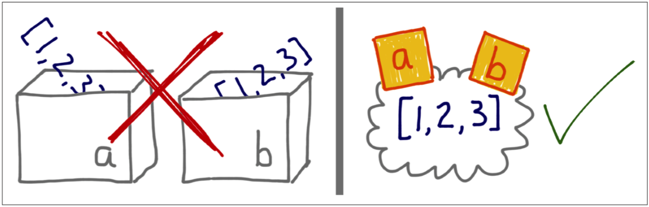
# Think variables as sticky notes

a = [1, 2, 3]

b = a

a.append(4)

print b  # [1, 2, 3, 4]

# 1. The object is created before the assignment. So variable is

# assigned to an object, not the other way around.
2. Identity, Equality, and Aliases
charles = {'name': 'Charles', 'born': 1832}

lewis = charles  # alias

print lewis is charles  # True

print id(lewis) == id(charles)  # True

lewis['born'] = 1844

print charles  # {'born': 1844, 'name': 'Charles'}

alex = {'name': 'Charles', 'born': 1844}

print alex == charles  # True (same value)

print alex is charles  # False (different identities)

# 1. In CPython, id() returns the memory address of the object, but

# it may be something else in another Python interpreter. The key

# point is that the ID is guaranteed to be a unique numeric label,

# and it will never change during the life of the object.

# 2. The is operator is faster than ==, because it cannot be

# overloaded, so Python does not have to find and invoke special

# methods to evaluate it, and computing is as simple as comparing

# two integer IDs.

# 3. a == b is syntactic sugar for a.__eq__(b). The __eq__ method

# inherited from object compares object IDs, so it produces the

# same result as is. But most built-in types override __eq__ with

# more meaningful implementations that actually take into account

# the values of the object attributes. Equality may involve a lot

# of processing. (large collections / deeply nested structures)
t1 = (1, 2, [30, 40])

t2 = (1, 2, [30, 40])

print t1 == t2  # True

print id(t1[-1])  # 4302515784

t1[-1].append(99)

print t1  # (1, 2, [30, 40, 99])

print id(t1[-1])  # 4302515784

print t1 == t2  # False

# 1. What can never change in a tuple is the identity of the

# items it contains.

# 2. Tuples, like most Python collections—lists, dicts, sets,

# etc.--hold references to objects. On the other hand, single-type

# sequences like str, bytes, and array.array are flat: they don’t

# contain references but physically hold their data--characters,

# bytes, and numbers--in contiguous memory.
3. Copies Are Shallow by Default
import copy

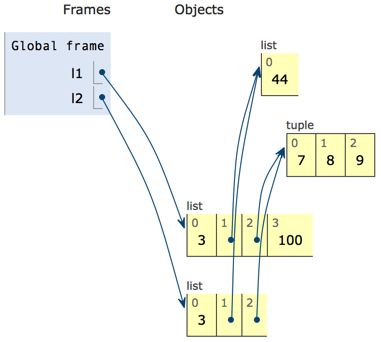
l1 = [3, [55, 44], (7, 8, 9)]

l2 = list(l1)  # l2 = l1[:] or l2 = copy.copy(l1)

print l2  # [3, [55, 44], (7, 8, 9)]

print l2 == l1  # True

print l2 is l1  # False

l1.append(100)

l1[1].remove(55)

print l1  # [3, [44], (7, 8, 9), 100]

print l2  # [3, [44], (7, 8, 9)]

l3 = copy.deepcopy(l2)

l3[1].append(55)

print l3  # [3, [44, 55], (7, 8, 9)]

print l2  # [3, [44], (7, 8, 9)]

# 1. Using the constructor or [:] or copy.copy() produces a shallow copy.
# Cyclic references

a = [10, 20]

b = [a, 30]

a.append(b)

print a  # [10, 20, [[...], 30]]

c = copy.deepcopy(a)

print c  # [10, 20, [[...], 30]]
[Notes]: You can control the behavior of both copy and deepcopy by implementing the __copy__() and __deepcopy__() special methods as described in the copy module documentation.
4. Function Parameters as References
def f(a, b):

	a += b

	return a

x = 1

y = 2

print f(x, y)  # 3

print x, y  # 1 2

a = [1, 2]

b = [3, 4]

print f(a, b)  # [1, 2, 3, 4]

print a, b  # [1, 2, 3, 4] [3, 4]

t = (10, 20)

u = (30, 40)

print f(t, u)  # (10, 20, 30, 40)

print t, u  # (10, 20) (30, 40)

1. The only mode of parameter passing in Python is call by sharing.

which means the parameters inside the function become aliases

of the actual arguments.

2. The result of this scheme is that a function may change any

mutable object passed as a parameter, but it cannot change the

identity of those objects

class A:

	def __init__(self, a_list=[]):

		self.a_list = a_list

	def add(self, name):

		self.a_list.append(name)

a1 = A()

a1.add('A')

print a1.a_list  # ['A']

a2 = A()

a2.add('B')

print a2.a_list  # ['A', 'B']

print a1.a_list  # ['A', 'B']

print a1.a_list is a2.a_list  # True

print A.__init__.__defaults__[0] is a1.a_list  # True

# 1. Two objects don’t get an initial list end up sharing the same

# list among themselves.

# 2. When the module is loaded, and the default values become

# attributes of the function object. So if a default value is a

# mutable object, and you change it, the change will affect every

# future call of the function.

class B:

	def __init__(self, a_list=None):

		if a_list is None:

			self.a_list = []

		else:

			self.a_list = a_list

			# self.a_list = list(a_list)  # make a copy

	def add(self, name):

		self.a_list.append(name)

l = [1, 2, 3]

b1 = B(l)

b1.add(5)

print b1.a_list  # [1, 2, 3, 5]

print l  # [1, 2, 3, 5]

# 1. You should think twice before aliasing the argument object

# by simply assigning it to an instance variable in your class.

# If in doubt, make a copy.
5. del and Garbage Collection
- The del statement deletes names, not objects. An object may be garbage collected as result of a del command, but only if the variable deleted holds the last reference to the object, or if the object becomes unreachable. Rebinding a variable may also cause the number of references to an object to reach zero, causing its destruction.
- unreachable: If two objects refer to each other, they may be destroyed if the garbage collector determines that they are otherwise unreachable because their only references are their mutual references.
There is a __del__ special method, but it does not cause the disposal of the instance, and should not be called by your code. __del__ is invoked by the Python interpreter when the instance is about to be destroyed to give it a chance to release external re‐sources. You will seldom need to implement __del__ in your own code
In CPython, the primary algorithm for garbage collection is reference counting. Es‐sentially, each object keeps count of how many references point to it. As soon as that refcount reaches zero, the object is immediately destroyed: CPython calls the __del__ method on the object (if defined) and then frees the memory allocated to the object. In CPython 2.0, a generational garbage collection algorithm was added to detect groups of objects involved in reference cycles—which may be unreachable even with outstanding references to them, when all the mutual references are contained within the group. Other implementations of Python have more sophisticated garbage collectors that do not rely on reference counting, which means the __del__ method may not be called immediately when there are no more references to the object.
import weakref

s1 = {1, 2, 3}

s2 = s1

def bye():

	print('Gone with the wind...')

ender = weakref.finalize(s1, bye)

print(ender.alive)  # True

del s1

print(ender.alive)  # True

s2 = 'spam'  # Gone with the wind...

print(ender.alive)  # False

# 1. del does not delete objects, but objects may be deleted

# as a consequence of being unreachable after del is used.

# 2. This works because final ize holds a weak reference to {1, 2, 3}.
6. Weak References
P236
7. Tricks Python Plays with Immutables
P240
8. Object References, Mutability, and Recycling的更多相关文章
- 《流畅的Python》Object References, Mutability, and Recycling--第8章
Object References, Mutability, and Recycling 本章章节: Variables Are Not Boxes identity , Equality , Al ...
- object references an unsaved transient instance - save the transient instance before flushing错误
异常1:not-null property references a null or transient value解决方法:将“一对多”关系中的“一”方,not-null设置为false(参考资料: ...
- ManyToMany【项目随笔】关于异常object references an unsaved transient instance
在保存ManyToMany 时出现异常: org.springframework.dao.InvalidDataAccessApiUsageException: org.hibernate.Tran ...
- Effective Java 06 Eliminate obsolete object references
NOTE Nulling out object references should be the exception rather than the norm. Another common sour ...
- [SAP ABAP开发技术总结]数据引用(data references)、对象引用(object references)
声明:原创作品,转载时请注明文章来自SAP师太技术博客( 博/客/园www.cnblogs.com):www.cnblogs.com/jiangzhengjun,并以超链接形式标明文章原始出处,否则将 ...
- 三大框架常遇的错误:hibernate : object references an unsaved transient instance
hibernate : object references an unsaved transient instance 该错误是操作顺序的问题,比如: save或update顺序问题---比方学生表和 ...
- Exception in thread "main" org.hibernate.TransientObjectException: object references an unsaved tran
今天在使用一对多,多对一保存数据的时候出现了这个错误 Hibernate错误: Exception in thread "main" org.hibernate.Transient ...
- ERROR org.hibernate.internal.SessionImpl - HHH000346: Error during managed flush [object references an unsaved transient instance - save the transient instance before flushing: cn.itcast.domain.Custom
本片博文整理关于Hibernate中级联策略cascade和它导致的异常: Exception in thread "main" org.hibernate.TransientOb ...
- object references an unsaved transient instance save the transient instance before flushing
object references an unsaved transient instance save the transient instance before flushing 对象引用未保存的 ...
随机推荐
- HashMap和ConcurrentHashMap 源码关键点解析
第一部分:关键源码讲解 1.HashMap 是如何存储的? a.底层是一个数组 tab b. hash=hash(key) ,然后根据数组长度n和hash值,决定当前需要put的元素对应的数组下标, ...
- Django:(07)数据库
一.ORM框架 ORM ,Object relational mapping 对象关系映射. 把类和数据库表对应,把对象和表记录对应,通过类和对象操作数据库表中的数据,而不需要编写SQL语句. Dja ...
- 什么是sigmoid激活函数?
上面我们讲了引入激活函数的意义,激活函数有多种,下面我们拿一种激活函数sigmoid来做示例,其他的类似.sigmoid函数表达式如下: 它的函数曲线图是: 看到上面的函数曲线图,可以看出是一 ...
- Map对象,Set对象使用(2)
今天重点见一下Set Set 在我印象里它主要就是去重,Set 是一个值的集合,这个集合中所有的值仅出现一次 Set 属性size:和Map的size一样,返回成员的总数 Set的方法: Set.pr ...
- shell学习笔记1-文件安全与权限
1,创建文件的用户和他所属的组拥有该文件,文件的属主可以设定谁具有读.写.执行该文件的权限,根用户可以改变任何普通用户的设置. 2,一个文件一经创建,就具有三种访问权限:读(可以显示该文件的内容).写 ...
- TOMCAT 安装教程 & 配置CGI & c语言exe
TOMCAT安装 参考原文网址:百度经验http://jingyan.baidu.com/article/154b4631aad2bb28ca8f4191.html 1.下载安装JDK 网址:http ...
- [LuoguP2164][SHOI2007]交通网络_拓扑排序_概率期望
交通网络 题目链接:https://www.luogu.org/problemnew/solution/P2164 数据范围:略. 题解: 直接算不好算,我们考虑建反图然后$Toposort$. 这样 ...
- linux系统调用、库函数和内核函数关系与区别
看系统调用,还有库函数,以前一直不明白,总是以为 系统调用跟库函数是一样的,但是今天才知道是不一样的. 库函数也就是我们通常所说的应用编程接口API,它其实就是一个函数定义,比如常见read().wr ...
- 杜教BM递推板子
Berlekamp-Massey 算法用于求解常系数线性递推式 #include<bits/stdc++.h> typedef std::vector<int> VI; typ ...
- NAT 模式下有两个虚拟机 网段不一样,一台可上网,可ping通,一台上不了网且ping不通
NAT 模式下有两个虚拟机 网段不一样,一台可上网,可ping通,一台上不了网且ping不通直接修改网段的话,会登录不上去,解决方法:设置>网络适配器>高级>生成mac地址重新登陆即 ...