
Django 简单评论实现
创建项目 django_comment 和应用 app01
修改 urls.py 文件
from django.contrib import admin

from django.urls import path

from app01 import views

urlpatterns = [

    path('admin/', admin.site.urls),

    path('comment/', views.comment),

]
修改 views.py 文件
from django.shortcuts import render, HttpResponse

from app01 import models

# Create your views here.

class Node:

    @staticmethod

    def digui(ret, row):

        for rt in ret:                           #  循环列表 ret

            if rt['id'] == row['parent_id']:     #  如果 rt 记录中的 id 与 row 的 praent_id 一样,则执行以下操作

                row['children'] = []

                rt['children'].append(row)       #  在 rt key 为 children 的值中添加 row 记录

                return

            else:

                Node.digui(rt['children'], row)  #  递归执行,判断 children 值里面的 id 是否与 row 的 praent_id 一样

    @staticmethod

    def create_tree(comment_list):

        ret = []                        #  定义列表 ret

        for row in comment_list:        #  循环列表

            if not row['parent_id']:    #  如果记录中 parent_id 不会空就执行操作

                row['children'] = []

                ret.append(row)

            else:

                Node.digui(ret, row)    #  如果记录中 parent_id 为空就执行操作

        return ret

def comment(request):

    comment_list = [

        {'id': 1, 'content': 'Python is best', 'user': 'klvchen', 'parent_id': None},

        {'id': 2, 'content': 'Java is best', 'user': 'klvchen', 'parent_id': None},

        {'id': 3, 'content': 'PHP is best', 'user': 'klvchen', 'parent_id': None},

        {'id': 4, 'content': 'what is best', 'user': 'lily', 'parent_id': 1},

        {'id': 5, 'content': 'hahaha', 'user': 'lucy', 'parent_id': 1},

        {'id': 6, 'content': 'Today', 'user': 'james', 'parent_id': 4},

        {'id': 7, 'content': 'good', 'user': 'jack', 'parent_id': 2},

        {'id': 8, 'content': 'I do not know', 'user': 'jack', 'parent_id': 3},

        {'id': 9, 'content': 'en', 'user': 'klvchen', 'parent_id': 8},

        {'id': 10, 'content': 'Hey Python', 'user': 'kim', 'parent_id': None},

    ]

    comment_tree = Node.create_tree(comment_list)

    for i in comment_tree:

        print(i)

    return HttpResponse('Comment')
访问 http://127.0.0.1:8000/comment/, 得到结果:
{'parent_id': None, 'user': 'klvchen', 'content': 'Python is best', 'children': [{'parent_id': 1, 'user': 'lily', 'content': 'what is best', 'children': [{'parent_id': 4, 'user': 'ja

mes', 'content': 'Today', 'children': [], 'id': 6}], 'id': 4}, {'parent_id': 1, 'user': 'lucy', 'content': 'hahaha', 'children': [], 'id': 5}], 'id': 1}

{'parent_id': None, 'user': 'klvchen', 'content': 'Java is best', 'children': [{'parent_id': 2, 'user': 'jack', 'content': 'good', 'children': [], 'id': 7}], 'id': 2}

{'parent_id': None, 'user': 'klvchen', 'content': 'PHP is best', 'children': [{'parent_id': 3, 'user': 'jack', 'content': 'I do not know', 'children': [{'parent_id': 8, 'user': 'klvc

hen', 'content': 'en', 'children': [], 'id': 9}], 'id': 8}], 'id': 3}

{'parent_id': None, 'user': 'kim', 'content': 'Hey Python', 'children': [], 'id': 10}
采用方式二:
Python 中字典,列表是引用类型。
新建一个 test.py 文件
comment_list = [

    {'id': 1, 'content': 'Python is best', 'user': 'klvchen', 'parent_id': None},

    {'id': 2, 'content': 'Java is best', 'user': 'klvchen', 'parent_id': None},

    {'id': 3, 'content': 'PHP is best', 'user': 'klvchen', 'parent_id': None},

    {'id': 4, 'content': 'what is best', 'user': 'lily', 'parent_id': 1},

    {'id': 5, 'content': 'hahaha', 'user': 'lucy', 'parent_id': 1},

    {'id': 6, 'content': 'Today', 'user': 'james', 'parent_id': 4},

    {'id': 7, 'content': 'good', 'user': 'jack', 'parent_id': 2},

    {'id': 8, 'content': 'I do not know', 'user': 'jack', 'parent_id': 3},

    {'id': 9, 'content': 'en', 'user': 'klvchen', 'parent_id': 8},

    {'id': 10, 'content': 'Hey Python', 'user': 'kim', 'parent_id': None},

]

for row in comment_list:

    row.update({'children': []})                 #  为每条记录添加一个 children 的 key

ret = []                                         #  定义一个 ret 列表

for item in comment_list:

    current_row = item

    current_row_parent_id = current_row['parent_id']

    if not current_row_parent_id:                #  记录不存在 parent_id 才执行

        ret.append(item)                         #  ret 列表添加记录

    else:

        for r in comment_list:                   #  遍历 comment_list

            if r['id'] == current_row_parent_id: #  若记录 r 中的 id 与上面的 current_row['parent_id'] 相同

                r['children'].append(item)       #  把当前记录加入 r['children'] 中

print(ret)
运行结果
[{'content': 'Python is best', 'parent_id': None, 'children': [{'content': 'what is best', 'parent_id': 1, 'children': [{'content': 'Today', 'parent_id': 4, 'children': [], 'id': 6, 'user': 'james'}], 'id': 4, 'user': 'lily'}, {'content': 'hahaha', 'parent_id': 1, 'children': [], 'id': 5, 'user': 'lucy'}], 'id': 1, 'user': 'klvchen'}, {'content': 'Java is best', 'parent_id': None, 'children': [{'content': 'good', 'parent_id': 2, 'children': [], 'id': 7, 'user': 'jack'}], 'id': 2, 'user': 'klvchen'}, {'content': 'PHP is best', 'parent_id': None, 'children': [{'content': 'I do not know', 'parent_id': 3, 'children': [{'content': 'en', 'parent_id': 8, 'children': [], 'id': 9, 'user': 'klvchen'}], 'id': 8, 'user': 'jack'}], 'id': 3, 'user': 'klvchen'}, {'content': 'Hey Python', 'parent_id': None, 'children': [], 'id': 10, 'user': 'kim'}]
采用方式三:
通过字典来优化代码。因为字典是通过键来索引的,关联到相对的值,理论上他的查询复杂度是O(1)。
comment_list = [

    {'id': 1, 'content': 'Python is best', 'user': 'klvchen', 'parent_id': None},

    {'id': 2, 'content': 'Java is best', 'user': 'klvchen', 'parent_id': None},

    {'id': 3, 'content': 'PHP is best', 'user': 'klvchen', 'parent_id': None},

    {'id': 4, 'content': 'what is best', 'user': 'lily', 'parent_id': 1},

    {'id': 5, 'content': 'hahaha', 'user': 'lucy', 'parent_id': 1},

    {'id': 6, 'content': 'Today', 'user': 'james', 'parent_id': 4},

    {'id': 7, 'content': 'good', 'user': 'jack', 'parent_id': 2},

    {'id': 8, 'content': 'I do not know', 'user': 'jack', 'parent_id': 3},

    {'id': 9, 'content': 'en', 'user': 'klvchen', 'parent_id': 8},

    {'id': 10, 'content': 'Hey Python', 'user': 'kim', 'parent_id': None},

]

ret = []

comment_list_dict = {}

for row in comment_list:                     #   遍历 comment_list

    row.update({'children': []})             #   每条记录添加一个 children key

    comment_list_dict[row['id']] = row       #  创建 comment_list_dict 字典,row['id'] 为 key,vaule 是 row

for item in comment_list:

    parent_row = comment_list_dict.get(item['parent_id'])    #  通过 item['parent_id'] 的获取其父亲记录

    if not parent_row:                                       #  若没有 parent_id

        ret.append(item)                                     #  在 ret 中增加记录

    else:

        parent_row['children'].append(item)                  #   其父亲记录的 children 添加当期记录

print(ret)
运行结果
[{'user': 'klvchen', 'parent_id': None, 'id': 1, 'content': 'Python is best', 'children': [{'user': 'lily', 'parent_id': 1, 'id': 4, 'content': 'what is best', 'children': [{'user': 'james', 'parent_id': 4, 'id': 6, 'content': 'Today', 'children': []}]}, {'user': 'lucy', 'parent_id': 1, 'id': 5, 'content': 'hahaha', 'children': []}]}, {'user': 'klvchen', 'parent_id': None, 'id': 2, 'content': 'Java is best', 'children': [{'user': 'jack', 'parent_id': 2, 'id': 7, 'content': 'good', 'children': []}]}, {'user': 'klvchen', 'parent_id': None, 'id': 3, 'content': 'PHP is best', 'children': [{'user': 'jack', 'parent_id': 3, 'id': 8, 'content': 'I do not know', 'children': [{'user': 'klvchen', 'parent_id': 8, 'id': 9, 'content': 'en', 'children': []}]}]}, {'user': 'kim', 'parent_id': None, 'id': 10, 'content': 'Hey Python', 'children': []}]
前端处理评论数据
增加 statics 文件夹,放入 jquery.min.js 文件
修改 settings.py
# 注释

# 'django.middleware.csrf.CsrfViewMiddleware',

# 在最后添加

STATICFILES_DIRS = [

    os.path.join(BASE_DIR, "statics"),

]
修改 urls.py
# 添加

path('index/', views.index),
修改 views.py
from django.shortcuts import render, HttpResponse

from app01 import models

# Create your views here.

def index(request):

    return render(request, 'index.html')

def comment(request):

    news_id = request.GET.get('news_id')

    comment_list = [

        {'id': 1, 'content': 'Python is best', 'user': 'klvchen', 'parent_id': None},

        {'id': 2, 'content': 'Java is best', 'user': 'klvchen', 'parent_id': None},

        {'id': 3, 'content': 'PHP is best', 'user': 'klvchen', 'parent_id': None},

        {'id': 4, 'content': 'what is best', 'user': 'lily', 'parent_id': 1},

        {'id': 5, 'content': 'hahaha', 'user': 'lucy', 'parent_id': 1},

        {'id': 6, 'content': 'Today', 'user': 'james', 'parent_id': 4},

        {'id': 7, 'content': 'good', 'user': 'jack', 'parent_id': 2},

        {'id': 8, 'content': 'I do not know', 'user': 'jack', 'parent_id': 3},

        {'id': 9, 'content': 'en', 'user': 'klvchen', 'parent_id': 8},

        {'id': 10, 'content': 'Hey Python', 'user': 'kim', 'parent_id': None},

        {'id': 10, 'content': 'I am god', 'user': 'god', 'parent_id': 6},

    ]

    comment_tree = []

    comment_list_dict = {}

    for row in comment_list:

        row.update({'children': []})

        comment_list_dict[row['id']] = row

    for item in comment_list:

        parent_row = comment_list_dict.get(item['parent_id'])

        if not parent_row:

            comment_tree.append(item)

        else:

            parent_row['children'].append(item)

    import json

    return HttpResponse(json.dumps(comment_tree))
在templates 下添加 index.html
<!DOCTYPE html>

<html lang="en">

<head>

    <meta charset="UTF-8">

    <title>Title</title>

    <style>

        .comment-box{

            margin-left: 20px;

        }

    </style>

</head>

<body>

    <div class="item">

        <a news_id="19" class="com">评论</a>

        <div class="comment-box">

            <span>Py最牛</span>

            <div class="comment-box">

                <span>PHP最牛</span>

                <div class="comment-box">

                    <span>what a pity</span>

                </div>

            </div>

            <div class="comment-box">

                <span>en en en </span>

            </div>

        </div>

    </div>

    <div class="item">

        <a news_id="18" class="com">评论</a>

    </div>

    <div class="item">

        <a news_id="17" class="com">评论</a>

    </div>

    <script src="/static/jquery.min.js"></script>

    <script>

        $(function () {

            bindCommentEvent();                         // 初始化 bindCommentEvent() 函数

        });

        function bindCommentEvent() {

            $('.com').click(function () {               // 添加点击事件

                var news_id = $(this).attr('news_id');  // 获取 news_id

                var _this = $(this);                    // 获取当前的元素

                $.ajax({

                    url: '/comment/',

                    type: 'GET',

                    data: {news_id: news_id},

                    dataType: "JSON",

                    success:function (arg) {

                        create_tree(arg, _this);       // 执行 create_tree() 函数

                    }

                })

            })

        }

        function diGui(children_list) {

            var html = "";

            $.each(children_list, function (ck, cv) {       // 递归 children_list

                var b = '<div class="comment-box"><span>';  // 拼凑 html 元素

                b += cv.content + "</span>";

                b += diGui(cv.children);

                b += "</div>";

                html += b;

            });

            return html;

        }

        function create_tree(data, $this) {

            var html = '<div class="comment-list">';

            $.each(data, function (k, v) {

                var a = '<div class="comment-box"><span>';

                a += v.content + "</span>";

                // 创建自评论

                a += diGui(v.children);                // 递归所有子评论

                a += "</div>";

                html += a;

            });

            html += "</div>"

            $this.append(html)

        }

    </script>

</body>

</html>
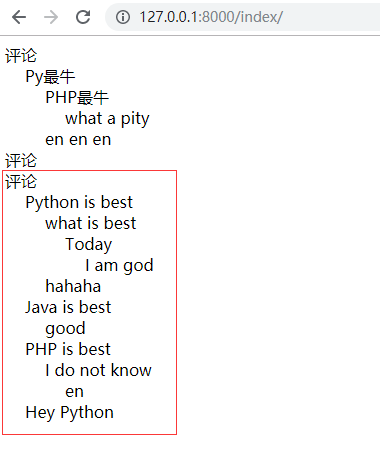
点击评论后,出现下面结果
后端处理评论数据
在 views.py 上添加
path('comment/', views.comment),
在 index.html 出修改
<!DOCTYPE html>

<html lang="en">

<head>

    <meta charset="UTF-8">

    <title>Title</title>

    <style>

        .comment-box{

            margin-left: 20px;

        }

    </style>

</head>

<body>

    <div class="item">

        <a news_id="19" class="com">评论</a>

        <div class="comment-box">

            <span>Py最牛</span>

            <div class="comment-box">

                <span>PHP最牛</span>

                <div class="comment-box">

                    <span>what a pity</span>

                </div>

            </div>

            <div class="comment-box">

                <span>en en en </span>

            </div>

        </div>

    </div>

    <div class="item">

        <a news_id="18" class="com">评论</a>

    </div>

    <div class="item">

        <a news_id="17" class="com">评论</a>

    </div>

    <script src="/static/jquery.min.js"></script>

    <script>

        $(function () {

            bindCommentEvent();

        });

        function bindCommentEvent() {

            $('.com').click(function () {

                var news_id = $(this).attr('news_id');

                var _this = $(this);

                $.ajax({

                    url: '/comment/',

                    type: 'GET',

                    data: {news_id: news_id},

                    dataType: "html",

                    success:function (arg) {

                        _this.after(arg);                    //  在该元素后添加后台返回的数据

                    }

                })

            })

        }

    </script>

</body>

</html>
创建一个 templateags 文件夹,里面创建 klvchen.py 文件
from django import template

from django.utils.safestring import mark_safe

register = template.Library()

def diGui(children_list):

    html = ""

    for cv in children_list:

        b = '<div class="comment-box"><span>'

        b += cv['content'] + "</span>"

        b += diGui(cv['children'])

        b += "</div>"

        html += b

    return html

@register.simple_tag

def create_tree(comment_tree):

    html = '<div class="comment-list">'

    for v in comment_tree:

        a = '<div class="comment-box"><span>'

        a += v['content'] + "</span>"

        a += diGui(v['children'])

        a += "</div>"

        html += a

    return mark_safe(html)
在 templates 文件夹里,创建 comment.html 文件
{% load klvchen %}

{% create_tree comment_tree %}
修改 views.py 文件
from django.shortcuts import render, HttpResponse

from app01 import models

# Create your views here.

def index(request):

    return render(request, 'index.html')

def comment(request):

    news_id = request.GET.get('news_id')

    comment_list = [

        {'id': 1, 'content': 'Python is best', 'user': 'klvchen', 'parent_id': None},

        {'id': 2, 'content': 'Java is best', 'user': 'klvchen', 'parent_id': None},

        {'id': 3, 'content': 'PHP is best', 'user': 'klvchen', 'parent_id': None},

        {'id': 4, 'content': 'what is best', 'user': 'lily', 'parent_id': 1},

        {'id': 5, 'content': 'hahaha', 'user': 'lucy', 'parent_id': 1},

        {'id': 6, 'content': 'Today', 'user': 'james', 'parent_id': 4},

        {'id': 7, 'content': 'good', 'user': 'jack', 'parent_id': 2},

        {'id': 8, 'content': 'I do not know', 'user': 'jack', 'parent_id': 3},

        {'id': 9, 'content': 'en', 'user': 'klvchen', 'parent_id': 8},

        {'id': 10, 'content': 'Hey Python', 'user': 'kim', 'parent_id': None},

        {'id': 10, 'content': 'I am god', 'user': 'god', 'parent_id': 6},

    ]

    comment_tree = []

    comment_list_dict = {}

    for row in comment_list:

        row.update({'children': []})

        comment_list_dict[row['id']] = row

    for item in comment_list:

        parent_row = comment_list_dict.get(item['parent_id'])

        if not parent_row:

            comment_tree.append(item)

        else:

            parent_row['children'].append(item)

    # import json

    # return HttpResponse(json.dumps(comment_tree))

    return render(request, 'comment.html', {'comment_tree': comment_tree})
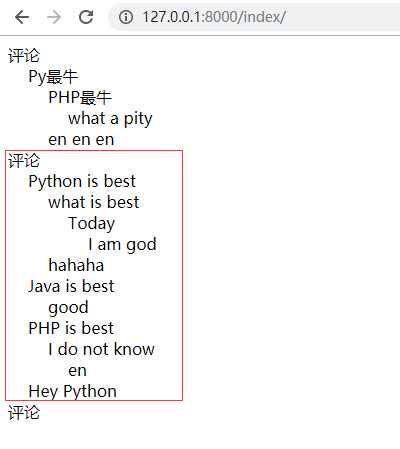
运行结果
Django 简单评论实现的更多相关文章
- [个人网站搭建]·Django增加评论功能(Python3)
[个人网站搭建]·Django增加评论功能 个人主页--> https://xiaosongshine.github.io/ 个人网站搭建github地址:https://github.com/ ...
- DJango简单的后台定义登录验证
第一步创建一个新的项目 APPLICATIONNAME : 表示创建子项目 第二步:找到主项目的url 进行 include 分发式url 简单的说,就是将app里边的url放在这里. 这里也可以找到 ...
- 我的Vue之旅 07 Axios + Golang + Sqlite3 实现简单评论机制
第三期 · 使用 Vue 3.1 + TailWind.CSS + Axios + Golang + Sqlite3 实现简单评论机制 效果图 CommentArea.vue 我们需要借助js的Dat ...
- Django——实现评论功能(包括评论回复)
提示:(1)功能不全面,仅仅实现评论(2)样式简单 1.项目目录结构 2.模型 from django.db import models from django.contrib.auth.models ...
- Django简单的数据库操作
当然,本篇的前提是你已经配置好了相关的环境,这里就不详细介绍. 一. 在settings.py文件中设置数据库属性. 如下: DATABASES = { 'default': { 'ENGINE': ...
- 循序渐进Python3(十二) --2-- web框架之django简单实现oracle数据库操作
在 Django 中构建 Oracle 数据库支持的 Web 应用程序 了解如何配置 Django 以便与 Oracle 数据库交互,并使用 ORM 进行数据库连接. 产能在软 ...
- django 简单的邮件系统
django邮件系统 Django发送邮件官方中文文档 总结如下: 1.首先这份文档看三两遍是不行的,很多东西再看一遍就通顺了. 2.send_mail().send_mass_mail()都是对Em ...
- Django多级评论
一.原理 #多级评论原理简单原理,弄完之后发现基础白学了 msg_list = [ {'id':1,'content':'xxx','parent_id':None}, {'id':2,'conten ...
- 前端、数据库、Django简单的练习
一.前端 1.前端页面由哪几层构成,分别是什么,作用是什么? 分为:结构层(html),表示层(css),行为层(js). 结构层 超文本标记语言.由HTML或XHTML之类的标记语言负责创建.标签, ...
随机推荐
- Linux—编译安装详解
编译安装python3 1.python是通过C语言编写,所以在编译安装python3时需要在C语言环境 [root@localhost ~]# yum install -y gcc 2.python ...
- qt md5加密,base64编码解码
qt md5加密,base64编码解码 md5加密 QByteArray data = "12121221"; data += "asdfas"; QByteA ...
- Lnmp架构部署动态网站环境.2019-7-3-1.4
安装wiki开源产品 一.创建数据库 [root@Lnmp bbs]# mysql -uroot -p123456 mysql> create database wiki; #创建wiki数据库 ...
- node exporter
在prometheus中负责数据汇报的程序统一叫做exporter; 负责主机信息收集的node_exporter 可以利用prometheus的static_configs来拉取node_expor ...
- Pwnable-cmd1
ssh cmd1@pwnable.kr -p2222 (pw:guest) 先看一下c的源码 #include <stdio.h> #include <string.h> in ...
- webapi使用ExceptionFilterAttribute过滤器
文章 public class ApiExceptionFilterAttribute:ExceptionFilterAttribute { public override void OnExcept ...
- <LinkedList> 369 (高)143 (第二遍)142 148
369. Plus One Linked List 1.第1次while: 从前往后找到第一个不是9的位,记录. 2.第2次while: 此位+1,后面的所有值设为0(因为后面的位都是9). 返回时注 ...
- weblogic 12c 安装与下载
转 一.WebLogic的介绍 WebLogic是美国bea公司出品的一个application server,确切的说是一个基于Javaee架构的中间件,纯java开发的,最新版本Web ...
- Prometheus神器之监控K8s集群
Prometheus 简介 Prometheus是SoundCloud开源的一款开源软件.它的实现参考了Google内部的监控实现,与源自Google的Kubernetes结合起来非常合适.另外相比i ...
- 造轮子ArrayList
这篇博客实现一个简单的ArrayList集合.博客里的代码首先根据自己的想法实现,在走不动的情况下会去参考JDK源代码.所以阅读本文,不要抱着跟JDK源码对比的心态.于我个人而言,国庆期间,纯属娱乐. ...