
POJ 1958 Strange Towers of Hanoi
| Time Limit: 1000MS | Memory Limit: 30000K | |
| Total Submissions: 3784 | Accepted: 2376 |
Description
Charlie Darkbrown sits in another one of those boring Computer Science
lessons: At the moment the teacher just explains the standard Tower of Hanoi
problem, which bores Charlie to death!
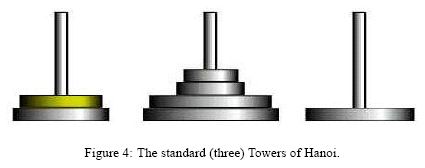
The teacher points to the blackboard (Fig. 4) and says: "So here is the
problem:
- There are three towers: A, B and C.
- There are n disks. The number n is constant while working the
puzzle.
- All disks are different in size.
- The disks are initially stacked on tower A increasing in size from
the top to the bottom.
- The goal of the puzzle is to transfer all of the disks from tower A
to tower C.
- One disk at a time can be moved from the top of a tower either to an
empty tower or to a tower with a larger disk on the top.
So your task is to write a program that calculates the smallest number of
disk moves necessary to move all the disks from tower A to C."
Charlie: "This is incredibly boring—everybody knows that this can be solved
using a simple recursion.I deny to code something as simple as this!"
The teacher sighs: "Well, Charlie, let's think about something for you to
do: For you there is a fourth tower D. Calculate the smallest number of disk
moves to move all the disks from tower A to tower D using all four towers."
Charlie looks irritated: "Urgh. . . Well, I don't know an optimal algorithm
for four towers. . . "
Problem
So the real problem is that problem solving does not belong to the things
Charlie is good at. Actually, the only thing Charlie is really good at is
"sitting next to someone who can do the job". And now guess what — exactly!
It is you who is sitting next to Charlie, and he is already glaring at you.
Luckily, you know that the following algorithm works for n <= 12: At first k
>= 1 disks on tower A are fixed and the remaining n-k disks are moved from
tower A to tower B using the algorithm for four towers.Then the remaining k
disks from tower A are moved to tower D using the algorithm for three
towers. At last the n - k disks from tower B are moved to tower D again
using the algorithm for four towers (and thereby not moving any of the k
disks already on tower D). Do this for all k 2 ∈{1, .... , n} and find the k
with the minimal number of moves.
So for n = 3 and k = 2 you would first move 1 (3-2) disk from tower A to
tower B using the algorithm for four towers (one move). Then you would move
the remaining two disks from tower A to tower D using the algorithm for
three towers (three moves). And the last step would be to move the disk from
tower B to tower D using again the algorithm for four towers (another move).
Thus the solution for n = 3 and k = 2 is 5 moves. To be sure that this
really is the best solution for n = 3 you need to check the other possible
values 1 and 3 for k. (But, by the way, 5 is optimal. . . )
Input
Output
of moves to solve the problem for four towers and n disks.
Sample Input
No input.
Sample Output
REFER TO OUTPUT.
Source
【题意】
本题大意是求n个盘子四座塔的hanoi问题的最少步数。输出n为1~12个盘子时各自的答案。
【分析】
汉罗塔改编的一个小问题。
以前经典的汉罗塔问题是三个柱子n个盘,每次选择一个盘子进行移动,小的不能放在大的上面。问你经过多少次操作可以使得将所有的盘子从a柱移动到c柱。
现在只是将题目小改了一下,就是将以前的三个柱子改成了四个。问你移动次数。
我们思考一下关于三个柱子的经典问题,我们的转移方程是:
dp[i] = dp[i-1]*2+1
这个方程是怎么来的呢?
就是我们先将n-1个盘移动到b柱上,代价为dp[i-1],然后将第n个盘移动到c柱,代价为1,然后将b柱上的n-1个盘子移动到c柱上代价是dp[i-1]。所以总代价是dp[i-1]+1+dp[i-1] = dp[i-1]*2+1。
对于题目给出的题目的改版,我们用同样的思想,首先,对于n个盘,我们考虑n-1个盘的子问题。那么我们显然可以得到: 对于n个盘,我们先把n-k个盘在有4个柱子的情况下移动到b柱子,然后对于剩下的k个盘子,显然前面的n-k个盘子占用了b柱子,并且剩下的k个盘子都比前面的n-k个盘子大,所以对于k个盘子来说我们只能使用剩下的3个柱子。也就是说:
f[i] = min(f[i-k]*2+f[k]),k属于[1,i)
【代码】
#include<cstdio>

#include<cstring>

#include<iostream>

using namespace std;

int d[20],f[20];

int main(){

	memset(f,0x3f,sizeof f);

	d[1]=1;f[1]=1;

	for(int i=1;i<=12;i++) d[i]=d[i-1]<<1|1;

	for(int i=1;i<=12;i++){

		for(int j=1;j<i;j++){

			f[i]=min(f[i],f[j]*2+d[i-j]);

		}

	}

	for(int i=1;i<=12;i++) printf("%d\n",f[i]);

	return 0;

}
POJ 1958 Strange Towers of Hanoi的更多相关文章
- POJ 1958 Strange Towers of Hanoi 解题报告
Strange Towers of Hanoi 大体意思是要求\(n\)盘4的的hanoi tower问题. 总所周知,\(n\)盘3塔有递推公式\(d[i]=dp[i-1]*2+1\) 令\(f[i ...
- POJ-1958 Strange Towers of Hanoi(线性动规)
Strange Towers of Hanoi Time Limit: 1000MS Memory Limit: 30000K Total Submissions: 2677 Accepted: 17 ...
- POJ1958 Strange Towers of Hanoi [递推]
题目传送门 Strange Towers of Hanoi Time Limit: 1000MS Memory Limit: 30000K Total Submissions: 3117 Ac ...
- 【POJ 1958】 Strange Towers of Hanoi
[题目链接] http://poj.org/problem?id=1958 [算法] 先考虑三个塔的情况,g[i]表示在三塔情况下的移动步数,则g[i] = g[i-1] * 2 + 1 再考虑四个塔 ...
- Strange Towers of Hanoi POJ - 1958(递推)
题意:就是让你求出4个塔的汉诺塔的最小移动步数,(1 <= n <= 12) 那么我们知道3个塔的汉诺塔问题的解为:d[n] = 2*d[n-1] + 1 ,可以解释为把n-1个圆盘移动到 ...
- poj1958——Strange Towers of Hanoi
The teacher points to the blackboard (Fig. 4) and says: "So here is the problem: There are thre ...
- POJ1958:Strange Towers of Hanoi
我对状态空间的理解:https://www.cnblogs.com/AKMer/p/9622590.html 题目传送门:http://poj.org/problem?id=1958 题目要我们求四柱 ...
- Strange Towers of Hanoi
题目链接:http://sfxb.openjudge.cn/dongtaiguihua/E/ 题目描述:4个柱子的汉诺塔,求盘子个数n从1到12时,从A移到D所需的最大次数.限制条件和三个柱子的汉诺塔 ...
- poj1958 strange towers of hanoi
说是递推,其实也算是个DP吧. 就是4塔的汉诺塔问题. 考虑三塔:先从a挪n-1个到b,把最大的挪到c,然后再把n-1个从b挪到c,所以是 f[i] = 2 * f[i-1] + 1; 那么4塔类似: ...
随机推荐
- Directx11代码下载
很多年前的代码,看还有朋友需要,上传到百度网盘了 https://pan.baidu.com/s/1pnGFt84htvdXeK86pvyR8Q https://pan.baidu.com/s/1zT ...
- 【POJ 3694】 Network(割边<桥>+LCA)
[POJ 3694] Network(割边+LCA) Network Time Limit: 5000MS Memory Limit: 65536K Total Submissions: 7971 ...
- expdp ORA-39070:Unable to open the log file
Oracle中,当执行expdp或impdp的时候,有时候会出现错误: [oracle@bi-dw ~]$ expdp dp_user/dp_password@dw directory=expdp_d ...
- 【tp5】tp5实现空模块、空控制器、空操作的页面404跳转
写在最开始:本教程适用于tp5路由的[强制模式+半pathinfo模式+pathinfo模式],通用. 比网上的[通过路由去控制空模块更强力.更全面]. PS:路由控制空模块缺点:仅仅在[强制模式下才 ...
- .NET 同步与异步 之 警惕闭包(十)
本随笔续接:.NET 同步与异步 之 原子操作和自旋锁(Interlocked.SpinLock)(九) 至此.同步与异步 相关的常规操作(比较常见的操作).差不多已经介绍完毕. 本随笔就着重说一下闭 ...
- [Aaronyang] 写给自己的WPF4.5 笔记8[复杂数据处理三步曲,数据视图精讲1/3]
真的好累了 ,笑了.做回自己吧 ------------- Aaronyang技术分享 www.ayjs.net 博文摘要: 详细介绍了WPF中视图的种类和开始学之前的准备工作 ...
- struts2:多业务方法的处理(动态调用,DMI)
struts2支持调用指定Action类中某一个业务方法.如果没有指定,则调用execute方法. 1. 第一种实现方式,通过URL叹号参数 1.1 创建Action类,带多个方法 package c ...
- 第三部分:Android 应用程序接口指南---第二节:UI---第二章 输入控件
第2章 输入控件 输入控件是应用程序中用户接口的一种交互式组件.Android提供了大量的可供人们在UI中使用的控件,比如按钮.文本区域.(带滑块的)进度条.复选框.缩放按钮以及切换按钮等等. 在UI ...
- 菜鸟教程之工具使用(五)——JRebel与Windows服务的Tomcat集成
之前写过一篇Tomcat借助JRebel支持热部署的文章——<借助JRebel使Tomcat支持热部署>.介绍的是在开发.测试环境中的配置,但是正式的部署环境,我们不会通过命令行来启动To ...
- Mac下不显示设备
使用命令行adb devices 试了下,没设备列表. 第一步: 查看usb设备信息 在 终端输入:system_profiler SPUSBDataType 可以查看连接的usb设备的信息 ...