
[Leetcode] Construct binary tree from inorder and postorder travesal 利用中序和后续遍历构造二叉树
Given inorder and postorder traversal of a tree, construct the binary tree.
Note:
You may assume that duplicates do not exist in the tree.
利用中序和后序遍历构造二叉树,要注意到后序遍历的最后一个元素是二叉树的根节点,而中序遍历中,根节点前面为左子树节点后面为右子树的节点。例如二叉树:{1,2,3,4,5,6,#}的后序遍历为4->5->2->6->3->1;中序遍历为:4->2->5->1->6->3。
故,递归的整体思路是,找到根节点,然后遍历左右子树。这里有一个很重要的条件是:树中没有重复元素。
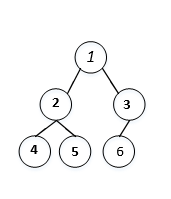
方法一:递归
值得注意的是:递归过程中,起始点的选取。Grandyang对下标的选取有较为详细的说明。至于这个递归过程,(个人愚见,欢迎大神给出更好递归过程)可以在脑海想,构造顺序为4->5->2构建好左子树,接上1,然后6->3构建好右子树,最后接上1,完成。
 /**

  * Definition for binary tree

  * struct TreeNode {

  *     int val;

  *     TreeNode *left;

  *     TreeNode *right;

  *     TreeNode(int x) : val(x), left(NULL), right(NULL) {}

  * };

  */

 class Solution {

 public:

     TreeNode *buildTree(vector<int> &inorder, vector<int> &postorder)

     {

         int len=inorder.size();

         return build(inorder,,len-,postorder,,len-);

     }

     TreeNode *build(vector<int> &inorder,int inBeg,int inEnd,vector<int> &postorder,int postBeg,int postEnd)

     {

         if(inBeg>inEnd||postBeg>postEnd)    return NULL;

         TreeNode *root=new TreeNode(postorder[postEnd]);

         for(int i=;i<inorder.size();++i)

         {

             if(inorder[i]==postorder[postEnd])

             {

                 root->left=build(inorder,inBeg,i-,postorder,postBeg,postBeg+i--inBeg);

                 root->right=build(inorder,i+,inEnd,postorder,postBeg+i-inBeg,postEnd-);

             }

         }

         return root;

     }

 };
方法二:
利用栈。这个方法是以前看到出处也尴尬的忘了,分析过程等我再次看懂了再补上。这种方法改变了数组。
 /**

  * Definition for binary tree

  * struct TreeNode {

  *     int val;

  *     TreeNode *left;

  *     TreeNode *right;

  *     TreeNode(int x) : val(x), left(NULL), right(NULL) {}

  * };

  */

 class Solution {

 public:

     TreeNode *buildTree(vector<int> &inorder, vector<int> &postorder)

     {

         if(inorder.size()==)   return NULL;

         TreeNode* p;

         TreeNode* root;

         stack<TreeNode*> stn;

         root=new TreeNode(postorder.back());

         stn.push(root);

         postorder.pop_back();

         while(true)

         {

             if(inorder.back()==stn.top()->val)

             {

                 p=stn.top();

                 stn.pop();

                 inorder.pop_back();

                 if(inorder.size()==)   break;

                 if(stn.size()&&inorder.back()==stn.top()->val)

                     continue;

                 p->left=new TreeNode(postorder.back());

                 postorder.pop_back();

                 stn.push(p->left);

             }

             else

             {

                 p=new TreeNode(postorder.back());

                 postorder.pop_back();

                 stn.top()->right=p;

                 stn.push(p);

             }

         }

         return root;

     }

 };
[Leetcode] Construct binary tree from inorder and postorder travesal 利用中序和后续遍历构造二叉树的更多相关文章
- [LeetCode] Construct Binary Tree from Inorder and Postorder Traversal 由中序和后序遍历建立二叉树
Given inorder and postorder traversal of a tree, construct the binary tree. Note: You may assume tha ...
- Construct Binary Tree from Inorder and Postorder Traversal(根据中序遍历和后序遍历构建二叉树)
根据中序和后续遍历构建二叉树. /** * Definition for a binary tree node. * public class TreeNode { * int val; * Tree ...
- [LeetCode] 106. Construct Binary Tree from Inorder and Postorder Traversal 由中序和后序遍历建立二叉树
Given inorder and postorder traversal of a tree, construct the binary tree. Note:You may assume that ...
- LeetCode 106. Construct Binary Tree from Inorder and Postorder Traversal 由中序和后序遍历建立二叉树 C++
Given inorder and postorder traversal of a tree, construct the binary tree. Note:You may assume that ...
- Construct Binary Tree from Inorder and Postorder Traversal ——通过中序、后序遍历得到二叉树
题意:根据二叉树的中序遍历和后序遍历恢复二叉树. 解题思路:看到树首先想到要用递归来解题.以这道题为例:如果一颗二叉树为{1,2,3,4,5,6,7},则中序遍历为{4,2,5,1,6,3,7},后序 ...
- LeetCode: 106_Construct Binary Tree from Inorder and Postorder Traversal | 根据中序和后序遍历构建二叉树 | Medium
要求:根据中序和后序遍历序列构建一棵二叉树 代码如下: struct TreeNode { int val; TreeNode *left; TreeNode *right; TreeNode(int ...
- LeetCode:Construct Binary Tree from Inorder and Postorder Traversal,Construct Binary Tree from Preorder and Inorder Traversal
LeetCode:Construct Binary Tree from Inorder and Postorder Traversal Given inorder and postorder trav ...
- LeetCode: Construct Binary Tree from Inorder and Postorder Traversal 解题报告
Construct Binary Tree from Inorder and Postorder Traversal Given inorder and postorder traversal of ...
- Leetcode Construct Binary Tree from Inorder and Postorder Traversal
Given inorder and postorder traversal of a tree, construct the binary tree. Note:You may assume that ...
随机推荐
- Mate20兼容性如何?WeTest带你抢先测!
自从九月份 iPhone XS 系列发布后,WeTest团队迅速入库了iPhone XS和iPhone XR设备,十月份国内巨头华为也重磅推出了一款“Mate 20”设备,让下半年的国内手机市场又热闹 ...
- ToString的格式化字符串
如下: , , ).ToString(@"d\.hh\:mm\:ss"); var b = DateTimeOffset.Now.ToString("yyyy-MM-dd ...
- Java 集合学习--HashMap
一.HashMap 定义 HashMap 是一个基于散列表(哈希表)实现的键值对集合,每个元素都是key-value对,jdk1.8后,底层数据结构涉及到了数组.链表以及红黑树.目的进一步的优化Has ...
- 搜索二维矩阵 II
描述 写出一个高效的算法来搜索m×n矩阵中的值,返回这个值出现的次数. 这个矩阵具有以下特性: 每行中的整数从左到右是排序的. 每一列的整数从上到下是排序的. 在每一行或每一列中没有重复的整数. 样例 ...
- leetcode-位1的个数(位与运算)
位1的个数 编写一个函数,输入是一个无符号整数,返回其二进制表达式中数字位数为 ‘1’ 的个数(也被称为汉明重量). 示例 : 输入: 11 输出: 3 解释: 整数 11 的二进制表示为 00000 ...
- (python)leetcode刷题笔记 01 TWO SUM
1. Two Sum Given an array of integers, return indices of the two numbers such that they add up to a ...
- 【转】VSstudio中的一些宏
说明 $(RemoteMachine) 设置为“调试”属性页上“远程计算机”属性的值.有关更多信息,请参见更改用于 C/C++ 调试配置的项目设置. $(References) 以分号分隔的引用列表被 ...
- HDU 4568 Hunter(最短路径+DP)(2013 ACM-ICPC长沙赛区全国邀请赛)
Problem Description One day, a hunter named James went to a mysterious area to find the treasures. J ...
- js经典试题之w3规范系列
js经典试题之w3规范系列 1:w3c 制定的 javascript 标准事件模型的正确的顺序? 答案:事件捕获->事件处理->事件冒泡 解析:先事件捕获从windows > doc ...
- 为什么23种设计模式中没有MVC
GoF (Gang of Four,四人组, <Design Patterns: Elements of Reusable Object-Oriented Software>/<设计 ...