
【poj2828】Buy Tickets 线段树 插队问题
【poj2828】Buy Tickets
Description
Railway tickets were difficult to buy around the Lunar New Year in China, so we must get up early and join a long queue…
The Lunar New Year was approaching, but unluckily the Little Cat still had schedules going here and there. Now, he had to travel by train to Mianyang, Sichuan Province for the winter camp selection of the national team of Olympiad in Informatics.
It was one o’clock a.m. and dark outside. Chill wind from the northwest did not scare off the people in the queue. The cold night gave the Little Cat a shiver. Why not find a problem to think about? That was none the less better than freezing to death!
People kept jumping the queue. Since it was too dark around, such moves would not be discovered even by the people adjacent to the queue-jumpers. “If every person in the queue is assigned an integral value and all the information about those who have jumped the queue and where they stand after queue-jumping is given, can I find out the final order of people in the queue?” Thought the Little Cat.
Input
There will be several test cases in the input. Each test case consists of N + 1 lines where N (1 ≤ N ≤ 200,000) is given in the first line of the test case. The next N lines contain the pairs of values Posiand Vali in the increasing order of i (1 ≤ i ≤ N). For each i, the ranges and meanings of Posi and Vali are as follows:
- Posi ∈ [0, i − 1] — The i-th person came to the queue and stood right behind the Posi-th person in the queue. The booking office was considered the 0th person and the person at the front of the queue was considered the first person in the queue.
- Vali ∈ [0, 32767] — The i-th person was assigned the value Vali.
There no blank lines between test cases. Proceed to the end of input.
Output
For each test cases, output a single line of space-separated integers which are the values of people in the order they stand in the queue.
Sample Inpu
4
Sample Output
77 33 69 51
Hint
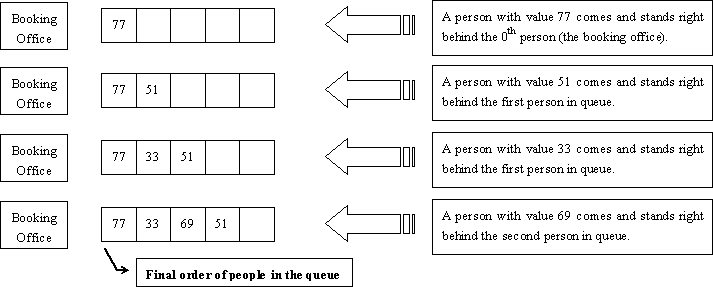
The figure below shows how the Little Cat found out the final order of people in the queue described in the first test case of the sample input.
题解
线段树的妙用,加深理解吧.....
代码
 #include <cstdio>

 #include <cmath>

 #include <cstring>

 #include <ctime>

 #include <iostream>

 #include <algorithm>

 #include <set>

 #include <vector>

 #include <queue>

 #include <typeinfo>

 #include <map>

 #include <stack>

 typedef long long ll;

 #define inf 0x7fffffff

 using namespace std;

 inline ll read()

 {

     ll x=,f=;

     char ch=getchar();

     while(ch<''||ch>'')

     {

         if(ch=='-')f=-;

         ch=getchar();

     }

     while(ch>=''&&ch<='')

     {

         x=x*+ch-'';

         ch=getchar();

     }

     return x*f;

 }

 //**************************************************************************************

 struct ss

 {

     int l,r,x;

 } tr[*];

 int n;

 int a[];

 void build(int k,int s,int t)

 {

     tr[k].l=s;

     tr[k].r=t;

     if(s==t)

     {

         tr[k].x=;

         return;

     }

     int mid=(s+t)>>;

     build(k<<,s,mid);

     build(k<<|,mid+,t);

     tr[k].x=tr[k<<].x+tr[k<<|].x;

 }

 void update(int k,int x,int y)

 {

     if(tr[k].l==tr[k].r)

     {

         tr[k].x=;

         a[tr[k].l]=y;

         return;

     }

     if(tr[k<<].x>=x)update(k<<,x,y);//能往左下放尽量放,同时你要明白这是个插队问题^-^!!

     else update(k<<|,x-tr[k<<].x,y);

     tr[k].x=tr[k<<].x+tr[k<<|].x;

 }

 int main()

 {

     int x[];

     int y[];

     while(scanf("%d",&n)!=EOF)

     {

         build(,,);

         for(int i=; i<=n; i++)

         {

             scanf("%d%d",&x[i],&y[i]);

             x[i]++;

         }

         for(int i=n; i>=; i--)

         {

             update(,x[i],y[i]);

         }

         for(int i=; i<n; i++)

         {

             printf("%d ",a[i]);

         }

         printf("%d\n",a[n]);

     }

     return ;

 }
【poj2828】Buy Tickets 线段树 插队问题的更多相关文章
- poj2828 Buy Tickets (线段树 插队问题)
Buy Tickets Time Limit: 4000MS Memory Limit: 65536K Total Submissions: 22097 Accepted: 10834 Des ...
- [poj2828] Buy Tickets (线段树)
线段树 Description Railway tickets were difficult to buy around the Lunar New Year in China, so we must ...
- poj-----(2828)Buy Tickets(线段树单点更新)
Buy Tickets Time Limit: 4000MS Memory Limit: 65536K Total Submissions: 12930 Accepted: 6412 Desc ...
- [POJ2828]Buy Tickets(线段树,单点更新,二分,逆序)
题目链接:http://poj.org/problem?id=2828 由于最后一个人的位置一定是不会变的,所以我们倒着做,先插入最后一个人. 我们每次处理的时候,由于已经知道了这个人的位置k,这个位 ...
- POJ 2828 Buy Tickets(线段树·插队)
题意 n个人排队 每一个人都有个属性值 依次输入n个pos[i] val[i] 表示第i个人直接插到当前第pos[i]个人后面 他的属性值为val[i] 要求最后依次输出队中各个人的属性 ...
- poj 2828 Buy Tickets (线段树(排队插入后输出序列))
http://poj.org/problem?id=2828 Buy Tickets Time Limit: 4000MS Memory Limit: 65536K Total Submissio ...
- Buy Tickets(线段树)
Buy Tickets Time Limit: 4000MS Memory Limit: 65536K Total Submissions: 16607 Accepted: 8275 Desc ...
- POJ 2828 Buy Tickets 线段树 倒序插入 节点空位预留(思路巧妙)
Buy Tickets Time Limit: 4000MS Memory Limit: 65536K Total Submissions: 19725 Accepted: 9756 Desc ...
- POJ 2828 Buy Tickets (线段树 or 树状数组+二分)
题目链接:http://poj.org/problem?id=2828 题意就是给你n个人,然后每个人按顺序插队,问你最终的顺序是怎么样的. 反过来做就很容易了,从最后一个人开始推,最后一个人位置很容 ...
随机推荐
- 老项目的#iPhone6与iPhone6Plus适配#iOS8无法开启定位问题和#解决方案#
本文永久地址为 http://www.cnblogs.com/ChenYilong/p/4020359.html,转载请注明出处. iOS8的定位和推送的访问都发生了变化, 下面是iOS7和iOS8申 ...
- 免费馅饼 Why WA
免费馅饼 Time Limit: 1 Sec Memory Limit: 64 MBSubmit: 1576 Solved: 577 Description 都说天上不会掉馅饼,但有一天gameb ...
- HTTP长连接短连接
一.什么是长连接 HTTP1.1规定了默认保持长连接(HTTP persistent connection ,也有翻译为持久连接),数据传输完成了保持TCP连接不断开(不发RST包.不四次握手),等待 ...
- scp 命令
复制文件: (1)将本地文件拷贝到远程 scp 文件名 用户名@计算机IP或者计算机名称:远程路径 (2)从远程将文件拷回本地 ...
- JAVA程序1,1,2,3,5,8,13,21....第30个是什么...?
解题思路:从第3个数字开始,后一个数字是前2个数字的和public class text{ public static void main(String[] args) { int num1=1,nu ...
- 【Django】Django 如何实现 如下 联表 JOIN 查询?
SQL语句: select distinct a.device_hash, sum(b.cmn_merge_count) from (select distinct device_hash from ...
- Linux下配置JDK
下面以CentOS为例,详细说一下Linux下配置JDK的过程 首先按照约定俗成的习惯,将jdk放在/usr/local/java下,首先进入/usr/local然后新建一个目录java 然后我们需要 ...
- Java for LeetCode 145 Binary Tree Postorder Traversal
Given a binary tree, return the postorder traversal of its nodes' values. For example: Given binary ...
- codeforces B. The Fibonacci Segment 解题报告
题目链接:http://codeforces.com/problemset/problem/365/B 题目意思:简单来说,就是要找出最长的斐波纳契长度. 解决的方法不难,但是要注意更新左区间和右区间 ...
- 两个文件去重的N种姿势
最近利用shell帮公司优化挖掘关键词的流程,用shell替代了多个环节的操作,极大提高了工作效率. shell在文本处理上确有极大优势,比如多文本合并.去重等,但是最近遇到了一个难搞的问题,即两个大 ...