
SSM-MyBatis-18:Mybatis中二级缓存和第三方Ehcache配置
------------吾亦无他,唯手熟尔,谦卑若愚,好学若饥-------------
二级缓存
Mybatis中,默认二级缓存是开启的。可以关闭。
一级缓存开启的。可以被卸载吗?不可以的。一级缓存不可以卸载,天然和框架绑定。
内置二级缓存
由于MyBatis从缓存中读取数据的依据与SQL的id相关,而非查询出的对象。所以,使用二级缓存的目的,不是在多个查询间共享查询结果(所有查询中只要查询结果中存在该对象,
就直接从缓存中读取,这是对查询结果的共享,Hibernate中的缓存就是为了在多个查询间共享查询结果,但MyBatis不是),而是为了防止同一查询(相同的Sql id,相同的sql语句)的反复执行。
一级缓存: 基于PerpetualCache 的 HashMap本地缓存,其生命周期为 Session,当 Session flush 或 close 之后,该Session中的所有 Cache 就将清空。
二级缓存与一级缓存其机制相同,默认也是采用 PerpetualCache,HashMap存储,不同在于其存储作用域为 Mapper(Namespace),并且可自定义存储源,如 Ehcache
对于缓存数据更新机制,当某一个作用域(一级缓存Session/二级缓存Namespaces)进行了 C/U/D 操作后,默认该作用域下所有 select 中的缓存将被clear
------------------------------------------------------------------------------------------------------------------------------------------------------------》
内置二级缓存的使用简单配置步骤
1.cacheEnabled=true;(这个默认值就是true,想用二级缓存可以不做配置,不想用改成false,在大配置中)
<settings>

        <setting name="cacheEnabled" value="true"/><!--开启,他也是默认值-->

        <!--<setting name="cacheEnabled" value="false"/>--><!--关闭-->

    </settings>
2.实体类实现序列化接口Serializeble
由于我做的是关联查询,并且没有做延迟加载,所以俩个实体类都得实现Serializeble接口
3.在接口同名的xml小配置中
加入一个自闭和的<cache/>
------------------------------------------------------------------------------------------------------------------------------------------------------------》
内置二级缓存存在性证明
都已经知道一级缓存是sqlsession的级别,如果要是close掉,换成不同的sqlsession怎么办?
/*二级缓存*/

    @Test

    public void t4SecondCacheHasExist(){

        SqlSession session= MyBatisUtils.getSession();

        IDeptDAO mapper = session.getMapper(IDeptDAO.class);

        Dept depts = mapper.findDeptnoALLEmpsMoreSql();

        System.out.println(depts.getDeptName());

        session.close();

        System.out.println("===================我是高冷的分割线=====================");

        SqlSession session2= MyBatisUtils.getSession();

        IDeptDAO mapper2 = session2.getMapper(IDeptDAO.class);

        Dept depts2 = mapper2.findDeptnoALLEmpsMoreSql();

        System.out.println(depts2.getDeptName());

        session2.close();

    }
运行结果
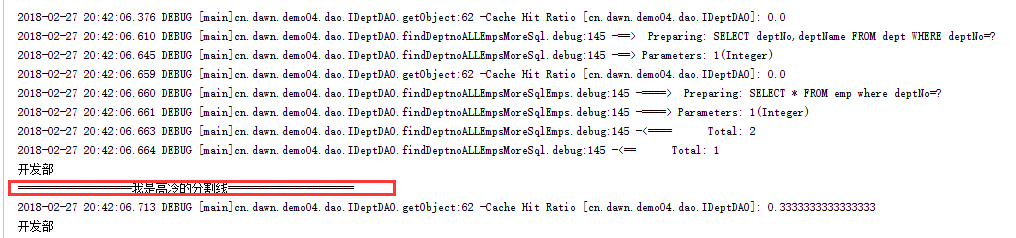
但由于他对数据库只发了上面的sql,分割线后就没有去数据库去查找了,而sqlsession关闭掉了,并且又开了一个,说明二级缓存真的存在,是真的运用上了
-----------------------------------------------------------------------------------》
二级缓存参数配置
在接口同名xml小配置中,可以指定具体的二级缓存参数配置
我以代码加注释的方式来解释一波
    <!--

        eviction:清理缓存策咯,默认值LRU,最近最少使用先清除

        flushInterval:刷新间隔,默认不设置,就是永久

        size:对象,默认1024

        readOnly:只读,默认false

     -->

    <!--二级缓存-->

    <cache eviction="FIFO" flushInterval="" size="" readOnly="true"/>
     eviction:清理缓存策咯,默认值LRU,最近最少使用先清除,此处设置的FIFO是先进先出的队列形式,先进来的先清除

        flushInterval:刷新间隔,默认不设置,就是永久,单位毫秒

        size:对象,默认1024

        readOnly:只读,默认false
------------------------------------------------------------------------------------》
二级缓存可以在一条sql语句上设置他的不开启-----------》局部关闭
useCache改为false,不使用,不开启
方法如下
    <!--设置二级缓存单条sql失效-->

    <select id="findDeptnoALLEmpsMoreSql" resultMap="DeptMoreSqlMapper" useCache="false">

        SELECT deptNo,deptName FROM dept WHERE deptNo=#{deptNo}

    </select>
-------------------------------------------------------------------------------------》
第三方的二级缓存引用---ehcache
使用方式
1.引入jar包,我给你们提供节点
        <dependency>

            <groupId>net.sf.ehcache</groupId>

            <artifactId>ehcache</artifactId>

            <version>2.10.</version>

        </dependency>

        <!--MyBatis整合EhCache的包-->

        <dependency>

            <groupId>org.mybatis.caches</groupId>

            <artifactId>mybatis-ehcache</artifactId>

            <version>1.1.</version>

        </dependency>
2.小配置中添加<cache/>具体配置,引用到第三方的缓存
<cache type="org.mybatis.caches.ehcache.EhcacheCache"></cache>
3.引入配置xml文件 ehcache.xml 名字一定这么取,别的不可以
里面内容
<ehcache>

    <!-- Sets the path to the directory where cache .data files are created.

         If the path is a Java System Property it is replaced by

         its value in the running VM.

         The following properties are translated:

         user.home - User's home directory

         user.dir - User's current working directory

         java.io.tmpdir - Default temp file path -->

    <diskStore path="java.io.tmpdir"/>

    <!--Default Cache configuration. These will applied to caches programmatically created through

        the CacheManager.

        The following attributes are required for defaultCache:

        maxInMemory       - Sets the maximum number of objects that will be created in memory

        eternal           - Sets whether elements are eternal. If eternal,  timeouts are ignored and the element

                            is never expired.

        timeToIdleSeconds - Sets the time to idle for an element before it expires. Is only used

                            if the element is not eternal. Idle time is now - last accessed time

        timeToLiveSeconds - Sets the time to live for an element before it expires. Is only used

                            if the element is not eternal. TTL is now - creation time

        overflowToDisk    - Sets whether elements can overflow to disk when the in-memory cache

                            has reached the maxInMemory limit.

        -->

    <defaultCache

        maxElementsInMemory=""

        eternal="false"

        timeToIdleSeconds=""

        timeToLiveSeconds=""

        overflowToDisk="true"

        />

    <!--Predefined caches.  Add your cache configuration settings here.

        If you do not have a configuration for your cache a WARNING will be issued when the

        CacheManager starts

        The following attributes are required for defaultCache:

        name              - Sets the name of the cache. This is used to identify the cache. It must be unique.

        maxInMemory       - Sets the maximum number of objects that will be created in memory

        eternal           - Sets whether elements are eternal. If eternal,  timeouts are ignored and the element

                            is never expired.

        timeToIdleSeconds - Sets the time to idle for an element before it expires. Is only used

                            if the element is not eternal. Idle time is now - last accessed time

        timeToLiveSeconds - Sets the time to live for an element before it expires. Is only used

                            if the element is not eternal. TTL is now - creation time

        overflowToDisk    - Sets whether elements can overflow to disk when the in-memory cache

                            has reached the maxInMemory limit.

        -->

    <!-- Sample cache named sampleCache1

        This cache contains a maximum in memory of  elements, and will expire

        an element if it is idle for more than  minutes and lives for more than

         minutes.

        If there are more than  elements it will overflow to the

        disk cache, which in this configuration will go to wherever java.io.tmp is

        defined on your system. On a standard Linux system this will be /tmp"

        -->

    <cache name="sampleCache1"

        maxElementsInMemory=""

        eternal="false"

        timeToIdleSeconds=""

        timeToLiveSeconds=""

        overflowToDisk="true"

        />

    <!-- Sample cache named sampleCache2

        This cache contains  elements. Elements will always be held in memory.

        They are not expired. -->

    <cache name="sampleCache2"

        maxElementsInMemory=""

        eternal="true"

        timeToIdleSeconds=""

        timeToLiveSeconds=""

        overflowToDisk="false"

        /> -->

    <!-- Place configuration for your caches following -->

</ehcache>
接着我们调用刚才二级缓存存在性证明的那个方法,测试引用到了第三方框架ehcache了没
运行结果
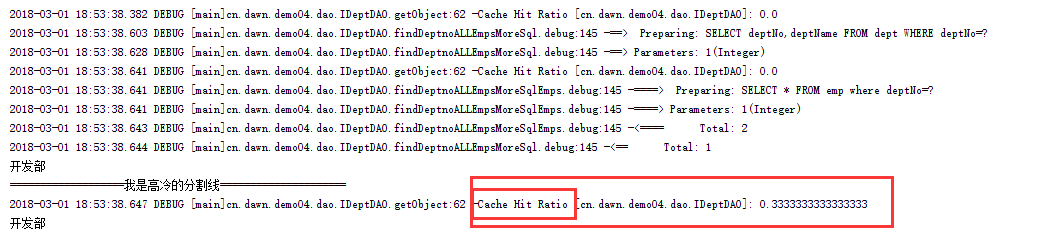
看到这个表示成功
Cache Hit Ratio 缓存命中率
--------------------------------孤傲的程序员------------------------------------------------------------------------------------------------
SSM-MyBatis-18:Mybatis中二级缓存和第三方Ehcache配置的更多相关文章
- Mybatis五(一级二级缓存、第三方缓存)
一级缓存 Mybatis对缓存提供支持,但是在没有配置的默认情况下,它只开启一级缓存,一级缓存只是相对于同一个SqlSession而言.所以在参数和SQL完全一样的情况下,我们使用同一个SqlSess ...
- Mybatis整合Redis实现二级缓存
Mybatis集成ehcache . 为什么需要缓存 拉高程序的性能 . 什么样的数据需要缓存 很少被修改或根本不改的数据 业务场景比如:耗时较高的统计分析sql.电话账单查询sql等 . ehcac ...
- mybatis(4)_二级缓存深入_使用第三方ehcache配置二级缓存
增删改对二级缓存的影响 1.增删改也会清空二级缓存 2.对于二级缓存的清空实质上是对value清空为null,key依然存在,并非将Entry<k,v>删除 3.从DB中进行select查 ...
- mybatis 使用redis实现二级缓存(spring boot)
mybatis 自定义redis做二级缓存 前言 如果关注功能实现,可以直接看功能实现部分 何时使用二级缓存 一个宗旨---不常变的稳定而常用的 一级是默认开启的sqlsession级别的. 只在单表 ...
- myBatis源码解析-二级缓存的实现方式
1. 前言 前面近一个月去写自己的mybatis框架了,对mybatis源码分析止步不前,此文继续前面的文章.开始分析mybatis一,二级缓存的实现.附上自己的项目github地址:https:// ...
- MyBatis加强(1)~缓存机制(一级缓存、二级缓存、第三方缓存技术redis、ehcache)
一.缓存机制 使用缓存可以使应用更快地获取数据,避免频繁的数据库交互操作,尤其是在查询越多,缓存命中率越高 的情况下,缓存的作用就越明显. 1.缓存原理:Map ■ 查询时,先从缓存区查询:找到,返回 ...
- Mybatis架构原理(二)-二级缓存源码剖析
Mybatis架构原理(二)-二级缓存源码剖析 二级缓存构建在一级缓存之上,在收到查询请求时,Mybatis首先会查询二级缓存,若二级缓存没有命中,再去查询一级缓存,一级缓存没有,在查询数据库; 二级 ...
- 缓存架构中的服务详解!SpringBoot中二级缓存服务的实现
创建缓存服务 创建缓存服务接口项目 创建myshop-service-redis-api项目,该项目只负责定义接口 创建项目的pom.xml: <?xml version="1.0&q ...
- Hibernatne 缓存中二级缓存简单介绍
hibernate的session提供了一级缓存,每个session,对同一个id进行两次load,不会发送两条sql给数据库,但是session关闭的时候,一级缓存就失效了. 二级缓存是Sessio ...
随机推荐
- MIDle生命周期详解,以及工作原理
当MIDlet被应用程序管理器成功地初始化之后,就开始展开了它的生命周期.MIDlet的生命周期完全由应用程序管理器控制,也就是说,当MIDlet要从一个状态变成另外一个状态时,应用程序管理器会调用对 ...
- PLSQL表
PL/SQL表 一,什么是PL/SQL表? 首先PL/SQL表和记录(Record)一样,都是复合数据类型.可以看做是一种用户自定义数据类型. PL/SQL表由多列单行的标量构成的临时索引表对象.组成 ...
- Android源代码目录组成介绍-android学习之旅(97)
android的主要源代码组成如下: Kernel:Android Linux 内核2.6 bionic:Android 标准C运行支持库 bootloader:内核加载器参考 build:Andro ...
- 用shell脚本挂载linux主机拷贝相应文件
#!/bin/sh TARGETIP=192.168.88.3 #这里是你要挂在的ftp服务器的IP地址 MOUNTDIR=/mnt TARGETDIR=/root/Desktop/Work ERRO ...
- 【Nginx】下载,请求限速,根据URL参数限速
这个场景是限制单个连接的下载速度,还有限制单个IP的连接数,或者单位时间内的请求数,实验环境 nginx1.9.x. 小例子为主,具体的细节请多看文档. 限制下载速度 location /downlo ...
- linux 常见命令及说明杂记
systemctl 命令: systemctl 是管制服务的主要工具, 它整合了chkconfig 与 service功能于一体.示例:systemctl is-enabled iptables.se ...
- sxoi爆炸祭
好吧,纯粹是去玩玩的,我这么一个弱省的蒟蒻,进队纯粹是开玩笑.... Day0 去五中试机,感觉电脑手感不错,打了半个线段树的板子才发现试机要在自己的电脑上试,然后我无奈的搬东西(从26号搬到2号), ...
- 4 sum
Given an array S of n integers, are there elements a, b, c, and d in S such that a + b + c + d = tar ...
- Spring中事务管理
spring事务管理两种方式 第一种 编程式事务管理(不用) 第二种 声明式事务管理 (1) 基于xml配置文件实现 (2) 基于注解实现 一:声明式事务管理(xml配置) 第一步 ...
- Centos 7 卸载自带的openjdk
[root@localhost ~]# rpm -qa|grep jdk java-1.6.0-openjdk-1.6.0.0-1.50.1.11.5.el6_3.x86_64 java-1.7.0- ...