
DS实验题 Dijkstra算法
参考:Dijkstra算法
数据结构来到了图论这一章节,网络中的路由算法基本都和图论相关。于是在拿到DS的实验题的时候,决定看下久负盛名的Dijkstra算法。
Dijkstra的经典应用是开放最短路径优先路由算法(OSPF)。
题目:
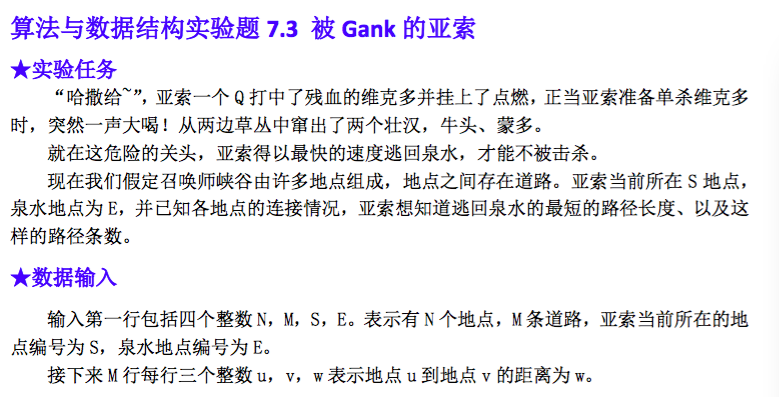
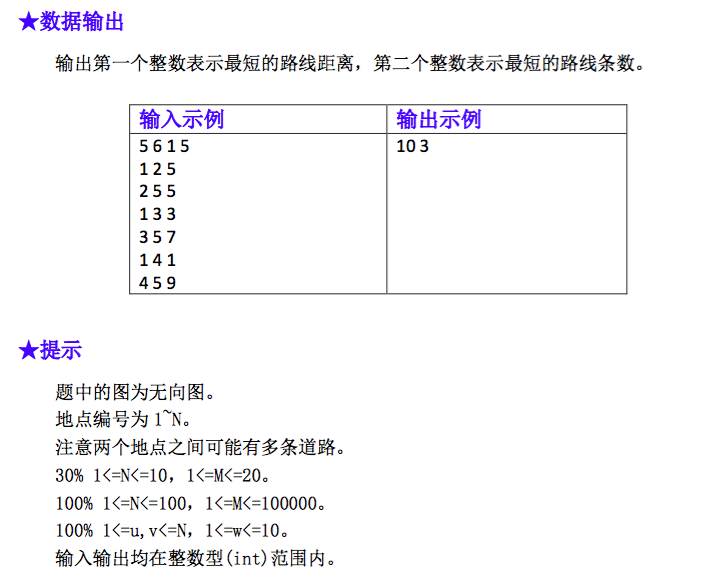
第一种实现的算法(错误):
在看过相关的Dijkstra算法解析之后,决定自己尝试写个算法,不过很遗憾,考虑并不全面,理解也不是特别深刻。
最后决定还是贴出来。
算法思想:
1.建立邻接表(后面用二维数组实现,相对来说轻松很多)
2.维护三个数组:dist代表从源点到某个节点的最短路径长度;ins代表这个节点是否已经被查询过;pre记录最短路径。
3.算法主体:
-1.当前节点 = 源节点。
-2.从当前节点出发,遍历邻接节点,找到离它最近的节点,且这个节点尚未遍历过,同时更新dist。
-3.跳转到找到的最近节点,先前节点的ins置1,回到2。
-4.当当前节点附近没有未遍历的节点时,break。
算法代码如下:
//

//  main.cpp

//  Gank_Dijkstra

//

//  Created by wasdns on 16/11/15.

//  Copyright © 2016年 wasdns. All rights reserved.

//

#include <cstdio>

#include <iostream>

#include <string.h>

#include <string>

#include <stack>

using namespace std;

#define maxn 100000000;

struct edge {

    edge *next;

    int num;

    int len;

} eg[100000];

struct head {

    edge *next;

    int num;

} h[100000];

void IniList(int n)

{

    int i;

    for (i = 1; i <= n; i++)

    {

        h[i].next = NULL;

        h[i].num = i;

    }

}

void CreatList(int n, int m)

{

    int i;

    int x, y, leng;

    for (i = 1; i <= n; i++)

    {

        h[i].next = NULL;

        h[i].num = i;

    }

    for (i = 0; i < m; i++)

    {

        cin >> x >> y >> leng;

        edge *p1, *p2;

        p1 = new edge;

        p1 -> next = NULL;

        p1 -> num = y;

        p1 -> len = leng;

        p2 = new edge;

        p2 -> next = NULL;

        p2 -> num = x;

        p2 -> len = leng;

        edge *p3, *p4;

        p3 = h[x].next;

        if (p3 == NULL) {

            h[x].next = p1;

        }

        else

        {

            while (p3 -> next != NULL) {

                p3 = p3 -> next;

            }

            p3 -> next = p1;

        }

        p4 = h[y].next;

        if (p4 == NULL) {

            h[y].next = p2;

        }

        else

        {

            while (p4 -> next != NULL) {

                p4 = p4 -> next;

            }

            p4 -> next = p2;

        }

    }

}

void PrintList(int n)

{

    int i;

    edge *p;

    for (i = 1; i <= n; i++)

    {

        p = h[i].next;

        cout << "Node:" << h[i].num << endl;

        while (p != NULL) {

            cout << p -> num << " " << p -> len << " ";

            p = p -> next;

        }

        cout << endl;

    }

}

int pre[105];

int dist[105];

bool ins[105];

void Initial(int b, int n)

{

    int i;

    memset(pre, -1, sizeof(pre));

    for (i = 1; i <= n; i++)

    {

        dist[i] = 10000000;

        ins[i] = false;

    }

    dist[b] = 0;

    pre[b] = b;

}

int Dijkstra(int b, int n, int end)

{

    Initial(b, n);

    int cnt = 0;

    int turn = b;

    while (cnt < n)

    {

        edge *p;

        p = h[turn].next;

        int minlen = maxn;

        int tnext = turn;

        while (p != NULL)

        {

            if (ins[p -> num]) {

                p = p -> next;

                continue;

            }

            int t = dist[turn] + p -> len;

            if (t < dist[p -> num]) {

                dist[p -> num] = t;

                pre[p -> num] = turn;

            }

            if (t < minlen) {

                minlen = t;

                tnext = p -> num;

            }

            p = p -> next;

        }

        ins[turn] = true;

        cnt++;

        if (turn == tnext) {

            turn = b;

        }

        turn = tnext;

    }

    return dist[end];

}

int main()

{

    int n, m, s, e;

    cin >> n >> m >> s >> e;

    CreatList(n, m);

    PrintList(n);

    cout << Dijkstra(s, n, e) << endl;

    return 0;

}

/*

 5 6 1 5

 1 2 5

 2 5 5

 1 3 3

 3 5 7

 1 4 1

 4 5 9

 6 9 1 6

 1 3 3

 1 2 6

 2 3 2

 2 4 5

 3 4 3

 3 5 4

 4 5 2

 4 6 3

 5 6 5

 5 6 1 5

 1 2 7

 1 3 1

 1 4 3

 2 5 1

 3 5 10

 4 5 9

*/
算法缺陷:
测试一下下面这个样例,
 5 6 1 5

 1 2 7

 1 3 1

 1 4 3

 2 5 1

 3 5 10

 4 5 9
答案应该为8,但是结果为11。
原因在于,当以上算法经过:1 -> 3 -> 5 -> 2 最终来到节点2的时候,节点2附近没有未遍历的节点了(节点2),跳出循环。
第二种算法:
//

//  main.cpp

//  Dijkstra

//

//  Created by wasdns on 16/11/16.

//  Copyright © 2016年 wasdns. All rights reserved.

//

#include <iostream>

#include <cstdio>

#include <string.h>

using namespace std;

int DijGraph[105][105];               //节点i和j之间的距离:DijGraph[i][j]

int pre[105];                         //最短路节点的前继节点(查询最短路)

int dist[105];                        //源点到每个节点的最短路距离

bool ins[105];                        //节点i是否位于已查询节点集合S

/*

    初始化函数

 */

void Initial(int n)

{

    for (int i = 1; i <= n; i++)

    {

        ins[i] = false;

        pre[i] = -1;

        for (int j = 1; j <= n; j++) {

            if (i == j) DijGraph[i][j] = 0;

            else DijGraph[i][j] = 1000000;

        }

    }

}

int cnt = 1;                                    //记录到目的节点的条数

int belen = 1000000;                            //到目的节点的最短路长度

void Dijkstra(int n, int b, int e)

{

    int i, j;

    for (i = 1; i <= n; i++) {                  //根据图的信息初始化dist数组

        dist[i] = DijGraph[b][i];

    }

    dist[b] = 0;

    ins[b] = true;                              //源节点加入集合S

    for (i = 2; i <= n; i++)                    //集合V一共有n-1个节点

    {

        int next = b;                           //记录此时V中最靠近源点的节点

        int minlen = 1000000;                   //以及源点到该节点的长度

        for (j = 1; j <= n; j++)                //源点从V中挑一个最近节点

        {

            if (ins[j]) continue;               //这个节点在S中,跳过

            if (dist[j] < minlen) {             //找到一个目前到源点距离最小的

                next = j;

                minlen = dist[j];               //更新离源点最近节点的信息

            }

        }

        ins[next] = true;                       //最近节点离开V加入S

        for (j = 1; j <= n; j++)                //新来的节点向外得到路径信息

        {                                       //并维护dist

            if (ins[j]) continue;

            /* 从源点到当前节点next的距离 + 当前节点next到某个相邻节点j的距离。*/

            /* 如果小于目前源点到节点j的最短距离dist[j],更新dist[j]。*/

            /* 另外,需要在这个时候记录到目的点的最短距离,以及路径条数。*/

            int t = dist[next] + DijGraph[next][j];

            if (t <= dist[j])

            {

                if (t < dist[j])

                {

                    dist[j] = t;

                    pre[j] = next;

                    if (j == e) {

                        cnt = 1;

                        belen = dist[j];

                    }

                }

                else

                {

                    if (j == e) cnt++;

                }

            }

        }

    }

}

int main()

{

    int i, n, m, s, e;

    cin >> n >> m >> s >> e;

    int x, y, len;

    Initial(n);

    for (i = 1; i <= m; i++) {

        cin >> x >> y >> len;

        DijGraph[x][y] = len;

        DijGraph[y][x] = len;

    }

    Dijkstra(n, s, e);

    cout << belen << " " << cnt << endl;

    return 0;

}
2016/11/15
DS实验题 Dijkstra算法的更多相关文章
- DS实验题 融合软泥怪-2 Heap实现
题目和STL实现:DS实验题 融合软泥怪-1 用堆实现优先队列 引言和堆的介绍摘自:Priority Queue(Heaps)--优先队列(堆) 引言: 优先队列是一个至少能够提供插入(Insert) ...
- DS实验题 Old_Driver UnionFindSet结构 指针实现邻接表存储
题目见前文:DS实验题 Old_Driver UnionFindSet结构 这里使用邻接表存储敌人之间的关系,邻接表用指针实现: // // main.cpp // Old_Driver3 // // ...
- 经典算法题每日演练——第十七题 Dijkstra算法
原文:经典算法题每日演练--第十七题 Dijkstra算法 或许在生活中,经常会碰到针对某一个问题,在众多的限制条件下,如何去寻找一个最优解?可能大家想到了很多诸如“线性规划”,“动态规划” 这些经典 ...
- DS实验题 sights
算法与数据结构实验题 6.3 sights ★实验任务 美丽的小风姑娘打算去旅游散心,她走进了一座山,发现这座山有 n 个景点, 由于山路难修,所以施工队只修了最少条的路,来保证 n 个景点联通,娇弱 ...
- DS实验题 order
算法与数据结构 实验题 6.4 order ★实验任务 给出一棵二叉树的中序遍历和每个节点的父节点,求这棵二叉树的先序和后序遍历. ★数据输入 输入第一行为一个正整数n表示二叉树的节点数目,节点编号从 ...
- DS实验题 Inversion
题目: 解题过程: 第一次做这题的时候,很自然的想到了冒泡和选择,我交的代码是用选择写的.基本全WA(摊手). 贴上第一次的代码: // // main.cpp // sequenceschange ...
- DS实验题 融合软泥怪-1
题目 思路 很容易想到第一种做法,用Huffman算法,从森林中找出两个值最小的节点,合并再加入森林,在这个过程中不断记录. 但是每一次需要sort一遍,将最小的两个值节点置于头两个节点,最坏情况下复 ...
- DS实验题 PlayGame Kruskal(UnionFindSet)
题目: 思路: 有两种做法,一种是Prim算法,另外一种则是我所使用的Kruskal算法,Kruskal的算法实现可以参考:最小生成树-Prim算法和Kruskal算法,讲的已经是十分清楚了. 具体算 ...
- DS实验题 Order 已知父节点和中序遍历求前、后序
题目: 思路: 这题是比较典型的树的遍历问题,思路就是将中序遍历作为位置的判断依据,假设有个节点A和它的父亲Afa,那么如果A和Afa的顺序在中序遍历中是先A后Afa,则A是Afa的左儿子,否则是右儿 ...
随机推荐
- LINUX下安装TeamViewer
https://www.teamviewer.com/zhcn/download/linux/ [root@ok teamviewer]# yum install -y teamviewer_11.0 ...
- .net学习之多线程、线程死锁、线程通信 生产者消费者模式、委托的简单使用、GDI(图形设计接口)常用的方法
1.多线程简单使用(1)进程是不执行代码的,执行代码的是线程,一个进程默认有一个线程(2)线程默认情况下都是前台线程,要所有的前台线程退出以后程序才会退出,进程里默认的线程我们叫做主线程或者叫做UI线 ...
- SQL 替换指定列中的指定字符串
Update 表名 Set 列名 = Replace(列名,‘被替换的字符’,‘要替换的字符’) Demo: UPDATE BPM_DailySET Workstation = REPLACE(Wor ...
- DHCP和NAT的概念与对比
转自:http://network.51cto.com/art/201009/223440.htm 在网络协议中,DHCP和NAT的使用非常普遍.那么对于这两个协议你是否有所掌握呢?这里我们针对这两方 ...
- SAE上传web应用(包括使用数据库)教程详解及问题解惑
转自:http://blog.csdn.net/baiyuliang2013/article/details/24725995 SAE上传web应用(包括使用数据库)教程详解及问题解惑: 最近由于工作 ...
- struts2框架——从后台取得数据集,并在前台页面循环显示
1.CourseBean.java public class CourseBean { private String f_courseId = ""; private String ...
- 【现代程序设计】homework-09
1. 了解Lambda的用法 计算“Hello World!”中 a.字母‘e’的个数 b. 字母‘l’的个数 首先: ISO C++ 标准的另一大亮点是引入Lambda表达式.语法如下: [](形参 ...
- 让/etc/profile文件修改后立即生效(转)
方法1:让/etc/profile文件修改后立即生效 ,可以使用如下命令:# . /etc/profile注意: . 和 /etc/profile 有空格方法2:让/etc/profile文件修改后 ...
- 下面就介绍下Android NDK的入门学习过程(转)
为何要用到NDK? 概括来说主要分为以下几种情况: 1. 代码的保护,由于apk的java层代码很容易被反编译,而C/C++库反汇难度较大. 2. 在NDK中调用第三方C/C++库,因为大部分的开源库 ...
- WITH AS短语,也叫做子查询部分(subquery factoring)
可以让你做很多事情,定义一个SQL片断,该SQL片断会被整个SQL语句所用到. 作为提供数据的部分. 代码例子: with temp as (select ID, Type_Name, Type_ID ...