
81-POJ-Wall(计算几何)
| Time Limit: 1000MS | Memory Limit: 10000K | |
| Total Submissions: 41143 | Accepted: 14068 |
Description
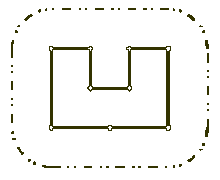
Your task is to help poor Architect to save his head, by writing a program that will find the minimum possible length of the wall that he could build around the castle to satisfy King's requirements.
The task is somewhat simplified by the fact, that the King's castle has a polygonal shape and is situated on a flat ground. The Architect has already established a Cartesian coordinate system and has precisely measured the coordinates of all castle's vertices in feet.
Input
Next N lines describe coordinates of castle's vertices in a clockwise order. Each line contains two integer numbers Xi and Yi separated by a space (-10000 <= Xi, Yi <= 10000) that represent the coordinates of ith vertex. All vertices are different and the sides of the castle do not intersect anywhere except for vertices.
Output
Sample Input
9 100

200 400

300 400

300 300

400 300

400 400

500 400

500 200

350 200

200 200
Sample Output
1628
Hint
Source
证明:

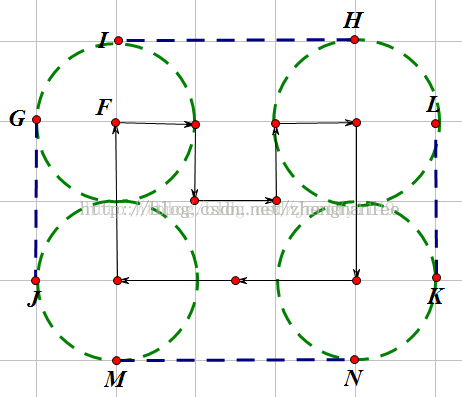
先从简单的例子看起:假设现在的凸包有四个顶点构成,可以就一个顶点来观察,我们可以看到此处的周角由四个部分组成:2个直角,一个凸包内角,一个圆弧对应的圆心角。
同理每个顶点都有类似的关系,同时周角固定为360度,而凸包内角和为(4-2)*180 ;
所以总的圆弧对应的圆心角 = 4个周角 - 4 * 2个直角 - 4个凸包内角 = 4 * 360 - 4 * 2 * 90 - (4-2)*180 = 1440-720-360 =360度。
现在推广到n个顶点的凸包:
则所有内角和 = 周角 * n - n * 2个直角 - (n-2)*180 = 360*n - n *180 - n*180 + 360 = 360度。
故对于任意的凸包,所有的圆弧对应的圆心角之和都为360度,它们构成一个完整的圆。
ac代码如下:
#include <iostream>

#include <algorithm>

#include <cstring>

#include <cmath>

using namespace std;

#define N 10005

const double PI = acos(-1.0);

int n,tot;//n为二维平面上点的个数,tot为凸包上点的个数

struct node  {

    int x,y;

}a[N],p[N]; //p[]用来储存凸包

double dis(node a1,node b1){  //两点间距离公式

    return sqrt((a1.x-b1.x)*(a1.x-b1.x)+(a1.y-b1.y)*(a1.y-b1.y) + 0.00);

}

//叉积:返回结果为正说明p2在向量p0p1的左边(三点构成逆时针方向);

//为负则相反;为0则三点共线(叉积的性质很重要)

double multi(node p0,node p1,node p2){ //

    return (p1.x-p0.x)*(p2.y-p0.y)-(p2.x-p0.x)*(p1.y-p0.y);

}

//极角排序:极角排序是根据坐标系内每一个点与x轴所成的角,逆时针比较。按照角度从小到大的方式排序

int cmp(node p1,node p2){  //极角排序;

    int x=multi(p1,p2,a[0]);

    if(x>0||(x==0&&dis(p1,a[0])<dis(p2,a[0])))

		return 1;

    return 0;

}

void Graham(){  //求凸包

    int k=0;

    for(int i=0;i<n;i++)   //找到最下最左的一个点

        if(a[i].y<a[k].y||(a[i].y==a[k].y&&a[i].x<a[k].x))

			k=i;

    swap(a[0],a[k]);       //将其设置为第一个点

    sort(a+1,a+n,cmp);

    tot=2,p[0]=a[0],p[1]=a[1];  //p[]模拟栈,用来储存凸包

    for(int i=2;i<n;i++){

        while(tot>1&&multi(p[tot-1],p[tot-2],a[i])>=0)

			tot--;     //右拐就回退

        p[tot++]=a[i]; //左拐就放入

    }

}

double getArea(){

	struct node b[3];

	b[0] = p[0], b[1] = p[1], b[2] = p[2];

	double area = 0;

	for(int i = 2; i < tot; i++){

		area += multi(b[0], b[1], p[i]) / 2.0;

		b[1] = p[i];

	}

	return area;

}

double getGirth(){

	double rt = 0;

	for(int i = 0; i < tot; i++){

		rt += dis(p[i], p[(i+1)%tot]);

	}

	return rt;

}

int main(){

	double L;

	while(cin >> n >> L){

		tot = 0;

		for(int i = 0; i < n; i++){

			cin >> a[i].x >> a[i].y;

		}

		Graham();

		double res = getGirth();

		res += 2*PI*L;

		cout << int(res + 0.5) << endl;

	}

	return 0;

}
81-POJ-Wall(计算几何)的更多相关文章
- POJ 1113 Wall(计算几何の凸包)
Description Once upon a time there was a greedy King who ordered his chief Architect to build a wall ...
- POJ 1556 计算几何+最短路
代码1: #include<iostream> #include<stdio.h> #include<string> #include<string.h> ...
- POJ 2954-Triangle(计算几何+皮克定理)
职务地址:POJ 2954 意甲冠军:三个顶点的三角形,给出,内部需求格点数. 思考:就像POJ 1265. #include <stdio.h> #include <math.h& ...
- poj 1410 计算几何
/** 注意: 千万得小心..就因为一个分号,调了一个晚上... **/ #include <iostream> #include <algorithm> using name ...
- poj 2653 计算几何
#include <iostream> #include <cstring> #include <algorithm> #include <cmath> ...
- poj 1269 计算几何
/** 判断直线位置关系 **/ #include <iostream> #include <cmath> #include <cstdio> using name ...
- poj 3304 计算几何
大意: 是否存在一条直线,使所有线段在直线上的投影至少交与一点 思路: 转换为是否存在一条直线与所有的线段相交,做这条直线的垂线,那么垂线即为所求 **/ #include <iostream& ...
- poj 2398 计算几何
#include <iostream> #include<cstdio> #include<cstring> #include <algorithm> ...
- BZOJ 1113 Wall ——计算几何
凸包第一题. 自己认为自己写的是Andrew 其实就是xjb写出来居然过掉了测试. 刚开始把pi定义成了int,调了半天 #include <map> #include <cmath ...
- POJ 3855 计算几何·多边形重心
思路: 多边形面积->任选一个点,把多边形拆成三角,叉积一下 三角形重心->(x1+x2+x3)/3,(y1+y2+y3)/3 多边形重心公式题目中有,套一下就好了 计算多边形重心方法: ...
随机推荐
- Spring RESTful之@ModelAttribute
@ModelAttribute有俩个位置,一个是在方法体中,下面这个demo的用意就是每次controller@RequestMapping方法被调用之前都会走这个方法,并向Model中(@Reque ...
- 通过修改注册表建立Windows自定义协议
引言 本文主要介绍注册表的概念与其相关根项的功能,以及浏览器如何通过连接调用自定义协议并与客户端进行数据通信.文中讲及如何通过C#程序.手动修改.安装项目等不同方式对注册表进行修改.其中通过安装项目对 ...
- GNU Radio 入门培训
1. GNU Radio介绍 1.1 什么是GNU Radio GNU Radio是一个完全开源的软件无线电结构平台,它可以用来设计和仿真,也可以用来连接真实的无线电系统.GNU Radio是一个高度 ...
- Struts2操作request、session和application对象
Struts 2提供了多种方式来访问上述的三种对象,归结起来,可以划分为两大类:与Servlet API解耦的访问方式和与Servlet API耦合的访问方式. 与Servlet API解耦的访问方式 ...
- 阿里云安装 virtio 驱动
为避免部分服务器.虚拟机或者云主机的操作系统在阿里云控制台 导入镜像 后,使用该自定义镜像创建的 ECS 实例无法启动,您需要在导入镜像前检查是否需要在源服务器中安装 Xen(pv)或 virtio ...
- redis改密码
一. 如何初始化redis的密码? 总共2个步骤: a.在配置文件中有个参数: requirepass 这个就是配置redis访问密码的参数. 比如 requirepass test123 b.配置 ...
- node启动appium.js
node启动appium.js,appium.js目录中不能有空格或者(x86)等字样
- redmineBUG系统
bitnami-redmine-2.6.3-0-linux-x64-installer.run 我的是linux 64位 官网下载bitnami-redmine http://bitnami.com/ ...
- linux tcp调优
Linux TCP Performance Tuning News Linux Performance Tuning Recommended Books Recommended Links Linux ...
- 在Android Studio 0.5.2中使用ArcGIS Android SDK
环境 操作系统:Mac OSX 10.8.5Android Studio: 0.5.2ArcGIS Android SDK: 10.2.3 操作步骤 在Android Studio中新建一个Modul ...