
【spring源码分析】IOC容器初始化——查漏补缺(五)
前言:我们知道在Spring中经常使用配置文件的形式对进行属性的赋值,那配置文件的值是怎么赋值到属性上的呢,本文将对其进行分析。
首先了解一个类:PropertySourcesPlaceholderConfigurer,该类对程序中使用占位符的方式对属性进行赋值的形式进行解析,如在xml配置文件中进行了key-value的配置,在程序中使用该配置的值的形式。
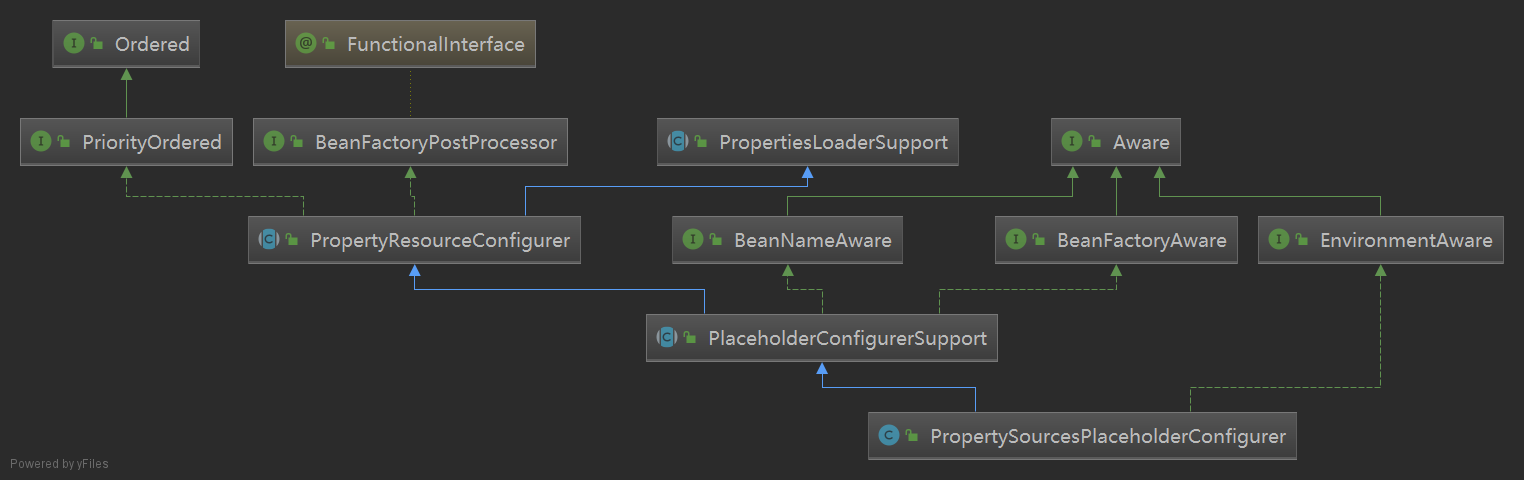
分析:
从PropertySourcesPlaceholderConfigurer的继承结构图上可知,PropertySourcesPlaceholderConfigurer间接实现了Aware和BeanFactoryPostProcessor两大接口,这里只关注BeanFactoryPostProcessor(Aware接口前面已经分析了),BeanFactoryPostProcessor接口中就只有一个postProcessBeanFactory方法,其实现如下:
 // PropertySourcesPlaceholderConfigurer

 public void postProcessBeanFactory(ConfigurableListableBeanFactory beanFactory) throws BeansException {

         // 如果propertySources为null,则初始化该属性

         if (this.propertySources == null) {

             this.propertySources = new MutablePropertySources();

             if (this.environment != null) {

                 this.propertySources.addLast(

                     new PropertySource<Environment>(ENVIRONMENT_PROPERTIES_PROPERTY_SOURCE_NAME, this.environment) {

                         @Override

                         @Nullable

                         public String getProperty(String key) {

                             return this.source.getProperty(key);

                         }

                     }

                 );

             }

             try {

                 // 构建localPropertySource对象,Properties通过mergeProperties方法获取。

                 PropertySource<?> localPropertySource =

                         new PropertiesPropertySource(LOCAL_PROPERTIES_PROPERTY_SOURCE_NAME, mergeProperties());

                 if (this.localOverride) {

                     this.propertySources.addFirst(localPropertySource);

                 }

                 else {

                     this.propertySources.addLast(localPropertySource);

                 }

             }

             catch (IOException ex) {

                 throw new BeanInitializationException("Could not load properties", ex);

             }

         }

         // 进行占位符替换

         processProperties(beanFactory, new PropertySourcesPropertyResolver(this.propertySources));

         this.appliedPropertySources = this.propertySources;

     }
分析:
- 首先需要构建MutablePropertySources对象,用于存储Properties,注意Properties是通过mergeProperties获取。
- 占位符的替换过程在processProperties函数中实现。
PropertiesLoaderSupport#mergeProperties
 protected Properties mergeProperties() throws IOException {

         // 创建Properties对象

         Properties result = new Properties();

         // 是否允许覆盖配置 之前

         if (this.localOverride) {

             // Load properties from file upfront, to let local properties override.

             loadProperties(result);

         }

         // 进行配置合并

         if (this.localProperties != null) {

             for (Properties localProp : this.localProperties) {

                 CollectionUtils.mergePropertiesIntoMap(localProp, result);

             }

         }

         // 再次进行覆盖 之后

         if (!this.localOverride) {

             // Load properties from file afterwards, to let those properties override.

             loadProperties(result);

         }

         return result;

     }
分析:
这里其实逻辑简单,主要通过loadProperties进行配置文件的导入。
PropertiesLoaderSupport#loadProperties
 protected void loadProperties(Properties props) throws IOException {

         // 遍历文件路径

         if (this.locations != null) {

             for (Resource location : this.locations) {

                 if (logger.isTraceEnabled()) {

                     logger.trace("Loading properties file from " + location);

                 }

                 try {

                     PropertiesLoaderUtils.fillProperties(

                             props, new EncodedResource(location, this.fileEncoding), this.propertiesPersister);

                 } catch (FileNotFoundException | UnknownHostException ex) {

                     if (this.ignoreResourceNotFound) {

                         if (logger.isDebugEnabled()) {

                             logger.debug("Properties resource not found: " + ex.getMessage());

                         }

                     } else {

                         throw ex;

                     }

                 }

             }

         }

     }
分析:
这里代码逻辑简单,变量locations对象,然后通过PropertiesLoaderUtils#fillProperties方法进行属性填充,这里不对该方法进行分析,有兴趣的可以自己详细看下。
PropertiesLoaderSupport#processProperties
 protected void processProperties(ConfigurableListableBeanFactory beanFactoryToProcess,

             final ConfigurablePropertyResolver propertyResolver) throws BeansException {

         // 设置"${"、"}"、":"

         propertyResolver.setPlaceholderPrefix(this.placeholderPrefix);

         propertyResolver.setPlaceholderSuffix(this.placeholderSuffix);

         propertyResolver.setValueSeparator(this.valueSeparator);

         // 根据是否需要忽略不能解析的符号进行分支处理

         StringValueResolver valueResolver = strVal -> {

             String resolved = (this.ignoreUnresolvablePlaceholders ?

                     propertyResolver.resolvePlaceholders(strVal) :

                     propertyResolver.resolveRequiredPlaceholders(strVal));

             if (this.trimValues) {

                 resolved = resolved.trim();

             }

             return (resolved.equals(this.nullValue) ? null : resolved);

         };

         // 进行具体解析

         doProcessProperties(beanFactoryToProcess, valueResolver);

     }
分析:
从函数的具体逻辑可以看出Spring中对占位符的解析只包含"${ }"和":"。
- 创建StringValueResolver对象,根据不同的策略(是否要忽略不能解析的符号),这里会在doProcessProperties中进行回调。其实resolvePlaceholders和resolveRequiredPlaceholders函数内部都调用的同一个函数,只是其初始化方式不同(false和true的区别),具体代码AbstractPropertyResolver中。
- 最终的具体解析过程落在doProcessProperties函数中。
AbstractPropertyResolver#resolveRequiredPlaceholders
 public String resolveRequiredPlaceholders(String text) throws IllegalArgumentException {

         // 如果strictHelper为null,则通过createPlaceholderHelper进行创建

         // 注意这里createPlaceholderHelper入参为false,这就是和resolvePlaceholders不一样的地方

         if (this.strictHelper == null) {

             this.strictHelper = createPlaceholderHelper(false);

         }

         // 通过PropertyPlaceholderHelper进行解析

         return doResolvePlaceholders(text, this.strictHelper);

 }

 private PropertyPlaceholderHelper createPlaceholderHelper(boolean ignoreUnresolvablePlaceholders) {

         return new PropertyPlaceholderHelper(this.placeholderPrefix, this.placeholderSuffix,

                 this.valueSeparator, ignoreUnresolvablePlaceholders);

     }

 private String doResolvePlaceholders(String text, PropertyPlaceholderHelper helper) {

         return helper.replacePlaceholders(text, this::getPropertyAsRawString);

     }

 // PropertyPlaceholderHelper

 public String replacePlaceholders(String value, PlaceholderResolver placeholderResolver) {

         Assert.notNull(value, "'value' must not be null");

         return parseStringValue(value, placeholderResolver, new HashSet<>());

     }
分析:
以上代码逻辑还是比较简单,最终的解析落入PropertyPlaceholderHelper#replacePlaceHolders函数中,该函数在【spring源码分析】IOC容器初始化(一)中已分析。
PlaceholderConfigurerSupport#doProcessProperties
 protected void doProcessProperties(ConfigurableListableBeanFactory beanFactoryToProcess,

             StringValueResolver valueResolver) {

         // 创建BeanDefinitionVisitor对象

         BeanDefinitionVisitor visitor = new BeanDefinitionVisitor(valueResolver);

         // 对BeanDefinition进行遍历

         String[] beanNames = beanFactoryToProcess.getBeanDefinitionNames();

         for (String curName : beanNames) {

             // Check that we're not parsing our own bean definition,

             // to avoid failing on unresolvable placeholders in properties file locations.

             // 校验

             // 当前PlaceholderConfigurerSupport不在解析范围内  同一个Spring容器

             if (!(curName.equals(this.beanName) && beanFactoryToProcess.equals(this.beanFactory))) {

                 BeanDefinition bd = beanFactoryToProcess.getBeanDefinition(curName);

                 try {

                     // 访问bean,其实是对属性进行解析

                     visitor.visitBeanDefinition(bd);

                 }

                 catch (Exception ex) {

                     throw new BeanDefinitionStoreException(bd.getResourceDescription(), curName, ex.getMessage(), ex);

                 }

             }

         }

         // New in Spring 2.5: resolve placeholders in alias target names and aliases as well.

         // 别名占位符

         beanFactoryToProcess.resolveAliases(valueResolver);

         // New in Spring 3.0: resolve placeholders in embedded values such as annotation attributes.

         // 解析嵌入值的占位符,例如注释属性

         beanFactoryToProcess.addEmbeddedValueResolver(valueResolver);

     }
分析:
- 首先创建BeanDefinitionVisitor对象,通过字符串解析器,用于后期对配置文件进行解析。
- 对BeanDefinition进行遍历,通过visitBeanDefinition方法进行配置文件解析。
- 解析别名占位符。
- 解析嵌入值的占位符,例如注释属性。
其实整个方法的核心在于visitBeanDefinition方法。
BeanDefinitionVisitor#visitBeanDefinition
 public void visitBeanDefinition(BeanDefinition beanDefinition) {

         visitParentName(beanDefinition);

         visitBeanClassName(beanDefinition);

         visitFactoryBeanName(beanDefinition);

         visitFactoryMethodName(beanDefinition);

         visitScope(beanDefinition);

         if (beanDefinition.hasPropertyValues()) {

             visitPropertyValues(beanDefinition.getPropertyValues());

         }

         if (beanDefinition.hasConstructorArgumentValues()) {

             ConstructorArgumentValues cas = beanDefinition.getConstructorArgumentValues();

             visitIndexedArgumentValues(cas.getIndexedArgumentValues());

             visitGenericArgumentValues(cas.getGenericArgumentValues());

         }

     }
分析:
该方法基本访问了BeanDefinition中所有值得访问的东西了,包括parent 、class 、factory-bean 、factory-method 、scope 、property 、constructor-arg。
这里关注visitPropertyValues方法。
BeanDefinitionVisitor#visitPropertyValues
     protected void visitPropertyValues(MutablePropertyValues pvs) {

         // 遍历PropertyValue数组

         PropertyValue[] pvArray = pvs.getPropertyValues();

         for (PropertyValue pv : pvArray) {

             // 解析真值

             Object newVal = resolveValue(pv.getValue());

             if (!ObjectUtils.nullSafeEquals(newVal, pv.getValue())) {

                 // 设置到PropertyValue中

                 pvs.add(pv.getName(), newVal);

             }

         }

     }
分析:
该函数主要就是对属性数组进行遍历,通过resolveValue方法对属性进行解析获取最新值,如果新值与就只不相等,则用新值替换旧值。
BeanDefinitionVisitor#resolveValue
 protected Object resolveValue(@Nullable Object value) {

         if (value instanceof BeanDefinition) {

             visitBeanDefinition((BeanDefinition) value);

         }

         else if (value instanceof BeanDefinitionHolder) {

             visitBeanDefinition(((BeanDefinitionHolder) value).getBeanDefinition());

         }

         else if (value instanceof RuntimeBeanReference) {

             RuntimeBeanReference ref = (RuntimeBeanReference) value;

             String newBeanName = resolveStringValue(ref.getBeanName());

             if (newBeanName == null) {

                 return null;

             }

             if (!newBeanName.equals(ref.getBeanName())) {

                 return new RuntimeBeanReference(newBeanName);

             }

         }

         else if (value instanceof RuntimeBeanNameReference) {

             RuntimeBeanNameReference ref = (RuntimeBeanNameReference) value;

             String newBeanName = resolveStringValue(ref.getBeanName());

             if (newBeanName == null) {

                 return null;

             }

             if (!newBeanName.equals(ref.getBeanName())) {

                 return new RuntimeBeanNameReference(newBeanName);

             }

         }

         else if (value instanceof Object[]) {

             visitArray((Object[]) value);

         }

         else if (value instanceof List) {

             visitList((List) value);

         }

         else if (value instanceof Set) {

             visitSet((Set) value);

         }

         else if (value instanceof Map) {

             visitMap((Map) value);

         }

         else if (value instanceof TypedStringValue) {

             TypedStringValue typedStringValue = (TypedStringValue) value;

             String stringValue = typedStringValue.getValue();

             if (stringValue != null) {

                 String visitedString = resolveStringValue(stringValue);

                 typedStringValue.setValue(visitedString);

             }

         }

         // 由于Properties中的是String,所以重点在此

         else if (value instanceof String) {

             return resolveStringValue((String) value);

         }

         return value;

     }
分析:
该函数对各种类型的属性进行解析,由于配置为String类型的,因此这里关注resolveStringValue函数。
BeanDefinitionVisitor#resolveStringValue
 protected String resolveStringValue(String strVal) {

         if (this.valueResolver == null) {

             throw new IllegalStateException("No StringValueResolver specified - pass a resolver " +

                     "object into the constructor or override the 'resolveStringValue' method");

         }

         // 解析真值

         String resolvedValue = this.valueResolver.resolveStringValue(strVal);

         // Return original String if not modified.

         return (strVal.equals(resolvedValue) ? strVal : resolvedValue);

     }
分析:
这里具体的解析就会回调valueResolver(根据不同策略创建的StringValueResolver对象),然后进入具体的解析,其解析过程已经分析,这里不在赘述。
总结
至此关于占位符的解析过程就大致分析完了,其实里面还有很多值得我们细究的地方,具体过程可debug调试一遍,可能会有更深的理解。
by Shawn Chen,2019.05.08,晚。
【spring源码分析】IOC容器初始化——查漏补缺(五)的更多相关文章
- 【spring源码分析】IOC容器初始化——查漏补缺(一)
前言:在[spring源码分析]IOC容器初始化(十一)中提到了初始化bean的三个步骤: 激活Aware方法. 后置处理器应用(before/after). 激活自定义的init方法. 这里我们就来 ...
- 【spring源码分析】IOC容器初始化——查漏补缺(二)
前言:在[spring源码分析]IOC容器初始化(八)中多次提到了前置处理与后置处理,本篇文章针对此问题进行分析.Spring对前置处理或后置处理主要通过BeanPostProcessor进行实现. ...
- 【spring源码分析】IOC容器初始化——查漏补缺(四)
前言:在前几篇查漏补缺中,其实我们已经涉及到bean生命周期了,本篇内容进行详细分析. 首先看bean实例化过程: 分析: bean实例化开始后 注入对象属性后(前面IOC初始化十几篇文章). 检查激 ...
- SPRING源码分析:IOC容器
在Spring中,最基本的IOC容器接口是BeanFactory - 这个接口为具体的IOC容器的实现作了最基本的功能规定 - 不管怎么着,作为IOC容器,这些接口你必须要满足应用程序的最基本要求: ...
- 【spring源码分析】IOC容器初始化——查漏补缺(三)
前言:本文分析InitializingBean和init-method方法,其实该知识点在AbstractAutowireCapableBeanFactory#initializeBean方法中有所提 ...
- Spring源码解析-ioc容器的设计
Spring源码解析-ioc容器的设计 1 IoC容器系列的设计:BeanFactory和ApplicatioContext 在Spring容器中,主要分为两个主要的容器系列,一个是实现BeanFac ...
- spring源码分析---IOC(1)
我们都知道spring有2个最重要的概念,IOC(控制反转)和AOP(依赖注入).今天我就分享一下spring源码的IOC. IOC的定义:直观的来说,就是由spring来负责控制对象的生命周期和对象 ...
- spring 源码之 ioc 容器的初始化和注入简图
IoC最核心就是两个过程:IoC容器初始化和IoC依赖注入,下面通过简单的图示来表述其中的关键过程:
- Spring源码阅读-IoC容器解析
目录 Spring IoC容器 ApplicationContext设计解析 BeanFactory ListableBeanFactory HierarchicalBeanFactory Messa ...
随机推荐
- shell脚本编写mind
首先我们要缩小这个问题的范围 如果在面试中被问到这样的问题,说说shell脚本编写思路 如:你是在公司主要负责zabbix监控的 对答如下:shell脚本这个说法挺广的,您看我这么跟您说吧,我在平时工 ...
- CentOS7安装CDH 第十四章:CDH的优化
相关文章链接 CentOS7安装CDH 第一章:CentOS7系统安装 CentOS7安装CDH 第二章:CentOS7各个软件安装和启动 CentOS7安装CDH 第三章:CDH中的问题和解决方法 ...
- Flutter——Radio组件、RadioListTile组件(单选按钮组件)
Radio组件 Radio组件的常用属性: 属性 描述 value 单选的值 onChanged 改变时触发 activeColor 选中的颜色.背景颜色 groupValue 选择组的值 impor ...
- STM32 LoRaWAN探索板B-L072Z-LRWAN1中文用户手册
UM2115用户手册 支持LoRaWAN和 LPWAN协议的STM32L0探索套件 前言 B-L072Z-LRWAN1探索套件采用了 Murata公司的CMWX1ZZABZ-091 LoRa模块.该探 ...
- 运输层8——TCP运输连接管理
目录 1. TCP的连接建立 2. TCP的连接释放 写在前面:本文章是针对<计算机网络第七版>的学习笔记 运输层1--运输层协议概述 运输层2--用户数据报协议UDP 运输层3--传输控 ...
- 缺包与maven
一. 缺包 1. 打开pom.xml 将依赖加入. 2. mvn clean install -DskipTests 3. scp target/lib/****.jar(刚刚的依赖的架包) 服务器地 ...
- 【记忆化搜索】[NOIP-2017--普及组] -- 棋盘
[题目描述] 原题目链接地址: 有一个m × m的棋盘,棋盘上每一个格子可能是红色.黄色或没有任何颜色的.你现在要从棋盘的最左上角走到棋盘的最右下角. 任何一个时刻,你所站在的位置必须是有颜色的( ...
- 大数据之路week06--day03(jdk8新特性 Lambda表达式)
为什么使用Lambda表达式?(做为初学者接触这个新的语法,会很懵逼,说道理,我在接触到这一块的时候,语法规则我看到了也很懵逼,因为这个和逻辑的关系不是很大,但就是作为一种新的语法出现,一时间很难接受 ...
- SqlHelper助手
正在机房重构中,自己一直在摸索,刚开始听说SqlHelper只是感觉很高深,都不知道是用来做什么用的,只是看见别人的博客上写的可以用来帮助连接数据库.但自己没有什么特别的感觉,就认真的去查阅资料来具体 ...
- 网站性能优化——DNS预热与合并HTTP请求
DNS预热 一次DNS解析耗时20-120ms, 当网页中使用的域名较多时,DNS预热节省的时间还是非常可观的 先看效果 预热的目的: 减少请求次数 提前对DNS预获取 预热的方式 爬虫 APP 网页 ...