
Stacked Autoencoders
转自:http://www.cnblogs.com/tornadomeet/archive/2013/03/25/2980357.html
如果使用多层神经网络的话,那么将可以得到对输入更复杂的函数表示,因为神经网络的每一层都是上一层的非线性变换。当然,此时要求每一层的activation函数是非线性的,否则就没有必要用多层了。
Deep networks的优点:
一、比单层神经网络能学习到更复杂的表达。比如说用k层神经网络能学习到的函数(且每层网络节点个数时多项式的)如果要用k-1层神经网络来学习,则这k-1层神经网络节点的个数必须是指数级庞大的数字。
二、不同层的网络学习到的特征是由最底层到最高层慢慢上升的。比如在图像的学习中,第一个隐含层层网络可能学习的是边缘特征,第二隐含层就学习到的是轮廓什么的,后面的就会更高级有可能是图像目标中的一个部位,也就是是底层隐含层学习底层特征,高层隐含层学习高层特征。
三、这种多层神经网络的结构和人体大脑皮层的多层感知结构非常类似,所以说有一定的生物理论基础。
Deep networks的缺点:
一、网络的层次越深,所需的训练样本数越多,如果是用有监督学习的话,那么这些样本就更难获取,因为要进行各种标注。但是如果样本数太少的话,就很容易产生过拟合现象。
二、因为多层神经网络的参数优化问题是一个高阶非凸优化问题,这个问题通常收敛到一个比较差的局部解,普通的优化算法一般都效果不好。也就是说,参数的优化问题是个难点。
三、梯度扩散问题。因为当网络层次比较深时,在计算损失函数的偏导时一般需要使用BP算法,但是这些梯度值随着深度慢慢靠前而显著下降,这样导致前面的网络对最终的损失函数的贡献很小。这样的话前面的权值更新速度就非常非常慢了。一个理论上比较好的解决方法是将后面网络的结构的神经元的个数提高非常多,以至于它不会影响前面网络的结构的学习。但这样岂不是和低深度的网络结构一样了吗?所以不妥。
所以一般都是采用的层次贪婪训练方法来训练网络的参数,即先训练网络的第一个隐含层,然后接着训练第二个,第三个…最后用这些训练好的网络参数值作为整体网络参数的初始值。这样的好处是数据更容易获取,因为前面的网络层次基本都用无监督的方法获得,很容易,只有最后一个输出层需要有监督的数据。另外由于无监督学习其实隐形之中已经提供了一些输入数据的先验知识,所以此时的参数初始化值一般都能得到最终比较好的局部最优解
A stacked autoencoder is a neural network consisting of multiple layers of sparse autoencoders in which the outputs of each layer is wired to the inputs of the successive layer.
Formally, consider a stacked autoencoder with n layers. Using notation from the autoencoder section, let W(k,1),W(k,2),b(k,1),b(k,2) denote the parameters W(1),W(2),b(1),b(2) for kth autoencoder. Then the encoding step for the stacked autoencoder is given by running the encoding step of each layer in forward order:
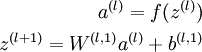
The decoding step is given by running the decoding stack of each autoencoder in reverse order:

The information of interest is contained within a(n), which is the activation of the deepest layer of hidden units. This vector gives us a representation of the input in terms of higher-order features. —— 高层次特征
Training
A good way to obtain good parameters for a stacked autoencoder is to use greedy layer-wise training. To do this, first train the first layer on raw input to obtain parameters W(1,1),W(1,2),b(1,1),b(1,2). Use the first layer to transform the raw input into a vector consisting of activation of the hidden units, A. Train the second layer on this vector to obtain parametersW(2,1),W(2,2),b(2,1),b(2,2). Repeat for subsequent layers, using the output of each layer as input for the subsequent layer.
This method trains the parameters of each layer individually while freezing parameters for the remainder of the model. To produce better results, after this phase of training is complete,fine-tuning using backpropagation can be used to improve the results by tuning the parameters of all layers are changed at the same time.
Example
To give a concrete example, suppose you wished to train a stacked autoencoder with 2 hidden layers for classification of MNIST digits
First, you would train a sparse autoencoder on the raw inputs x(k) to learn primary features h(1)(k) on the raw input.
Next, you would feed the raw input into this trained sparse autoencoder, obtaining the primary feature activations h(1)(k)for each of the inputs x(k). You would then use these primary features as the "raw input" to another sparse autoencoder to learn secondary features h(2)(k) on these primary features.
Following this, you would feed the primary features into the second sparse autoencoder to obtain the secondary feature activations h(2)(k) for each of the primary features h(1)(k) (which correspond to the primary features of the corresponding inputs x(k)). You would then treat these secondary features as "raw input" to a softmax classifier, training it to map secondary features to digit labels.
Finally, you would combine all three layers together to form a stacked autoencoder with 2 hidden layers and a final softmax classifier layer capable of classifying the MNIST digits as desired.
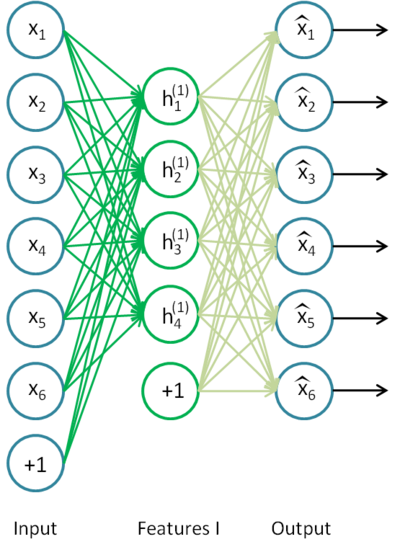
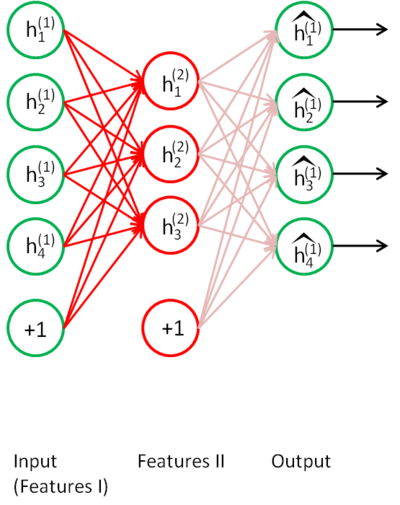
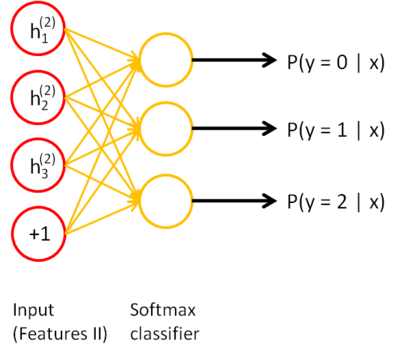
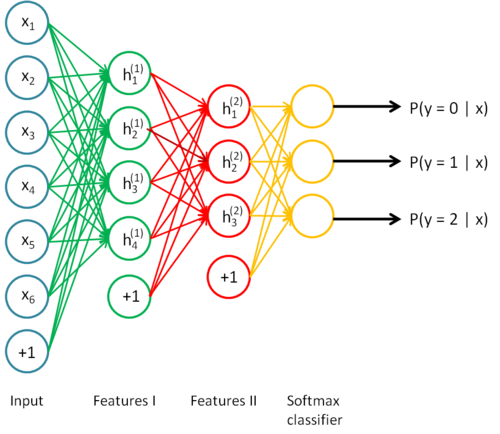
由此,层层深入,从发掘简单特征到发掘复杂特征,识别~~
Stacked Autoencoders的更多相关文章
- 论文翻译:2018_Artificial Bandwidth Extension with Memory Inclusion using Semi-supervised Stacked Auto-encoders
论文地址:使用半监督堆栈式自动编码器实现包含记忆的人工带宽扩展 作者:Pramod Bachhav, Massimiliano Todisco and Nicholas Evans 博客作者:凌逆战 ...
- 第十五章——自编码器(Autoencoders)
自编码器是一种能够通过无监督学习,学到输入数据高效表示的人工神经网络.输入数据的这一高效表示称为编码(codings),其维度一般远小于输入数据,使得自编码器可用于降维(查看第八章).更重要的是,自编 ...
- matlab 实现 stacked Autoencoder 解决图像分类问题
Train Stacked Autoencoders for Image Classification 1. 加载数据到内存 [train_x, train_y] = digitTrainCellAr ...
- NLP&数据挖掘基础知识
Basis(基础): SSE(Sum of Squared Error, 平方误差和) SAE(Sum of Absolute Error, 绝对误差和) SRE(Sum of Relative Er ...
- [Machine Learning] 机器学习常见算法分类汇总
声明:本篇博文根据http://www.ctocio.com/hotnews/15919.html整理,原作者张萌,尊重原创. 机器学习无疑是当前数据分析领域的一个热点内容.很多人在平时的工作中都或多 ...
- Spark入门实战系列--8.Spark MLlib(上)--机器学习及SparkMLlib简介
[注]该系列文章以及使用到安装包/测试数据 可以在<倾情大奉送--Spark入门实战系列>获取 .机器学习概念 1.1 机器学习的定义 在维基百科上对机器学习提出以下几种定义: l“机器学 ...
- Top Deep Learning Projects in github
Top Deep Learning Projects A list of popular github projects related to deep learning (ranked by sta ...
- FAQ: Machine Learning: What and How
What: 就是将统计学算法作为理论,计算机作为工具,解决问题.statistic Algorithm. How: 如何成为菜鸟一枚? http://www.quora.com/How-can-a-b ...
- paper 53 :深度学习(转载)
转载来源:http://blog.csdn.net/fengbingchun/article/details/50087005 这篇文章主要是为了对深度学习(DeepLearning)有个初步了解,算 ...
随机推荐
- WebRTC Native APIs
WebRTC Native APIs The WebRTC Native APIs implementation is based on W3C’s WebRTC 1.0: Real-time Com ...
- caioj 1072 动态规划入门(二维一边推5:最长公共子序列 LCSS加强版)
在51nod刷到过同样的题,直接秒杀 见https://blog.csdn.net/qq_34416123/article/details/81697683 #include<cstdio> ...
- CMSIS-RTOS功能概述
以下列表简要概述了所有CMSIS-RTOS功能.标有$的函数是可选的.特定的CMSIS-RTOS实现可能无法提供所有功能,但osFeatureXXXX定义明确指出了这一点. 注意 RTX实现不支持的功 ...
- POJ 1723 SOLDIERS
SOLDIERS Time Limit: 1000ms Memory Limit: 10000KB This problem will be judged on PKU. Original ID: 1 ...
- 洛谷 P2630 图像变换
P2630 图像变换 题目描述 给定3行3列的图像各像素点灰度值,给定最终图像,求最短.字典序最小的操作序列. 其中,可能的操作及对应字符有如下四种: A:顺时针旋转90度: B:逆时针旋转90度: ...
- Java的几个有用小Util函数(日期处理和http)
/** * 依据日期返回当前日期是一年的第几天 * @param date * @return */ public static int orderDa ...
- Android资源之图像资源(状态图像资源)
在上一篇博文中.我主要解说了XML图像资源中的图层资源,在此图像资源博文中我会给大家陆续解说XMl图像资源的图像状态资源.图像级别资源.淡入淡出资源.嵌入图像资源.剪切图像资源和外形资源. 1.图像状 ...
- Android LruCache 压缩图片 有效避免程序OOM
转载请注明出处:http://blog.csdn.net/guolin_blog/article/details/9316683 本篇文章主要内容来自于Android Doc,我翻译之后又做了些加工, ...
- 理解Linq查询
using System; using System.Linq; static class Program { static double Square(double n) { Console.Wri ...
- 简单缓存Cache
接口 interface ICache { /// <summary> /// 添加 /// </summary> /// <param name="key&q ...