
2024-01-17:lc的30. 串联所有单词的子串
2024-01-17:用go语言,给定一个字符串 s 和一个字符串数组 words。 words 中所有字符串 长度相同。
s 中的 串联子串 是指一个包含 words 中所有字符串以任意顺序排列连接起来的子串。
例如,如果 words = ["ab","cd","ef"],
那么 "abcdef", "abefcd","cdabef",
"cdefab","efabcd", 和 "efcdab" 都是串联子串,
"acdbef" 不是串联子串,因为他不是任何 words 排列的连接。
返回所有串联字串在 s 中的开始索引。
你可以以 任意顺序 返回答案。
1 <= s.length <= 10^4,
1 <= words.length <= 5000,
1 <= words[i].length <= 30。
words[i] 和 s 由小写英文字母组成。
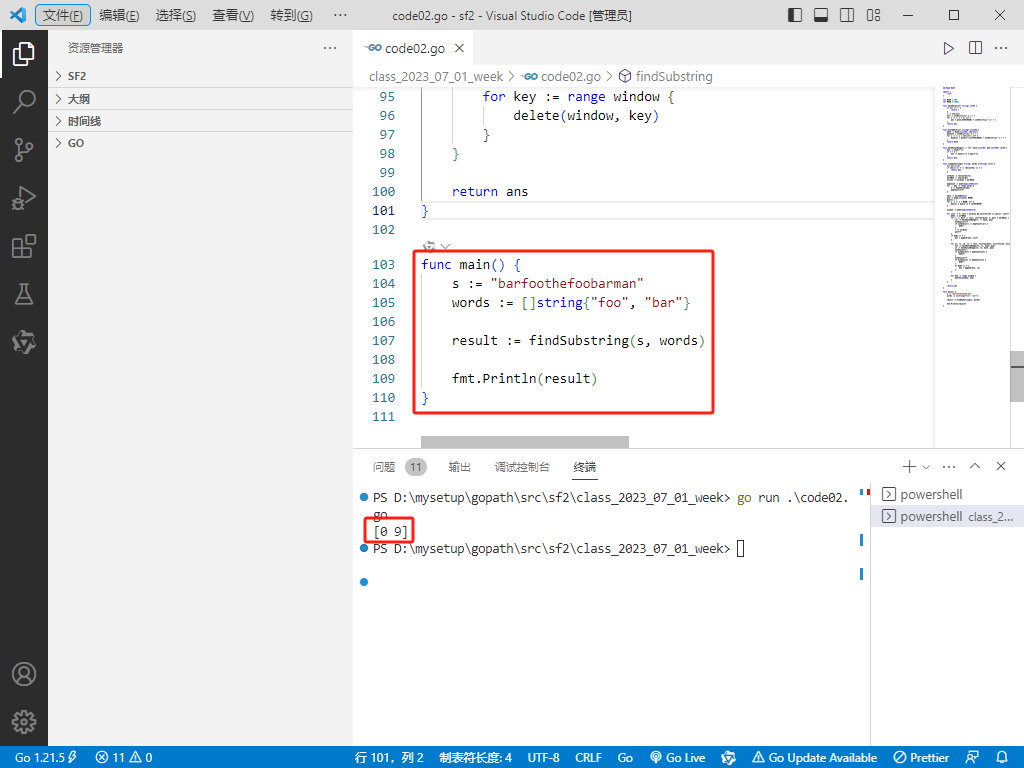
输入:s = "barfoothefoobarman", words = ["foo","bar"]。
输出:[0,9]。
来自lc的30. 串联所有单词的子串。
答案2024-01-17:
来自左程云。
大体过程如下:
定义一些常量和变量,包括
BASE和MAXN,以及存储结果的切片ans。实现
hashValue函数,用于计算字符串的哈希值。这里使用一个基于索引的简单哈希函数将字符串映射为一个唯一的整数。实现
buildHash函数,用于构建字符串的前缀哈希数组。通过动态规划的方式计算每个位置的哈希值。实现
hashValueRange函数,用于计算子串的哈希值。利用前缀哈希数组,根据子串的起始和结束位置计算哈希值。创建一个哈希表
mapCount用于存储words中每个单词的出现次数。构建字符串
s的前缀哈希数组hash。创建一个数组
pow,用于存储 BASE 的幂次方,便于后续计算子串的哈希值。创建一个滑动窗口
window,用于记录当前窗口中每个单词出现的次数。循环遍历
s中每个起始位置的可能性(即从 0 到wordLen-1)。在每个起始位置,初始化一个变量
debt用于记录还需要凑齐的单词数。在每个起始位置,遍历
words中的单词,依次将其添加到窗口中,并更新debt的值。如果
debt等于 0,表示窗口中已经包含了所有words中的单词,则将当前起始位置加入结果数组ans中。对于每个起始位置,向右移动窗口,同时更新窗口中单词的出现次数。
检查窗口中的哈希值和单词出现次数是否符合要求,如果符合则将当前起始位置加入结果数组
ans中。清空滑动窗口
window。返回结果数组
ans。
总的时间复杂度:O(n * m * k),其中 n 是字符串 s 的长度,m 是 words 的长度,k 是单词的平均长度。
总的额外空间复杂度:O(n),其中 n 是字符串 s 的长度,主要用于存储哈希表、前缀哈希数组和结果数组。
go完整代码如下:
package main

import (

	"fmt"

)

var BASE = 499

var MAXN = 10001

func hashValue(str string) int64 {

	if str == "" {

		return 0

	}

	n := len(str)

	ans := int64(str[0]-'a') + 1

	for j := 1; j < n; j++ {

		ans = ans*int64(BASE) + int64(str[j]-'a') + 1

	}

	return ans

}

func buildHash(str string) []int64 {

	hash := make([]int64, len(str))

	hash[0] = int64(str[0]-'a') + 1

	for j := 1; j < len(str); j++ {

		hash[j] = hash[j-1]*int64(BASE) + int64(str[j]-'a') + 1

	}

	return hash

}

func hashValueRange(l, r int, hash []int64, pow []int64) int64 {

	ans := hash[r-1]

	if l > 0 {

		ans -= hash[l-1] * pow[r-l]

	}

	return ans

}

func findSubstring(s string, words []string) []int {

	var ans []int

	if len(s) == 0 || len(words) == 0 {

		return ans

	}

	wordLen := len(words[0])

	wordNum := len(words)

	allLen := wordLen * wordNum

	mapCount := make(map[int64]int)

	for _, key := range words {

		v := hashValue(key)

		mapCount[v]++

	}

	hash := buildHash(s)

	pow := make([]int64, MAXN)

	pow[0] = 1

	for j := 1; j < MAXN; j++ {

		pow[j] = pow[j-1] * int64(BASE)

	}

	window := make(map[int64]int)

	for init := 0; init < wordLen && init+allLen <= len(s); init++ {

		debt := wordNum

		for l, r, part := init, init+wordLen, 0; part < wordNum; l += wordLen {

			cur := hashValueRange(l, r, hash, pow)

			window[cur]++

			if window[cur] <= mapCount[cur] {

				debt--

			}

			r += wordLen

			part++

		}

		if debt == 0 {

			ans = append(ans, init)

		}

		for l1, r1, l2, r2 := init, init+wordLen, init+allLen, init+allLen+wordLen; r2 <= len(s); l1, r1, l2, r2 = l1+wordLen, r1+wordLen, l2+wordLen, r2+wordLen {

			out := hashValueRange(l1, r1, hash, pow)

			in := hashValueRange(l2, r2, hash, pow)

			window[out]--

			if window[out] < mapCount[out] {

				debt++

			}

			window[in]++

			if window[in] <= mapCount[in] {

				debt--

			}

			if debt == 0 {

				ans = append(ans, r1)

			}

		}

		for key := range window {

			delete(window, key)

		}

	}

	return ans

}

func main() {

	s := "barfoothefoobarman"

	words := []string{"foo", "bar"}

	result := findSubstring(s, words)

	fmt.Println(result)

}
2024-01-17:lc的30. 串联所有单词的子串的更多相关文章
- Java实现 LeetCode 30 串联所有单词的子串
30. 串联所有单词的子串 给定一个字符串 s 和一些长度相同的单词 words.找出 s 中恰好可以由 words 中所有单词串联形成的子串的起始位置. 注意子串要与 words 中的单词完全匹配, ...
- leetcode 30. 串联所有单词的子串 【时间击败 90.28%】 【内存击败 97.44%】
这道题让我从早做到晚-3--- 设len=words[0].length(). 一开始我按照words的顺序扩大区间,发现这样就依赖words的顺序.之后改成遍历s的所有长度为len*words.le ...
- [LeetCode] 30. 串联所有单词的子串
题目链接: https://leetcode-cn.com/problems/substring-with-concatenation-of-all-words/ 题目描述: 给定一个字符串 s 和一 ...
- Leetcode 30 串联所有单词的子串 滑动窗口+map
见注释.滑动窗口还是好用. class Solution { public: vector<int> findSubstring(string s, vector<string> ...
- [LeetCode] 30. Substring with Concatenation of All Words 串联所有单词的子串
You are given a string, s, and a list of words, words, that are all of the same length. Find all sta ...
- [LeetCode] Substring with Concatenation of All Words 串联所有单词的子串
You are given a string, s, and a list of words, words, that are all of the same length. Find all sta ...
- 【LeetCode-面试算法经典-Java实现】【030-Substring with Concatenation of All Words(串联全部单词的子串)】
[030-Substring with Concatenation of All Words(串联全部单词的子串)] [LeetCode-面试算法经典-Java实现][全部题目文件夹索引] 原题 Yo ...
- 【LeetCode 30】串联所有单词的子串
题目链接 [题解] 开个字典树记录下所有的单词. 然后注意题目的已知条件 每个单词的长度都是一样的. 这就说明不会出现某个字符串是另外一个字符串的前缀的情况(除非相同). 所以可以贪心地匹配(遇到什么 ...
- leetcode30 串联所有单词的子串
先对words中的单词排列组合,然后对s滑窗操作:部分样例超时,代码如下: class Solution { public: vector<int> findSubstring(strin ...
- 2019/01/17 基于windows使用fabric将gitlab的文件远程同步到服务器(git)
觉得django项目把本地更新push到gitlab,再执行fabric脚本从gitlab更新服务器项目挺方便的,当然从本地直接到服务器就比较灵活. 2019/01/17 基于windows使用fab ...
随机推荐
- 【VMware vCenter】使用cmsso-util命令进行链接、删除、修改多个vCenter Server(VCSA)的SSO域。
VMware vCenter Server 支持新安装的时候选择将vCenter SSO域加入到另外一个现有的SSO域中,同时也支持使用cmsso-util命令将现有的两个或多个vCenter SSO ...
- 8.0的新特性 -- invisible(不可见索引)
版权声明:原创作品,谢绝转载!否则将追究法律责任. ----- 作者:kirin invisible index 不可见索引 以前的版本,假如这个索引无用了会怎么样?那就只能是drop掉了.但是dro ...
- JAVAweek8
编程,要学会将大问题逐渐分解成一个个小问题,逐步完成. 将整个程序分成若干个组件(分解) 将多次出现的相似功能设成独立的方法(模式识别.抽象.算法) 调试每个独立组件的健壮性(单元测试) 按照功能要求 ...
- C++ Qt开发:ComboBox下拉组合框组件
Qt 是一个跨平台C++图形界面开发库,利用Qt可以快速开发跨平台窗体应用程序,在Qt中我们可以通过拖拽的方式将不同组件放到指定的位置,实现图形化开发极大的方便了开发效率,本章将重点介绍ComboBo ...
- hello Flask最简单的Flask项目
# 1.导包 from flask import Flask # 2.实例化Flask对象.一般变量名都叫app,大家都是这样用,很多扩展插件的文档也是叫app,所以统一都叫app. # __name ...
- pinia入门案例-获取频道分类列表并渲染
使用pinia的action异步获取频道分类列表数据并渲染到页面中. 接口: GET请求,http://geek.itheima.net/v1_0/channels store/channel.js ...
- 华企盾DSC防泄密申请解密、外发等失败常见处理方法
1.检查文件是否已经打开或被占用,以及文件的权限不是只读(错误代码32或5,这种情况比较常见) 2.系统用户名不能带特殊字符.老版本文件路径中不能含特殊字符(包括备份路径) 3.备份路径是否有读写权限 ...
- MagicArray:像php一样,让Go业务代码不再卷!
卷!一个字形容了当今码农行业的现状.一层一层的代码结构,一个一个dto,entity,vo,req,resp.这些对象越来越多,让码农们非常劳于奔命,加一个字段,改一个字段,影响面有多少.代码量也越来 ...
- git报错解决,warning: could not find UI helper 'git-credential-manager-ui'
在克隆远程代码时,可能遇到这样的报错 warning: could not find UI helper 'git-credential-manager-ui' 这样的报错经常会在我们换了一台电脑或者 ...
- TypeScript核心基础
前言 为了方便我们直接使用脚手架让他帮我们直接编译就完事了 创建一个 Vue 应用 前提条件 熟悉命令行 已安装 16.0 或更高版本的 Node.js npm init vue@latest 这一指 ...