
struts原理图
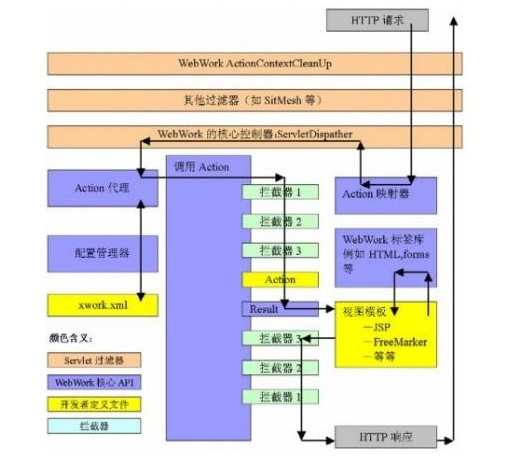

n the diagram, an initial request goes to the Servlet container (such as Jetty or Resin) which is passed through a standard filter chain. The chain includes the (optional) ActionContextCleanUp filter, which is useful when integrating technologies such as SiteMesh Plugin. Next, the required FilterDispatcher is called, which in turn consults the ActionMapper to determine if the request should invoke an action.
If the ActionMapper determines that an Action should be invoked, the FilterDispatcher delegates control to the ActionProxy. The ActionProxy consults the framework Configuration Files manager (initialized from the struts.xml file). Next, the ActionProxy creates an ActionInvocation, which is responsible for the command pattern implementation. This includes invoking any Interceptors (the before clause) in advance of invoking the Action itself.
Once the Action returns, the ActionInvocation is responsible for looking up the proper result associated with the Action result code mapped in struts.xml. The result is then executed, which often (but not always, as is the case for Action Chaining) involves a template written in JSP or FreeMarker to be rendered. While rendering, the templates can use the Struts Tags provided by the framework. Some of those components will work with the ActionMapper to render proper URLs for additional requests.
All objects in this architecture (Actions, Results, Interceptors, and so forth) are created by an ObjectFactory. This ObjectFactory is pluggable. We can provide our own ObjectFactory for any reason that requires knowing when objects in the framework are created. A popular ObjectFactory implementation uses Spring as provided by the Spring Plugin.
Interceptors are executed again (in reverse order, calling the after clause). Finally, the response returns through the filters configured in the web.xml. If the ActionContextCleanUp filter is present, the FilterDispatcher will not clean up the ThreadLocal ActionContext. If the ActionContextCleanUp filter is not present, the FilterDispatcher will cleanup all ThreadLocals.
struts原理图的更多相关文章
- 4.Struts2转向类型详解
struts2中提供了多种视图转向类型,类型由type属性指定,如: dispatcher:请求转发(默认值) redirect:重定向到页面 redirectAction:重定向到Action pl ...
- 最佳新秀SSH十六Struts2它是如何工作的内部
前面说完了Spring.Hibernate,非常自然今天轮到struts了.struts的核心原理就是通过拦截器来处理client的请求,经过拦截器一系列的处理后,再交给Action.以下先看看str ...
- 菜鸟学SSH(十六)——Struts2内部是如何工作的
前面说完了Spring.Hibernate,很自然今天轮到struts了.struts的核心原理就是通过拦截器来处理客户端的请求,经过拦截器一系列的处理后,再交给Action.下面先看看struts官 ...
- 轻量级Java EE开发框架设计系统应用架构
首先来说一下Java EE 概述 其中常说的三大框架即是:ssh Spring:功能强大的组件粘合济,能够将你的所有的java功能模块用配置文件的方式组合起来(还让你感觉不到spring的存在)成为一 ...
- Struts 2.3.24源码解析+Struts2拦截参数,处理请求,返回到前台过程详析
Struts2官网:http://struts.apache.org/ 目前最新版本:Struts 2.3.24 Struts1已经完全被淘汰了,而Struts2是借鉴了webwork的设计理念而设计 ...
- Struts 2知识回顾----拦截器(Intercept)总结
什么是Struts 2拦截器? 从软件构架上来说,拦截器是实现了面向方面编程的组件.它将影响了多个业务对象的公共行为封装到一个个可重用的模块,减少了系统的重复代码,实现功能的高度内聚,确保了业务对象的 ...
- Java Web编程的主要组件技术——Struts入门
参考书籍:<J2EE开源编程精要15讲> Struts是一个开源的Java Web框架,很好地实现了MVC设计模式.通过一个配置文件,把各个层面的应用组件联系起来,使组件在程序层面联系较少 ...
- Struts面试笔记
Struts2面试题1.struts2工作流程Struts 2框架本身大致可以分为3个部分:核心控制器FilterDispatcher.业务控制器Action和用户实现的企业业务逻辑组件. 核心控制器 ...
- struts详细解释拦截器
1.拦截器:Struts2拦截器将一个Action要么Action的方法.之前或截取后场,和Struts2拦截器是可插拔,拦截器AOP一种实现. WebWork:拦截器是动态拦截Action调用的对象 ...
随机推荐
- Python开发之AJAX
一.概述 对于WEB应用程序:用户浏览器发送请求,服务器接收并处理请求,然后返回结果,往往返回就是字符串(HTML),浏览器将字符串(HTML)渲染并显示浏览器上. 1.传统的Web应用:一个简单操作 ...
- [Unity基础]镜头管理类
一个游戏中可能会有各种类型的镜头,例如有时候是第一人称,有时是第三人称,有时又会给个特写等等,因此可以定义一个镜头类型枚举,在不同的场合进行切换,管理起来很方便. CameraManager.cs u ...
- demo: 全页面CSS3动画的一个参考例子
全页面CSS3动画的一个参考例子: http://wow.blizzard.cn/wow/wod-achievement/ 魔兽的一个活动页 第二页.第三页,文字进入页面 <script src ...
- Mybatis学习4——一对一关联查询方法2------实体作为属性
实体order和user采用resultMap order package pojo; import java.util.Date; public class Order { private Inte ...
- Windows系统不同磁盘间的扩容教程
1.windows系统不同磁盘的空间扩展: https://www.cnblogs.com/yunweis/p/8023098.html
- JavaScript取消默认控件并添加新控件(DOM编程艺术第11章)
这一章实现的这个功能我研究了好久,这个思路我感觉已经是现在的我要膜拜的了,我感觉我的逻辑还是有些问题. 第一个问题:vid.height与vid.videoHeight vid.height = vi ...
- [记录] Ubuntu 配置Apache虚拟站点
版本 Ubuntu 16.04 1 . 首先找到Apapche配置文件夹 /etc/apache2/ apache2.conf conf-enabled magic mods-enabled sit ...
- JVM老年代和新生代的比例
在 Java 中,堆被划分成两个不同的区域:新生代 ( Young ).老年代 ( Old ).新生代 ( Young ) 又被划分为三个区域:Eden.From Survivor.To Surviv ...
- 深度学习原理与框架-RNN网络架构-RNN网络 1.RNN的前向传播 2.RNN的反向传播
对于神经网络而言,每一个样本的输入与输入直接都是独立的,即预测的结果之间并没有联系 而对于RNN而言:不仅仅是有当前的输入,而且上一层的隐藏层也将进行输入,用于进行结果的预测.因此每一个输入都与之前的 ...
- python 阿狸的进阶之路(7)
面向对象 转自林海峰的博客 http://www.cnblogs.com/linhaifeng/articles/6182264.html 面向对象的理解: 将数据分类,比如学生类.数据有关的函数, ...