
poj 3463 最短路与次短路的方案数求解
| Time Limit: 2000MS | Memory Limit: 65536K | |
| Total Submissions: 8968 | Accepted: 3139 |
Description
Tour operator Your Personal Holiday organises guided bus trips across the Benelux. Every day the bus moves from one city S to another city F. On this way, the tourists in the bus can see the sights alongside the route travelled. Moreover, the bus makes a number of stops (zero or more) at some beautiful cities, where the tourists get out to see the local sights.
Different groups of tourists may have different preferences for the sights they want to see, and thus for the route to be taken from S to F. Therefore, Your Personal Holiday wants to offer its clients a choice from many different routes. As hotels have been booked in advance, the starting city S and the final city F, though, are fixed. Two routes from S to F are considered different if there is at least one road from a city A to a city B which is part of one route, but not of the other route.
There is a restriction on the routes that the tourists may choose from. To leave enough time for the sightseeing at the stops (and to avoid using too much fuel), the bus has to take a short route from S to F. It has to be either a route with minimal distance, or a route which is one distance unit longer than the minimal distance. Indeed, by allowing routes that are one distance unit longer, the tourists may have more choice than by restricting them to exactly the minimal routes. This enhances the impression of a personal holiday.
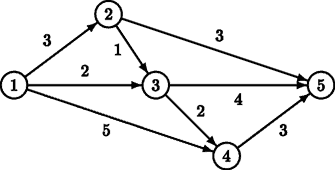
For example, for the above road map, there are two minimal routes from S = 1 to F = 5: 1 → 2 → 5 and 1 → 3 → 5, both of length 6. There is one route that is one distance unit longer: 1 → 3 → 4 → 5, of length 7.
Now, given a (partial) road map of the Benelux and two cities S and F, tour operator Your Personal Holiday likes to know how many different routes it can offer to its clients, under the above restriction on the route length.
Input
The first line of the input file contains a single number: the number of test cases to follow. Each test case has the following format:
One line with two integers N and M, separated by a single space, with 2 ≤ N ≤ 1,000 and 1 ≤ M ≤ 10, 000: the number of cities and the number of roads in the road map.
M lines, each with three integers A, B and L, separated by single spaces, with 1 ≤ A, B ≤ N, A ≠ B and 1 ≤ L ≤ 1,000, describing a road from city A to city B with length L.
The roads are unidirectional. Hence, if there is a road from A to B, then there is not necessarily also a road from B to A. There may be different roads from a city A to a city B.
One line with two integers S and F, separated by a single space, with 1 ≤ S, F ≤ N and S ≠ F: the starting city and the final city of the route.
There will be at least one route from S to F.
Output
For every test case in the input file, the output should contain a single number, on a single line: the number of routes of minimal length or one distance unit longer. Test cases are such, that this number is at most 109 = 1,000,000,000.
Sample Input
2

5 8

1 2 3

1 3 2

1 4 5

2 3 1

2 5 3

3 4 2

3 5 4

4 5 3

1 5

5 6

2 3 1

3 2 1

3 1 10

4 5 2

5 2 7

5 2 7

4 1
Sample Output
3

2
Hint
The first test case above corresponds to the picture in the problem description.
Source
 /******************************

 code by drizzle

 blog: www.cnblogs.com/hsd-/

 ^ ^    ^ ^

  O      O

 ******************************/

 //#include<bits/stdc++.h>

 #include<map>

 #include<set>

 #include<cmath>

 #include<queue>

 #include<bitset>

 #include<math.h>

 #include<vector>

 #include<string>

 #include<stdio.h>

 #include<cstring>

 #include<iostream>

 #include<algorithm>

 //#pragma comment(linker, "/STACK:102400000,102400000")

 using namespace std;

 #define  A first

 #define B second

 const int mod=;

 const int MOD1=;

 const int MOD2=;

 const double EPS=0.00000001;

 typedef __int64 ll;

 const ll M22OD=;

 const int INF=;

 const ll MAX=1ll<<;

 const double eps=1e-;

 const double inf=~0u>>;

 const double pi=acos(-1.0);

 typedef double db;

 typedef unsigned int uint;

 typedef unsigned long long ull;

 struct node

 {

     int v,next,w;

 }edge[];

 int d[][],e,n,m;

 int cnt[][];

 int head[];

 bool vis[][];

 void init()

 {

     e=;

     memset(head,,sizeof(head));

 }

 void insert(int x,int y,int w)

 {

     e++;

     edge[e].v=y;

     edge[e].w=w;

     edge[e].next=head[x];

     head[x]=e;

 }

 int dijkstra(int s,int t)

 {

     int flag,u;

     memset(vis,,sizeof(vis));

     memset(cnt,,sizeof(cnt));

     for(int i=;i<=n;i++){

         d[i][]=d[i][]=INF;

     }

     cnt[s][]=;

     d[s][]=;

     for(int i=;i<=*n;i++)

     {

         int mini=INF;

         for(int j=;j<=n;j++)

         {

             if(!vis[j][]&&d[j][]<mini)

             {

                 u=j;

                 flag=;

                 mini=d[j][];

             }

             else if(!vis[j][]&&d[j][]<mini)

             {

                 u=j;

                 flag=;

                 mini=d[j][];

             }

         }

         if(mini==INF) break;

         vis[u][flag]=;

         for(int j=head[u];j;j=edge[j].next)

         {

             int w=edge[j].w;

             int v=edge[j].v;

             if(d[v][]>mini+w){

                 d[v][]=d[v][];

                 cnt[v][]=cnt[v][];

                 d[v][]=mini+w;

                 cnt[v][]=cnt[u][flag];

             }

             else if(d[v][]==mini+w) cnt[v][]+=cnt[u][flag];

             else if(d[v][]>mini+w){

                 d[v][]=mini+w;

                 cnt[v][]=cnt[u][flag];

             }

             else if(d[v][]==mini+w) cnt[v][]+=cnt[u][flag];

         }

     }

     int ans=;

     if(d[t][]==d[t][]+) ans=cnt[t][]+cnt[t][];

     else  ans=cnt[t][];

     return ans;

 }

 int main()

 {

     int s,t, T,x,y,w;

     scanf("%d",&T);

      while(T--)

      {

          init();

          scanf("%d %d",&n,&m);

          for(int i=;i<=m;i++)

          {

              scanf("%d %d %d",&x,&y,&w);

              insert(x,y,w);

          }

          scanf("%d %d",&s,&t);

          printf("%d\n",dijkstra(s,t));

      }

     return ;

 }
poj 3463 最短路与次短路的方案数求解的更多相关文章
- poj 3463/hdu 1688 求次短路和最短路个数
http://poj.org/problem?id=3463 http://acm.hdu.edu.cn/showproblem.php?pid=1688 求出最短路的条数比最短路大1的次短路的条数和 ...
- poj 3463 Sightseeing( 最短路与次短路)
http://poj.org/problem?id=3463 Sightseeing Time Limit: 2000MS Memory Limit: 65536K Total Submissio ...
- poj 3463 Sightseeing——次短路计数
题目:http://poj.org/problem?id=3463 当然要给一个点记最短路和次短路的长度和方案. 但往优先队列里放的结构体和vis竟然也要区分0/1,就像把一个点拆成两个点了一样. 不 ...
- POJ - 3463 Sightseeing 最短路计数+次短路计数
F - Sightseeing 传送门: POJ - 3463 分析 一句话题意:给你一个有向图,可能有重边,让你求从s到t最短路的条数,如果次短路的长度比最短路的长度多1,那么在加上次短路的条数. ...
- POJ 3463 有向图求次短路的长度及其方法数
题目大意: 希望求出走出最短路的方法总数,如果次短路只比最短路小1,那也是可取的 输出总的方法数 这里n个点,每个点有最短和次短两种长度 这里采取的是dijkstra的思想,相当于我们可以不断找到更新 ...
- poj 3463 Sightseeing(次短路+条数统计)
/* 对dij的再一次理解 每个点依旧永久标记 只不过这里多搞一维 0 1 表示最短路还是次短路 然后更新次数相当于原来的两倍 更新的时候搞一下就好了 */ #include<iostream& ...
- poj 3463 最短路+次短路
独立写查错不能,就是维护一个次短路的dist 题意:给定一个有向图,问从起点到终点,最短路+比最短路距离长1的路的个数. Sample Input25 81 2 31 3 21 4 52 3 12 5 ...
- poj 3463 次短路
题意:给定一个有向图,问从起点到终点,最短路+比最短路距离长1的路的个数. 当年数据结构课程设计用A*做过,现在忘光了,2333 #include<stdio.h> #include< ...
- POJ 3463 Sightseeing (次短路)
题意:求两点之间最短路的数目加上比最短路长度大1的路径数目 分析:可以转化为求最短路和次短路的问题,如果次短路比最短路大1,那么结果就是最短路数目加上次短路数目,否则就不加. 求解次短路的过程也是基于 ...
随机推荐
- [转] 控制Arduino的利器-Windows Remote Arduino
原文地址:控制Arduino的利器-Windows Remote Arduino 1. 概述 相信很多朋友已经在玩 Arduino了,而且一般都是使用官方的Arduino IDE来写程序控制Ardui ...
- [Oracle] SQL*Loader 详细使用教程(4)- 字段列表
在上一篇中我们介绍了SQL*Loader中最重要的文件——控制文件,而本篇要介绍控制文件中最重要的部分——字段列表,字段列表的作用是把数据文件中的记录和数据库中表的列对应起来,下面是字段列表的一个例子 ...
- MTF(Move-to-front transform)数据转换
1.什么是MTF MTF(move-to-front)是一种数据编码方式,用于提高数据压缩技术效果. 在数据压缩算法中,MTF可以作为一个额外的步骤.也就是说 ,可以先进行MTF编码,在进行数据压缩. ...
- redhat网络基础配置
添加浮动IP: ifconfig eth0:1 192.168.1.106 IP配置文件: BOOTPROTO: 采用的启动协议,有三种选择: (1) none:不使用启动协议 (2) static: ...
- 关于extra加强延迟加载
一对多和多对多关联的查询策略 lazy属性的另一个属性extra 加强延迟加载 表明采用增强延迟加载策略:在<set>元素配置lazy属性为"extra".增强延迟加载 ...
- IT的灵魂是流程,流程的灵魂是业务,业务的灵魂是战略
IT的灵魂是流程,流程的灵魂是业务,业务的灵魂是战略.高效的IT平台不在于IT技术,而在于好的管理模式与流程设计 从以组织为核心转向以流程为核心 流程管理核心是从流程角度出发,关注流程是否增值,籍此建 ...
- 生成XML文件
import java.io.FileOutputStream;import java.io.IOException; import org.jdom.Document;import org.jdom ...
- 删除Windows 服务
删除的办法有两个: 办法一: 用sc.exe这个Windows命令 开始--运行--cmd.exe,然后输入sc就可以看到了.使用办法很简单: sc delete “服务名” (如果服务名中间有空格, ...
- 初识selendroid
Testerhome社区的lihuazhang对selendroid官网的部分内容进行了翻译和讲解. 以下内容均摘自lihuazhang.感谢lihuazhang的讲解.原文地址:https://gi ...
- android布局学习之相对布局(RelativeLayout)
移通152余继彪 RelativeLayout可以设置某一个视图相对于其他视图的位置,这些位置可以包括上下左右等 RelativeLayout 属性 说明 android:layout_bel ...