
Java8新特性之三:Stream API
Java8的两个重大改变,一个是Lambda表达式,另一个就是本节要讲的Stream API表达式。Stream 是Java8中处理集合的关键抽象概念,它可以对集合进行非常复杂的查找、过滤、筛选等操作,在新版的JPA中,也已经加入了Stream。如:
 @Query("select u from User u")

 Stream<User> findAllByCustomQueryAndStream();

 Stream<User> readAllByFirstnameNotNull();

 @Query("select u from User u")

 Stream<User> streamAllPaged(Pageable pageable);
Stream API给我们操作集合带来了强大的功用,同时Stream API操作简单,容易上手。
1、Stream的操作步骤
Stream有如下三个操作步骤:
一、创建Stream
从一个数据源,如集合、数组中获取流。
二、中间操作
一个操作的中间链,对数据源的数据进行操作。
三、终止操作
一个终止操作,执行中间操作链,并产生结果。
要注意的是,对流的操作完成后需要进行关闭操作(或者用JAVA7的try-with-resources)。
举个简单的例子:
假设有一个Person类和一个Person列表,现在有两个需求:1)找到年龄大于18岁的人并输出;2)找出所有中国人的数量。
 @Data

 class Person {

     private String name;

     private Integer age;

     private String country;

     private char sex;

     public Person(String name, Integer age, String country, char sex) {

         this.name = name;

         this.age = age;

         this.country = country;

         this.sex = sex;

     }

 }
 List<Person> personList = new ArrayList<>();

 personList.add(new Person("欧阳雪",18,"中国",'F'));

 personList.add(new Person("Tom",24,"美国",'M'));

 personList.add(new Person("Harley",22,"英国",'F'));

 personList.add(new Person("向天笑",20,"中国",'M'));

 personList.add(new Person("李康",22,"中国",'M'));

 personList.add(new Person("小梅",20,"中国",'F'));

 personList.add(new Person("何雪",21,"中国",'F'));

 personList.add(new Person("李康",22,"中国",'M'));
在JDK8以前,我们可以通过遍历列表来完成。但是在有了Stream API后,可以这样来实现:
  public static void main(String[] args) {

     // 1)找到年龄大于18岁的人并输出;

     personList.stream().filter((p) -> p.getAge() > 18).forEach(System.out::println);

     System.out.println("-------------------------------------------");

     // 2)找出所有中国人的数量

     long chinaPersonNum = personList.stream().filter((p) -> p.getCountry().equals("中国")).count();

     System.out.println("中国人有:" + chinaPersonNum + "个");

 }
输出结果:
Person(name=Tom, age=24, country=美国, sex=M)
Person(name=Harley, age=22, country=英国, sex=F)
Person(name=向天笑, age=20, country=中国, sex=M)
Person(name=李康, age=22, country=中国, sex=M)
Person(name=小梅, age=20, country=中国, sex=F)
Person(name=何雪, age=21, country=中国, sex=F)
Person(name=李康, age=22, country=中国, sex=M)
-------------------------------------------
中国人有:6
在这个例子中,personList.stream()是创建流,filter()属于中间操作,forEach、count()是终止操作。
2、Stream中间操作--筛选与切片
- filter:接收Lambda,从流中排除某些操作;
- limit:截断流,使其元素不超过给定对象
- skip(n):跳过元素,返回一个扔掉了前n个元素的流,若流中元素不足n个,则返回一个空流,与limit(n)互补
- distinct:筛选,通过流所生成元素的hashCode()和equals()去除重复元素。
2.1 limit举例
需求,从Person列表中取出两个女性。
personList.stream().filter((p) -> p.getSex() == 'F').limit(2).forEach(System.out::println);
输出结果为:
Person(name=欧阳雪, age=18, country=中国, sex=F)

Person(name=Harley, age=22, country=英国, sex=F)
2.2 skip举例
从Person列表中从第2个女性开始,取出所有的女性。
personList.stream().filter((p) -> p.getSex() == 'F').skip(1).forEach(System.out::println);
输出结果为:
Person(name=Harley, age=22, country=英国, sex=F)

Person(name=小梅, age=20, country=中国, sex=F)

Person(name=何雪, age=21, country=中国, sex=F)
2.3 distinct举例
personList.stream().filter((p) -> p.getSex() == 'M').distinct().forEach(System.out::println);
输出结果为:
Person(name=Tom, age=24, country=美国, sex=M)

Person(name=向天笑, age=20, country=中国, sex=M)

Person(name=李康, age=22, country=中国, sex=M)
男性中有两个李康,去除掉了一个重复的。
3、Stream中间操作--映射
- map--接收Lambda,将元素转换成其他形式或提取信息。接收一个函数作为参数,该函数会被应用到每个元素上,并将其映射成一个新的元素。
- flatMap--接收一个函数作为参数,将流中的每个值都换成另一个流,然后把所有流连接成一个流
3.1 map举例
例1:比如,我们用一个PersonCountry类来接收所有的国家信息:
 @Data

 class PersonCountry {

     private String country;

 }

 personList.stream().map((p) -> {

        PersonCountry personName = new PersonCountry();

        personName.setCountry(p.getCountry());

        return personName;

 }).distinct().forEach(System.out::println);
输出结果为:
PersonName(country=中国)

PersonName(country=美国)

PersonName(country=英国)
例2:假如有一个字符列表,需要提出每一个字符
List<String> list = Arrays.asList("aaa","bbb","ccc","ddd","ddd");
代码如下:
根据字符串获取字符方法:
 public static Stream<Character> getCharacterByString(String str) {

     List<Character> characterList = new ArrayList<>();

     for (Character character : str.toCharArray()) {

         characterList.add(character);

     }

     return characterList.stream();

 }
 List<String> list = Arrays.asList("aaa","bbb","ccc","ddd","ddd");

 final Stream<Stream<Character>> streamStream

         = list.stream().map(TestStreamAPI::getCharacterByString);

 streamStream.forEach(System.out::println);
运行结果:
java.util.stream.ReferencePipeline$Head@3f91beef

java.util.stream.ReferencePipeline$Head@1a6c5a9e

java.util.stream.ReferencePipeline$Head@37bba400

java.util.stream.ReferencePipeline$Head@179d3b25

java.util.stream.ReferencePipeline$Head@254989ff
从输出结果及返回结果类型(Stream<Stream<Character>>)可以看出这是一个流中流,要想打印出我们想要的结果,需要对流中的每个流进行打印:
streamStream.forEach(sm -> sm.forEach(System.out::print));
运行结果为:
aaabbbcccdddddd
但我们希望的是返回的是一个流,而不是一个包含了多个流的流,而flatMap可以帮助我们做到这一点。
3.2 flatMap举例
改写上面的方法,将map改成flatMap:
 final Stream<Character> characterStream = list.stream().flatMap(TestStreamAPI::getCharacterByString);

 characterStream.forEach(System.out::print);
运行结果为:
aaabbbcccdddddd
3.3 map和flatMap的图解
map图解:
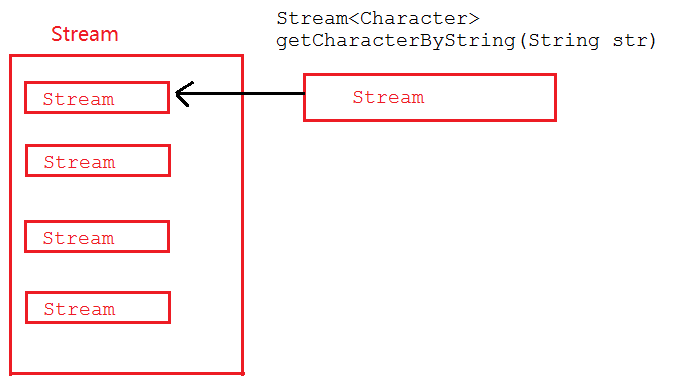
map在接收到流后,直接将Stream放入到一个Stream中,最终整体返回一个包含了多个Stream的Stream。
flatMap图解:
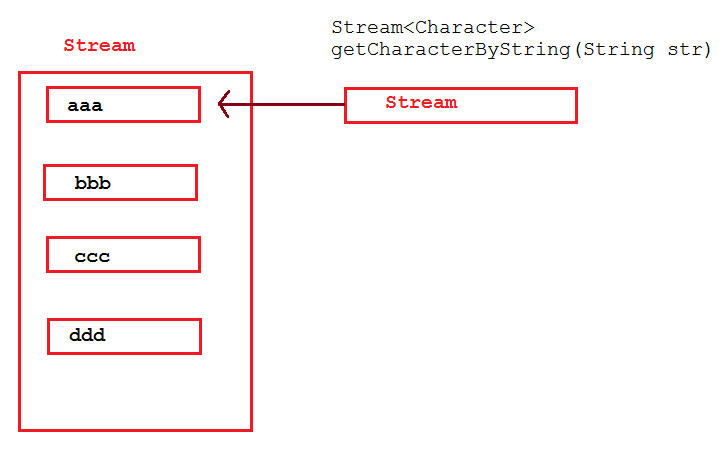
flatMap在接收到Stream后,会将接收到的Stream中的每个元素取出来放入一个Stream中,最后将一个包含多个元素的Stream返回。
ps:图画得丑,将就一下。
4、Stream中间操作--排序
- sorted()--自然排序(Comparable)
- sorted(Comparator com)--定制排序(Comparator)
自然排序比较好理解,这里只讲一下定制排序,对前面的personList按年龄从小到大排序,年龄相同,则再按姓名排序:
 final Stream<Person> sorted = personList.stream().sorted((p1, p2) -> {

     if (p1.getAge().equals(p2.getAge())) {

         return p1.getName().compareTo(p2.getName());

     } else {

         return p1.getAge().compareTo(p2.getAge());

     }

 });

 sorted.forEach(System.out::println);
运行结果:
Person(name=欧阳雪, age=18, country=中国, sex=F)

Person(name=向天笑, age=20, country=中国, sex=M)

Person(name=小梅, age=20, country=中国, sex=F)

Person(name=何雪, age=21, country=中国, sex=F)

Person(name=Harley, age=22, country=英国, sex=F)

Person(name=李康, age=22, country=中国, sex=M)

Person(name=李康, age=22, country=中国, sex=M)

Person(name=Tom, age=24, country=美国, sex=M)
5、终止操作--查找与匹配
- allMatch--检查是否匹配所有元素
- anyMatch--检查是否至少匹配一个元素
- noneMatch--检查是否没有匹配所有元素
- findFirst--返回第一个元素
- findAny--返回当前流中的任意元素
- count--返回流中元素的总个数
- max--返回流中最大值
- min--返回流中最小值
这些方面在Stream类中都有说明,这里不一一举例,只对allMatch、max各举一例进行说明。
4.1 allMatch
判断personList中的人是否都是成年人:
 final boolean adult = personList.stream().allMatch(p -> p.getAge() >= 18);

 System.out.println("是否都是成年人:" + adult);

 final boolean chinaese = personList.stream().allMatch(p -> p.getCountry().equals("中国"));

 System.out.println("是否都是中国人:" + chinaese);
运行结果:
是否都是成年人:true

是否都是中国人:false
4.1 max min
 final Optional<Person> maxAge = personList.stream().max((p1, p2) -> p1.getAge().compareTo(p2.getAge()));

 System.out.println("年龄最大的人信息:" + maxAge.get());

 final Optional<Person> minAge = personList.stream().min((p1, p2) -> p1.getAge().compareTo(p2.getAge()));

 System.out.println("年龄最小的人信息:" + minAge.get());
运行结果:
年龄最大的人信息:Person(name=Tom, age=24, country=美国, sex=M)

年龄最小的人信息:Person(name=欧阳雪, age=18, country=中国, sex=F)
5、归约
Stream API的归约操作可以将流中元素反复结合起来,得到一个值,有:
 Optional<T> reduce(BinaryOperator<T> accumulator);

 T reduce(T identity, BinaryOperator<T> accumulator);

 <U> U reduce(U identity,

                  BiFunction<U, ? super T, U> accumulator,

                  BinaryOperator<U> combiner);
5.1 求一个1到100的和
 List<Integer> integerList = new ArrayList<>(100);

 for(int i = 1;i <= 100;i++) {

     integerList.add(i);

 }

 final Integer reduce = integerList.stream().reduce(0, (x, y) -> x + y);

 System.out.println("结果为:" + reduce);
结果为:5050
这个例子用到了reduce第二个方法:T reduce(T identity, BinaryOperator<T> accumulator)
把这个动作拆解一下,其运算步骤模拟如下:
0  (1,2) -> 1 + 2 + 0

3  (3,4) -> 3 + 4 + 3

10 (5,6) -> 5 + 6 + 10

.

.

.
其运算步骤是,每次将列表的两个元素相加,并将结果与前一次的两个元素的相加结果进行累加,因此,在开始时,将identity设为0,因为第1个元素和第2个元素在相加的时候,前面还没有元素操作过。
5.2 求所有人的年龄之和
 final Optional<Integer> reduce = personList.stream().map(Person::getAge).reduce(Integer::sum);

System.out.println("年龄总和:" + reduce);
年龄总和:169
6、收集
collect:将流转换为其他形式,接收一个Collector接口实现 ,用于给Stream中汇总的方法
 <R, A> R collect(Collector<? super T, A, R> collector);

 <R> R collect(Supplier<R> supplier,

                   BiConsumer<R, ? super T> accumulator,

                   BiConsumer<R, R> combiner);
collect不光可以将流转换成其他集合等形式,还可以进行归约等操作,具体实现也很简单,主要是与Collectors类搭配使用。
6.1 改写3.1 map举例中的的例子,将国家收集起来转换成List
 final List<String> collect = personList.stream().map(p -> p.getCountry()).distinct().collect(Collectors.toList());

         System.out.println(collect);
输出结果:
[中国, 美国, 英国]
6.2 计算出平均年龄
 final Double collect1 = personList.stream().collect(Collectors.averagingInt(p -> p.getAge()));

2 System.out.println("平均年龄为:" + collect1);
输出结果:
平均年龄为:21.125
6.3 找出最小年龄、最大年龄
 final Optional<Integer> maxAge2 = personList.stream().map(Person::getAge).collect(Collectors.maxBy(Integer::compareTo));

 System.out.println(maxAge2.get());
最小年龄类型。
还有其他很操作,可以参考java.util.stream.Collectors。
7 注意流的关闭
 try(final Stream<Integer> integerStream = personList.stream().map(Person::getAge)) {

   final Optional<Integer> minAge = integerStream.collect(Collectors.minBy(Integer::compareTo));

   System.out.println(minAge.get());

}
最好将流的操作放到try-with-resources,本章前面内容为了方便,没有放到try-with-resources中。
8 完整测试代码
 import lombok.Data;

 import java.util.ArrayList;

 import java.util.Arrays;

 import java.util.List;

 import java.util.Optional;

 import java.util.stream.Collectors;

 import java.util.stream.Stream;

 public class TestStreamAPI {

     public static void main(String[] args) {

         List<Person> personList = new ArrayList<>();

         personList.add(new Person("欧阳雪",18,"中国",'F'));

         personList.add(new Person("Tom",24,"美国",'M'));

         personList.add(new Person("Harley",22,"英国",'F'));

         personList.add(new Person("向天笑",20,"中国",'M'));

         personList.add(new Person("李康",22,"中国",'M'));

         personList.add(new Person("小梅",20,"中国",'F'));

         personList.add(new Person("何雪",21,"中国",'F'));

         personList.add(new Person("李康",22,"中国",'M'));

         // 1)找到年龄大于18岁的人并输出;

         personList.stream().filter((p) -> p.getAge() > 18).forEach(System.out::println);

         System.out.println("-------------------------------------------");

         // 2)找出所有中国人的数量

         long chinaPersonNum = personList.stream().filter((p) -> p.getCountry().equals("中国")).count();

         System.out.println("中国人有:" + chinaPersonNum);

         // limit

         personList.stream().filter((p) -> p.getSex() == 'F').limit(2).forEach(System.out::println);

         System.out.println();

         // skip

         personList.stream().filter((p) -> p.getSex() == 'F').skip(1).forEach(System.out::println);

         // distinct

         personList.stream().filter((p) -> p.getSex() == 'M').distinct().forEach(System.out::println);

         // map

         personList.stream().map((p) -> {

             PersonCountry personName = new PersonCountry();

             personName.setCountry(p.getCountry());

             return personName;

         }).distinct().forEach(System.out::println);

         // map2

         List<String> list = Arrays.asList("aaa","bbb","ccc","ddd","ddd");

         final Stream<Stream<Character>> streamStream

                 = list.stream().map(TestStreamAPI::getCharacterByString);

 //        streamStream.forEach(System.out::println);

         streamStream.forEach(sm -> sm.forEach(System.out::print));

         // flatMap

         final Stream<Character> characterStream = list.stream().flatMap(TestStreamAPI::getCharacterByString);

         characterStream.forEach(System.out::print);

         // sort

         final Stream<Person> sorted = personList.stream().sorted((p1, p2) -> {

             if (p1.getAge().equals(p2.getAge())) {

                 return p1.getName().compareTo(p2.getName());

             } else {

                 return p1.getAge().compareTo(p2.getAge());

             }

         });

         sorted.forEach(System.out::println);

         // allMatch

         final Stream<Person> stream = personList.stream();

         final boolean adult = stream.allMatch(p -> p.getAge() >= 18);

         System.out.println("是否都是成年人:" + adult);

         final boolean chinaese = personList.stream().allMatch(p -> p.getCountry().equals("中国"));

         System.out.println("是否都是中国人:" + chinaese);

         // max min

         final Optional<Person> maxAge = personList.stream().max((p1, p2) -> p1.getAge().compareTo(p2.getAge()));

         System.out.println("年龄最大的人信息:" + maxAge.get());

         final Optional<Person> minAge = personList.stream().min((p1, p2) -> p1.getAge().compareTo(p2.getAge()));

         System.out.println("年龄最小的人信息:" + minAge.get());

         // reduce

         List<Integer> integerList = new ArrayList<>(100);

         for(int i = 1;i <= 100;i++) {

             integerList.add(i);

         }

         final Integer reduce = integerList.stream().reduce(0, (x, y) -> x + y);

         System.out.println("结果为:" + reduce);

         final Optional<Integer> totalAge = personList.stream().map(Person::getAge).reduce(Integer::sum);

         System.out.println("年龄总和:" + totalAge);

         // collect

         final List<String> collect = personList.stream().map(p -> p.getCountry()).distinct().collect(Collectors.toList());

         System.out.println(collect);

         final Double collect1 = personList.stream().collect(Collectors.averagingInt(p -> p.getAge()));

         System.out.println("平均年龄为:" + collect1);

         final Optional<Integer> maxAge2 = personList.stream().map(Person::getAge).collect(Collectors.maxBy(Integer::compareTo));

         System.out.println(maxAge2.get());

         try(final Stream<Integer> integerStream = personList.stream().map(Person::getAge)) {

             final Optional<Integer> minAge2 = integerStream.collect(Collectors.minBy(Integer::compareTo));

             System.out.println(minAge2.get());

         }

     }

     public static Stream<Character> getCharacterByString(String str) {

         List<Character> characterList = new ArrayList<>();

         for (Character character : str.toCharArray()) {

             characterList.add(character);

         }

         return characterList.stream();

     }

 }

 @Data

 class PersonCountry {

     private String country;

 }

 @Data

 class Person {

     private String name;

     private Integer age;

     private String country;

     private char sex;

     public Person(String name, Integer age, String country, char sex) {

         this.name = name;

         this.age = age;

         this.country = country;

         this.sex = sex;

     }

 }
Java8新特性之三:Stream API的更多相关文章
- Java8 新特性之Stream API
1. Stream 概述 Stream 是Java8中处理集合的关键抽象概念,可以对集合执行非常复杂的查找,过滤和映射数据等操作; 使用 Stream API 对集合数据进行操作,就类似于使用 SQL ...
- 【Java8新特性】Stream API有哪些中间操作?看完你也可以吊打面试官!!
写在前面 在上一篇<[Java8新特性]面试官问我:Java8中创建Stream流有哪几种方式?>中,一名读者去面试被面试官暴虐!归根结底,那哥儿们还是对Java8的新特性不是很了解呀!那 ...
- Java8 新特性 Lambda & Stream API
目录 Lambda & Stream API 1 Lambda表达式 1.1 为什么要使用lambda表达式 1.2 Lambda表达式语法 1.3 函数式接口 1.3.1 什么是函数式接口? ...
- 乐字节-Java8新特性之Stream流(上)
上一篇文章,小乐给大家介绍了<Java8新特性之方法引用>,下面接下来小乐将会给大家介绍Java8新特性之Stream,称之为流,本篇文章为上半部分. 1.什么是流? Java Se中对于 ...
- 乐字节-Java8新特性之Date API
上一篇文章,小乐给大家带来了Java8新特性之Optional,接下来本文将会给大家介绍Java8新特性之Date API 前言: Java 8通过发布新的Date-Time API来进一步加强对日期 ...
- 【Java8新特性】- Stream流
Java8新特性 - Stream流的应用 生命不息,写作不止 继续踏上学习之路,学之分享笔记 总有一天我也能像各位大佬一样 一个有梦有戏的人 @怒放吧德德 分享学习心得,欢迎指正,大家一起学习成长! ...
- Java8 新特性 Data Time API
Java8新的日期类型 在Java8以前,Date日期API对我们非常的不友好,它无法表示日期,只能以毫秒的精试来表示时间,并且可以修改,他的线程还不是安全的.所以Java8中引入了全新的日期和时间A ...
- java8 新特性入门 stream/lambda
Java 8 中的 Stream 是对集合(Collection)对象功能的增强,它专注于对集合对象进行各种非常便利.高效的聚合操作(aggregate operation),或者大批量数据操作 (b ...
- Java8新特性之Stream
原文链接:http://ifeve.com/stream/ Java8初体验(二)Stream语法详解 感谢同事[天锦]的投稿.投稿请联系 tengfei@ifeve.com上篇文章Java8初体验( ...
随机推荐
- ASP.NET MVC中的路由IRouteConstraint方法应用实例
在如下代码的写法中: public class RouteConfig { public static void RegisterRoutes(RouteCollection routes) { ro ...
- spring中配置quartz调用两次及项目日志log4j不能每天生成日志解决方法
在quartz中配置了一个方法运行时会连续调用两次,是因为加载两次,只需在tomcat的server.xml中修改配置 <Host name="www.xx.cn" appB ...
- 第二章 ArrayList源码解析
一.对于ArrayList需要掌握的七点内容 ArrayList的创建:即构造器 往ArrayList中添加对象:即add(E)方法 获取ArrayList中的单个对象:即get(int index) ...
- 《T-SQL查询》读书笔记Part 2.执行计划
一.关于执行计划 执行计划是优化器生成的用于确定如何处理一个给定查询的“工作计划”.一个计划包含一组运算符,通常按照特定的顺序来应用这些运算符.此外,一些运算符可以在它们之前的运算符还在处理时被应用( ...
- selenium+python自动化测试
F12: 右键 选择复制 path 在selenium+python自动化测试(一)–环境搭建中,运行了一个测试脚本,脚本内容如下: from selenium import webdriver ...
- FutureTask理解
一.概述 FutureTask包装器是一种非常便利的机制,同时实现了Future和Runnable接口. 类图如下: FutureTask是一种可以取消的异步的计算任务.它的计算是通过Callable ...
- Spring Cloud Eureka Server高可用注册服务中心的配置
前言 Eureka 作为一个云端负载均衡,本身是一个基于REST的服务,在 Spring Cloud 中用于发现和注册服务. 那么当成千上万个微服务注册到Eureka Server中的时候,Eurek ...
- 第五章——支持向量机(Support Vector Machines)
svm可用于线性或非线性分类.回归.甚至异常检测. svm尤其适用于中小数据集的复杂分类问题. 5.1 Linear SVM Classification svm对feature scales敏感,如 ...
- Hibernate Validator 6.0.9.Final - JSR 380 Reference Implementation: Reference Guide
Preface Validating data is a common task that occurs throughout all application layers, from the pre ...
- 使用Map标签指定点击区域时的兼容性问题
电商m站的首页,有一个需求是配一张大的banner图,然后指定某些区域是热区,点击之后跳转到不同的活动页. 听起来简单明了,实现也比较容易,立刻就想起来有个map标签,简直就是为这个需求量身定做. 简 ...