
从头学Android之Android布局管理:LinerLayout线性布局
LinerLayout线性布局:
这种布局方式是指在这个里面的控件元素显线性,我们可以通过setOrientation(int orientation)来指定线性布局的显示方式,其值有:HORIZONTAL(0)、VERTICAL(1)。默认为HORIZONTAL。与之相关的我们也可以在布局文件中通过android:orientation来指定。同理,其值也有:horizontal、vertical
LinearLayout是线性布局控件,它包含的子控件将以横向或竖向的方式排列,按照相对位置来排列所有的widgets或者其他的containers,超过边界时,某些控件将缺失或消失,不能完全显示。因此垂直方式排列时,每一行只会有一个 widget或者是container,而不管他们有多宽,而水平方式排列是将会只有一个行高(高度为最高子控件的高度加上边框高度)。LinearLayout保持其所包含的 widget或者是container之间的间隔以及互相对齐(相对一个控件的右对齐、中间对齐或者左对齐)。
关于layout_weight:
LinearLayout还支持为其包含的widget或者是container指定填充权值。允许其包含的widget或者是container可以填充屏幕上的剩余空间。剩余的空间会按这些widgets或者是containers指定的权值比例分配屏幕。默认的 weight 值为0 ,表示按照widgets或者是containers实际大小来显示,若高于0的值,则将 Container剩余可用空间分割,分割大小具体取决于每一个widget或者是 container的layout_weight及该权值在所有widgets或者是containers中的比例。例如,如果有三个文本框,前两个文本框的取值一个为2,一个为1,显示第三个文本框后剩余的空间的2/3给权值为2的,1/3大小给权值为1的。而第三个文本框不会放大,按实际大小来显示。也就是权值越大,重要度越大,显示时所占的剩余空间越大。
示例1:
 <?xml version="1.0" encoding="utf-8"?>

 <LinearLayout xmlns:android="http://schemas.android.com/apk/res/android"

    android:orientation="vertical" android:layout_width="match_parent"

    android:layout_height="match_parent">

    <EditText android:id="@+id/txt01" android:layout_width="fill_parent"

       android:layout_height="wrap_content" android:layout_weight="1"

       android:text="1111" />

    <EditText android:id="@+id/txt02" android:layout_width="fill_parent"

       android:layout_height="wrap_content" android:layout_weight="2"

       android:text="2222" />

    <EditText android:id="@+id/txt03" android:layout_width="fill_parent"

       android:layout_height="wrap_content" android:text="3333" />

 </LinearLayout>

几个常用的XML属性的详解:
|
属性名称 |
相关方法 |
描述 |
|
android:baselineAligned |
setBaselineAligned (boolean baselineAligned) |
是否允许用户调整它内容的基线。 |
|
android:baselineAlignedChildIndex |
setBaselineAlignedChildIndex (int i) |
是当前LinearLayout与其它View的对齐方式 |
|
android:gravity |
setGravity (int gravity) |
指定控件中内容的基本内容的对齐方式(本元素里的所有元素的重力方向)。其值有: |
|
android:layout_gravity |
|
是当前元素相对于父元素的重力方向 |
|
android:measureWithLargestChild |
|
当被设置为真时,所有的子控件将被认为是具有重量最小面积最大的子控件 |
|
android:orientation |
setOrientation (int orientation) |
置它内容的对其方向,有两个可以选择的值: horizontal和vertical。分别表示水平排列和垂直排列。 |
|
android:weightSum |
在Android里我们可以通过两种方式来设置布局文件,一种是可以通过XML文件来设置布局,这也是官方推荐,另外一种方式就是我们可以通过代码来设置我们的布局模式
方式一:通过XML文件。只要在onCreate()方法里通过setContentView()指定布局文件即可
 <?xml version="1.0" encoding="utf-8"?>

 <LinearLayout xmlns:android="http://schemas.android.com/apk/res/android"

     android:orientation="vertical"

     android:layout_width="fill_parent"

     android:layout_height="fill_parent">

   <LinearLayout

       android:orientation="horizontal"

       android:layout_width="fill_parent"

       android:layout_height="fill_parent"

       android:layout_weight="1">

       <TextView

           android:text="red"

           android:gravity="center_horizontal"

           android:background="#aa0000"

           android:layout_width="wrap_content"

           android:layout_height="fill_parent"

           android:layout_weight="1"/>

       <TextView

           android:text="green"

           android:gravity="center_horizontal"

           android:background="#00aa00"

           android:layout_width="wrap_content"

           android:layout_height="fill_parent"

           android:layout_weight="1"/>

       <TextView

           android:text="blue"

           android:gravity="center_horizontal"

           android:background="#0000aa"

           android:layout_width="wrap_content"

           android:layout_height="fill_parent"

           android:layout_weight="1"/>

       <TextView

           android:text="yellow"

           android:gravity="center_horizontal"

           android:background="#aaaa00"

           android:layout_width="wrap_content"

           android:layout_height="fill_parent"

           android:layout_weight="1"/>

   </LinearLayout>

   <LinearLayout

     android:orientation="vertical"

     android:layout_width="fill_parent"

     android:layout_height="fill_parent"

     android:layout_weight="1">

     <TextView

         android:text="row one"

         android:textSize="15pt"

         android:layout_width="fill_parent"

         android:layout_height="wrap_content"

         android:layout_weight="1"/>

     <TextView

         android:text="row two"

         android:textSize="15pt"

         android:layout_width="fill_parent"

         android:layout_height="wrap_content"

         android:layout_weight="1"/>

     <TextView

         android:text="row three"

         android:textSize="15pt"

         android:layout_width="fill_parent"

         android:layout_height="wrap_content"

         android:layout_weight="1"/>

     <TextView

         android:text="row four"

         android:textSize="15pt"

         android:layout_width="fill_parent"

         android:layout_height="wrap_content"

         android:layout_weight="1"/>

   </LinearLayout>

 </LinearLayout>
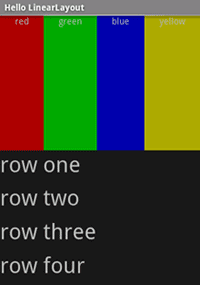
方式二:代码方式
LinerLayout类的常用方法及常量
|
方法及常量 |
类型 |
描述 |
|
public static final int HORIZONTAL |
常量 |
设置水平对齐 |
|
public static final int VERTICAL |
常量 |
设置垂直对齐 |
|
public LinerLayout(Context context) |
构造方法 |
创建LinerLayout类的对象 |
|
public void addView(View child, ViewGroup.LayoutParams params) |
普通方法 |
增加组组件并且指定布局参数 |
|
public void addView(View childView) |
普通方法 |
增加组件 |
|
public void setOrientation(int orientaiton) |
普通方法 |
设置对齐方式 |
LinerLayout.LayoutParams用于指定线性布局的参数
类结构图:
|
↳ |
|||
|
|
↳ |
||
|
|
|
↳ |
android.widget.LinearLayout.LayoutParams |
常用布局参数:
public static final int FILL_PARENT
public static final int WRAP_CONTENT
 package com.jiahui.activity;

 import android.app.Activity;

 import android.content.Intent;

 import android.os.Bundle;

 import android.view.View;

 import android.view.ViewGroup;

 import android.view.View.OnClickListener;

 import android.widget.Button;

 import android.widget.LinearLayout;

 import android.widget.TextView;

 import android.widget.LinearLayout.LayoutParams;

 /**

  * 动态设置布局

  *

  * @author Administrator

  *

  */

 public class Dyanmic_Layout_Activity extends Activity {

        public void onCreate(Bundle savedInstanceState) {

               super.onCreate(savedInstanceState);

               // 定义线性布局管理器

               LinearLayout layout = new LinearLayout(this);

               // 定义布局管理器的指定宽和高

               LinearLayout.LayoutParams params = new LinearLayout.LayoutParams(

                             ViewGroup.LayoutParams.FILL_PARENT,

                             ViewGroup.LayoutParams.FILL_PARENT);

               layout.setOrientation(LinearLayout.VERTICAL);

               // 定义要显示组件的布局管理器

               LinearLayout.LayoutParams txtParam = new LinearLayout.LayoutParams(

                             ViewGroup.LayoutParams.FILL_PARENT,

                             ViewGroup.LayoutParams.WRAP_CONTENT);

               TextView textView = new TextView(this);

               // 显示的文字

               textView.setText("动态设置布局增加的TextView组件");

               // 设置文本的参数

               textView.setLayoutParams(txtParam);

               // 增加组件

               layout.addView(textView, txtParam);

               // 增加新的布局管理器

               super.setContentView(layout, params);

        }

 }
实现效果

源代码下载:http://download.csdn.net/detail/jiahui524/3677960
从头学Android之Android布局管理:LinerLayout线性布局的更多相关文章
- Android学习系列(二)布局管理器之线性布局的3种实现方式
转载请注明出处:http://blog.csdn.net/lhy_ycu/article/details/39643669 LinearLayout是Android控件中的线性布局控件,它包括的子控件 ...
- Android BGABadgeView:BGABadgeLinearLayout以整体线性布局作为BadgeView(3)
Android BGABadgeView:BGABadgeLinearLayout以整体线性布局作为BadgeView(3) Android BGABadgeView不仅可以把某个View作为B ...
- 三十三、Java图形化界面设计——布局管理器之null布局(空布局)
摘自http://blog.csdn.net/liujun13579/article/details/7774267 三十三.Java图形化界面设计--布局管理器之null布局(空布局) 一般容器都有 ...
- Android -- UI布局管理,相对布局,线性布局,表格布局,绝对布局,帧布局
1. 相对布局 <RelativeLayout xmlns:android="http://schemas.android.com/apk/res/android" xmln ...
- 【Android】7.2 LinearLayout(线性布局)
分类:C#.Android.VS2015: 创建日期:2016-02-10 一.简介 LinearLayout将容器内的组件一个挨着一个地横向或纵向依次堆叠起来(不重叠).该布局和WPF的StackP ...
- Java 图形编程 二:布局管理器之顺序布局
package second; import java.awt.*; import java.awt.event.WindowAdapter; import java.awt.event.Window ...
- 转:三十三、Java图形化界面设计——布局管理器之null布局(空布局)——即SWT中的绝对布局
http://blog.csdn.net/liujun13579/article/details/7774267 一般容器都有默认布局方式,但是有时候需要精确指定各个组建的大小和位置,就需要用到 ...
- Java图形化界面设计——布局管理器之null布局(空布局)
一般容器都有默认布局方式,但是有时候需要精确指定各个组建的大小和位置,就需要用到空布局. 操作方法: 1) 首先利用setLayout(null)语句将容器的布局设置为null布局(空布局 ...
- Android课程---布局管理器之相对布局(二)
这次示例代码是相对布局中兄弟组件之间,设置按钮的位置,难度:*****,一定要注意有同方向和反方向之分: 1.同方向 1)layout_alignLeft 同方向左对齐 2)layout_alignR ...
随机推荐
- AFNetwork 作用和用法详解
转自:http://www.cnblogs.com/mkai/p/5729685.html AFNetworking是一个轻量级的iOS网络通信类库.它建立在NSURLConnection和NSOpe ...
- 小甲鱼python视频弟十一讲(课后习题)
1.修改列表里的值 list1 = [,,[,,,[,,,,] list1[] = print(list1) list1[][][] = '?' print(list1) 2.列表的排序(sort) ...
- 在sqlserver存储过程中给in参数传带逗号值的办法,如传'1','2','3'这样的
最近在一项目修改中,要在存储过程中给in参数传值,语句写的也对,但怎么执行都得不出结果,如果把这语句直接赋值.执行,却能得出结果,很是奇怪,如: 直接执行select schoolname from ...
- spring访问静态资源文件
用 Spring MVC 开发应用程序,对于初学者有一个很头疼的问题,那就是程序数据都已经查询出来了,但界面样式仍然十分丑陋,加载不了 css,js,图片等资源文件.当你在浏览器上直接输入某个css文 ...
- 【Java学习笔记】泛型
泛型: jdk1.5出现的安全机制 好处: 1.将运行时期的问题ClassCastException转到了编译时期. 2.避免了强制转换的麻烦. <>: 什么时候用? 当操作的引用数据类型 ...
- 将html页改成jsp的两种方式
将html页改成jsp的两种方式 作者: 字体:[增加 减小] 类型:转载 时间:2013-08-13 将html页改成jsp有两种方法,第一种是直接修改html文件,另一种是新建jsp文件.下面为大 ...
- 基于注解的DWR使用
dwr3.0支持使用注解,如果不喜欢配置dwr.xml文件,注解是个不错的方法,简单快捷. 步骤如下: 1.配置web.xml文件,需要在DwrServlet里加classes初始化参数: <i ...
- 窗口类(Window Class)概述
windows窗口编程(通常意义上的win32)有几个比较核心的概念:入口函数WinMain.窗口类Window Class.窗口过程.消息处理机制.通用控件.本文主要介绍窗口类的相关概念,包括: 窗 ...
- hibernate连接查询
Hibernate的HQL语言类似于SQL语言,更适合于Java面向对象的思想. 类与数据库映射好了,不必考虑数据库. 实现Class1的表与Class2的表的联合查询: Class1的class2属 ...
- 第六天:用javascript实现购彩拆分票的计算奖金
需求如下: 购彩金额 拆分票数 <= 10 1票<= 100 10票<= 200 20票<= 500 50票<= 1000 100票 中奖金额 ...