
双目测距+点云——使用MiddleBurry数据集的图片
效果
输入:
|
|
|
 左图
左图
 右图
右图
输出:
 视差图
视差图
 深度图
深度图
实现了鼠标点击图片中的位置,显示其深度。
 点云
点云
其他例子点云:
|
|
|
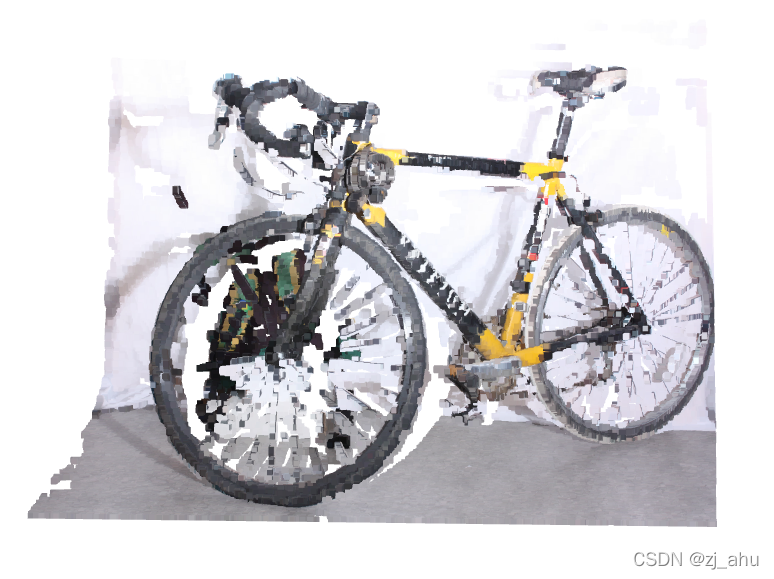 bicycle
 motorcycle
使用自己的双目摄像头拍摄的图片:
|
|
|
 bottle
 laptop
由于摄像头不是很好,所以最后效果没有数据集的好,但大致能分辨出物体。
代码
stereoConfig.py
# -*- coding: utf-8 -*-

# @Time : 2022/3/25 16:06

# @Author : Zhang Jun

# @File : stereoConfig.py

# @Software: PyCharm

import numpy as np

####################仅仅是一个示例###################################

# 双目相机参数

class stereoCamera(object):

    def __init__(self):

        # 左相机内参

        self.cam_matrix_left = np.array([[1499.641, 0, 1097.616],

                                         [0., 1497.989, 772.371],

                                         [0., 0., 1.]])

        # 右相机内参

        self.cam_matrix_right = np.array([[1494.855, 0, 1067.321],

                                          [0., 1491.890, 777.983],

                                          [0., 0., 1.]])

        # 左右相机畸变系数:[k1, k2, p1, p2, k3]

        self.distortion_l = np.array([[-0.1103, 0.0789, -0.0004, 0.0017, -0.0095]])

        self.distortion_r = np.array([[-0.1065, 0.0793, -0.0002, -8.9263e-06, -0.0161]])

        # 旋转矩阵

        self.R = np.array([[0.9939, 0.0165, 0.1081],

                           [-0.0157, 0.9998, -0.0084],

                           [-0.1082, 0.0067, 0.9940]])

        # 平移矩阵

        self.T = np.array([[-423.716], [2.561], [21.973]])

        # 主点列坐标的差

        self.doffs = 0.0

        # 指示上述内外参是否为经过立体校正后的结果

        self.isRectified = False

    # def setMiddleBurryParams(self):

    #     self.cam_matrix_left = np.array([[3997.684, 0, 225.0],

    #                                      [0., 3997.684, 187.5],

    #                                      [0., 0., 1.]])

    #     self.cam_matrix_right = np.array([[3997.684, 0, 225.0],

    #                                       [0., 3997.684, 187.5],

    #                                       [0., 0., 1.]])

    #     self.distortion_l = np.zeros(shape=(5, 1), dtype=np.float64)

    #     self.distortion_r = np.zeros(shape=(5, 1), dtype=np.float64)

    #     self.R = np.identity(3, dtype=np.float64)

    #     self.T = np.array([[-193.001], [0.0], [0.0]])

    #     self.doffs = 131.111

    #     self.isRectified = True

    def setMiddleBurryParams(self):

        self.cam_matrix_left = np.array([[7190.247, 0, 1035.513],

                                         [0., 7190.247, 945.196],

                                         [0., 0., 1.]])

        self.cam_matrix_right = np.array([[7190.247, 0, 1378.036],

                                          [0., 7190.247, 945.196],

                                          [0., 0., 1.]])

        self.distortion_l = np.zeros(shape=(5, 1), dtype=np.float64)

        self.distortion_r = np.zeros(shape=(5, 1), dtype=np.float64)

        self.R = np.identity(3, dtype=np.float64)

        self.T = np.array([[-174.945], [0.0], [0.0]])

        self.doffs = 342.523

        self.isRectified = True
stereo.py
# -*- coding: utf-8 -*-

# @Time : 2022/3/25 16:05

# @Author : Zhang Jun

# @File : stereo.py

# @Software: PyCharm

# -*- coding: utf-8 -*-

import sys

import cv2

import numpy as np

import stereoConfig

import open3d as o3d

# 预处理

def preprocess(img1, img2):

    # 彩色图->灰度图

    if (img1.ndim == 3):

        img1 = cv2.cvtColor(img1, cv2.COLOR_BGR2GRAY)  # 通过OpenCV加载的图像通道顺序是BGR

    if (img2.ndim == 3):

        img2 = cv2.cvtColor(img2, cv2.COLOR_BGR2GRAY)

    # 直方图均衡

    img1 = cv2.equalizeHist(img1)

    img2 = cv2.equalizeHist(img2)

    return img1, img2

# 消除畸变

def undistortion(image, camera_matrix, dist_coeff):

    undistortion_image = cv2.undistort(image, camera_matrix, dist_coeff)

    return undistortion_image

# 获取畸变校正和立体校正的映射变换矩阵、重投影矩阵

# @param:config是一个类,存储着双目标定的参数:config = stereoconfig.stereoCamera()

def getRectifyTransform(height, width, config):

    # 读取内参和外参

    left_K = config.cam_matrix_left

    right_K = config.cam_matrix_right

    left_distortion = config.distortion_l

    right_distortion = config.distortion_r

    R = config.R

    T = config.T

    # 计算校正变换

    R1, R2, P1, P2, Q, roi1, roi2 = cv2.stereoRectify(left_K, left_distortion, right_K, right_distortion,

                                                      (width, height), R, T, alpha=0)

    map1x, map1y = cv2.initUndistortRectifyMap(left_K, left_distortion, R1, P1, (width, height), cv2.CV_32FC1)

    map2x, map2y = cv2.initUndistortRectifyMap(right_K, right_distortion, R2, P2, (width, height), cv2.CV_32FC1)

    return map1x, map1y, map2x, map2y, Q

# 畸变校正和立体校正

def rectifyImage(image1, image2, map1x, map1y, map2x, map2y):

    rectifyed_img1 = cv2.remap(image1, map1x, map1y, cv2.INTER_AREA)

    rectifyed_img2 = cv2.remap(image2, map2x, map2y, cv2.INTER_AREA)

    return rectifyed_img1, rectifyed_img2

# 立体校正检验----画线

def draw_line(image1, image2):

    # 建立输出图像

    height = max(image1.shape[0], image2.shape[0])

    width = image1.shape[1] + image2.shape[1]

    output = np.zeros((height, width, 3), dtype=np.uint8)

    output[0:image1.shape[0], 0:image1.shape[1]] = image1

    output[0:image2.shape[0], image1.shape[1]:] = image2

    # 绘制等间距平行线

    line_interval = 50  # 直线间隔:50

    for k in range(height // line_interval):

        cv2.line(output, (0, line_interval * (k + 1)), (2 * width, line_interval * (k + 1)), (0, 255, 0), thickness=2,

                 lineType=cv2.LINE_AA)

    return output

# 视差计算

def stereoMatchSGBM(left_image, right_image, down_scale=False):

    # SGBM匹配参数设置

    if left_image.ndim == 2:

        img_channels = 1

    else:

        img_channels = 3

    blockSize = 3

    paraml = {'minDisparity': 0,

              'numDisparities': 128,

              'blockSize': blockSize,

              'P1': 8 * img_channels * blockSize ** 2,

              'P2': 32 * img_channels * blockSize ** 2,

              'disp12MaxDiff': 1,

              'preFilterCap': 63,

              'uniquenessRatio': 15,

              'speckleWindowSize': 100,

              'speckleRange': 1,

              'mode': cv2.STEREO_SGBM_MODE_SGBM_3WAY

              }

    # 构建SGBM对象

    left_matcher = cv2.StereoSGBM_create(**paraml)

    paramr = paraml

    paramr['minDisparity'] = -paraml['numDisparities']

    right_matcher = cv2.StereoSGBM_create(**paramr)

    # 计算视差图

    size = (left_image.shape[1], left_image.shape[0])

    if down_scale == False:

        disparity_left = left_matcher.compute(left_image, right_image)

        disparity_right = right_matcher.compute(right_image, left_image)

    else:

        left_image_down = cv2.pyrDown(left_image)

        right_image_down = cv2.pyrDown(right_image)

        factor = left_image.shape[1] / left_image_down.shape[1]

        disparity_left_half = left_matcher.compute(left_image_down, right_image_down)

        disparity_right_half = right_matcher.compute(right_image_down, left_image_down)

        disparity_left = cv2.resize(disparity_left_half, size, interpolation=cv2.INTER_AREA)

        disparity_right = cv2.resize(disparity_right_half, size, interpolation=cv2.INTER_AREA)

        disparity_left = factor * disparity_left

        disparity_right = factor * disparity_right

    # 真实视差(因为SGBM算法得到的视差是×16的)

    trueDisp_left = disparity_left.astype(np.float32) / 16.

    trueDisp_right = disparity_right.astype(np.float32) / 16.

    return trueDisp_left, trueDisp_right

def getDepthMapWithQ(disparityMap: np.ndarray, Q: np.ndarray) -> np.ndarray:

    points_3d = cv2.reprojectImageTo3D(disparityMap, Q)

    depthMap = points_3d[:, :, 2]

    reset_index = np.where(np.logical_or(depthMap < 0.0, depthMap > 65535.0))

    depthMap[reset_index] = 0

    return depthMap.astype(np.float32)

def getDepthMapWithConfig(disparityMap: np.ndarray, config: stereoConfig.stereoCamera) -> np.ndarray:

    fb = config.cam_matrix_left[0, 0] * (-config.T[0])

    doffs = config.doffs

    depthMap = np.divide(fb, disparityMap + doffs)

    reset_index = np.where(np.logical_or(depthMap < 0.0, depthMap > 65535.0))

    depthMap[reset_index] = 0

    reset_index2 = np.where(disparityMap < 0.0)

    depthMap[reset_index2] = 0

    return depthMap.astype(np.float32)

if __name__ == '__main__':

    # 读取MiddleBurry数据集的图片

    iml = cv2.imread('perfect001/Backpack-perfect/im0.png', 1)  # 左图

    imr = cv2.imread('perfect001/Backpack-perfect/im1.png', 1)  # 右图

    if (iml is None) or (imr is None):

        print("Error: Images are empty, please check your image's path!")

        sys.exit(0)

    height, width = iml.shape[0:2]

    # 读取相机内参和外参

    # 使用之前先将标定得到的内外参数填写到stereoconfig.py中的StereoCamera类中

    config = stereoConfig.stereoCamera()

    config.setMiddleBurryParams()

    print(config.cam_matrix_left)

    # 立体校正

    map1x, map1y, map2x, map2y, Q = getRectifyTransform(height, width, config)  # 获取用于畸变校正和立体校正的映射矩阵以及用于计算像素空间坐标的重投影矩阵

    iml_rectified, imr_rectified = rectifyImage(iml, imr, map1x, map1y, map2x, map2y)

    print(Q)

    # 绘制等间距平行线,检查立体校正的效果

    line = draw_line(iml_rectified, imr_rectified)

    cv2.imwrite('check_rectification.png', line)

    # 立体匹配

    iml_, imr_ = preprocess(iml, imr)  # 预处理,一般可以削弱光照不均的影响,不做也可以

    disp, _ = stereoMatchSGBM(iml, imr, True)  # 这里传入的是未经立体校正的图像,因为我们使用的middleburry图片已经是校正过的了

    cv2.imwrite('disaprity.png', disp)

    # 计算深度图

    #depthMap = getDepthMapWithQ(disp, Q)

    depthMap = getDepthMapWithConfig(disp, config)

    minDepth = np.min(depthMap)

    maxDepth = np.max(depthMap)

    print(minDepth, maxDepth)

    depthMapVis = (255.0 * (depthMap - minDepth)) / (maxDepth - minDepth)

    depthMapVis = depthMapVis.astype(np.uint8)

    def callbackFunc(e, x, y, f, p):

        if e == cv2.EVENT_LBUTTONDOWN:

            print('目标的深度距离为 %2f mm' % depthMap[y][x])

    cv2.namedWindow('DepthMap', 0)

    cv2.setMouseCallback("DepthMap", callbackFunc, None)

    cv2.imshow("DepthMap", depthMapVis)

    cv2.waitKey(0)

    # 使用open3d库绘制点云

    iml = cv2.cvtColor(iml, cv2.COLOR_BGR2RGB)

    colorImage = o3d.geometry.Image(iml)

    depthImage = o3d.geometry.Image(depthMap)

    rgbdImage = o3d.geometry.RGBDImage.create_from_color_and_depth(colorImage, depthImage, depth_scale=1000.0,

                                                                     depth_trunc=np.inf,convert_rgb_to_intensity=False)

    intrinsics = o3d.camera.PinholeCameraIntrinsic()

    fx = config.cam_matrix_left[0, 0]

    fy = fx

    cx = config.cam_matrix_left[0, 2]

    cy = config.cam_matrix_left[1, 2]

    print(fx, fy, cx, cy)

    intrinsics.set_intrinsics(width, height, fx=fx, fy=fy, cx=cx, cy=cy)

    extrinsics = np.array([[1., 0., 0., 0.],

                           [0., 1., 0., 0.],

                           [0., 0., 1., 0.],

                           [0., 0., 0., 1.]])

    pointcloud = o3d.geometry.PointCloud().create_from_rgbd_image(rgbdImage, intrinsic=intrinsics, extrinsic=extrinsics)

    # 计算像素点的3D坐标(左相机坐标系下)

    points_3d = cv2.reprojectImageTo3D(disp, Q)  # 参数中的Q就是由getRectifyTransform()函数得到的重投影矩阵

    # 构建点云--Point_XYZRGBA格式

    o3d.io.write_point_cloud("0/PointCloud.pcd", pointcloud=pointcloud)

    o3d.visualization.draw_geometries([pointcloud], width=720, height=480)
参考资料
双目测距理论及其python实现
MiddleBurry数据集官网
双目测距+点云——使用MiddleBurry数据集的图片的更多相关文章
- 学习笔记:使用opencv做双目测距(相机标定+立体匹配+测距).
最近在做双目测距,觉得有必要记录点东西,所以我的第一篇博客就这么诞生啦~ 双目测距属于立体视觉这一块,我觉得应该有很多人踩过这个坑了,但网上的资料依旧是云里雾里的,要么是理论讲一大堆,最后发现还不知道 ...
- 学习OpenCV双目测距原理及常见问题解答
学习OpenCV双目测距原理及常见问题解答 转自博客:https://blog.csdn.net/angle_cal/article/details/50800775 一. 整体思路和问题转化. 图 ...
- 使用OpenCV/python进行双目测距
在做SLAM时,希望用到深度图来辅助生成场景,所以要构建立体视觉,在这里使用OpenCV的Stereo库和python来进行双目立体视觉的图像处理. 立体标定 应用标定数据 转换成深度图 标定 在开始 ...
- 【计算机视觉】双目测距(六)--三维重建及UI显示
原文: http://blog.csdn.NET/chenyusiyuan/article/details/5970799 在获取到视差数据后,利用 OpenCV 的 reProjectImageTo ...
- 采用线性回归方法降低双目测距到平面的误差(sklearn)
继上篇,为了改善标定板的深度信息: remove_idx1 = np.where(Z <= 0) remove_idx2 = np.where(Z > 500)#将Z轴坐标限定在0-500 ...
- 图片流量节省大杀器:基于腾讯云CDN的sharpP自适应图片技术实践
目前移动端运营素材大部分依赖图片,基于对图片流量更少,渲染速度更快的诉求,我们推动CDN,X5内核,即通产品部共同推出了一套业务透明,无痛接入的CDN图片优化方案:基于CDN的sharpP自适应图片无 ...
- 【caffe-windows】 caffe-master 之 训练自己数据集(图片转换成lmdb or leveldb)
前期准备: 文件夹train:此文件夹中按类别分好子文件夹,各子文件夹里存放相应图片 文件夹test:同train,有多少类就有多少个子文件夹 trainlabels.txt : 存的是训练集的标签 ...
- 微信小程序里如何用阿里云上传视频,图片。。
纯手写,踩了半天多的坑干出来了... 网上也有对于阿里云如何在微信小程序里使用,但是很不全,包括阿里云文档的最佳实践里. 话不多说上代码了. upvideo(){ var aliOssParams = ...
- 使用OpenCV把二进制mnist数据集转换为图片
mnist数据集是以二进制形式保存的,这里借助OpenCV把mnist数据集转换成图片格式.转换程序如下: #include <iostream> #include <fstream ...
- 阿里云使用js 实现OSS图片上传、获取OSS图片列表、获取图片外网访问地址(读写权限私有、读写权限公共);
详情请参考:https://help.aliyun.com/document_detail/32069.html?spm=a2c4g.11186623.6.763.ZgC59a 或者https://h ...
随机推荐
- 前端监控系列4 | SDK 体积与性能优化实践
背景 字节各类业务拥有众多用户群,作为字节前端性能监控 SDK,自身若存在性能问题,则会影响到数以亿计的真实用户的体验.所以此类 SDK 自身的性能在设计之初,就必须达到一个非常极致的水准. 与此同时 ...
- Unity——第一人称控制器的实现
Unity--第一人称控制器的实现 一.功能描述 在一个场景中实现人物的前后左右移动和跳跃功能:其中前后左右移动通过W.A.S.D方向键实现,跳跃功能通过空格键实现,并且考虑到重力作用,来调节跳跃功能 ...
- 三十一、kubernetes网络介绍
Kubernetes 网络介绍 Service是Kubernetes的核心概念,通过创建Service,可以为一组具有相同功能的容器应用提供一个统一的入口地址,并且将请求负载分发到后端的各个容器应用上 ...
- 二十九、Helm常用命令
# 创建一个chart范例 helm create HELM-NAME # 检查chart语法 helm lint ./HELM-NAME # 使用默认chart部署到k8s helm install ...
- 部署redis-cluster
1.环境准备 ☆ 每个Redis 节点采用相同的相同的Redis版本.相同的密码.硬件配置 ☆ 所有Redis服务器必须没有任何数据 #所有主从节点执行: [root@ubuntu2004 ~]#ba ...
- 【单元测试】Junit 4(三)--Junit4断言
1.0 前言 断言(assertion)是一种在程序中的一阶逻辑(如:一个结果为真或假的逻辑判断式),目的为了表示与验证软件开发者预期的结果--当程序执行到断言的位置时,对应的断言应该为真.若断言 ...
- JavaWeb2
1. web服务器软件:Tomcat 1.1 概述 服务器:安装了服务器软件的计算机 服务器软件:接受用户的请求,处理请求,做出响应 web服务器软件:接受用户的请求,处理请求,做出响应 在web服务 ...
- 如何使用webgl(three.js)实现3D储能,3D储能站,3D智慧储能、储能柜的三维可视化解决方案——第十七课
前言 上节课我们讲了<3D光伏发电>,与之配套的就是能量存储 这节课我们主要讲讲储能,储能站,在分布式能源系统中起到调节用对电的尖峰平谷进行削峰填谷的作用.特别是小型储能站,更加灵活,因地 ...
- Java开发环境安装与配置(干货详细教程)
Java开发环境安装与配置(干货详细教程) 对于文章中出现的任何错误请大家批评指出,会及时做出修改! 安装JDK JDK是 Java 语言的软件开发工具包要学习 链接Java中国官网https:/ ...
- 说一下 ArrayList 和 LinkedList 的区别?
本文已收录到 AndroidFamily,技术和职场问题,请关注公众号 [彭旭锐] 提问. 前言 大家好,我是小彭. 在上一篇文章里,我们聊到了基于动态数组 ArrayList 线性表,今天我们来讨论 ...