
Vision-Based Positioning for Internet-of-Vehicles
Vision-Based Positioning for Internet-of-Vehicles
Introduction
Ego-positioning aims at locating an object in a global coordinate system based on its sensor inputs. With the growth of mobile or wearable devices, accurate positioning has be- come increasingly important. Unlike indoor positioning, considerably less efforts have been put into developing high-accuracy ego-positioning systems for outdoor environments. Global Positioning System (GPS) is the most widely used technology implemented in vehicles. However, the precision of GPS sensors is approximately 3 to 20 meters, which is not sufficient for distinguishing the traffic lanes and highway lane levels critical for intelligent vehicles. In addition, the existing GPS systems do not work properly in urban areas where signals are obstructed by high rise buildings. Although several positioning methods based on expensive sensors, such as radar sensors and Velodyne 3D laser scanners, can achieve high accuracy, they are not widely adopted because of cost issues. Hence, it is important to develop accurate ready-to-deploy IoV approaches for outdoor environments.
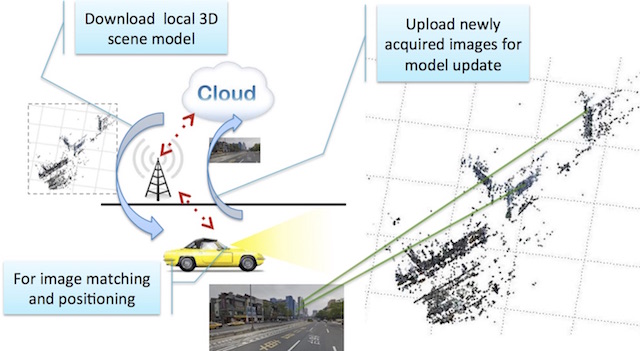
We presents an algorithm for ego-positioning by using a low-cost monocular camera for systems based on the Internet-of-Vehicles (IoV). To reduce the computational and memory requirements, as well as the communication load, we tackle the model compression task as a weighted k-cover problem for better preserving the critical structures. For real-world vision-based positioning applications, we consider the issue of large scene changes and introduce a model update algorithm to address this problem. A large positioning dataset containing data collected for more than a month, 106 sessions, and 14,275 images is constructed. Extensive experimental results show that sub- meter accuracy can be achieved by the proposed ego-positioning algorithm, which outperforms existing vision-based approaches.
Overview of the algorithm
(a) training phase: images from passing vehicles are uploaded to a cloud server for model construction and compression;

(b) ego-positioning phase: SIFT features from images acquired on vehicles are matched against 3D models previously constructed for ego-positioning. In addition, the newly acquired images are used to update 3D models.
Result
Video on Youtube:http://www.youtube.com/embed/ZLjHGcqhbYA
Dataset
http://www.clarenceliang.com/dataset
Related Publications
[1] Kuan-Wen Chen, Chun-Hsin Wang, Xiao Wei, Qiao Liang, Ming-Hsuan Yang, Chu-Song Chen, and Yi-Ping Hung, “Vision-Based Positioning for Internet-of-Vehicles,” IEEE Transactions on Intelligent Transportation Systems, 2017.
[2] Kuan-Wen Chen, Chun-Hsin Wang, Xiao Wei, Qiao Liang, Ming-Hsuan Yang, Chu-Song Chen, and Yi-Ping Hung, “Vision-Based Positioning with Sub-meter Accuracy for Internet-of-Vehicles,” the 28th IPPR Conference on Computer Vision, Graphics, and Image Processing, Aug., 2015. (Best Paper Award)
Vision-Based Positioning for Internet-of-Vehicles的更多相关文章
- VIPS: a VIsion based Page Segmentation Algorithm
VIPS: a VIsion based Page Segmentation Algorithm VIPS: a VIsion based Page Segmentation Algorithm In ...
- Computer English Notes
Chapter 1 : About Computer Answer the following - Abbreviation LBS - Location-Based Services HTML - ...
- REST is not the Best for Micro-Services GRPC and Docker makes a compelling case
原文:https://hackernoon.com/rest-in-peace-grpc-for-micro-service-and-grpc-for-the-web-a-how-to-908cc05 ...
- 【AR实验室】ARToolKit之概述篇
0x00 - 前言 我从去年就开始对AR(Augmented Reality)技术比较关注,但是去年AR行业一直处于偶尔发声的状态,丝毫没有其"异姓同名"的兄弟VR(Virtual ...
- Socket网络编程一
1.Socket参数介绍 A network socket is an endpoint of a connection across a computer network. Today, most ...
- Python之路,Day8 - Python基础 面向对象高级进阶与socket基础
类的成员 类的成员可以分为三大类:字段.方法和属性 注:所有成员中,只有普通字段的内容保存对象中,即:根据此类创建了多少对象,在内存中就有多少个普通字段.而其他的成员,则都是保存在类中,即:无论对象的 ...
- Python之路第一课Day8--随堂笔记(socket 承接上节---网络编程)
本节内容 Socket介绍 Socket参数介绍 基本Socket实例 Socket实现多连接处理 通过Socket实现简单SSH 通过Socket实现文件传送 作业:开发一个支持多用户在线的FTP程 ...
- python走起之第八话
1. Socket介绍 概念 A network socket is an endpoint of a connection across a computer network. Today, mos ...
- Python学习路程day8
Socket语法及相关 socket概念 A network socket is an endpoint of a connection across a computer network. Toda ...
- 大规模视觉识别挑战赛ILSVRC2015各团队结果和方法 Large Scale Visual Recognition Challenge 2015
Large Scale Visual Recognition Challenge 2015 (ILSVRC2015) Legend: Yellow background = winner in thi ...
随机推荐
- Docker的学习笔记(开发的技术分享转发)
我的Docker学习记录一.安装dockeryum install -y docker-io二.使用docker1.下载镜像docker pull <image>2.查询镜像docker ...
- 牛客网Java刷题知识点之垃圾回收算法过程、哪些内存需要回收、被标记需要清除对象的自我救赎、对象将根据存活的时间被分为:年轻代、年老代(Old Generation)、永久代、垃圾回收器的分类
不多说,直接上干货! 首先,大家要搞清楚,java里的内存是怎么分配的.详细见 牛客网Java刷题知识点之内存的划分(寄存器.本地方法区.方法区.栈内存和堆内存) 哪些内存需要回收 其实,一般是对堆内 ...
- Fragment、Activity比较——Android碎片介绍
Fragment是Android honeycomb 3.0新增的概念,Fragment名为碎片不过却和Activity十分相似,下面介绍下Android Fragment的作用和用法.Fragmen ...
- CTSC/APIO2018 游记
狗牌滚粗选手,此博客证明我去过...... CTSC 消失的源代码与消失的分数...... 我也不知道发生了什么....... APIO 旁边两位小哥太强了,心态完全炸裂,最后也滚粗了...... 回 ...
- 深入理解JavaScript系列(29):设计模式之装饰者模式
介绍 装饰者提供比继承更有弹性的替代方案. 装饰者用用于包装同接口的对象,不仅允许你向方法添加行为,而且还可以将方法设置成原始对象调用(例如装饰者的构造函数). 装饰者用于通过重载方法的形式添加新功能 ...
- Java 获取当前时间距离当天凌晨的秒数
原文出自:https://blog.csdn.net/seesun2012 在前期项目中遇到一个客户端与服务器间的时间同步问题,需要获取到当前时间与当天凌晨时间距离的秒数,写这篇文章主要是为了总结一下 ...
- C#程序执行时间
Stopwatch类 using System.Diagnostics; static void Main(string[] args) { Stopwatch stopWatch = new Sto ...
- Observer(观察者)设计模式[转]
Observer设计模式中主要包括如下两类对象: Subject:监视对象,它往往包含着其他对象所感兴趣的内容.在本范例中,热水器就是一个监视对象,它包含的其他对象所感兴趣的内容,就是tempratu ...
- js 匹配中文字符串(也包含日文和韩文)
<script> var str="payTypeNam门诊账户\n\t"; document.write(str.match(/[\u4E00-\u9FA5\uF90 ...
- 运行jsp时,报错404
The origin server did not find a current reprsentation for the target resource or is not willing to ...