
201871010113-刘兴瑞《面向对象程序设计(java)》第十七周学习总结
|
项目 |
内容 |
|
这个作业属于哪个课程 |
<任课教师博客主页链接>https://www.cnblogs.com/nwnu-daizh/ |
|
这个作业的要求在哪里 |
<作业链接地址>https://www.cnblogs.com/nwnu-daizh/p/12073034.html |
|
作业学习目标 |
(1) 理解和掌握线程的优先级属性及调度方法; (2) 掌握线程同步的概念及实现技术; (3) Java线程综合编程练习 |
第一部分:总结线程同步技术
1.Java通过多线程的并发运行提高系统资源利用率,改善系统性能。
2.假设有两个或两个以上的线程共享 某个对象,每个线程都调用了改变该对象类状态的方法,就会引起的不确定性。
3.多线程并发执行中的问题
◆多个线程相对执行的顺序是不确定的。
◆线程执行顺序的不确定性会产生执行结果的不确定性。
◆在多线程对共享数据操作时常常会产生这种不确定性。
4.多线程并发运行不确定性问题解决方案:引入线程同步机制。
5.(1)锁对象与条件对象
用ReentrantLock保护代码块的基本结构如下:
myLock.lock();
try { critical section }
finally{
myLock.unlock();
}
(2)synchronized关键字
synchronized关键字作用:
➢ 某个类内方法用synchronized 修饰后,该方 法被称为同步方法;
➢ 只要某个线程正在访问同步方法,其他线程 欲要访问同步方法就被阻塞,直至线程从同 步方法返回前唤醒被阻塞线程,其他线程方 可能进入同步方法。
第二部分:实验部分
1、实验目的与要求
(1) 掌握线程同步的概念及实现技术;
(2) 线程综合编程练习
2、实验内容和步骤
实验1:测试程序并进行代码注释。
测试程序1:
l 在Elipse环境下调试教材651页程序14-7,结合程序运行结果理解程序;
l 掌握利用锁对象和条件对象实现的多线程同步技术。
实验代码注释如下:
Bank.java:
package synch;

import java.util.*;

import java.util.concurrent.locks.*;

/**

 * A bank with a number of bank accounts that uses locks for serializing access.

 * @version 1.30 2004-08-01

 * @author Cay Horstmann

 */

public class Bank

{

   private final double[] accounts;

   private Lock bankLock;

   private Condition sufficientFunds;

   /**

    * Constructs the bank.

    * @param n the number of accounts

    * @param initialBalance the initial balance for each account

    */

   public Bank(int n, double initialBalance)

   {

      accounts = new double[n];

      Arrays.fill(accounts, initialBalance);

      bankLock = new ReentrantLock();

      sufficientFunds = bankLock.newCondition();//在等待条件前,锁必须由当前线程保持。

   }

   /**

    * Transfers money from one account to another.

    * @param from the account to transfer from

    * @param to the account to transfer to

    * @param amount the amount to transfer

    */

   public void transfer(int from, int to, double amount) throws InterruptedException

   {

      bankLock.lock();//获取锁

      try

      {

         while (accounts[from] < amount)

            sufficientFunds.await();//造成当前线程在接到信号或被中断之前一直处于等待状态。

         System.out.print(Thread.currentThread());

         accounts[from] -= amount;

         System.out.printf(" %10.2f from %d to %d", amount, from, to);

         accounts[to] += amount;

         System.out.printf(" Total Balance: %10.2f%n", getTotalBalance());

         sufficientFunds.signalAll();//如果所有的线程都在等待此条件,则唤醒所有线程

      }

      finally

      {

         bankLock.unlock();//释放锁。

      }

   }

   /**

    * Gets the sum of all account balances.

    * @return the total balance

    */

   public double getTotalBalance()

   {

      bankLock.lock();

      try

      {

         double sum = 0;

         for (double a : accounts)

            sum += a;

         return sum;

      }

      finally

      {

         bankLock.unlock();

      }

   }

   /**

    * Gets the number of accounts in the bank.

    * @return the number of accounts

    */

   public int size()

   {

      return accounts.length;

   }

}
SynchBankTest.java:
package synch;

/**

 * This program shows how multiple threads can safely access a data structure.

 * @version 1.31 2015-06-21

 * @author Cay Horstmann

 */

public class SynchBankTest

{

   public static final int NACCOUNTS = 100;

   public static final double INITIAL_BALANCE = 1000;

   public static final double MAX_AMOUNT = 1000;

   public static final int DELAY = 10;

   public static void main(String[] args)

   {

      Bank bank = new Bank(NACCOUNTS, INITIAL_BALANCE);

      for (int i = 0; i < NACCOUNTS; i++)

      {

         int fromAccount = i;

         Runnable r = () -> {

            try

            {

               while (true)

               {

                  int toAccount = (int) (bank.size() * Math.random());

                  double amount = MAX_AMOUNT * Math.random();

                  bank.transfer(fromAccount, toAccount, amount);

                  Thread.sleep((int) (DELAY * Math.random()));

               }

            }

            catch (InterruptedException e)

            {

            }

         };

         Thread t = new Thread(r);

         t.start();

      }

   }

}
运行结果如下:

测试程序2:
l 在Elipse环境下调试教材655页程序14-8,结合程序运行结果理解程序;
l 掌握synchronized在多线程同步中的应用。
实验代码注释如下:
Bank.java:
package synch2;

import java.util.*;

/**

 * A bank with a number of bank accounts that uses synchronization primitives.

 * @version 1.30 2004-08-01

 * @author Cay Horstmann

 */

public class Bank

{

   private final double[] accounts;

   /**

    * Constructs the bank.

    * @param n the number of accounts

    * @param initialBalance the initial balance for each account

    */

   public Bank(int n, double initialBalance)

   {

      accounts = new double[n];

      Arrays.fill(accounts, initialBalance);

   }

   /**

    * Transfers money from one account to another.

    * @param from the account to transfer from

    * @param to the account to transfer to

    * @param amount the amount to transfer

    */

   public synchronized void transfer(int from, int to, double amount) throws InterruptedException

   {

      while (accounts[from] < amount)

         wait();//在其他线程调用此对象的 notify() 方法或 notifyAll() 方法前,导致当前线程等待

      System.out.print(Thread.currentThread());

      accounts[from] -= amount;

      System.out.printf(" %10.2f from %d to %d", amount, from, to);

      accounts[to] += amount;

      System.out.printf(" Total Balance: %10.2f%n", getTotalBalance());

      notifyAll();//唤醒在此对象监视器上等待的所有线程

   }

   /**

    * Gets the sum of all account balances.

    * @return the total balance

    */

   public synchronized double getTotalBalance()

   {

      double sum = 0;

      for (double a : accounts)

         sum += a;

      return sum;

   }

   /**

    * Gets the number of accounts in the bank.

    * @return the number of accounts

    */

   public int size()

   {

      return accounts.length;

   }

}
SynchBankTest2.java:
package synch2;

/**

 * This program shows how multiple threads can safely access a data structure,

 * using synchronized methods.

 * @version 1.31 2015-06-21

 * @author Cay Horstmann

 */

public class SynchBankTest2

{

   public static final int NACCOUNTS = 100;

   public static final double INITIAL_BALANCE = 1000;

   public static final double MAX_AMOUNT = 1000;

   public static final int DELAY = 10;

   public static void main(String[] args)

   {

      Bank bank = new Bank(NACCOUNTS, INITIAL_BALANCE);

      for (int i = 0; i < NACCOUNTS; i++)

      {

         int fromAccount = i;

         Runnable r = () -> {

            try

            {

               while (true)

               {

                  int toAccount = (int) (bank.size() * Math.random());

                  double amount = MAX_AMOUNT * Math.random();

                  bank.transfer(fromAccount, toAccount, amount);

                  Thread.sleep((int) (DELAY * Math.random()));

               }

            }

            catch (InterruptedException e)

            {

            }

         };

         Thread t = new Thread(r);

         t.start();

      }

   }

}
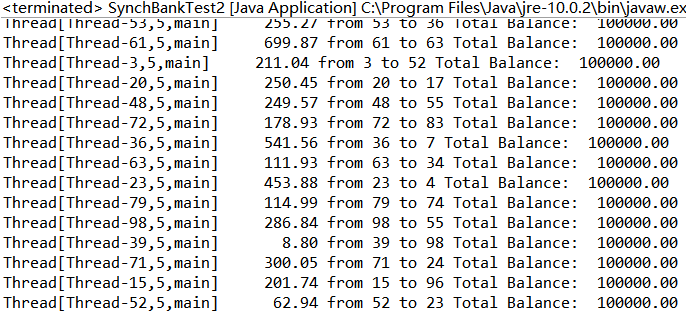
代码运行结果如下:
测试程序3:
l 在Elipse环境下运行以下程序,结合程序运行结果分析程序存在问题;
l 尝试解决程序中存在问题。
package a;

class Cbank

{

     private static int s=2000;

     public   static void sub(int m)

     {

           int temp=s;

           temp=temp-m;

          try {

   			  Thread.sleep((int)(1000*Math.random()));

   			}

           catch (InterruptedException e)  {              }

    	      s=temp;

    	      System.out.println("s="+s);

  		}

	}

class Customer extends Thread

{

  public void run()

  {

   for( int i=1; i<=4; i++)

     Cbank.sub(100);

    }

 }

public class Thread3

{

 public static void main(String args[])

  {

   Customer customer1 = new Customer();

   Customer customer2 = new Customer();

   customer1.start();

   customer2.start();

  }

}
代码运行结果如图:

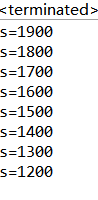
运行结果显示两个线程各自运行各自的:并没有实现需要的两个线程一起每次减一百,减八次。
修改代码如下:
class Cbank

{

    private static int s=2000;

    public synchronized static void sub(int m)

    {

        int temp=s;

        temp=temp-m;

        try {

            Thread.sleep((int)(1000*Math.random()));

        } catch (InterruptedException e) {              }

            s=temp;

            System.out.println("s="+s);

    }

}

class Customer extends Thread

{

    public void run()

    {

        for(int i=1;i<=4;i++)

            Cbank.sub(100);

    }

}

public class Thread3 {

    public static void main(String args[])

    {

        Customer customer1 = new Customer();

        Customer customer2 = new Customer();

        customer1.start();

        customer2.start();

    }

}
运行结果如下:
实验2:结对编程练习包含以下4部分(10分)
1) 程序设计思路简述;
2) 符合编程规范的程序代码;
3) 程序运行功能界面截图;
利用多线程及同步方法,编写一个程序模拟火车票售票系统,共3个窗口,卖10张票,程序输出结果类似(程序输出不唯一,可以是其他类似结果)。
Thread-0窗口售:第1张票
Thread-0窗口售:第2张票
Thread-1窗口售:第3张票
Thread-2窗口售:第4张票
Thread-2窗口售:第5张票
Thread-1窗口售:第6张票
Thread-0窗口售:第7张票
Thread-2窗口售:第8张票
Thread-1窗口售:第9张票
Thread-0窗口售:第10张票
代码如下:
import javax.swing.plaf.SliderUI;

public class shou {

public static void main(String[] args) {

 Mythread mythread=new Mythread();

 Thread t1=new Thread(mythread);

 Thread t2=new Thread(mythread);

 Thread t3=new Thread(mythread);

 t1.start();

 t2.start();

 t3.start();

}

}

 /*

    new Thread() {

        @Override

        public void run() {

            System.out.println();

    };

}.start();

}

}*/

class Mythread implements Runnable{

int t=1;

boolean flag=true;

    @Override

    public void run() {

        while(flag) {

            try {

            Thread.sleep(500);

            }

            catch (InterruptedException e) {

                // TODO: handle exception

                e.printStackTrace();

            }

            synchronized (this) {

            if(t<=10) {

                System.out.println(Thread.currentThread().getName()+"窗口售:第"+t+"张票");

                t++;

            }

            if(t<0) {

                flag=false;

            }

        }

    }

    }

}
运行结果如图:

实验总结; 这周继续学习了有关线程的知识,主要学习了有关线程同步的问题。线程同步主要是为了解决多线程并发运行不确定性问题,使得多个线程中在一个线程使用某种方法时候,另一线程要使用该方法,就只能等待。实验课上,老师和学长通过演示具体的例子给我们展现了多线程中在不加锁时会出现的情况,让我们对线程同步有了更加清晰地认识。虽然很多地方还是不太懂还是存在很大的问题,但是实验课上讲的内容听得比较清晰,课后自己再运行试验时也有了更深的体会。通过本学期的学习,由刚开始的新手小白,对Java一无所知,到通过大量的练习慢慢对Java编程有所熟悉,虽然现在还不是很熟练,但在课程结束后仍需继续关注学习Java的知识及编程。
201871010113-刘兴瑞《面向对象程序设计(java)》第十七周学习总结的更多相关文章
- 201771010134杨其菊《面向对象程序设计java》第九周学习总结
第九周学习总结 第一部分:理论知识 异常.断言和调试.日志 1.捕获 ...
- 201871010132-张潇潇《面向对象程序设计(java)》第一周学习总结
面向对象程序设计(Java) 博文正文开头 项目 内容 这个作业属于哪个课程 https://www.cnblogs.com/nwnu-daizh/ 这个作业的要求在哪里 https://www.cn ...
- 扎西平措 201571030332《面向对象程序设计 Java 》第一周学习总结
<面向对象程序设计(java)>第一周学习总结 正文开头: 项目 内容 这个作业属于哪个课程 https://www.cnblogs.com/nwnu-daizh/ 这个作业的要求在哪里 ...
- 杨其菊201771010134《面向对象程序设计Java》第二周学习总结
第三章 Java基本程序设计结构 第一部分:(理论知识部分) 本章主要学习:基本内容:数据类型:变量:运算符:类型转换,字符串,输入输出,控制流程,大数值以及数组. 1.基本概念: 1)标识符:由字母 ...
- 201871010124 王生涛《面向对象程序设计JAVA》第一周学习总结
项目 内容 这个作业属于哪个课程 https://www.cnblogs.com/nwnu-daizh/ 这个作业的要求在哪里 https://edu.cnblogs.com/campus/xbsf/ ...
- 201871010115——马北《面向对象程序设计JAVA》第二周学习总结
项目 内容 这个作业属于哪个课程 https://www.cnblogs.com/nwnu-daizh/ 这个作业的要求在哪里 https://www.cnblogs.com/nwnu-daizh/p ...
- 201777010217-金云馨《面向对象程序设计(Java)》第二周学习总结
项目 内容 这个作业属于哪个课程 https://www.cnblogs.com/nwnu-daizh/ 这个作业的要求在哪里 https://www.cnblogs.com/nwnu-daizh/p ...
- 201871010132——张潇潇《面向对象程序设计JAVA》第二周学习总结
项目 内容 这个作业属于哪个课程 https://www.cnblogs.com/nwnu-daizh/ 这个作业的要求在哪里 https://www.cnblogs.com/nwnu-daizh/p ...
- 201771010123汪慧和《面向对象程序设计Java》第二周学习总结
一.理论知识部分 1.标识符由字母.下划线.美元符号和数字组成, 且第一个符号不能为数字.标识符可用作: 类名.变量名.方法名.数组名.文件名等.第二部分:理论知识学习部分 2.关键字就是Java语言 ...
- 马凯军201771010116《面向对象与程序设计Java》第九周学习总结
一.理论知识部分 异常.日志.断言和调试 1.异常:在程序的执行过程中所发生的异常事件,它中断指令的正常执行. 2.Java的异常处理机制可以控制程序从错误产生的位置转移到能够进行错误处理的位置. 3 ...
随机推荐
- 回归损失函数2 : HUber loss,Log Cosh Loss,以及 Quantile Loss
均方误差(Mean Square Error,MSE)和平均绝对误差(Mean Absolute Error,MAE) 是回归中最常用的两个损失函数,但是其各有优缺点.为了避免MAE和MSE各自的优缺 ...
- 什么是jsp(java server pages)
JSP是一种运行在服务器端的脚本语言,是用来开发动态网页的技术,它是JAVA Web 程序开发的重要技术.本章介绍JSP技术的相关概念以及如何开发JSP程序,主要内容包括JSP技术简介.JSP的处理过 ...
- 数组(Array)和列表(ArrayList)有什么区别?什么时候应该使用Array而不是ArrayList?
下面列出了Array和ArrayList的不同点:Array可以包含基本类型和对象类型,ArrayList只能包含对象类型.Array大小是固定的,ArrayList的大小是动态变化的.ArrayLi ...
- Appium移动端自动化测试--控件定位方法
常用定位手段 id Accessibility ID XPath 控件基础知识 DOM: Document Object Model文档对象模型 DOM应用:最早应用于HTML和Javascript的 ...
- webpack学习2.3webpack核心概念
核心概念(四个) Entry(入口) Output(出口) Loaders()来处理其他类型的资源文件 Plugins(插件) 1.入口(Entry) 作用:代码的入口,打包的入口,单个或多个, 示例 ...
- poj 3279 Fliptile (简单搜索)
Fliptile Time Limit: 2000MS Memory Limit: 65536K Total Submissions: 16558 Accepted: 6056 Descrip ...
- spf13-vim 显示neocomplete requires ...th Lua support
安装spf13-vim的时候下载了许多插件,neocomplete应该是比较重要的一个,毕竟自动补全.但是在使用时却一直有:neocomplete requires ...th Lua support ...
- 基于 TrueLicense 的项目证书验证
一.简述 开发的软件产品在交付使用的时候,往往有一段时间的试用期,这期间我们不希望自己的代码被客户二次拷贝,这个时候 license 就派上用场了,license 的功能包括设定有效期.绑定 ip.绑 ...
- Maven pom.xml 全配置(一)常用配置
Maven pom.xml 全配置(一)常用配置 这里贴出一个Maven中出现频率较高的配置参数注释,方便理解项目中Maven的配置具体的作用.如果在此博文中没有找到你想看到的参数,可以移步Maven ...
- Java并发之synchronized关键字深度解析(二)
前言 本文继续[Java并发之synchronized关键字深度解析(一)]一文而来,着重介绍synchronized几种锁的特性. 一.对象头结构及锁状态标识 synchronized关键字是如何实 ...