
The .NET of Tomorrow
Ed Charbeneau(http://developer.telerik.com/featured/the-net-of-tomorrow/)
Exciting times lie ahead for .NET developers. During Build, Microsoft’s biggest developer event of the year, clear roadmaps were given on the future of .NET and C#. Microsoft is re-positioning .NET to be a platform that can be written anywhere and run anywhere, which is a departure from it’s long history of proprietary technologies.
Frameworks and Libraries
.NET TODAY
.NET TOMORROW
The Language of the Future is C#
ROSLYN
Conclusion
Microsoft is also reinventing itself in other ways too, like its developer tooling and the way it communicates with developers in general. This more open nature of Microsoft has even started to win over even the most skeptical of developers, such as my co-worker Cody Lindley, which you can see in his latest article, “What Has Microsoft Done For You Lately?”.
So what does all this mean for .NET developers? A well thought-out roadmap from Microsoft showing the strategy for the future of .NET. In this post, we’ll take a look at what that roadmap is.
Frameworks and Libraries
The state of .NET today is a little scattered. Restructuring projects always seem to make them worse before they get better, and this is no different. The road ahead has been a bit fuzzy since the introduction of .NET Core and perhaps got a little fuzzier with the recent announcement adding Xamarin to the mix.
While these are exciting times, they are unclear and uncertain for developers.
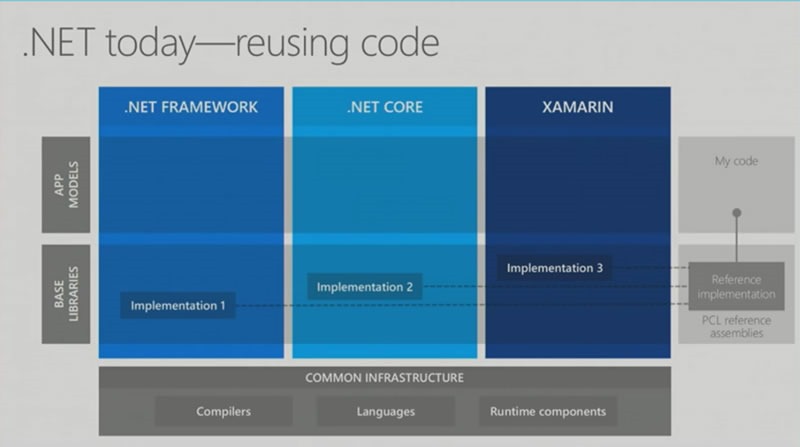
.NET TODAY
With the current structure of .NET, creating code that spans across different Microsoft platforms means working with portable class libraries (PCL). The PCL has shared functionality, but is very limited when compared to the .NET framework and understanding how the PCL is supported on various platforms is less than straightforward. In addition, working across the complete .NET ecosystem means working with up to three different base libraries: Base Class Library (.NET Framework), .NET Core, and Mono Class Library (Xamarin). Developer fatigue really begins to set in when trying to grasp which APIs are available for a given scenario.
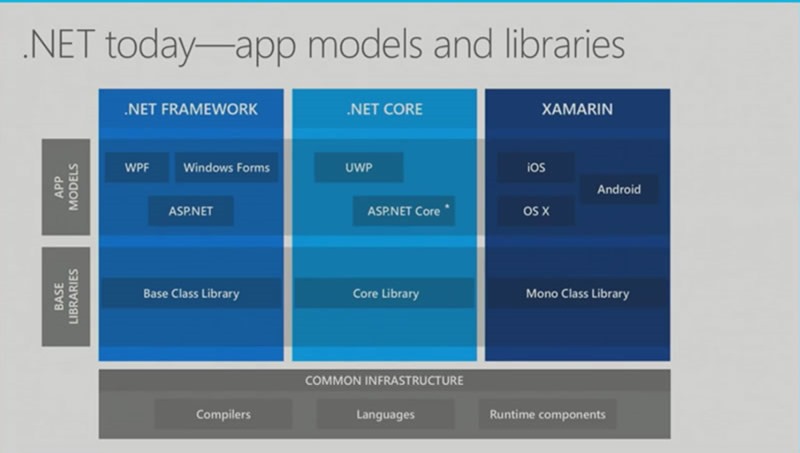
.NET TOMORROW
Thankfully Microsoft understands the issue at hand and has a clear vision of how .NET things will work in the .NET of tomorrow. A big part of this strategy is to deprecate the PCL and replace it with a contract for common API support. This new contract will be called the .NET Standard Library. The .NET Standard Library will also include a specific set of reference assemblies that all .NET Platforms must support, known as the .NET Platform Standard.
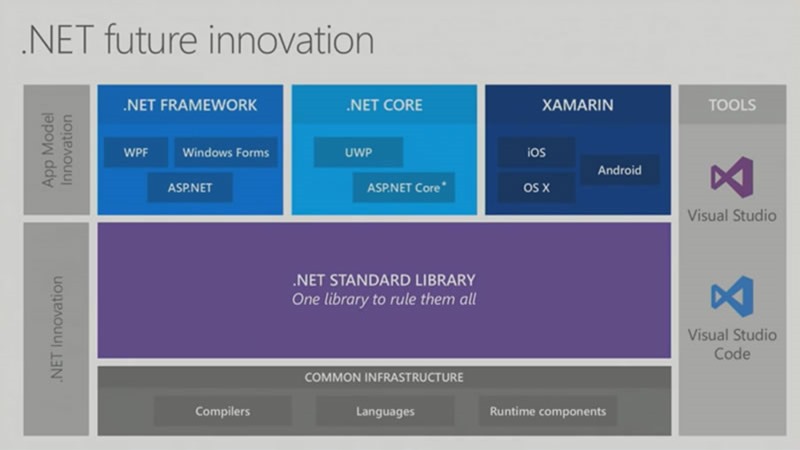
The .NET Standard Library decouples the application models from the base libraries and tooling. This decoupled scenario allows for better code reuse and a shorter learning curve. Having a decoupled approach also means that the .NET Standard Library can be updated with less friction (aka breaking changes), this will mean more innovation at a faster pace. As the .NET Standard Library API surface increases with newer versions, some platforms will be left behind and become legacy. The upside is that new and yet to be created platforms have a clear foundation to build upon.
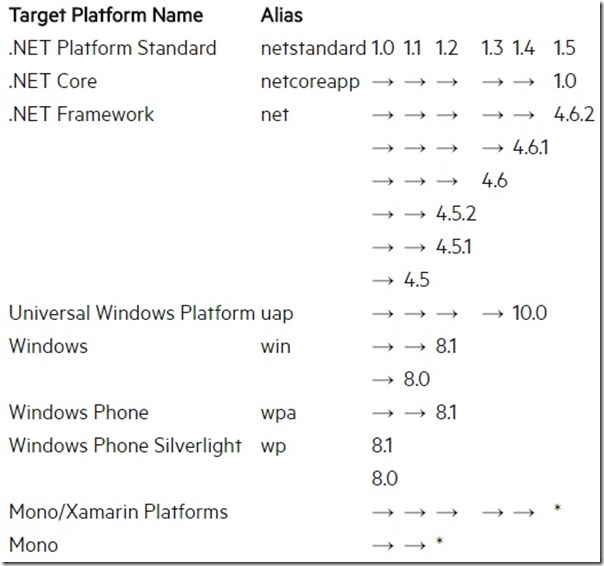
With the following table it’s easy to see that an ASP.NET Core 1.0 application has access to the full .NET Platform Standard version 1.5 APIs. In the same regard, Windows Phone 8.1 would not have access to APIs added to the standard after version 1.2.
The Language of the Future is C#
Since C# is the most popular language in .NET, it’s necessary to include it in the conversation. While C# is a very mature language, it has an exciting future as well. Much like the .NET framework, C# is being developed as an open source project. Now that C# is open source, its development will be visible to the public, including the roadmap.
Much like with the .NET Standard Library, Microsoft is promising a faster release cycle with C#. These out-of-band releases will include new language features to further enhance an already robust and mature language. In future releases we’ll see some interesting new ways for developers to write C#.
Local functions will allow functions inside of methods that will have access to variables in scope.
Tuples let functions return multiple results. The results can be named so that the code remains readable.
1: //Local function and Tuples preview
2: static void Main(string[] args)
3: {4: int[] numbers = { 1,2,3,4,5 };5:
6: // Local function
7: (int sum, int count) Tally(IEnumerable list)
8: {9: var r = (s: 0, c: 0);
10: foreach (var v in list)
11: {12: r.s += v; r.c++;
13: }
14: return r; // return Tuple of (int:sum, int:count)
15: }
16:
17: var t = Tally(numbers);
18: WriteLine($"Sum: {t.sum}, Count {t.count}"); // => Sum: 15, Count: 519:
20: }
Pattern matching extensions for C# enable many of the benefits of algebraic data types and pattern matching from functional languages, but in a way that smoothly integrates with the feel of the underlying language. Pattern matching is able to switch on the type of data and offers greater flexibility when working with non-primitive data types.
1: // pattern matching in C#
2: var people = {3: new Student("Dustin", "Campbell", 195434) { Grades = { 4.0m, 4.0m, 3.9m, 4.0m, 3.8m, 4.0m }},4: new Student("Mads", "Torgersen", 193845) { Grades = { 2.0m, 2.4m, 3.4m, 1.8m, 3.9m, 0.2m }},5: new Student("David", "Stephens", 230954) { Grades = { }},6: new Professor("Anders", "Hejlsberg", "Programming languages"),7: new Professor("Scott", "Guthrie", "Clouds"),8: new Professor("Scott", "Hunter", ".NET")9: };
10:
11: foreach (var p in people)
12: {13: if (p is Professor { Subject is var s, FirstName is "Scott"})14: {15: WriteLine($"One of the Scotts is teaching {s}");16: }
17: if (p is Student { FirstName is var n, Gpa is decimal g})18: {19: WriteLine($"{n} has a GPA of {g}:N2");20: }
21: }
Immutable objects are a feature being discussed for beyond C# 7. Immutable objects are an explicit shorthand way of writing immutable classes with the added benefit of the compiler being able to identify them as immutable.
1: // new up an immutable object
2: var p1 = new Point { X = 3, Y = 7 };3:
4: // copy p1 to p2 with an X value of negative p1's X value.
5: var p2 = p1 with { X = -p1.X }; //=> { X = -3, Y = 7 }
ROSLYN
The write anywhere run everywhere strategy of .NET is really apparent with C#. Because of Roslyn, the cross platform compiler as a service, C# can be written and run on any platform. Roslyn enables C# to run in IDEs and editors and opens the door to support from any linter, refactoring tool, and code generation tooling. In the future, expect to see more uses for C# in more places.
Conclusion
.NET is always changing and improving as a platform. Because of the sheer amount of changes happening and the speed at which they are delivered, expect some difficulties along the way. However, gone are the days of Microsoft secrecy, so enjoy the new open development process and transparent roadmaps that have been outlined. There’s an exciting future ahead for .NET, it’s cross platform, open source, and full of features one would expect from a modern set of tools and languages.
随机推荐
- 【原】FMDB源码阅读(三)
[原]FMDB源码阅读(三) 本文转载请注明出处 —— polobymulberry-博客园 1. 前言 FMDB比较优秀的地方就在于对多线程的处理.所以这一篇主要是研究FMDB的多线程处理的实现.而 ...
- 简单有效的kmp算法
以前看过kmp算法,当时接触后总感觉好深奥啊,抱着数据结构的数啃了一中午,最终才大致看懂,后来提起kmp也只剩下“奥,它是做模式匹配的”这点干货.最近有空,翻出来算法导论看看,原来就是这么简单(先不说 ...
- Angular企业级开发(4)-ngResource和REST介绍
一.RESTful介绍 RESTful维基百科 REST(表征性状态传输,Representational State Transfer)是Roy Fielding博士在2000年他的博士论文中提出来 ...
- 挑子学习笔记:特征选择——基于假设检验的Filter方法
转载请标明出处: http://www.cnblogs.com/tiaozistudy/p/hypothesis_testing_based_feature_selection.html Filter ...
- ASP.Net MVC4+Memcached+CodeFirst实现分布式缓存
ASP.Net MVC4+Memcached+CodeFirst实现分布式缓存 part 1:给我点时间,允许我感慨一下2016年 正好有时间,总结一下最近使用的一些技术,也算是为2016年画上一个完 ...
- spring applicationContext.xml和hibernate.cfg.xml设置
applicationContext.xml配置 <?xml version="1.0" encoding="UTF-8"?> <beans ...
- 使用github远程仓库
经过几天对github的研究,终于把自己想完成的给解决了,发现google真的有很多解释,但是很多也会出现一些bug,对于初学者真的很多烦恼,所以整理一份,能给初识github的你有所帮助 一,首先, ...
- Flexible 弹性盒子模型之CSS flex-flow
实例 让弹性盒的元素以相反的顺序显示,且在必要的时候进行拆行: display:flex; flex-flow:row-reverse wrap; 效果预览 浏览器支持 表格中的数字表示支持该属性 ...
- 【SAP业务模式】之ICS(七):IDOC配置
这是ICS业务模式系列的最后一篇了,主要讲解IDOC的配置. 一.指定EDI传输的供应商逻辑地址 事务代码:WEL1 注意:上面逻辑地址是生产公司+内部客户.有以下两种情形: 1.如果内部客户都是纯数 ...
- Jenkins的一个bug-同时build一个项目两次导致失败
我们有一个job A, A只是配置了一些参数,它会去触发模板job B. 我一开始点击构建A, 马上发现参数配置不对,于是撤消了构建,但是我没有发现B已经被触发,我重新配置参数,然后再次构建A,这个时 ...