
Multivariate Linear Regression
Multiple Features

Linear regression with multiple variables is also known as "multivariate linear regression".
We now introduce notation for equations where we can have any number of input variables.

The multivariable form of the hypothesis function accommodating these multiple features is as follows:

In order to develop intuition about this function, we can think about θ0 as the basic price of a house, θ1 as the price per square meter, θ2 as the price per floor, etc. x1 will be the number of square meters in the house, x2 the number of floors, etc.
Using the definition of matrix multiplication, our multivariable hypothesis function can be concisely represented as:

This is a vectorization of our hypothesis function for one training example; see the lessons on vectorization to learn more.
Remark: Note that for convenience reasons in this course we assume  .This allows us to do matrix operations with theta and x. Hence making the two vectors 'θ' and
  match each other element-wise (that is, have the same number of elements: n+1).]
Gradient Descent For Multiple Variables
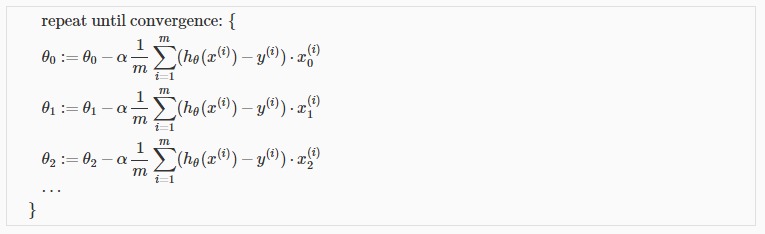
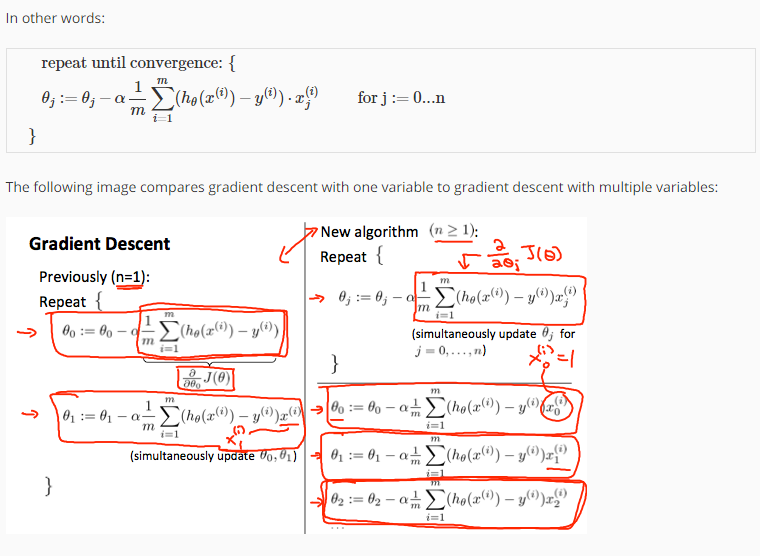
The gradient descent equation itself is generally the same form; we just have to repeat it for our 'n' features:
Gradient Descent in Practice I - Feature Scaling
Note: [6:20 - The average size of a house is 1000 but 100 is accidentally written instead]
We can speed up gradient descent by having each of our input values in roughly the same range. This is because θ will descend quickly on small ranges and slowly on large ranges, and so will oscillate inefficiently down to the optimum when the variables are very uneven.
The way to prevent this is to modify the ranges of our input variables so that they are all roughly the same. Ideally:
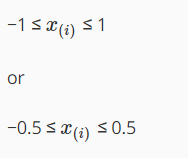
These aren't exact requirements; we are only trying to speed things up. The goal is to get all input variables into roughly one of these ranges, give or take a few.
Two techniques to help with this are feature scaling and mean normalization. Feature scaling involves dividing the input values by the range (i.e. the maximum value minus the minimum value) of the input variable, resulting in a new range of just 1. Mean normalization involves subtracting the average value for an input variable from the values for that input variable resulting in a new average value for the input variable of just zero. To implement both of these techniques, adjust your input values as shown in this formula:
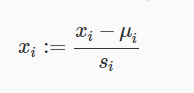
Where  is the average of all the values for feature (i) and s_i is the range of values (max - min), or s_i is the standard deviation.
Note that dividing by the range, or dividing by the standard deviation, give different results. The quizzes in this course use range - the programming exercises use standard deviation.
For example, if x_i represents housing prices with a range of 100 to 2000 and a mean value of 1000, then, x_i := \dfrac{price-1000}{1900}.
Gradient Descent in Practice II - Learning Rate
Note: [5:20 - the x -axis label in the right graph should be θ rather than No. of iterations ]
Debugging gradient descent. Make a plot with number of iterations on the x-axis. Now plot the cost function, J(θ) over the number of iterations of gradient descent. If J(θ) ever increases, then you probably need to decrease α.
Automatic convergence test. Declare convergence if J(θ) decreases by less than E in one iteration, where E is some small value such as 10−3. However in practice it's difficult to choose this threshold value.

It has been proven that if learning rate α is sufficiently small, then J(θ) will decrease on every iteration.

To summarize:
If α is too small: slow convergence.
If α is too large: may not decrease on every iteration and thus may not converge.
Features and Polynomial Regression
We can improve our features and the form of our hypothesis function in a couple different ways.
We can combine multiple features into one. For example, we can combine x1 and x2 into a new feature x3 by taking x1⋅x2.
Polynomial Regression
Our hypothesis function need not be linear (a straight line) if that does not fit the data well.
We can change the behavior or curve of our hypothesis function by making it a quadratic, cubic or square root function (or any other form).
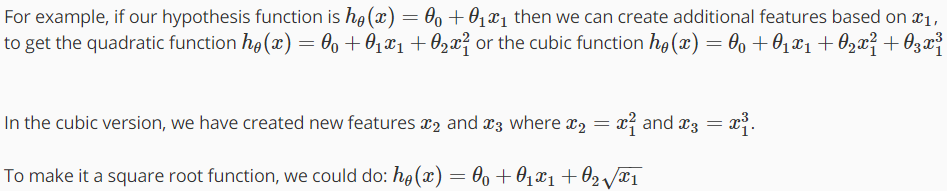
One important thing to keep in mind is, if you choose your features this way then feature scaling becomes very important.

Multivariate Linear Regression的更多相关文章
- Machine Learning - week 2 - Multivariate Linear Regression
Multiple Features 上一章中,hθ(x) = θ0 + θ1x,表示只有一个 feature.现在,有多个 features,所以 hθ(x) = θ0 + θ1x1 + θ2x2 + ...
- 多元线性回归(Multivariate Linear Regression)简单应用
警告:本文为小白入门学习笔记 数据集: http://openclassroom.stanford.edu/MainFolder/DocumentPage.php?course=DeepLearnin ...
- Machine Learning – 第2周(Linear Regression with Multiple Variables、Octave/Matlab Tutorial)
Machine Learning – Coursera Octave for Microsoft Windows GNU Octave官网 GNU Octave帮助文档 (有900页的pdf版本) O ...
- 【转】Derivation of the Normal Equation for linear regression
I was going through the Coursera "Machine Learning" course, and in the section on multivar ...
- 机器学习---线性回归(Machine Learning Linear Regression)
线性回归是机器学习中最基础的模型,掌握了线性回归模型,有利于以后更容易地理解其它复杂的模型. 线性回归看似简单,但是其中包含了线性代数,微积分,概率等诸多方面的知识.让我们先从最简单的形式开始. 一元 ...
- Andrew Ng Machine Learning 专题【Linear Regression】
此文是斯坦福大学,机器学习界 superstar - Andrew Ng 所开设的 Coursera 课程:Machine Learning 的课程笔记. 力求简洁,仅代表本人观点,不足之处希望大家探 ...
- CheeseZH: Stanford University: Machine Learning Ex1:Linear Regression
(1) How to comput the Cost function in Univirate/Multivariate Linear Regression; (2) How to comput t ...
- Coursera machine learning 第二周 quiz 答案 Linear Regression with Multiple Variables
https://www.coursera.org/learn/machine-learning/exam/7pytE/linear-regression-with-multiple-variables ...
- Multivariate Adaptive Regression Splines (MARSplines)
Introductory Overview Regression Problems Multivariate Adaptive Regression Splines Model Selection a ...
随机推荐
- 如何优雅的写UI——(6)内存泄漏
控件讲了这么久,其实我的程序有两个Bug不知道大家有没有发现,这两个Bug都不会报错,对程序运行来说都没有阻碍,但是这种Bug对整个代码来说是一个很大的安全隐患. 什么是内存泄漏 内存泄漏(Memor ...
- 项目EasyUi和JS中遇到的问题总汇
近期因为项目用到EasyUi,曾经仅仅是听过,可是没有详细用过.仅仅能一边学一边做.如今将做的过程中遇到的一些难点总结例如以下,以备后用: EsayUi使用: Json格式:key:value,key ...
- Java7与G1
Lucene 4.8開始不支持java6了,所以在下次版本号升级之前我们要先升级至java7. 我使用1/3的全量索引(7.3G).进行測试,20并发,40万请求: sun jdk 1.6.0_26 ...
- apache 使用 mod_fcgid.so模块时 配置指令
FcgidBusyScanInterval指令 说明:扫描繁忙超时进程的间隔 语法: FcgidBusyScanInterval seconds 默认:FcgidBusyScanInterval 12 ...
- 38..Node.js工具模块---底层的网络通信--Net模块
转自:http://www.runoob.com/nodejs/nodejs-module-system.html Node.js Net 模块提供了一些用于底层的网络通信的小工具,包含了创建服务器/ ...
- 1.18 Python基础知识 - Python内置函数
官方地址:https://docs.python.org/3.5/library/functions.html abs(x): 返回数字的绝对值 all(iterable): 如果迭代器的所有元素都为 ...
- Linux桌面新彩虹-Fedora 14 炫酷应用新体验
Linux桌面新彩虹 --Fedora 14 炫酷应用新体验 650) this.width=650;" hspace="12" align="left&quo ...
- 自定义HTML标签属性
为HTML元素添加一自定义的属性非常方便,只须将其加到尖括号中即可,与内置属性地位相等. 如我们要为TextBox元素添加属性idvalue: <input type="text&qu ...
- LOJ 6229 LCM / GCD (杜教筛+Moebius)
链接: https://loj.ac/problem/6229 题意: \[F(n)=\sum_{i=1}^n\sum_{j=1}^i\frac{\mathrm{lcm}(i,j)}{\mathrm{ ...
- go package的理解
golang package是基本的管理单元, 同一个package下面,可以有非常多的不同文件,只要 每个文件的头部 都有 如 "package xxx" 的相同name, ...