
优化特性(Attribute)性能
通过这篇文章,不仅可以了解到Attribute的工作原理,还可以了解到GetcustomeAttribute是的内部执行流程。最后,你会看到,使用缓存机制可以极大的优化反射Attribute的性能。
本文结构:
1.为什么在对象上标记Attribute性能很慢。
2.编译器如何编译带有Attribute标记的类型
3.定义解析器,在运行时获取并解析对象上的Attribute
4.GetCustomeAttributes方法的工作原理
5.优化Attribute
6.Attribute性能优化完整代码
7.总结
参考资料:
关于Attribute的缓存思想请参见后面的链接,当然这篇文章里还介绍了依赖注入以及ORM中的一些优化,链接如下:http://www.codeproject.com/Articles/503527/Reflection-optimization-techniques
关于CustomeAttribute的介绍请参见ECMA-CLI文档第二部分Partition_II_Metadata的第22章第10节,但我再后面还是给出了这个介绍。
1.为什么在对象上标记Attribute性能很慢。
首先请看如下代码:
   [TableAttribute("student")]

    class StudentModel {

        public string Id{get;set;}

    }

    class TableAttribute : Attribute {

        string name;

        public string Name {

            get { return name; }

        }

        public TableAttribute(string name) {

            this.name = name;

        }

    }
性能损耗1:每创建一个StudentModel对象,都要利用反射创建一个TableAttribute对象。
性能损耗2:上一步骤中创建的所有TableAttribute都是完全相同的,值都是”student”。换句话说,如果创建了n 个StudentModel,那么就会具有n个完全一样的TableAttribute。
2.编译器如何编译带有Attribute标记的类型
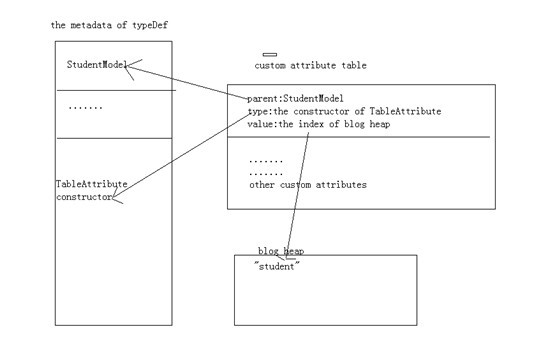
编译器在编译上述代码时,发现StudentModel有一个TableAttribute特性,就会在最终的程序集中生成一个customeAttribute元数据表,这个表有三个字段:parent,type,value。其中parent指向StudentModel类,type指向TableAttribute的构造函数,value值是要传递给TableAttribute的参数,这个里的参数就是”student”。如下图:
3.定义解析器,在运行时获取并解析对象上的Attribute
如果对象上仅仅是标记了Attribute,那么是不会有什么性能损失的,因为我们并没有使用它。
每当我们自定义一个Attribute时,都要同时创建一个用于解析这个Attribute的解析器。这个解析器需要做两件事:第一获取对象上标记的Attribute,其次根据Attribute中的属性值来执行相应的动作。代码如下:
 class AttributeInterpreter {

        public static void Interprete() {

            TableAttribute[] attributes = typeof(StudentModel).GetCustomAttributes(typeof(TableAttribute), true) as TableAttribute[];

            foreach(var eachAttribute in attributes) {

                string tableName = eachAttribute.TableName;

                //根据tableName访问数据库中的对应表,然后读取数据并创建StudentModel对象。

            }

        }

    }
这里,首先获取StudentModel的Type,然后调用Type的GetCustomeAttributes方法,并传递了typeof(TableAttribute)参数。最后GetCustomeAttributes方法返回StudentModel上标记的TableAttribue对象。
附注:ECMA-CLI中的CustomeAttribute详细说明:
  .     C us to mAt tr i b ut e :  x0 C

The CustomAttribute table has the following columns:

?  Parent (an index into  any metadata table, except the CustomAttribute table  itself; more precisely,

a HasCustomAttribute    (§24.2.) coded index)

?  Type (an index into the  MethodDef or MemberRef table; more precisely, a  CustomAttributeType

(§24.2.) coded index)

?  Value (an index into  the  Blob heap)

Partition II

The CustomAttribute table stores data that can be used to instantiate a Custom Attribute (more precisely, an

object of the specified Custom Attribute class) at runtime. The column called Type is slightly misleading—it

actually indexes a constructor method—the owner of that constructor method is the Type of the Custom

Attribute.

A row in the CustomAttribute table for a parent is created by the .custom attribute, which gives the value of

the Type column and optionally that of the Value column (§).
ECMA-CLI CustomeAttribute简介
4.GetCustomeAttributes方法的工作原理
在运行时,当调用GetCustomeAttributes时,CLR会遍历customeAttribute元数据表,查找parent=StudentModle和type=TableAttribute的CustomeAttribute元数据表。找到之后,根据type字段找到TableAttribute,然后创建他的实例,调用构造函数,并为构造函数传递参数“student”。
5.优化Attribute
优化的第一步就是利用缓存机制来存储已经创建好的TableAttribute,当需要对象时直接从缓存里取,这样只有在第一次创建StudentModel时,才会反射创建TableAttribute对象。如下
 private static Dictionary<Type, TableInfo> cache = new Dictionary<Type, TableInfo>();

        public StudentModel() {

            Type studentModelType = this.GetType();

            Type tableAttType=typeof(TableAttribute);

            if(!cache.TryGetValue(tableAttType, out tableINfo)) {

                TableAttribute[] tableAttributes = studentModelType.GetCustomAttributes(typeof(TableAttribute), true) as TableAttribute[];

                if(tableAttributes == null)

                    return;

                TableAttribute tableAttribute = tableAttributes[];

                cache.Add(tableAttType, new TableInfo(tableAttribute.TableName));

            }
使用缓存需要考虑锁的问题。当几个线程同时修改缓存时,必须保证在同一时刻只有一个线程修改,这里使用双锁机制来进行线程同步。如下:
 public StudentModel() {

            Type studentModelType = this.GetType();

            Type tableAttType=typeof(TableAttribute);

            TableInfo tableInfo;

            if(!cache.TryGetValue(tableAttType, out tableInfo)) {

                lock(this) {

                    if(!cache.TryGetValue(tableAttType, out tableInfo)) {

                        TableAttribute[] tableAttributes = studentModelType.GetCustomAttributes(typeof(TableAttribute), true) as TableAttribute[];

                        if(tableAttributes == null)

                            return;

                        TableAttribute tableAttribute = tableAttributes[];

                        cache.Add(tableAttType, new TableInfo(tableAttribute.TableName));

                    }

                }

            }

        }
优化的结果:只在第一次创建对象时反射Attribute,减少了内存的使用。
6.Attribute性能优化完整代码
 [Table("student")]

    class StudentModel {

        public string Id{get;set;}

        //定义缓存,存储已经创建好的TableAttribute对象。

        private static Dictionary<Type, TableInfo> cache = new Dictionary<Type, TableInfo>();

        public StudentModel() {

            Type studentModelType = this.GetType();

            Type tableAttType=typeof(TableAttribute);

            TableInfo tableInfo;

            if(!cache.TryGetValue(tableAttType, out tableInfo)) {

                lock(this) {

                    if(!cache.TryGetValue(tableAttType, out tableInfo)) {

                        TableAttribute[] tableAttributes = studentModelType.GetCustomAttributes(typeof(TableAttribute), true) as TableAttribute[];

                        if(tableAttributes == null)

                            return;

                        TableAttribute tableAttribute = tableAttributes[];

                        cache.Add(tableAttType, new TableInfo(tableAttribute.TableName));

                    }

                }

            }

        }

    }

    //AlloMultiple为true,表明这个特性不能被重复标记,原因很简单,一个实体对象不能映射到两个表。

    [AttributeUsage(AttributeTargets.Class,AllowMultiple=false)]

    class TableAttribute : Attribute {

        string tableName;

        public string TableName {

            get { return tableName; }

        }

        public TableAttribute(string name) {

            this.tableName = name;

        }

    }
Attribute性能优化完整代码
7.总结
在使用Attribute特性时,编译器会在最终的程序集中生成一个CustomeAttribute元数据表,这个表实际上是一个映射表,其中的type字段和parent字段将特性和对象相关联。
仅仅定义个Attribute是没有任何实际作用的,我们需要定义一个解析器用于获取对象上的Attribute并根据其属性值采取相应的动作。
在运行的时候,想要获取对象上的某特性时,需要调用Type的GetCustomeAttributes方法。这个方法在内部使用了反射来获取特性并实例化特性。
由于反射很浪费性能,并且对于类型的每一个对象,与其关联的Attribute都是相同的,所以可以利用字典只保存其中的一个。由于反射很浪费性能,所以可以考虑将创建好的Attribute缓存起来。
如果这个缓存需要被多个线程修改,需要使用锁来同步,这里为了提供性能,使用了双锁机制和Monitor。
优化特性(Attribute)性能的更多相关文章
- php8.0正式版新特性和性能优化学习
前言 PHP团队宣布PHP8正式GA(链接).php的发展又开启了新的篇章,PHP8.0.0版本引入了一些重大变更及许多新特性和性能优化机制.火速学习下~ JIT(Just in Time Compi ...
- 特性attribute,声明和使用attribute,应用attribute,AOP面向切面,多种方式实现AOP
1 特性attribute,和注释有什么区别2 声明和使用attribute3 应用attribute4 AOP面向切面5 多种方式实现AOP ---------------------------- ...
- [C#] C# 知识回顾 - 特性 Attribute
C# 知识回顾 - 特性 Attribute [博主]反骨仔 [原文地址]http://www.cnblogs.com/liqingwen/p/5911289.html 目录 特性简介 使用特性 特性 ...
- .Net内置特性Attribute介绍
特性Attribute概述 特性(Attribute)是一种特殊的类型,可以加载到程序集或者程序集的类型上,这些类型包括模块.类.接口.结构.构造函数.方法.字段等,加载了特性的类型称之为特性的目标. ...
- 通过 SMB 直通优化文件服务器的性能
https://technet.microsoft.com/zh-cn/library/hh831487.aspx Windows Server 2012 内置新增功能,称为 SMB 直通,用来支持使 ...
- java gc的工作原理、如何优化GC的性能、如何和GC进行有效的交互
java gc的工作原理.如何优化GC的性能.如何和GC进行有效的交互 一个优秀的Java 程序员必须了解GC 的工作原理.如何优化GC的性能.如何和GC进行有效的交互,因为有一些应用程序对性能要求较 ...
- Angular2 VS Angular4 深度对比:特性、性能
欢迎大家持续关注葡萄城控件技术团队博客,更多更好的原创文章尽在这里~~ 在Web应用开发领域,Angular被认为是最好的开源JavaScript框架之一. Google的Angular团队已于3月 ...
- Redis基础用法、高级特性与性能调优以及缓存穿透等分析
一.Redis介绍 Redis是一个开源的,基于内存的结构化数据存储媒介,可以作为数据库.缓存服务或消息服务使用.Redis支持多种数据结构,包括字符串.哈希表.链表.集合.有序集合.位图.Hype ...
- web页面内容优化管理与性能技巧
来源:GBin1.com 回 想一下,以前我们不得不花费大量时间去优化页面内容(图片.CSS等等),如今用户有更快速的互联网链接,我们似乎能够使用更大的图像或更大的闪 存文件,里面包含的有视频或者图片 ...
随机推荐
- SpringBoot Jms
https://dzone.com/articles/spring-boot-example-of-spring-integration-and-acti
- Delphi中线程类TThread实现多线程编程1---构造、析构……
参考:http://www.cnblogs.com/rogee/archive/2010/09/20/1832053.html Delphi中有一个线程类TThread是用来实现多线程编程的,这个绝大 ...
- 【20140113-2】MyEclipse生成javadoc时出错:编码GBK的不可映射字符
今天生成java doc文档时,出现了如下所示的错误: 正在装入软件包 com.wisdom.test 的源文件...F:\workspace\StringUtils\src\com\wisdom\t ...
- Oracle优化 -- 关于Database Buffer Cache相关参数DB_CACHE_SIZE的优化设置
select size_for_estimate, buffers_for_estimate ,ESTD_PHYSICAL_READ_factor,ESTD_PHYSICAL_READS from v ...
- 关于cout<<ends你不知道的那些事
关于ends是C++中比较基础的一个东西,但是可能不是每个人都能够清楚的理解这是个什么东西,我就经历了这么一个过程,写出来让大家看看,有什么理解的不对的地方欢迎拍砖. 今天以前我对ends的理解是:输 ...
- Effective C++ 之 Item 4:确定对象被使用前已先被初始化
Effective C++ Chapter 1. 让自己习惯C++ (Accustoming Yourself to C++) Item 4. 确定对象被使用前已先被初始化 (Make sure th ...
- 50个必备的实用jQuery代码段
本文会给你们展示50个jquery代码片段,这些代码能够给你的javascript项目提供帮助.其中的一些代码段是从jQuery1.4.2才开始支持的做法,另一些则是真正有用的函数或方法,他们能够帮助 ...
- Build better apps: Windows 10 by 10 development series
http://blogs.windows.com/buildingapps/2015/08/05/build-better-apps-windows-10-by-10-development-seri ...
- VPS -Digital Ocean -初试以及VPN的搭建
首先恭喜你找到这篇博客,它会带你走出困境. 题外话(请忽略):一直以来想搞一个VPS,终于在自己的刺激下试了一下Digital Ocean,还没有使用很长时间不做太多评论,唯一给我的感觉是各种操作还算 ...
- ASP.NET MVC使用过滤器进行权限控制
1.新建MVC项目 2.找到Models文件夹,新建 LoginCheckFilterAttribute 类 public class LoginCheckFilterAttribute : Acti ...