
【定时任务】Timer
Java原生api Timer类就可以实现简单的定时任务。下面将简单介绍一下Timer。
一、使用 Timer 实现定时任务
具体代码如下。
可以看到我们主要是分三步进行的
1、new Timer() 创建定时器
2、new TimerTask() 创建任务。这里是通过继承TimerTask类实现的。
3、使用定时器调度。这里我们使用的是Timer类中的schedule(TimerTask task, long delay, long period) 方法,里面有三个参数,
第一个参数表示任务,第二个参数表示延迟的时间,第三个参数表示任务执行的间隔(也就是每隔多少秒执行一次任务)。
public class TimerTest {

    public static void main(String[] args) {

        Timer timer = new Timer();

        timer.schedule(new TimerTest().new MyTask(), 1000, 5000);

    }

    /**

     * 任务

     * @author LKB

     *

     */

    class MyTask extends TimerTask{

        @Override

        public void run() {

            // TODO Auto-generated method stub

            System.out.println("current time is " + new Date());

        }

    }

}
二、Timer 实现定时任务的原理
Timer 的实现需要四个类:Timer TimerThread TaskQueue TimerTask。
2.1 TimerTask
其中 TimerTask 表示任务,它是个抽象类TimeTask 抽象类 继承Runnable。可以看到每个Task都是一个runnable对象。
TimeTask中全局变量有
   lock    锁

    state    VIRGIN: 任务未被调度

            SCHEDULED: 任务被调度但是还未执行

            EXECUTED: 任务已经被执行但是未被取消

            CANCELLED:任务被取消

            nextExecutionTime:任务下一次被执行的时间

            period:重复任务之间的间隔
内部方法有
  //取消调度

    public boolean cancel() {

        synchronized(lock) {

            boolean result = (state == SCHEDULED);

            state = CANCELLED;

            return result;

        }

    }

    //计算下次执行时间

    public long scheduledExecutionTime() {

        synchronized(lock) {

            return (period < 0 ? nextExecutionTime + period

                               : nextExecutionTime - period);

        }

    }
2.2 TaskQueue
TaskQueue 是一个优先队列,它是通过一个数组实现的。
全局变量有:
  private TimerTask[] queue = new TimerTask[128];  一个数组,数组元素类型为TimerTask。这个数组用来实现优先队列。

    private int size = 0; //优先队列中的任务个数  需要注意的是任务在优先队列中的存储是queue[1]-queue[size]
内部的方法有挺多的,最基本的我认为是下面几个:
  /**

     * Adds a new task to the priority queue.

     */

    void add(TimerTask task) {

        // Grow backing store if necessary

        if (size + 1 == queue.length)

            queue = Arrays.copyOf(queue, 2*queue.length);

        queue[++size] = task;

        fixUp(size);

    }

    /**

     * Return the "head task" of the priority queue.  (The head task is an

     * task with the lowest nextExecutionTime.)

     */

    TimerTask getMin() {

        return queue[1];

    }

    /**

     * Remove the head task from the priority queue.

     */

    void removeMin() {

        queue[1] = queue[size];

        queue[size--] = null;  // Drop extra reference to prevent memory leak

        fixDown(1);

    }
add 是往队列中添加任务,removeMin 是移除队头元素。因为 TaskQueue 是通过优先队列实现的,所以的删除或者添加一个元素的复杂度为O(lgN)。
2.3 TimerThread
TimerThread 继承Thread 类,Timer 定时器正是通过这个线程实现任务调度的。
全局变量有
boolean newTasksMayBeScheduled = true;  //如果该标志位false 则表示对 Timer 对象没有任何有效的引用,没有任何的任务需要做了,线程可以优雅地终止了

private TaskQueue queue; //任务队列
重写的 run 方法如下
    public void run() {

        try {

            mainLoop();

        } finally {

            // Someone killed this Thread, behave as if Timer cancelled

            synchronized(queue) {

                newTasksMayBeScheduled = false;

                queue.clear();  // Eliminate obsolete references

            }

        }

    }

    /**

     * The main timer loop.  (See class comment.)

     */

    private void mainLoop() {

        while (true) {

            try {

                TimerTask task;

                boolean taskFired;

                synchronized(queue) {

                    // Wait for queue to become non-empty

                    while (queue.isEmpty() && newTasksMayBeScheduled)

                        queue.wait();

                    if (queue.isEmpty())

                        break; // Queue is empty and will forever remain; die

                    // Queue nonempty; look at first evt and do the right thing

                    long currentTime, executionTime;

                    task = queue.getMin();

                    synchronized(task.lock) {

                        if (task.state == TimerTask.CANCELLED) {

                            queue.removeMin();

                            continue;  // No action required, poll queue again

                        }

                        currentTime = System.currentTimeMillis();

                        executionTime = task.nextExecutionTime;

                        if (taskFired = (executionTime<=currentTime)) {

                            if (task.period == 0) { // Non-repeating, remove

                                queue.removeMin();

                                task.state = TimerTask.EXECUTED;

                            } else { // Repeating task, reschedule

                                queue.rescheduleMin(

                                  task.period<0 ? currentTime   - task.period

                                                : executionTime + task.period);

                            }

                        }

                    }

                    if (!taskFired) // Task hasn't yet fired; wait

                        queue.wait(executionTime - currentTime);

                }

                if (taskFired)  // Task fired; run it, holding no locks

                    task.run();

            } catch(InterruptedException e) {

            }

        }

    }
可以看到TimerThread 运行的方式很简单,在一个while(true)循环中,首先判断任务队列中是否有任务,没有任务则一直等待;
如果有任务,取出该任务(运行时间离当前时间最近的任务),判断任务时间,任务时间到了,则调用task.run()运行任务。
2.4 Timer
Timer 是一个调度器,该调度器内部只有一个调度线程,并且只有一个任务队列。
全局变量有:
   private final TaskQueue queue = new TaskQueue(); //任务队列

   private final TimerThread thread = new TimerThread(queue); //调度线程

   private final Object threadReaper = new Object() {

       protected void finalize() throws Throwable {

           synchronized(queue) {

               thread.newTasksMayBeScheduled = false;

               queue.notify(); // In case queue is empty.

           }

       }

   }; //该对象可以使得当没有任何有效引用指向Timer对象时,定时器被优雅回收

    /**

     * This ID is used to generate thread names.

     */

    private final static AtomicInteger nextSerialNumber = new AtomicInteger(0);

    private static int serialNumber() {

        return nextSerialNumber.getAndIncrement();

    }
最基本的构造器如下。可以看到,当我们new一个 Timer 对象出来时,Timer 中对应的调度线程就被启动了。
 public Timer(String name) {

        thread.setName(name);

        thread.start();

    }
最基本的调度方法如下。可以看出它其实就是对任务队列的一个操作。
首先将当前任务配置好(计算好下次执行时间,间隔与状态),然后加入任务队列,如果刚好是队列的队头,再将队列唤醒,让队列直接处理。
 private void sched(TimerTask task, long time, long period) {

        if (time < 0)

            throw new IllegalArgumentException("Illegal execution time.");

        // Constrain value of period sufficiently to prevent numeric

        // overflow while still being effectively infinitely large.

        if (Math.abs(period) > (Long.MAX_VALUE >> 1))

            period >>= 1;

        synchronized(queue) {

            if (!thread.newTasksMayBeScheduled)

                throw new IllegalStateException("Timer already cancelled.");

            synchronized(task.lock) {

                if (task.state != TimerTask.VIRGIN)

                    throw new IllegalStateException(

                        "Task already scheduled or cancelled");

                task.nextExecutionTime = time;

                task.period = period;

                task.state = TimerTask.SCHEDULED;

            }

            queue.add(task);

            if (queue.getMin() == task)

                queue.notify();

        }

    }
综上,我们可以任务定时器的工作原理如下:
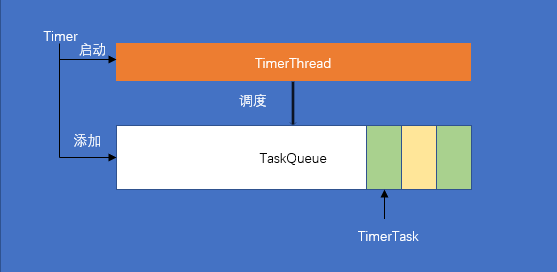
Timer 内部拥有一个 TimerThread 和 一个TaskQueue,当我们new Timer() 时,我们就拥有了这两个对象,并启动了TimerThread。
当我们这样调动 timer.schedule(new TimerTest().new MyTask(), 1000, 5000); schedule方法时我们就将对应的任务加到TaskQueue中。
TimeThread 负责调度TaskQueue,TaskQueue 是一个优先队列,里面的元素全是TimerTask 对象。
【定时任务】Timer的更多相关文章
- Java基础--定时任务Timer
Java基础--定时任务Timer 一.Timer介绍 java.util.Timer java.util.TimerTask Timer是一个定时器类,通过该类可以为指定的定时任务进行配置.Time ...
- Java基础--定时任务Timer(转载)
Java基础--定时任务Timer 一.Timer介绍 java.util.Timer java.util.TimerTask Timer是一个定时器类,通过该类可以为指定的定时任务进行配置.Time ...
- JAVA定时任务Timer
故事起因 因业务需要,写了一个定时任务Timer,任务将在每天的凌晨2点执行,代码顺利码完,一切就绪,开始测试.运行程序,为了节省时间,将系统时间调整为第二天凌晨1点59分,看着秒针滴答滴答的转动,期 ...
- Java定时任务Timer、TimerTask与ScheduledThreadPoolExecutor详解
定时任务就是在指定时间执行程序,或周期性执行计划任务.Java中实现定时任务的方法有很多,本文从从JDK自带的一些方法来实现定时任务的需求. 一.Timer和TimerTask Timer和Tim ...
- 详解java定时任务---Timer篇
一.简介 在java的jdk中提供了Timer.TimerTask两个类来做定时任务. Timer是一种定时器工具,用来在一个后台线程计划执行指定任务,而TimerTask一个抽象类,它的子 ...
- Java之旅--定时任务(Timer、Quartz、Spring、LinuxCron)
在Java中,实现定时任务有多种方式,本文介绍4种,Timer和TimerTask.Spring.QuartZ.Linux Cron. 以上4种实现定时任务的方式,Timer是最简单的,不需要任何框架 ...
- 服务器启动完成执行定时任务Timer,TimerTask
由于项目需求:每隔一段时间就要调外部接口去进行某些操作,于是在网上找了一些资料,用了半天时间弄好了,代码: import java.util.TimerTask; public class Accou ...
- java定时任务Timer与ScheduledExecutorService<转>
在我们编程过程中如果需要执行一些简单的定时任务,无须做复杂的控制,我们可以考虑使用JDK中的Timer定时任务来实现.下面LZ就其原理.实例以及Timer缺陷三个方面来解析java Timer定时器. ...
- java web定时任务---Timer
写在前面: 在最近的项目中需要每天定时对数据库表进行查询,并完成相关数据的更新操作.首先让我想到的是Timer类,记得在一开始维护那个老系统的时候,开了个接口,也涉及到了定时的操作.下面就记录下大概的 ...
- 定时任务-Timer
Timer类的全限定名 java.util.Timer java.util.Timer类的构造函数 public Timer(); public Timer(boolean isDaemon); pu ...
随机推荐
- 六、强大的 Stream API
一.了解 Stream Java8中有两大最为重要的改变.第一个是 Lambda 表达式:另外一个则是 Stream API(java.util.stream.*).Stream 是 Java8 中处 ...
- 详细讲解安全升级MySQL的方法
MySQL升级是非常必要的. 我们在Percona Support上列出了关于MySQL升级最佳实践的各种问题.这篇文章推荐了一些不同情况下升级MySQL的方法. 为什么MySQL升级是必须的? 原因 ...
- 【清华集训 2017】小Y的地铁 [模拟退火]
小Y的地铁 Time Limit: 50 Sec Memory Limit: 256 MB Description Input Output 对于每组输入数据,输出一行一个整数,表示除掉这 n 个换 ...
- 配置SpringBoot-从日志系统配置说起
大小系统都需要打日志. 系统在不同环境下对日志的配置要求是不一样的 比如 开发本地: 直接输出到控制台 生产环境: 输出到文件或者额外的日志收集系统, 比如 graylog. (本文不探讨具体日志系统 ...
- URAL 1416 Confidential (最小生成树+次小生成树)
Description Zaphod Beeblebrox - President of the Imperial Galactic Government. And by chance he is a ...
- 【Java基础】JAVA不可变类(immutable)机制与String的不可变性
一.不可变类简介 不可变类:所谓的不可变类是指这个类的实例一旦创建完成后,就不能改变其成员变量值.如JDK内部自带的很多不可变类:Interger.Long和String(8种基本数据类型的包装类和S ...
- JSON数据生成树——(四)
1.页面中准备树的div <div class="user_left_tree_info"> <div class="user_left_tree_in ...
- RabbitMQ--Publish/Subscribe(三)
前言 在先前例子中我们创建了一个work queue,封装一个task到一个message中并发送到queue.一个worker(consumer)取出任务并执行. 像这种producer把messa ...
- HTML 多张图片无缝连接
<table border="0" cellspacing="0" cellpadding="0" style="heigh ...
- Vue项目之IE下打开页面是空白
原因是:Babel 默认只转换新的 JavaScript 句法(syntax),而不转换新的 API ,比如 Iterator.Generator.Set.Maps.Proxy.Reflect.Sym ...