
HDFS 读写流程-英
HDFS 文件读取流程
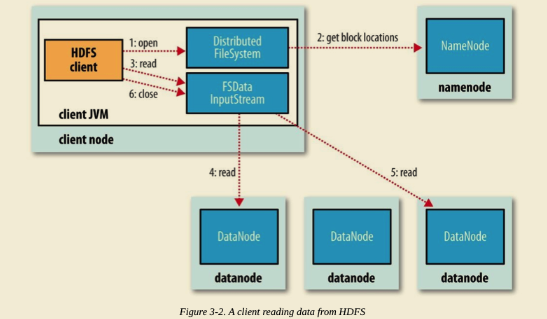
The client opens the file it wishes to read by calling open() on the FileSystem object, which for HDFS is an instance of DistributedFileSystem (step 1 in Figure 3-2).
DistributedFileSystem calls the namenode, using remote procedure calls (RPCs), to determine the locations of the first few blocks in the file (step 2). For each block, the namenode returns the addresses of the datanodes that have a copy of that block.
Furthermore, the datanodes are sorted according to their proximity to the client (according to the topology of the cluster’s network;). If the client is itself a datanode (in the case of a MapReduce task, for instance), the client will read from the local datanode if that datanode hosts a copy of the block.
The DistributedFileSystem returns an FSDataInputStream (an input stream that supports file seeks) to the client for it to read data from. FSDataInputStream in turn wraps a DFSInputStream, which manages the datanode and namenode I/O.
The client then calls read() on the stream (step 3). DFSInputStream, which has stored the datanode addresses for the first few blocks in the file, then connects to the first (closest) datanode for the first block in the file. Data is streamed from the datanode back to the client, which calls read() repeatedly on the stream (step 4). When the end of the block is reached, DFSInputStream will close the connection to the datanode, then find the best datanode for the next block (step 5). This happens transparently to the client, which from its point of view is just reading a continuous stream.
Blocks are read in order, with the DFSInputStream opening new connections to datanodes as the client reads through the stream. It will also call the namenode to retrieve the datanode locations for the next batch of blocks as needed. When the client has finished reading, it calls close() on the FSDataInputStream (step 6).
During reading, if the DFSInputStream encounters an error while communicating with a datanode, it will try the next closest one for that block. It will also remember datanodes that have failed so that it doesn’t needlessly retry them for later blocks. The DFSInputStream also verifies checksums for the data transferred to it from the datanode.
If a corrupted block is found, the DFSInputStream attempts to read a replica of the block from another datanode; it also reports the corrupted block to the namenode.
One important aspect of this design is that the client contacts datanodes directly to retrieve data and is guided by the namenode to the best datanode for each block. This design allows HDFS to scale to a large number of concurrent clients because the data traffic is spread across all the datanodes in the cluster. Meanwhile, the namenode merely has to service block location requests (which it stores in memory, making them very efficient) and does not, for example, serve data, which would quickly become a bottleneck as the number of clients grew.
HDFS 文件写入流程
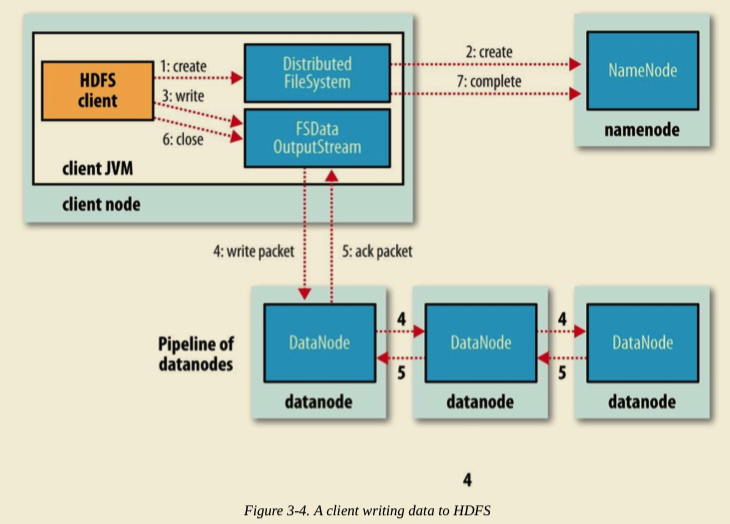
The client creates the file by calling create() on DistributedFileSystem (step 1 in Figure 3-4).
DistributedFileSystem makes an RPC call to the namenode to create a new file in the filesystem’s namespace, with no blocks associated with it (step 2). The namenode performs various checks to make sure the file doesn’t already exist and that the client has the right permissions to create the file. If these checks pass, the namenode makes a record of the new file; otherwise, file creation fails and the client is thrown an IOException. The DistributedFileSystem returns an FSDataOutputStream for the client to start writing data to. Just as in the read case, FSDataOutputStream wraps a DFSOutputStream, which handles communication with the datanodes and namenode.
As the client writes data (step 3), the DFSOutputStream splits it into packets, which it writes to an internal queue called the data queue. The data queue is consumed by the DataStreamer, which is responsible for asking the namenode to allocate new blocks by picking a list of suitable datanodes to store the replicas. The list of datanodes forms a pipeline, and here we’ll assume the replication level is three, so there are three nodes in the pipeline. The DataStreamer streams the packets to the first datanode in the pipeline, which stores each packet and forwards it to the second datanode in the pipeline. Similarly, the second datanode stores the packet and forwards it to the third (and last) datanode in the pipeline (step 4).
The DFSOutputStream also maintains an internal queue of packets that are waiting to be acknowledged by datanodes, called the ack queue. A packet is removed from the ack queue only when it has been acknowledged by all the datanodes in the pipeline (step 5).
If any datanode fails while data is being written to it, then the following actions are taken, which are transparent to the client writing the data. First, the pipeline is closed, and any packets in the ack queue are added to the front of the data queue so that datanodes that are downstream from the failed node will not miss any packets. The current block on the good datanodes is given a new identity, which is communicated to the namenode, so that the partial block on the failed datanode will be deleted if the failed datanode recovers later on.
The failed datanode is removed from the pipeline, and a new pipeline is constructed from the two good datanodes. The remainder of the block’s data is written to the good datanodes in the pipeline. The namenode notices that the block is under-replicated, and it arranges for a further replica to be created on another node. Subsequent blocks are then treated as normal.
When the client has finished writing data, it calls close() on the stream (step 6). This action flushes all the remaining packets to the datanode pipeline and waits for acknowledgments before contacting the namenode to signal that the file is complete (step 7). The namenode already knows which blocks the file is made up of (because DataStreamer asks for block allocations), so it only has to wait for blocks to be minimally replicated before returning successfully.
欢迎关注我的公众号

HDFS 读写流程-英的更多相关文章
- 大数据系列文章-Hadoop的HDFS读写流程(二)
在介绍HDFS读写流程时,先介绍下Block副本放置策略. Block副本放置策略 第一个副本:放置在上传文件的DataNode:如果是集群外提交,则随机挑选一台磁盘不太满,CPU不太忙的节点. 第二 ...
- 【转】HDFS读写流程
概述开始之前先看看其基本属性,HDFS(Hadoop Distributed File System)是GFS的开源实现. 特点如下: 能够运行在廉价机器上,硬件出错常态,需要具备高容错性流式数据访问 ...
- HDFS读写流程(转载)
概述开始之前先看看其基本属性,HDFS(Hadoop Distributed File System)是GFS的开源实现.特点如下: 能够运行在廉价机器上,硬件出错常态,需要具备高容错性 ...
- 超详细的HDFS读写流程详解(最容易理解的方式)
HDFS采用的是master/slaves这种主从的结构模型管理数据,这种结构模型主要由四个部分组成,分别是Client(客户端).Namenode(名称节点).Datanode(数据节点)和Seco ...
- Hadoop之HDFS读写流程
hadoophdfs 1. HDFS写流程 2. HDFS写流程 1. HDFS写流程 HDFS写流程 副本存放策略: 上传的数据块后,触发一个新的线程,进行存放. 第一个副本:与client最近的机 ...
- HDFS 读写流程-译
HDFS 文件读取流程 Client 端调用 DistributedFileSystem 对象的 open() 方法. 由 DistributedFileSystem 通过 RPC 向 NameNod ...
- HDFS读写流程(重点)
@ 目录 一.写数据流程 举例: 二.异常写流程 读数据流程 一.写数据流程 ①服务端启动HDFS中的NN和DN进程 ②客户端创建一个分布式文件系统客户端,由客户端向NN发送请求,请求上传文件 ③NN ...
- HDFS读写流程learning
有许多对流程进行描述的博客,但是感觉还是应当学习一遍代码,不然总感觉怪怪的,https://blog.csdn.net/popsuper1982/article/details/51615285,首先 ...
- HDFS读写流程
01.并行读取 02.逐个节点写入
随机推荐
- RGW 学习 前言
对于CEPH的学习已经有一段的时间了,最近的一段时间都是集中在RGW网关这一方面,所以准备将学习的过程以及源代码的分析,将以随笔的形式记录下来. 每天更新一章.
- c#小灶——数据类型
C#中有许多数据类型,存储不同的数据要用不同的数据类型.我们这里面向初学只介绍值类型,引用类型和指针类型在后续的学习中会有接触. 整型 int是最常用的整型,用来存储整数.除了int之外,还有其他不常 ...
- Amazon S3
Amazon S3 是什么? Amazon S3 是亚马逊推出的一款存储服务,名为 Amazon Simple Storage Service,即亚马逊简单存储服务. 有些 S3 的概念需要了解一下: ...
- Opengl_入门学习分享和记录_02_渲染管线(一)顶点着色器&片段着色器
写在前面的废话:今天俺又来了哈哈,真的好棒棒! 今天的内容:之前我们大概描述了,我们自己定义的顶点坐标是如何被加载到GPU之中,并且介绍了顶点缓冲对象VBO用于管理这一块内存.今天开始详细分析它的具体 ...
- pdf.js跨域加载文件
pdf.js一个基于Html的工具类,熟悉pdf.js的朋友们很清楚,pdf.js帮助我们做了很多事.尤其金融类网站会产生很多的报表.需要在线预览.pdf.js绝对是我们的首选 本地预览 在pdf.j ...
- zabbix自发现item监控
在zabbix监控中,我们可以通过自带item的可以和自定义key进行监控,但是当所需要的监控项不确定,比如key会根据时间进行变化时,这时候我们就不能把item的key定义死,要通过自发现这个高级功 ...
- ES6中比较实用的几个特性
1.Default Parameters(默认参数) in ES6 es6之前,定义默认参数的方法是在一个方法内部定义 var link = function (height, color, url) ...
- gunicorn 基础配置使用
flask 自带的 web 服务器稳定性较差,只能用于测试.最近做的 web 项目,每次启动,需要敲一堆参数文件,今天学习了官方文档里关于配置的说明,记录一下. 创建一个 gunicorn.conf ...
- UI 组件 | Button
最近在与其他自学 Cocos Creator 的小伙伴们交流过程中,发现许多小伙伴对基础组件的应用并不是特别了解,自己在编写游戏的过程中也经常对某个属性或者方法的用法所困扰,而网上也没有比较清晰的用法 ...
- springboot的mybatis的xml相关的配置
POM文件的配置: mybatis.type-aliases-package=com.handsight.platform.fras mybatis.mapper-locations=classpat ...