
【C#进阶学习】泛型
一、泛型引入
需求:传入一个类型(整型/日期/字符串或其他),打印出它的类型和内容。
1.初级版
     public class CommonMethod

     {

         /// <summary>

         /// 打印int值

         /// </summary>

         /// <param name="iParameter"></param>

         public static void ShowInt(int iParameter)

         {

             Console.WriteLine("This is {0},parameter={1},type={2}",

                 typeof(CommonMethod).Name, iParameter.GetType().Name, iParameter);

         }

         /// <summary>

         /// 打印string值

         /// </summary>

         /// <param name="sParameter"></param>

         public static void ShowString(string sParameter)

         {

             Console.WriteLine("This is {0},parameter={1},type={2}",

                 typeof(CommonMethod).Name, sParameter.GetType().Name, sParameter);

         }

         /// <summary>

         /// 打印DateTime值

         /// </summary>

         /// <param name="dParameter"></param>

         public static void ShowDateTime(DateTime dParameter)

         {

             Console.WriteLine("This is {0},parameter={1},type={2}",

                 typeof(CommonMethod).Name, dParameter.GetType().Name, dParameter);

         }

     }
typeof和gettype的区别
调用
         static void Main(string[] args)

         {

             DateTime dt = DateTime.Now;

             int i = ;

             string test = "test";

             object o = new object();

             CommonMethod.ShowDateTime(dt);

             CommonMethod.ShowInt(i);

             CommonMethod.ShowString(test);

         }
2.升级版
         /// <summary>

         /// 打印object值

         /// 1.object是一切类型的基础

         /// 2.通过集成,子类拥有父类的一切属性和行为

         /// </summary>

         /// <param name="o"></param>

         public static void ShowObject(object oParameter)

         {

             Console.WriteLine("This is {0},parameter={1},type={2}",

                 typeof(CommonMethod).Name, oParameter.GetType().Name, oParameter);

         }
调用
             DateTime dt = DateTime.Now;

             int i = ;

             string test = "test";

             object o = new object();

             CommonMethod.ShowObject(dt);

             CommonMethod.ShowObject(i);

             CommonMethod.ShowObject(test);

             CommonMethod.ShowObject(o);
缺点:如果传递的是值类型,会装箱拆箱
二、泛型来喽
定义泛型
     public class GenericMethod

     {

         /// <summary>

         /// 方法名字后面带上尖括号 类型参数

         /// T可以换成其他任何未定义的名称,但是不要用关键字、类名等等

         /// 来自 .net framework2.0 CLR升级的

         /// 解决相同内容/操作,对于不同参数的问题

         ///

         /// 延迟声明,声明方法的时候没有指定参数类型,而是等到调用的时候指定

         /// 延迟思想:推迟一切可以推迟的

         ///

         /// 编译的时候  类型参数编译为占位符   `(1旁边英文输入状态)

         /// 程序运行的时候,jit即时编译替换为真实类型

         ///

         ///

         /// </summary>

         /// <param name="o"></param>

         public static void Show<T>(T tParameter)

         {

             Console.WriteLine("This is {0},parameter={1},type={2}",

                 typeof(CommonMethod).Name, tParameter.GetType().Name, tParameter);

         }

     }
调用
             GenericMethod.Show<DateTime>(dt);

             GenericMethod.Show(dt);//不指定类型参数,编译器自动推算(编译器的语法糖)

             GenericMethod.Show<int>(i);

             GenericMethod.Show<string>(test);

             GenericMethod.Show<object>(o);
三、消耗时间对比
 using System;

 using System.Diagnostics;

 namespace MyGeneric

 {

     public class Monitor

     {

         public static void Show()

         {

             Console.WriteLine("******************Monitor****************");

             int iValue = ;

             long commonSecond = ;

             long objectSecond = ;

             long genericSecond = ;

             {

                 Stopwatch watch = new Stopwatch();

                 watch.Start();

                 for (int i = ; i < ; i++)

                 {

                     ShowInt(iValue);

                 }

                 watch.Stop();

                 commonSecond = watch.ElapsedMilliseconds;

             }

             {

                 Stopwatch watch = new Stopwatch();

                 watch.Start();

                 for (int i=;i<;i++)

                 {

                     ShowObject(iValue);

                 }

                 watch.Stop();

                 objectSecond = watch.ElapsedMilliseconds;

             }

             {

                 Stopwatch watch = new Stopwatch();

                 watch.Start();

                 for (int i = ; i < ; i++)

                 {

                     Show(iValue);

                 }

                 watch.Stop();

                 genericSecond = watch.ElapsedMilliseconds;

             }

             Console.WriteLine("commonSecond={0},objectSecond={1},genericSecond={2}",

                 commonSecond, objectSecond, genericSecond);

             Console.Read();

         }

         public static void ShowInt(int iParameter)

         {

             //do nothing

         }

         public static void ShowObject(object oParameter)

         {

             //do nothing

         }

         public static void Show<T>(T tParameter)

         {

             //do nothing

         }

     }

 }
调试启动的时间如下,可以看出泛型执行的时间是最短的。
如果更换顺序,将执行泛型的方法放到第一位的话,会出现泛型时间和普通时间一样,甚至还会比它耗费时间长的情况。

ctrl+F5启动时间对比如下(这一块不懂,为什么普通方法要比泛型的时间快呢)

四、泛型类
 using System;

 namespace MyGeneric

 {

     //泛型类

     public class GenericClass<W,Jasmine,Apple>//参数类型可以随便指定,意思就是相当于在这个类中定义了一个w的类型

     {

         public void Show(W w) { }

         public Jasmine Get()

         {

             return default(Jasmine);

         }

     }

     /// <summary>

     /// 泛型接口

     /// </summary>

     /// <typeparam name="T"></typeparam>

     public interface IStudy<T>

     {

         T Study(T t);

     }

     public delegate Everything GetHandler<Everything>();//泛型委托

     /// <summary>

     /// 普通类

     /// </summary>

     public class Child

        //: GenericClass<string,int,string> //指定类型参数后即可继承

        //:GenericClass<W, Jasmine, Apple> 这种写法是错误的,普通类不能直接继承泛型类

        //:IStudy<T> 普通类不能直接实现泛型接口

        : IStudy<string>

     {

         public string Study(string t)

         {

             throw new NotImplementedException();

         }

     }

     public class GenericChild<W,Jasmine, Apple>

        //: GenericClass<W,Jasmine,Apple>  //泛型类可以直接继承泛型类

     //public class GenericChild<W, Jasmine>//等于声明了两个局部类型 W和Jasmin

         //: GenericClass<W, Jasmine, string>

         :IStudy<W>                            //泛型类不能直接实现泛型接口

     {

         public W Study(W t)

         {

             throw new NotImplementedException();

         }

     }

 }
五、泛型约束
1.所需模型
 using System;

 namespace MyGeneric

 {

     public class Model

     {

         public class People

         {

             public int Id { get; set; }

             public string Name { get; set; }

             public void Hi()

             {

             }

         }

         public interface ISports

         {

             void PingPang();

         }

         public interface IWork

         {

             void Work();

         }

         public class Chinese : People,ISports,IWork

         {

             public void Tradition()

             {

                 Console.WriteLine("谦虚");

             }

             public void SayHi()

             {

             }

             public void PingPang()

             {

                 throw new NotImplementedException();

             }

             public void Work()

             {

                 throw new NotImplementedException();

             }

         }

         public class Sichuan : Chinese

         {

             public string Panda { get; set; }

             public void Huoguo()

             {

                 Console.WriteLine("吃火锅啦");

             }

         }

     }

 }
2.泛型约束(基类约束)
 using System;

 using static MyGeneric.Model;

 namespace MyGeneric

 {

     public class Constraint

     {

         /// <summary>

         /// 有约束才有自由,有权利就得有义务

         ///

         /// 1.基类约束,就可以访问基类的方法和属性(基类/子类)

         /// </summary>

         /// <typeparam name="T"></typeparam>

         /// <param name="tParameter"></param>

         public static void Show<T>(T tParameter) where T : People //基类约束

         {

             Console.WriteLine("This is {0},parameter={2},type={1}",

                 typeof(CommonMethod).Name, tParameter.GetType().Name, tParameter);

             Console.WriteLine(tParameter.Id);

             Console.WriteLine(tParameter.Name);

             tParameter.Hi();

         }

     }

 }
调用
             People people = new People()

             {

                 Id = ,

                 Name = "张三"

             };

             Chinese chinese = new Chinese()

             {

                 Id = ,

                 Name = "李四"

             };

             Sichuan sichuan = new Sichuan()

             {

                 Id = ,

                 Name = "小红"

             };

             Constraint.Show(people);

             Constraint.Show(chinese);

             Constraint.Show(sichuan);
3.泛型约束(接口约束)
         public static void ShowSports<T>(T tParameter) where T : ISports //基类约束

         {

             Console.WriteLine("This is {0},parameter={2},type={1}",

                 typeof(CommonMethod).Name, tParameter.GetType().Name, tParameter);

             tParameter.PingPang();

         }
调用和上面的相同,实现了该接口的类,可直接当做参数传入。
4.其他泛型约束写法
         public static T Get<T>()

             //where T:class //引用类型约束

             //where T:struct//值类型约束

             where T:new() //无参数构造函数约束

         {

             T t = new T();

             return default(T);

         }
六、协变
1.相关模型(Sparrow是Bird的子类)
         public class Bird

         {

         }

         public class Sparrow : Bird

         {

         }
2.
         Bird bird1 = new Bird();

         //左边父类,右边子类

         Bird bird2 = new Sparrow();

         Sparrow sparrow1 = new Sparrow();

         List<Bird> birdList1 = new List<Bird>();

         //List<Bird> bird3 = new List<Sparrow>();   //不是父子关系,没有继承关系

         List<Bird> birdlist2 = new List<Sparrow>().Select(s => (Bird)s).ToList();
3.查看IEnumerable定义,可以看到有一个关键字out
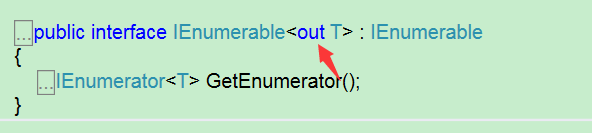
4.下面可实现左边是父类,右边是子类
         //协变

         IEnumerable<Bird> birdList4 = new List<Bird>();

         IEnumerable<Bird> birdList5 = new List<Sparrow>();//协变
5.具体应用
 /// <summary>

     /// out协变  只能是返回值

     /// 协变逆变只存在于接口或者委托

     /// </summary>

     /// <typeparam name="T"></typeparam>

     public interface ICustomerListOut<out T>

     {

         T Get();

         //void Show(T t); // 此处错误,T不能作为传入参数

     }

     /// <summary>

     /// 类没有协变逆变

     /// </summary>

     /// <typeparam name="T"></typeparam>

     public class CustomerListOut<T> : ICustomerListOut<T>

     {

         public T Get()

         {

             return default(T);

         }

     }
调用
         ICustomerListOut<Bird> customerList = new CustomerListOut<Bird>();

         ICustomerListOut<Bird> customerList1 = new CustomerListOut<Sparrow>(); //协变
七、逆变
1.定义
     public interface ICustomerListIn<in T>

     {

         //T Get();

         void Show(T t);

     }

     /// <summary>

     /// 逆变 只能作为参数传入

     /// </summary>

     /// <typeparam name="T"></typeparam>

     public class CustomerListIn<T> : ICustomerListIn<T>

     {

         //T Get(); //不能作为返回值

         public void Show(T t)

         {

         }

     }
2.调用
 //逆变

             ICustomerListIn<Sparrow> customerList2 = new CustomerListIn<Sparrow>();

             ICustomerListIn<Sparrow> customerList3 = new CustomerListIn<Bird>(); //左边是子类的时候,右边可以是父类

             ICustomerListIn<Bird> birdList6 = new CustomerListIn<Bird>();

             birdList6.Show(new Sparrow());

             birdList6.Show(new Bird());
八、协变逆变混合应用
1.定义
     public interface IMyList<in inT, out outT>

     {

         void Show(inT t);

         outT Get();

         outT Do(inT t);  //out只能是返回值  in只能是参数

     }

     public class MyList<T1, T2> : IMyList<T1, T2>

     {

         public void Show(T1 t)

         {

             Console.WriteLine(t.GetType().Name);

         }

         public T2 Get()

         {

             Console.WriteLine(typeof(T2).Name);

             return default(T2);

         }

         public T2 Do(T1 t)

         {

             Console.WriteLine(t.GetType().Name);

             Console.WriteLine(typeof(T2).Name);

             return default(T2);

         }

     }
2.调用
             IMyList<Sparrow, Bird> myList1 = new MyList<Sparrow, Bird>();

             IMyList<Sparrow, Bird> myList2 = new MyList<Sparrow, Sparrow>();   //协变

             IMyList<Sparrow, Bird> myList3 = new MyList<Bird, Bird>();   //逆变

             IMyList<Sparrow, Bird> myList4 = new MyList<Bird, Sparrow>();   //逆变
九、泛型缓存
不太懂,有时间再好好研究下(捂脸......)
【C#进阶学习】泛型的更多相关文章
- Mybatis基础进阶学习2
Mybatis基础进阶学习2 1.测试基本结构 2.三个POJO package com.pojo; import java.io.Serializable; import java.util.Dat ...
- 爱了!阿里大神最佳总结“Flutter进阶学习笔记”,理论与实战
前言 "小步快跑.快速迭代"的开发大环境下,"一套代码.多端运行"是很多开发团队的梦想,美团也一样.他们做了很多跨平台开发框架的尝试:React Native. ...
- PHP程序员进阶学习书籍参考指南
PHP程序员进阶学习书籍参考指南 @heiyeluren lastmodify: 2016/2/18 [初阶](基础知识及入门) 01. <PHP与MySQL程序设计(第4版)> ...
- Matlab 进阶学习记录
最近在看 Faster RCNN的Matlab code,发现很多matlab技巧,在此记录: 1. conf_proposal = proposal_config('image_means', ...
- 在学习泛型时遇到的困惑经常与func<T,U>混淆
在学习泛型时遇到的困惑经常与func<T,U>混淆,总认为最后一个值是返回类型.现在区分一下,原来问题出在泛型委托上. C#委托的介绍(delegate.Action.Func.predi ...
- zuul进阶学习(二)
1. zuul进阶学习(二) 1.1. zuul对接apollo 1.1.1. Netflix Archaius 1.1.2. 定期拉 1.2. zuul生产管理实践 1.2.1. zuul网关参考部 ...
- ROS进阶学习笔记(11)- Turtlebot Navigation and SLAM - ROSMapModify - ROS地图修改
ROS进阶学习笔记(11)- Turtlebot Navigation and SLAM - 2 - MapModify地图修改 We can use gmapping model to genera ...
- Spring.NET依赖注入框架学习-- 泛型对象的创建和使用
Spring.NET依赖注入框架学习-- 泛型对象的创建和使用 泛型对象的创建方法和普通对象是一样的. 通过构造器创建泛型对象 下面是一个泛型类的代码: namespace GenericsPlay ...
- Struts2进阶学习4
Struts2进阶学习4 自定义拦截器的使用 核心配置文件 <?xml version="1.0" encoding="UTF-8"?> <! ...
- Struts2进阶学习3
Struts2进阶学习3 OGNL表达式与Struts2的整合 核心配置文件与页面 <?xml version="1.0" encoding="UTF-8" ...
随机推荐
- XGBoost 完整推导过程
参考: 陈天奇-"XGBoost: A Scalable Tree Boosting System" Paper地址: <https://arxiv.org/abs/1603 ...
- Django 练习班级管理系统五 -- 查看老师列表
models.py 对应的配置 class Classes(models.Model): caption = models.CharField(max_length=32) class Teacher ...
- Jmeter接口测试,变量是订单和订单明细,怎么一起传?
", "price": 12.0, "orderDate": "2019-07-05 10:40:00", "order ...
- 【面试题】了解session和cookie吗?
问题:SESSION与COOKIE的区别? 1.cookie数据存放在客户的浏览器上,session数据放在服务器上. 2.cookie不是很安全,别人可以分析存放在本地的COOKIE并进行COOKI ...
- NCcat学习使用
一.使用手册 1.简介:nc/NetCat是一款端口监听工具,可以用来建立系统之间的连接.传输文件.TCP代理等. 2.命令参数 nc [-options] hostname port[s] ...
- 201871010114-李岩松《面向对象程序设计(java)》第十五周学习总结
项目 内容 这个作业属于哪个课程 https://www.cnblogs.com/nwnu-daizh/ 这个作业的要求在哪里 https://www.cnblogs.com/nwnu-daizh/p ...
- django学习-安装、创建应用、编写视图
快速安装指南 py -3 -m pip install django >>> import django >>> django.get_version() '2.2 ...
- 虚拟机使用配置固定IP
首先打开虚拟机 打开xshell5连接虚拟机(比较方便,这里默认设置过Linux的ip,只是不固定) 输入ifconfig,可以查看网管相关配置信息: 然后输入 vi /etc/sysconfi ...
- StarUML 系列,静态图与动态图,用例图,类图
大部分: 静态图部分,即静态不动的图 1.用例图, Use case diagram 1.展示系统核心功能及与其交互的用户ACTOR 表示:椭圆
- (day47)jQuery
目录 一.初识jQuery (一)jQuery介绍 (二)版本介绍 (三)jQuery对象 (四)相关网站 (五)基础语法 二.查找标签 (一)基本选择器 (1)id选择器 (2)标签选择器 (3)c ...