
Circuit level-shifts ac signals
AC signals can emanate from many sources, and many of these sources are incompatible with the most popular interface voltages, such as TTL. A temptation always exists to capacitively couple the ac signals because capacitive coupling strips off the dc level. Capacitive coupling sometimes doesn't work, because the coupled signal's voltage swings around ground, so you have to add dc offset to make the coupled signal compatible with the interface voltage. Also, the coupled signal contains a dc content, VDC, which varies with pulse width, and the dc variation interferes with the interface voltage when the signal swing is large. This circuit completes the signal interface by measuring the dc offset, adding appropriate compensation to the capacitively coupled signal and adding an adjustable-dc- level feature (Figure 1).

R1and C2 form a lowpass filter (f3dB=0.312 Hz) that measures the dc content of the input signal. The transfer equation is the following:
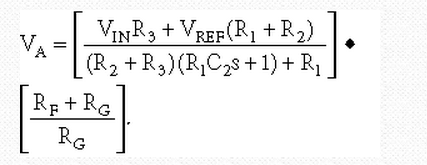
When R1+R2=R3 and RF=RG, VDC transfers to the output signal, VA, because it is multiplied by 1/2(2)=1 or a gain of one. The output voltage for the same resistor values contains VREF; thus, the output signal is level-shifted by the voltage, VREF, not VREF plus the VDC. When the input signal's duty cycle changes, rather than the output voltage's changing with duty cycle, the op amp keeps the output-voltage level constant. The gain for the VDC must be one, so that it cancels the voltage shift after ac-coupling. The gain for the reference voltage can be greater than one; for example if R1+R2=3R3 and RF=3RG, the dc content is 1/4(4)=1, and the reference-voltage gain is 3/4(4)=3. VREF can be positive or negative, so you can obtain TTL, CMOS, or ECL logic levels with this circuit. The time constant formed by C1 and R4 must be large enough to pass the lowest frequency signal without distortion. The value of R4 is not critical, as long as the op amp can drive R4 without losing too much signal swing. In some cases, you can size R4 to present the driving-point impedance you need to eliminate near-end reflections. The circuit easily couples 400-MHz data as configured, but the data rate depends on the time constant formed by R4 and the input impedance of the driven circuit.
Circuit level-shifts ac signals的更多相关文章
- Level shifting a +/- 2.5V signal to 0 - 5V
Google : Op-Amp Level Shifter Level shifting a +/- 2.5V signal to 0 - 5V I have a front end module t ...
- RFID 读写器 Reader Writer Cloner
RFID读写器的工作原理 RFID的数据采集以读写器为主导,RFID读写器是一种通过无线通信,实现对标签识别和内存数据的读出和写入操作的装置. 读写器又称为阅读器或读头(Reader).查询器(Int ...
- RFID Reader 线路图收集
This 125 kHz RFID reader http://www.serasidis.gr/circuits/RFID_reader/125kHz_RFID_reader.htm http:// ...
- Verilog Tips and Interview Questions
Verilog Interiew Quetions Collection : What is the difference between $display and $monitor and $wr ...
- SAE J1850 VPW Implement
---恢复内容开始--- OBDII Interface Project When I can ever find enough time away from schoolwork, I try to ...
- Make a DAC with a microcontroller's PWM timer
http://www.edn.com/design/analog/4337128/Make-a-DAC-with-a-microcontroller-s-PWM-timer Many embedded ...
- Level-shifting nixes need for dual power supply
The AD736 true-rms-to-dcconverter is useful for many applications that require precise calculation o ...
- parallelism
COMPUTER ORGANIZATION AND ARCHITECTURE DESIGNING FOR PERFORMANCE NINTH EDITION Traditionally, the co ...
- Redis集群知识解析
redis集群在启动的时候就自动在多个节点间分好片.同时提供了分片之间的可用性:当一部分redis节点故障或网络中断,集群也能继续工作.但是,当大面积的节点故障或网络中断(比如大部分的主节点都不可用了 ...
随机推荐
- 设计模式之笔记--享元模式(Flyweight)
享元模式(Flyweight) 定义 享元模式(Flyweight),运用共享技术有效地支持大量细粒度的对象. 类图 描述 Flyweight:抽象享元类,是所有的具体享元类的基类,为子类规定出需要实 ...
- ThoughtWorks代码挑战——FizzBuzzWhizz游戏 通用高速版(C/C++ & C#)
最早看到这个题目是从@ 程序媛想事儿(Alexia) 的 最难面试的IT公司之ThoughtWorks代码挑战——FizzBuzzWhizz游戏 开始的,然后这几天陆陆续续有N个小伙伴发表了自己的文章 ...
- log优化
isLoggable(Level level) 包含计算的日志记录用isLoggable判断下. debug info warn error ,一般记录error, 但是其他里面的计算还是 ...
- Delphi根据字符串实例化对象
我们可以通过ClassRegistry单元的TClassRegistry类很轻松的根据字符串创建出对象. 下面是该类几个主要函数的说明: // 获取TClassRegistry自身的单例引用class ...
- 前端网页进度Loading
loading随处可见,比如一个app经常会有下拉刷新,上拉加载的功能,在刷新和加载的过程中为了让用户感知到 load 的过程,我们会使用一些过渡动画来表达.最常见的比如“转圈圈”,“省略号”等等. ...
- 洛谷 P1568赛跑 题解
题目传送门 这道题非常的水,只要你能搞清楚题意,将SH.KC不要混起来即可(所以我使用了结构体) #include<bits/stdc++.h> using namespace std; ...
- 小技巧:tar命令打包目录时,排除文件和目录的命令
今天不巧要用上,百度. tar zcvf fd.tar.gz pardir --exclude=pardir/file1 --exclude=pardir/dir1
- SpringBoot入门系列
集合redis,mysql,测试例子 http://blog.csdn.net/lxhjh/article/details/51764604
- javascript 原生得到document.Element的方法
今天这里写这个博客的主要目的是记录一下javascript原生的选择dom的集中方法. 1.document.getElementById.这个方法接收1个参数,就是DOM元素的id(区分大小写),这 ...
- 初识GeneXus产品
本人由于工作原因接触了GeneXus产品,从使用到现在也有些年头了.从刚开始的不熟悉到现在使用GeneXus开发了很多项目,慢慢也总结了一些经验,当然中间也走了很多的弯路.对于在国内同样使用GeneX ...