
Make a DAC with a microcontroller's PWM timer
http://www.edn.com/design/analog/4337128/Make-a-DAC-with-a-microcontroller-s-PWM-timer
Many embedded-microcontroller applications require generation of analog signals. An integrated or stand-alone DAC fills the role. However, you can often use PWM signals for generating the required analog signals. You can use PWM signals to create both dc and ac analog signals. This Design Idea shows how to use a PWM timer to simultaneously create a sinusoid, a ramp, and a dc voltage. A PWM signal is a digital signal with fixed frequency but varying duty cycle. If the duty cycle of the PWM signal varies with time and you filter the PWM signal, the output of the filter is an analog signal (Figure 1).

If you build a PWM DAC in this manner, its resolution is equivalent to the resolution of the PWM signal you use to create the DAC. The PWM output signal requires a frequency that is equivalent to the update rate of the DAC, because each change in PWM duty cycle is the equivalent of one DAC sample. The frequency the PWM timer requires depends on the required PWM signal frequency and the desired resolution. The required frequency is FCLOCK=FPWM×2n, where FCLOCK is the required PWM-timer frequency, FPWM is the PWM-signal frequency, and n is the desired DAC resolution in bits.

depicts a circuit that delivers a 250-Hz sine wave, a 125-Hz ramp, and a dc signal. The desired sampling rate is 8 kHz (32 samples for each sine-wave cycle (16× oversampled), and 64 samples for each ramp cycle (32× oversampled)). These figures result in a required PWM-signal frequency of 8 kHz and a required PWM clock frequency of 2.048 MHz. It is usually best for the PWM signal frequency to be much higher than the desired bandwidth of the signals to be produced. Generally, the higher the PWM frequency, the lower the order of filter required and the easier it is to build a suitable filter. This design uses Timer B of the MSP430 in 16-bit mode and in "up" mode, in which the counter counts up to the contents of capture/compare register 0 (CCR0) and then restarts at zero. CCR0 is loaded with 255, thereby giving the counter an effective 8-bit length. You can find this register and others in a DAC demonstration program for the MSP430 microcontroller. Click here to download the program.
CCR1 and output TB1 produce the sine wave. CCR2 and TB2 generate the ramp, and CCR3 and TB3 yield the dc value. For each output, the output mode is the reset/set mode. In this mode, each output resets when the counter reaches the respective CCRx value and sets when the counter reaches the CCR0 value. This scheme provides positive pulses equivalent to the value in CCRx on each respective output. If you use the timer in 8-bit mode, the reset/set output mode is unavailable for the PWM outputs because the reset/set mode requires CCR0. The timer's clock rate is 2.048 MHz. Figure 3

shows the sine and ramp waveforms. The sine wave in this example uses 32 samples per cycle. The sample values are in a table at the beginning of the program. A pointer points to the next value in the sine table, so that, at the end of each PWM cycle, the new value of the sine wave is written to the capture/compare register of the PWM timer.
The ramp in this example does not require a table of data values. Rather, the ramp simply increments the duty cycle for each cycle of the PWM signal until it reaches the maximum and then starts over at the minimum duty cycle. This gradual increase in PWM-signal duty cycle results in a ramp voltage when the signal passes through a filter. You control the dc level by simply setting and not changing the value of the PWM-signal duty cycle. The dc level is directly proportional to the duty cycle of the PWM signal. Figure 2 shows the reconstruction filters used for each signal in this example. The filter for the ac signals is a simple two-pole, stacked-RC filter, which is simple and has no active components. This type of filter necessitates a higher sampling rate than would be required if the filter had a higher order. With the type of filter shown in Figure 2, you should use at least a 16× oversampling rate.
The filter yields its best response when R2>>R1. Also, setting the cutoff frequency too close to the bandwidth edge causes a fair amount of attenuation. To reduce the amount of attenuation in the filter, set the cutoff frequency above the bandwidth edge but much lower than the frequency of the PWM signal. The filter for the dc value serves for charge storage rather than ac-signal filtering. Therefore, it uses a simple, single-pole RC filter. Figure 4
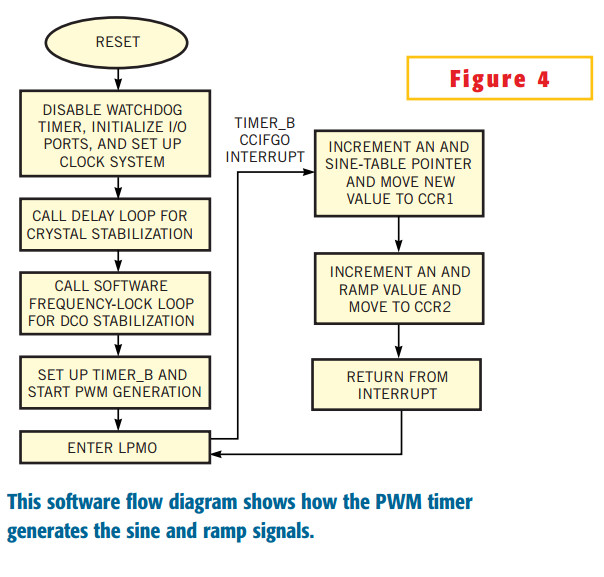
shows the software flow for the DAC. After a reset, the routine stops the watchdog timer, configures the output ports, and sets up the clock system. Next, the software calls a delay to allow the 32,768-Hz crystal to stabilize to calibrate the DCO (digitally controlled oscillator).
Next, the routine calls the calibration routine to set the operating frequency to 2.048 MHz. After the DCO calibration, the program sets up Timer_B, CCR1 and CCR2 for PWM generation and then starts the timer. Finally, the MSP430 goes into low-power mode 0 (LPM0) to conserve power. The CPU wakes up to handle each CCIFG0 interrupt from the PWM timer and then re-enters LPM0. (See references 1, 2, and 3 for more information on the DCO and the MSP430 family.)
Make a DAC with a microcontroller's PWM timer的更多相关文章
- 【STM32】PWM DAC基本原理(实验:PWM实现DAC)
虽然STM32F103ZET6具有内部DAC,但是也仅仅只有两条DAC通道,并且STM32还有其他的很多型号是没有DAC的.通常情况下,采用专用的D/A芯片来实现,但是这样就会带来成本的增加. 不过S ...
- Create a DAC from a microcontroller's ADC
Few microcontrollers include a DAC. Although you can easily find an inexpensive DAC to control from ...
- Cortex-A9 PWM Timer
PWM定时器 4412时钟为我们提供了PWM定时器,在4412中共有5个32位的定时器,这些定时器可发送中断信号给ARM子系统.另外,定时器0.1.2.3包含了脉冲宽度调制(PWM),并 ...
- PWM DAC vs. Standalone
http://analogtalk.com/?p=534 http://analogtalk.com/?p=551 Posted by AnalogAdvocate on April 09, 2010 ...
- PWM DAC Low Pass Filtering
[TI博客大赛][原创]LM3S811之基于PWM的DAC http://bbs.ednchina.com/BLOG_ARTICLE_3005301.HTM http://www.fpga4fun.c ...
- how to generate an analog output from a in-built pwm of Atmega 32AVR microcontrloller?
how to generate an analog output from a in-built pwm of Atmega 32AVR microcontrloller? you need a re ...
- M451 PWM对照数据手册分析
PWM_T Struct Reference Control Register » Pulse Width Modulation Controller(PWM) typedef struct { ...
- 说说M451例程之PWM的寄存器讲解
M451提供了两路PWM发生器.每路PWM支持6通道PWM输出或输入捕捉.有一个12位的预分频器把时钟源分频后输入给16位的计数器,另外还有一个16位的比较器.PWM计数器支持向上,向下,上下计数方式 ...
- 说说M451例程之PWM
/**************************************************************************//** * @file main.c * @ve ...
随机推荐
- github后端开发面试题大集合(一)
作者:小海胆链接:https://www.nowcoder.com/discuss/3614?type=0&order=0&pos=5&page=0?from=wb来源:牛客网 ...
- hdu 3951 硬币围成一圈(博弈)
n个硬币围成一个环 每次只能取1-K个硬币 最后取完者胜 假如5个硬币 每次取1-2个情况1 先手取1个 后手取剩下4个中间2个 破坏了连续 虽然最后剩2个,但先手只能取一个 然后后再取一个 后手胜 ...
- 【POJ】4007.Flood-it!
原题戳这里 题解 搜索是个好东西,不是人人都会搜 迭代加深,然后用一个函数估值,值是除了和左上连通的部分还有几个颜色不同的块,如果走的步数加上估值大于当前枚举的深度就跳出 代码 #include &l ...
- 极简操作无需root隐藏S8导航栏和状态栏
距离三星Galaxy S8国行发布快一个礼拜了,相信论坛不少小同伴已经拿到手,许多人和我一样被那块全视曲面屏给诱惑剁手的,当拿到手把玩一段时间后却發现这么美的一块屏幕居然大部分应用上下都有一行碍眼的状 ...
- Dubbo的特点
1.介绍 DUBBO有良好的连通性.健壮性.伸缩性.升级性.结合dubbo可以相对于单体系统提升系统整体的扩展性 2. 连通性 注册中心负责服务地址的注册与查找,相当于目录服务,服务提供者和消费者只在 ...
- matplotlib使用总结
一.简介 Matplotlib 是一个 Python 的 2D绘图库,它以各种硬拷贝格式和跨平台的交互式环境生成出版质量级别的图形.通过 Matplotlib,开发者可以仅需要几行代码,便可以生成绘图 ...
- Python 多线程 实例
多线程实例 import threading import time def eat(): eatTime = time.time() for i in range(30): print('count ...
- 洛谷P1527 [国家集训队] 矩阵乘法 [整体二分,二维树状数组]
题目传送门 矩阵乘法 题目描述 给你一个N*N的矩阵,不用算矩阵乘法,但是每次询问一个子矩形的第K小数. 输入输出格式 输入格式: 第一行两个数N,Q,表示矩阵大小和询问组数: 接下来N行N列一共N* ...
- UVa210 Concurrency Simulator (ACM/ICPC World Finals 1991) 双端队列
Programs executed concurrently on a uniprocessor system appear to be executed at the same time, but ...
- <泛> 并查集
最近写这些东西呢,主要是整理一下知识,自己写一遍,看看还是不是我的. 原理与实践相结合,缺一不可 背景 有时候,给你一张很复杂的关系网络图,如果关系具有传递性,那么,我们该如何处理这些关系集合. 一个 ...