
吴裕雄--天生自然python机器学习:使用决策树预测隐形眼镜类型
解决策树如何预测患者需要佩戴的隐形眼镜类型。使用小数据
集,我们就可以利用决策树学到很多知识:眼科医生是如何判断患者需要佩戴的镜片类型;一旦
理解了决策树的工作原理,我们甚至也可以帮助人们判断需要佩戴的镜片类型。
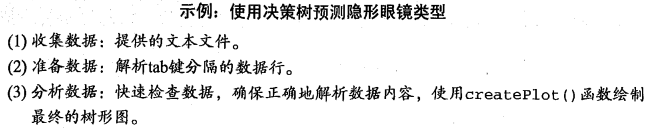


隐 形 眼 镜 数 据 集 是 非 常 著 名 的 数 据 集 ,它 包 含 很 多 患 者 眼 部 状 况 的 观 察 条 件 以 及 医 生 推 荐 的
隐 形 眼 镜 类 型 。隐 形 眼 镜 类 型 包 括 硬 材 质 、软 材 质 以 及 不 适 合 佩 戴 隐 形 眼 镜 。数 据 来 源 于UCI 数 据
库。
import numpy as np

import operator as op

from math import log

def calcShannonEnt(dataSet):

    labelCounts = {}

    for featVec in dataSet:

        currentLabel = featVec[-1]

        if(currentLabel not in labelCounts.keys()):

            labelCounts[currentLabel] = 0

        labelCounts[currentLabel] += 1

    shannonEnt = 0.0

    rowNum = len(dataSet)

    for key in labelCounts:

        prob = float(labelCounts[key])/rowNum

        shannonEnt -= prob * log(prob,2)

    return shannonEnt

def splitDataSet(dataSet, axis, value):

    retDataSet = []

    for featVec in dataSet:

        if(featVec[axis] == value):

            reducedFeatVec = featVec[:axis]

            reducedFeatVec.extend(featVec[axis+1:])

            retDataSet.append(reducedFeatVec)

    return retDataSet

def chooseBestFeatureToSplit(dataSet):

    numFeatures = np.shape(dataSet)[1]-1

    baseEntropy = calcShannonEnt(dataSet)

    bestInfoGain = 0.0

    bestFeature = -1

    for i in range(numFeatures):

        featList = [example[i] for example in dataSet]

        uniqueVals = set(featList)

        newEntropy = 0.0

        for value in uniqueVals:

            subDataSet = splitDataSet(dataSet, i, value)

            prob = len(subDataSet)/float(len(dataSet))

            newEntropy += prob * calcShannonEnt(subDataSet)

        infoGain = baseEntropy - newEntropy

        if (infoGain > bestInfoGain):

            bestInfoGain = infoGain

            bestFeature = i

    return bestFeature

def majorityCnt(classList):

    classCount={}

    for vote in classList:

        if(vote not in classCount.keys()):

            classCount[vote] = 0

        classCount[vote] += 1

    sortedClassCount = sorted(classCount.items(), key=op.itemgetter(1), reverse=True)

    return sortedClassCount[0][0]

def createTree(dataSet,labels):

    classList = [example[-1] for example in dataSet]

    if(classList.count(classList[0]) == len(classList)):

        return classList[0]

    if len(dataSet[0]) == 1:

        return majorityCnt(classList)

    bestFeat = chooseBestFeatureToSplit(dataSet)

    bestFeatLabel = labels[bestFeat]

    myTree = {bestFeatLabel:{}}

    del(labels[bestFeat])

    featValues = [example[bestFeat] for example in dataSet]

    uniqueVals = set(featValues)

    for value in uniqueVals:

        subLabels = labels[:]

        myTree[bestFeatLabel][value] = createTree(splitDataSet(dataSet, bestFeat, value),subLabels)

    return myTree

def classify(inputTree,featLabels,testVec):

    for i in inputTree.keys():

        firstStr = i

        break

    secondDict = inputTree[firstStr]

    featIndex = featLabels.index(firstStr)

    key = testVec[featIndex]

    valueOfFeat = secondDict[key]

    if isinstance(valueOfFeat, dict):

        classLabel = classify(valueOfFeat, featLabels, testVec)

    else:

        classLabel = valueOfFeat

    return classLabel

data = open("F:\\machinelearninginaction\\Ch03\\lenses.txt")

dataSet = [inst.strip().split("\t") for inst in data.readlines()]

print(dataSet)

print(np.shape(dataSet))

labels = ["age","prescript","astigmatic","tearRate"]

tree = createTree(dataSet,labels)

print(tree)

import matplotlib.pyplot as plt

decisionNode = dict(boxstyle="sawtooth", fc="0.8")

leafNode = dict(boxstyle="round4", fc="0.8")

arrow_args = dict(arrowstyle="<-")

def getNumLeafs(myTree):

    numLeafs = 0

    for i in myTree.keys():

        firstStr = i

        break

    secondDict = myTree[firstStr]

    for key in secondDict.keys():

        if type(secondDict[key]).__name__=='dict':

            numLeafs += getNumLeafs(secondDict[key])

        else:   numLeafs +=1

    return numLeafs

def getTreeDepth(myTree):

    maxDepth = 0

    for i in myTree.keys():

        firstStr = i

        break

    secondDict = myTree[firstStr]

    for key in secondDict.keys():

        if type(secondDict[key]).__name__=='dict':

            thisDepth = 1 + getTreeDepth(secondDict[key])

        else:   thisDepth = 1

        if thisDepth > maxDepth: maxDepth = thisDepth

    return maxDepth

def plotNode(nodeTxt, centerPt, parentPt, nodeType):

    createPlot.ax1.annotate(nodeTxt, xy=parentPt,  xycoords='axes fraction',xytext=centerPt, textcoords='axes fraction',va="center", ha="center", bbox=nodeType, arrowprops=arrow_args )

def plotMidText(cntrPt, parentPt, txtString):

    xMid = (parentPt[0]-cntrPt[0])/2.0 + cntrPt[0]

    yMid = (parentPt[1]-cntrPt[1])/2.0 + cntrPt[1]

    createPlot.ax1.text(xMid, yMid, txtString, va="center", ha="center", rotation=30)

def plotTree(myTree, parentPt, nodeTxt):

    numLeafs = getNumLeafs(myTree)

    depth = getTreeDepth(myTree)

    for i in myTree.keys():

        firstStr = i

        break

    cntrPt = (plotTree.xOff + (1.0 + float(numLeafs))/2.0/plotTree.totalW, plotTree.yOff)

    plotMidText(cntrPt, parentPt, nodeTxt)

    plotNode(firstStr, cntrPt, parentPt, decisionNode)

    secondDict = myTree[firstStr]

    plotTree.yOff = plotTree.yOff - 1.0/plotTree.totalD

    for key in secondDict.keys():

        if type(secondDict[key]).__name__=='dict':

            plotTree(secondDict[key],cntrPt,str(key))

        else:

            plotTree.xOff = plotTree.xOff + 1.0/plotTree.totalW

            plotNode(secondDict[key], (plotTree.xOff, plotTree.yOff), cntrPt, leafNode)

            plotMidText((plotTree.xOff, plotTree.yOff), cntrPt, str(key))

    plotTree.yOff = plotTree.yOff + 1.0/plotTree.totalD

def createPlot(inTree):

    fig = plt.figure(1, facecolor='white')

    fig.clf()

    axprops = dict(xticks=[], yticks=[])

    createPlot.ax1 = plt.subplot(111, frameon=False, **axprops)

    #createPlot.ax1 = plt.subplot(111, frameon=False) #ticks for demo puropses

    plotTree.totalW = float(getNumLeafs(inTree))

    plotTree.totalD = float(getTreeDepth(inTree))

    plotTree.xOff = -0.5/plotTree.totalW; plotTree.yOff = 1.0;

    plotTree(inTree, (0.5,1.0), '')

    plt.show()

createPlot(tree)
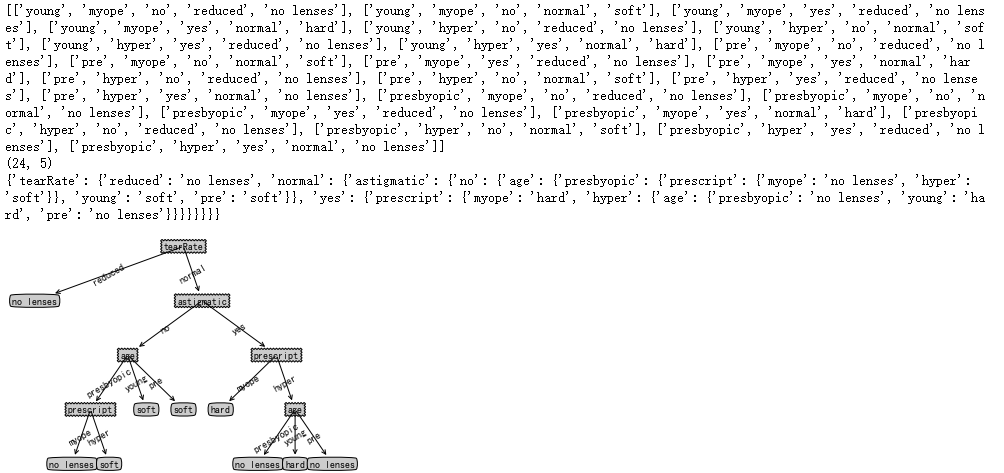
可 以 发 现 ,医 生 最 多 需 要 问 四 个 问 题 就 能 确 定 患 者 需 要 佩 戴 哪 种 类 型 的 隐 形 眼 镜 。
小结:
吴裕雄--天生自然python机器学习:使用决策树预测隐形眼镜类型的更多相关文章
- 吴裕雄--天生自然python机器学习:机器学习简介
除却一些无关紧要的情况,人们很难直接从原始数据本身获得所需信息.例如 ,对于垃圾邮 件的检测,侦测一个单词是否存在并没有太大的作用,然而当某几个特定单词同时出现时,再辅 以考察邮件长度及其他因素,人们 ...
- 吴裕雄--天生自然python机器学习实战:K-NN算法约会网站好友喜好预测以及手写数字预测分类实验
实验设备与软件环境 硬件环境:内存ddr3 4G及以上的x86架构主机一部 系统环境:windows 软件环境:Anaconda2(64位),python3.5,jupyter 内核版本:window ...
- 吴裕雄--天生自然python机器学习:决策树算法
我们经常使用决策树处理分类问题’近来的调查表明决策树也是最经常使用的数据挖掘算法. 它之所以如此流行,一个很重要的原因就是使用者基本上不用了解机器学习算法,也不用深究它 是如何工作的. K-近邻算法可 ...
- 吴裕雄--天生自然python机器学习:朴素贝叶斯算法
分类器有时会产生错误结果,这时可以要求分类器给出一个最优的类别猜测结果,同 时给出这个猜测的概率估计值. 概率论是许多机器学习算法的基础 在计算 特征值取某个值的概率时涉及了一些概率知识,在那里我们先 ...
- 吴裕雄--天生自然python机器学习:支持向量机SVM
基于最大间隔分隔数据 import matplotlib import matplotlib.pyplot as plt from numpy import * xcord0 = [] ycord0 ...
- 吴裕雄--天生自然python机器学习:使用K-近邻算法改进约会网站的配对效果
在约会网站使用K-近邻算法 准备数据:从文本文件中解析数据 海伦收集约会数据巳经有了一段时间,她把这些数据存放在文本文件(1如1^及抓 比加 中,每 个样本数据占据一行,总共有1000行.海伦的样本主 ...
- 吴裕雄--天生自然python机器学习:基于支持向量机SVM的手写数字识别
from numpy import * def img2vector(filename): returnVect = zeros((1,1024)) fr = open(filename) for i ...
- 吴裕雄--天生自然python机器学习:使用Logistic回归从疝气病症预测病马的死亡率
,除了部分指标主观和难以测量外,该数据还存在一个问题,数据集中有 30%的值是缺失的.下面将首先介绍如何处理数据集中的数据缺失问题,然 后 再 利 用 Logistic回 归 和随机梯度上升算法来预测 ...
- 吴裕雄--天生自然python机器学习:Logistic回归
假设现在有一些数据点,我们用 一条直线对这些点进行拟合(该线称为最佳拟合直线),这个拟合过程就称作回归.利用Logistic回归进行分类的主要思想是:根据现有数据对分类边界线建立回归公式,以此进行分类 ...
随机推荐
- MyBatis:一对多、多对一处理
多对一的处理 多对一的理解: 多个学生对应一个老师 如果对于学生这边,就是一个多对一的现象,即从学生这边关联一个老师! 数据库设计 CREATE TABLE `teacher` ( `id` INT( ...
- 一天一个设计模式——(Singleton)单例模式(线程安全性)
一.模式说明 有时候,我们希望在应用程序中,仅生成某个类的一个实例,这时候需要用到单例模式. 二.模式类图 三.模式中的角色 Singleton角色,该模式中仅有的一个角色,该角色有一个返回唯一实例的 ...
- VUE中的MVVM模式
1.传统MVP模式:业务逻辑相关的控制层 M:模型层,ajax请求 V:dom层,视图 P:控制器.js代码之类的 2.MVVM MVVM模式主要操作数据层,代码减少量是MVP的30%甚至70%
- 实盘交易哪些代码BUG产生严重亏损
1.少写一个return,疯狂开平2900次,以爆仓结束 2.在上生产环境前,不小心误删除了一个“!”(我至今也不清楚为什么会误删了,晕),导致平仓逻辑一直不满足,不止损,让我损失惨重! 3.卖单变买 ...
- Java学生管理系统(IO版)
图解: cade: student.java /* * 这是我的学生类 */ public class Student { //学号 private String id; //姓名 private S ...
- 学会拒绝,是一种智慧——OO电梯章节优化框架的思考
在本章的三次作业里,每次作业我都有一个主题,分别是:托盘型共享数据.单步电梯运行优化.多部电梯运行优化,因而电梯优化实际是第二.三次作业.虽然后两次作业从性能分上看做得还不错,但阅读其他大佬博客,我深 ...
- vue样式的动态绑定
true显示样式,flase不显示 <!DOCTYPE html> <html lang="en"> <head> <meta chars ...
- 五步解决windows系统慢的问题
第一步:清理浏览器缓存 第二步:磁盘整理 第三步:碎片整理 第四步:清理系统临时文件 echo 正在清除系统垃圾文件,请稍等...... del /f /s /q %systemdrive%\*.tm ...
- java8 String intern()
public class Solution { public static void main(String[] args) { String a = new String("he" ...
- poj 3013 最短路SPFA算法
POJ_3013_最短路 Big Christmas Tree Time Limit: 3000MS Memory Limit: 131072K Total Submissions: 23630 ...