
IEEE Trans 2008 Gradient Pursuits论文学习
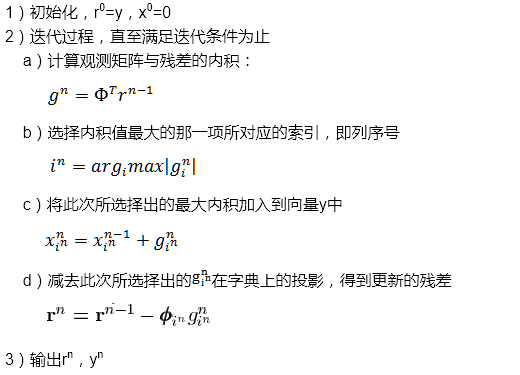
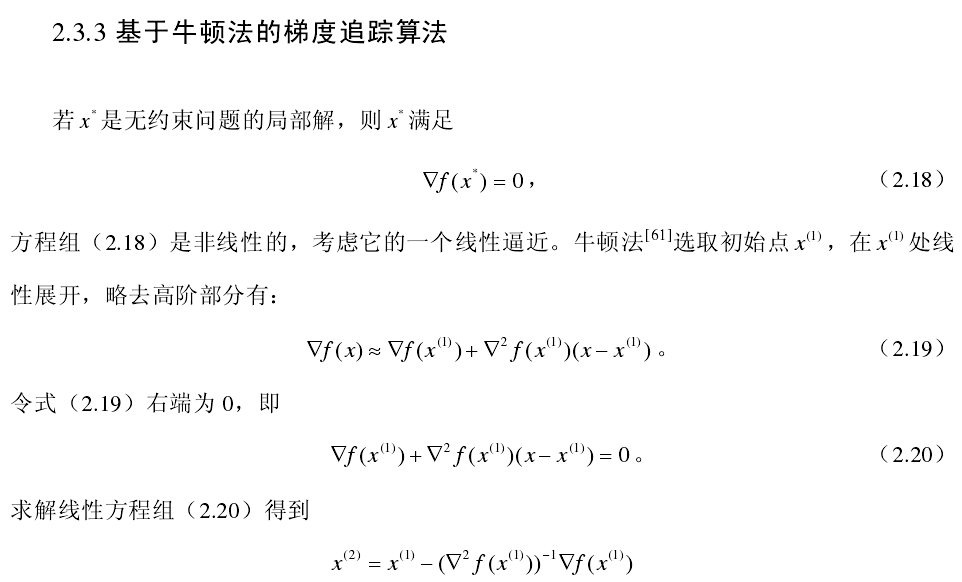
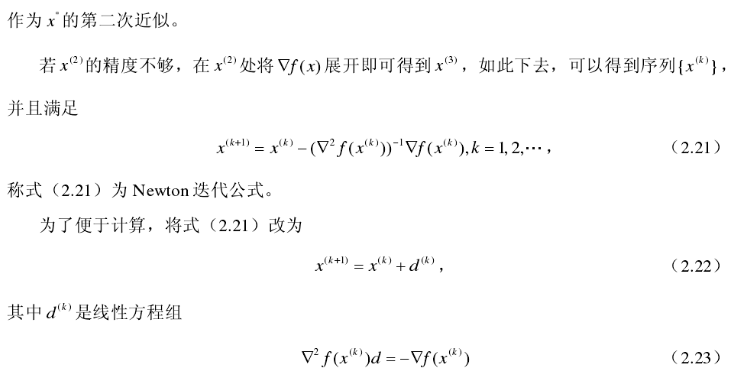
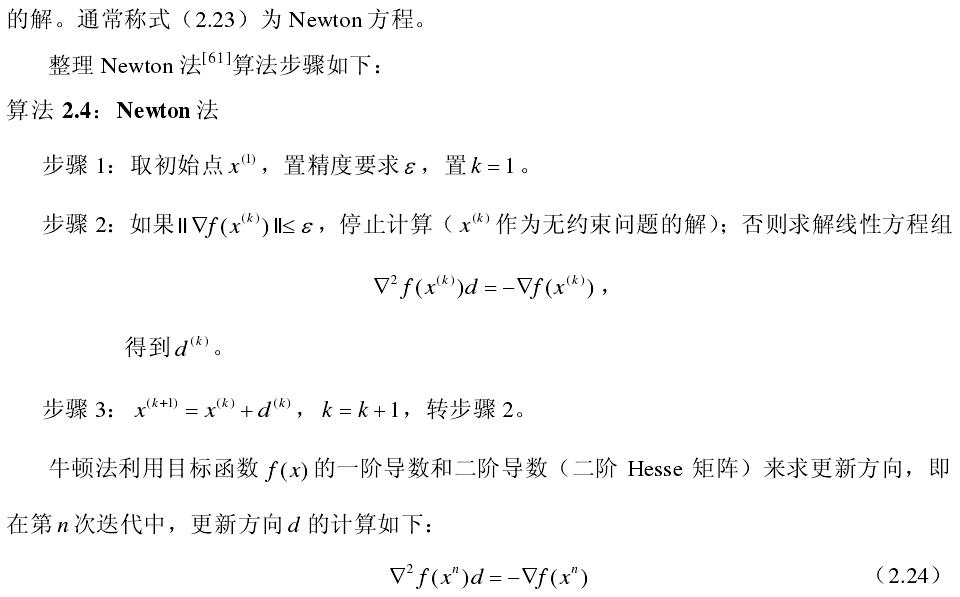
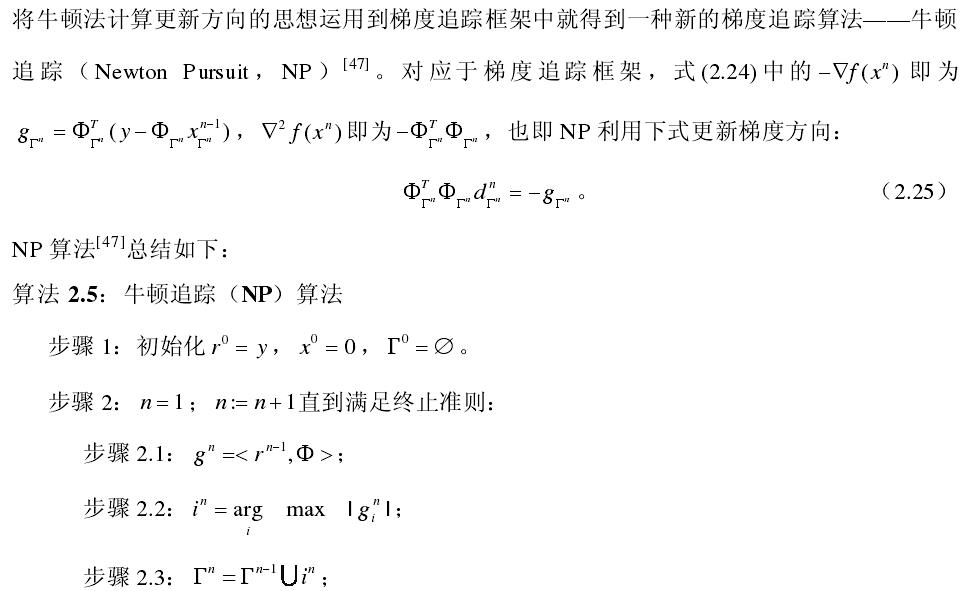
之前所学习的论文中求解稀疏解的时候一般采用的都是最小二乘方法进行计算,为了降低计算复杂度和减少内存,这篇论文梯度追踪,属于贪婪算法中一种。主要为三种:梯度(gradient)、共轭梯度(conjugate gradient)、近似共轭梯度(an approximation to the conjugate gradient),看师兄之前做压缩感知的更新点就是使用近似共轭梯度方法代替了StOMP中的最小二乘的步骤。

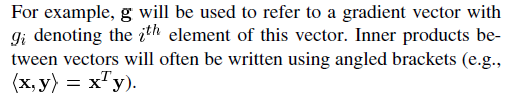

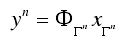
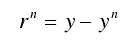
.png) 中选出最相关的原子。
中选出最相关的原子。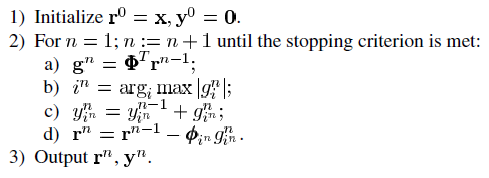
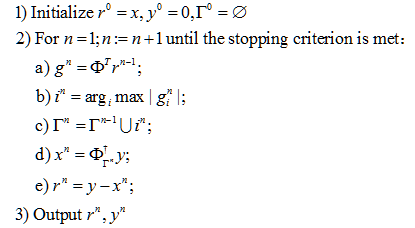
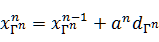 来代替MP算法中的2c,其中dΓn是梯度更新方向,其中步长
 ,向量
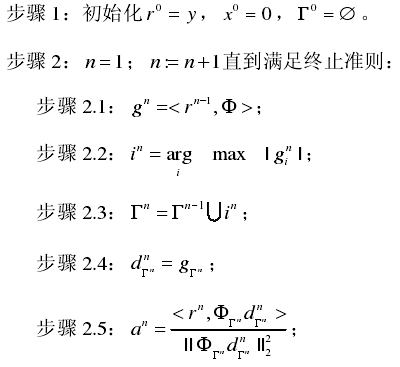
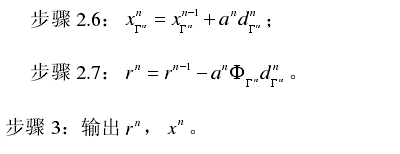
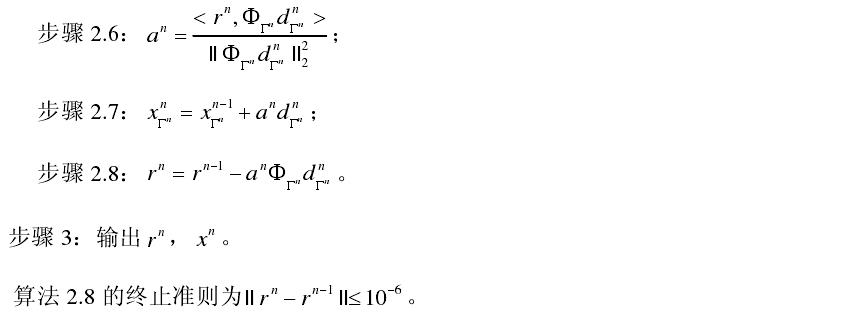
,向量 。不同的梯度算法所选择的dΓn不同。综上,我们可将梯度追踪算法的总体框架归纳如下: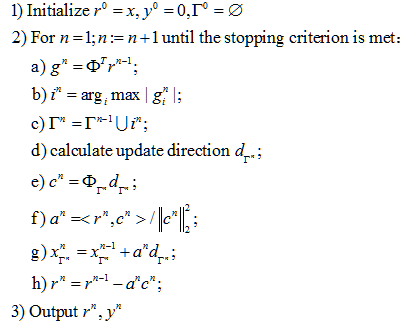
接下来分别介绍论文中提出的三种梯度追踪方法。
基于最速下降法的匹配追踪
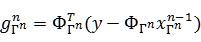
最速下降法(这个翻译是从参考文献2中得来的)是采用目标函数的负梯度作为更新方向。目标函数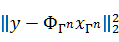 的梯度大小为:
function[theta]=CS_GP(y,A,t)

    %CS_GP Summary of this function goes here

    %Version: 1.0 written by wwf @2017-04-28

    %   Detailed explanation goes here

    %   y = Phi * x

    %   x = Psi * theta

    %   y = Phi*Psi * theta

    %   令 A = Phi*Psi, 则y=A*theta

    %   现在已知y和A,求theta

    [y_rows,y_columns]= size(y);

    if y_rows<y_columns

        y = y';%y should be a column vector

    end

    [M,N]= size(A);                            %传感矩阵A为M*N矩阵

    theta = zeros(N,1);                         %用来存储恢复的theta(列向量)

    aug_y=[];

    r_n = y;                                    %初始化残差(residual)为y

    Aug_t=[];

    for ii =1:t                                  %迭代t次,t为输入参数

        for col=1:N;

            product(col)=abs(A(:,col)'*r_n);             %传感矩阵A各列与残差的内积

        end

        [val,pos]= max(abs(product));        %找到最大内积绝对值,即与残差最相关的列

        Aug_t=[Aug_t,A(:,pos)];

        pos_array(ii)=pos;

        g_n=Aug_t'*r_n;                               %  梯度方向

        c_n=Aug_t*g_n;

        w_n=(r_n'*c_n)/(c_n'*c_n);                   %  最速下降步长

        d_n=w_n*g_n;

        [x1,x2]=size(d_n);

        [y1,y2]=size(aug_y);

        D=aug_y;

        aug_y=zeros(x1,x2);

        aug_y(1:y1,1:y2)=D;

        aug_y=aug_y+d_n ;                                %  最小二乘,使残差最小

        r_n=r_n-(w_n)*(c_n);                               %  残差

    end

   theta(pos_array)=aug_y;

end
function[theta]=GP_test(y,A,t)

%CS_GP Summary of this function goes here

%Version: 1.0 written by wwf @2017-04-28

%   Detailed explanation goes here

%   y = Phi * x

%   x = Psi * theta

%   y = Phi*Psi * theta

%   令 A = Phi*Psi, 则y=A*theta

%   现在已知y和A,求theta

    [y_rows,y_columns]= size(y);

    if y_rows<y_columns

        y = y';%y should be a column vector

    end

    [M,N]= size(A);                            %传感矩阵A为M*N矩阵

    theta = zeros(N,1);                         %用来存储恢复的theta(列向量)

    r_n = y;                                    %初始化残差(residual)为y

    d_n=zeros(N,1);

    P =@(z) A*z;

    Pt =@(z) A'*z;

    IN=[];

    for ii =1:50                                  %迭代t次,t为输入参数

        product=Pt(r_n);

        [v I]=max(abs(product));

        if isempty(find (IN==I))

            IN=[IN I];

        else

            break;

        end

        d_n(IN)=product(IN);

        c_n=P(d_n);

        a_n=r_n'*c_n/(c_n'*c_n);

        theta=theta+a_n*d_n;

        r_n=r_n-a_n*c_n;

    end

end
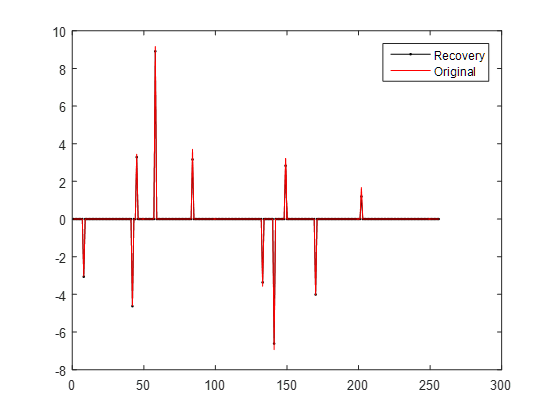
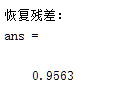
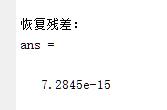
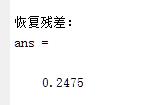
调用作者写的代码的时候发现,有的时候恢复效果比较好,残差很小,但有的时候也会出现残差比较大的情况,猜测可能和生成的信号有关系,因为每次信号是随机生成的。结果如下图所示:







while~done

     DR(IN)=0;

    [v I]=max(abs(DR));

     IN=[IN I];

     k=k+1;

        ifk==1

             d(IN)=1;

             PG(1)=1;

        else

   %%%% Calculate P'*G, but only need new column and new row %%%%%

             mask=zeros(m,1);

             mask(IN(k))=1;%将mask中对应的第k次迭代所选出的内积所在的列序号的项置为1

             new_element=P(mask);%选出此次迭代所选择出的原子

             gnew=Pt(new_element);%gnew相当于G,即Psi'*Psi

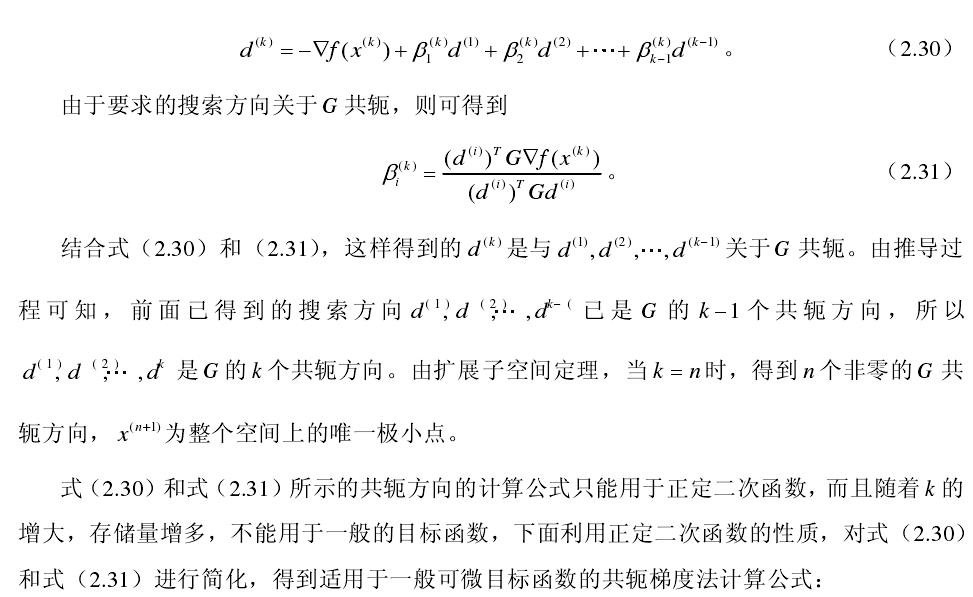
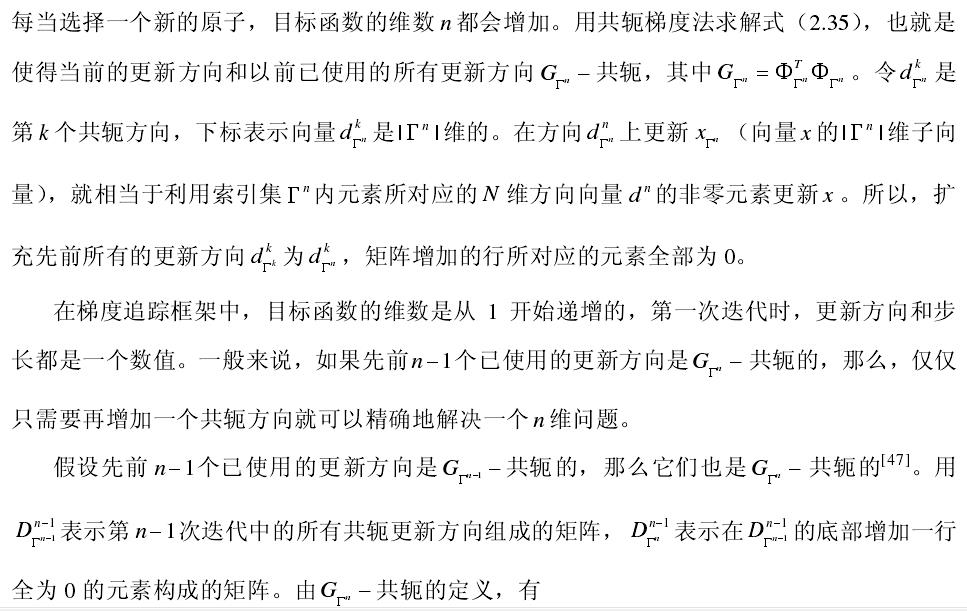
             PG(k-1,k-1)=D(1:k,k-1)'*[g;1];

             g=gnew(IN);

            %PG计算的是D’*G

             PG(:,k)=D'*[g;zeros(maxM-k,1)]; % 1 general mult.

   %%%% Calculate conjugate directions %%%

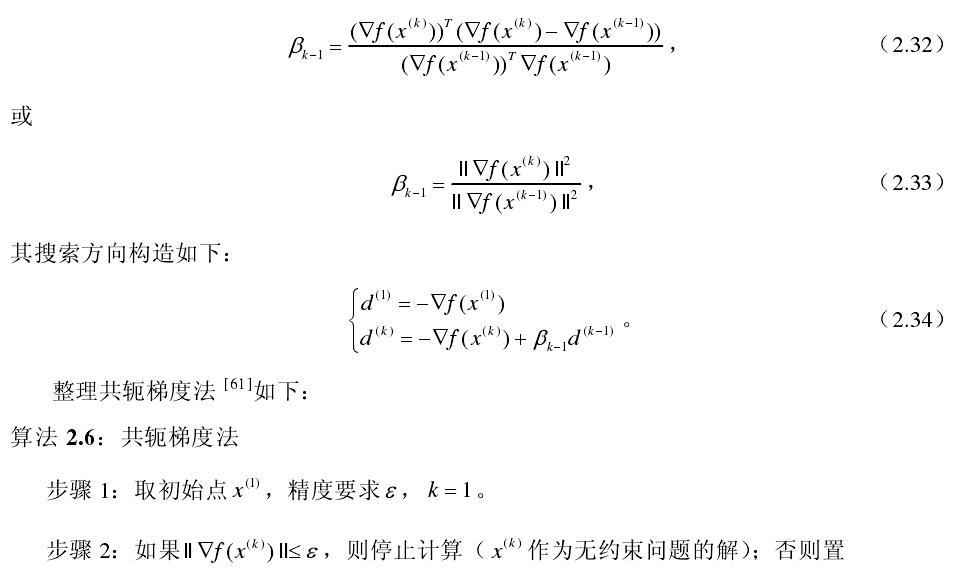
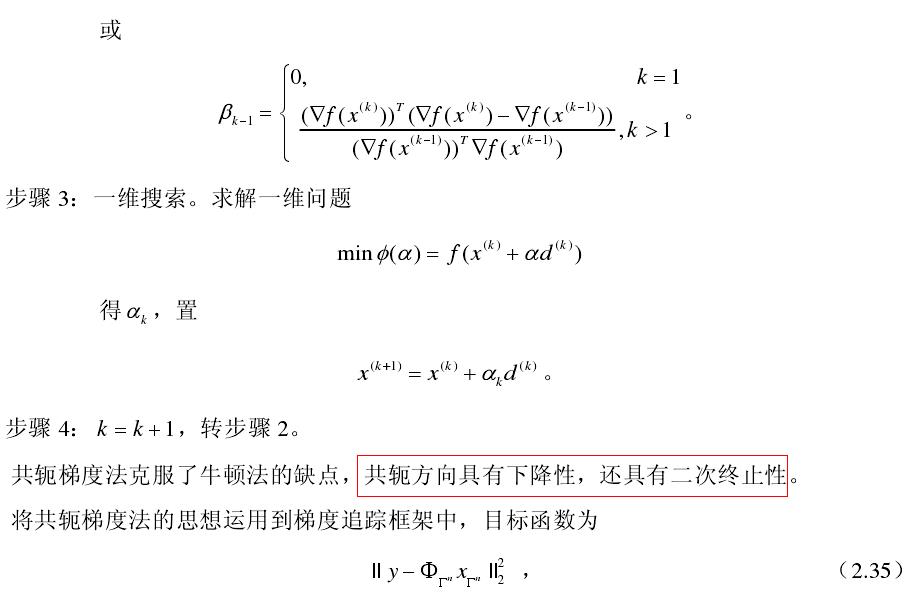
             b=(PG(1:k-1,1:k)*DR(IN))./(dPPd(1:k-1));

             d(IN)=DR(IN)-D(1:k,1:k-1)*b;%d should be orthogonal to the first k-1 columns of G.

        end

         D(1:k,k)=d(IN);%D是由n-1次的更新方向组成的矩阵

         Pd=P(d);

         dPPd(k)=Pd'*Pd;

         a=(DR'*d)/dPPd(k);

         s=s+a*d;

         Residual=Residual-a*Pd;

         DR=Pt(Residual);

    ERR=Residual'*Residual/n;

    ifcomp_err

         err_mse(iter)=ERR;

    end

    ifcomp_time

         iter_time(iter)=toc;

    end
tic

t=0;

p=zeros(m,1);

DR=Pt(Residual);

[v I]=max(abs(DR));

ifweakness~=1

   [vals inds]=sort(abs(DR),'descend');

    I=inds(find(vals>=alpha*v));

end

IN=union(IN,I);

ifstrcmp(STOPCRIT,'M')&length(IN)>=STOPTOL

    IN=IN(1:STOPTOL);

end

MASK=zeros(size(DR));

pDDp=1;

done=0;

iter=1;

while~done

   % Select new element

   ifisa(GradSteps,'char')

       ifstrcmp(GradSteps,'auto')

%%%%%%%%%%%%%%%%%%%%%%%%%%%%%%%%%%%%%%%%%%%%%%%%%%%%%%%%%%%%%%%%%%%%%%%%%%%

%  Iteration to automatic selection of the number of gradient steps

%%%%%%%%%%%%%%%%%%%%%%%%%%%%%%%%%%%%%%%%%%%%%%%%%%%%%%%%%%%%%%%%%%%%%%%%%%%

%             finished=0;

%             while ~finished

           % Update direction

                ifiter==1

                     p(IN)=DR(IN);   %p相当于论文中的d_n,当迭代次数为1时,d_n等于内积

                     Dp=P(p);        %Dp相当于论文中的c_n,即Psi与d_n的乘积

                else

                     MASK(IN)=1;     %IN为此次迭代选出的内积值最大的列序号,将MASK的该项置为1

                     PDR=P(DR.*MASK);%取出最大的内积值,与字典矩阵Psi相乘

                     b=-Dp'*PDR/pDDp;%计算系数b1

                     p(IN)=DR(IN)+b*p(IN);%计算更新的方向d_n

                     Dp=PDR+b*Dp;  %c_n是Psi与d_n-1的乘积,即P(d_n-1),将d_n-1展开带入即得

                end

            % Step size

%                  Dp=P(p); % =P(DR(IN)) +b P(p(IN));

                 pDDp=Dp'*Dp;

                 a=Residual'*Dp/(pDDp);

            % Update coefficients

                 s=s+a*p;

            % New Residual and inner products

                 Residual=Residual-a*Dp;

                 DR=Pt(Residual);

                % select new element

                    [v I]=max(abs(DR));

                    ifweakness~=1

                        [vals inds]=sort(abs(DR),'descend');

                         I=inds(find(vals>=alpha*v));

                    end

                     IN=union(IN,I);

                    ifstrcmp(STOPCRIT,'M')&length(IN)>=STOPTOL

                        IN=IN(1:STOPTOL);

                    end

%                  % Only if we select new element do we leave the loop

%                      if isempty(find (IN==I, 1))

%                         IN=[IN I];

%                         finished=1;

%                      end

%             end
IEEE Trans 2008 Gradient Pursuits论文学习的更多相关文章
- IEEE Trans 2009 Stagewise Weak Gradient Pursuits论文学习
论文在第二部分先提出了贪婪算法框架,如下截图所示: 接着根据原子选择的方法不同,提出了SWOMP(分段弱正交匹配追踪)算法,以下部分为转载<压缩感知重构算法之分段弱正交匹配追踪(SWOMP)&g ...
- 对比学习下的跨模态语义对齐是最优的吗?---自适应稀疏化注意力对齐机制 IEEE Trans. MultiMedia
论文介绍:Unified Adaptive Relevance Distinguishable Attention Network for Image-Text Matching (统一的自适应相关性 ...
- IEEE Trans 2007 Signal Recovery From Random Measurements via OMP
看了一篇IEEE Trans上的关于CS图像重构的OMP算法的文章,大部分..看不懂,之前在看博客的时候对流程中的一些标号看不太懂,看完论文之后对流程有了一定的了解,所以在这里解释一下流程,其余的如果 ...
- 《Explaining and harnessing adversarial examples》 论文学习报告
<Explaining and harnessing adversarial examples> 论文学习报告 组员:裴建新 赖妍菱 周子玉 2020-03-27 1 背景 Sz ...
- 论文学习笔记 - 高光谱 和 LiDAR 融合分类合集
A³CLNN: Spatial, Spectral and Multiscale Attention ConvLSTM Neural Network for Multisource Remote Se ...
- Faster RCNN论文学习
Faster R-CNN在Fast R-CNN的基础上的改进就是不再使用选择性搜索方法来提取框,效率慢,而是使用RPN网络来取代选择性搜索方法,不仅提高了速度,精确度也更高了 Faster R-CNN ...
- Apache Calcite 论文学习笔记
特别声明:本文来源于掘金,"预留"发表的[Apache Calcite 论文学习笔记](https://juejin.im/post/5d2ed6a96fb9a07eea32a6f ...
- 论文学习笔记--无缺陷样本产品表面缺陷检测 A Surface Defect Detection Method Based on Positive Samples
文章下载地址:A Surface Defect Detection Method Based on Positive Samples 第一部分 论文中文翻译 摘要:基于机器视觉的表面缺陷检测和分类可 ...
- 论文学习笔记 - Classifification of Hyperspectral and LiDAR Data Using Coupled CNNs
Classifification of Hyperspectral and LiDAR Data Using Coupled CNNs 来源:IEEE TGRS 2020 下载:https://arx ...
随机推荐
- Pseudoforest(伪最大生成树)
Pseudoforest Time Limit: 10000/5000 MS (Java/Others) Memory Limit: 65536/65536 K (Java/Others) Total ...
- PHP实现前台页面与MySQL的数据绑定、同步更新
今天我来给大家介绍一个PHP-MySQL的小项目. 使用 PHP和前台Ajax 实现在前台对MySQL数据库中数据的增.删等操作语句功能. 如果有问题,欢迎拍砖~ 首先,我们先做好前台HTML.CSS ...
- Codeforces 862A Mahmoud and Ehab and the MEX
传送门:CF-862A A. Mahmoud and Ehab and the MEX time limit per test 2 seconds memory limit per test 256 ...
- selenium页面元素操作(简易版)
介绍一下,这是处理页面元素的基本方法,@selenium 发送文字 element.send_keys(keys_to_send) 单击 element.click() 提交表单 el ...
- cgg之数据类型
所有例子都在64为操作系统 Linux 2.6.30 x86_64 x86_64 x86_64 GNU/Linux 1.1整数 在stdint.h中定义一些看上去更明确的整数类型 #ifndef __ ...
- 如何创建 Swarm 集群?- 每天5分钟玩转 Docker 容器技术(95)
本节我们将创建三节点的 swarm 集群. swarm-manager 是 manager node,swarm-worker1 和 swarm-worker2 是 worker node. 所有节点 ...
- Unity3D高性能战争迷雾实现
效果图 先上效果图吧,这是为了吸引到你们的ヽ(。◕‿◕。)ノ゚ 战争迷雾效果演示图 战争调试界面演示图 由于是gif录制,为了压缩图片,帧率有点低,实际运行时,参数调整好是不会像这样一卡一顿的. 战争 ...
- 洛谷 P3391 【模板】文艺平衡树
题目背景 这是一道经典的Splay模板题--文艺平衡树. 题目描述 您需要写一种数据结构,来维护一个有序数列,其中需要提供以下操作:翻转一个区间,例如原有序序列是5 4 3 2 1,翻转区间是[2,4 ...
- 为什么ERP行业发展缓慢规模难扩大?
题记:这个行业只会越来越好,但是能沉淀下来做事儿的企业越来越少,因为收益真的很漫长:能够真正进入这个行业难,出去也难... 经常在知乎上看到类似的问题:既然所有ERP系统都很烂,那有没有创业公司的空间 ...
- 书籍推荐系列之一 -- 《凤凰项目:一个IT运维的传奇故事》
博客已经完全更新了名字,新的名字,新的开始,想让自走向新的道路是很难的,走出舒适圈说了好久,也是时候开始行动了,今天就从写博客开始. 今天给大家推荐一本书,<凤凰项目:一个IT运维的传奇故事&g ...